Ensuring ROI with White Label PPC: A Complete Guide

On This Page
- What Is Pay-per-click Marketing, and Why Is It Important?
- What Is White Label PPC?
- Why Do Agencies Outsource PPC Management?
- How Does White Label PPC Work?
- How Do You Protect ROI with White Label PPC?
- How Do You Choose the Right White Label PPC Partner?
- Is White Label PPC Right for Your Agency?
- Frequently Asked Questions
White label PPC is an arrangement in which a marketing agency hires a third-party specialist to run its clients’ pay-per-click campaigns, then delivers the work under the agency’s own brand. The agency keeps the client relationship and pricing, while the partner handles keyword research, ad builds, optimization, and reporting behind the scenes.
This guide explains what pay-per-click marketing is and why it matters, how white label PPC works, why agencies outsource it, how to protect ROI, and the eight factors to check before you choose a partner. It is written for agency owners and marketing leads who want to offer paid search without building a full in-house PPC team.
What Is Pay-per-click Marketing, and Why Is It Important?
Pay-per-click (PPC) is digital advertising in which the advertiser pays each time someone clicks an ad. It matters because it puts your offer in front of people who are already searching for it, and every dollar can be tracked to a result.
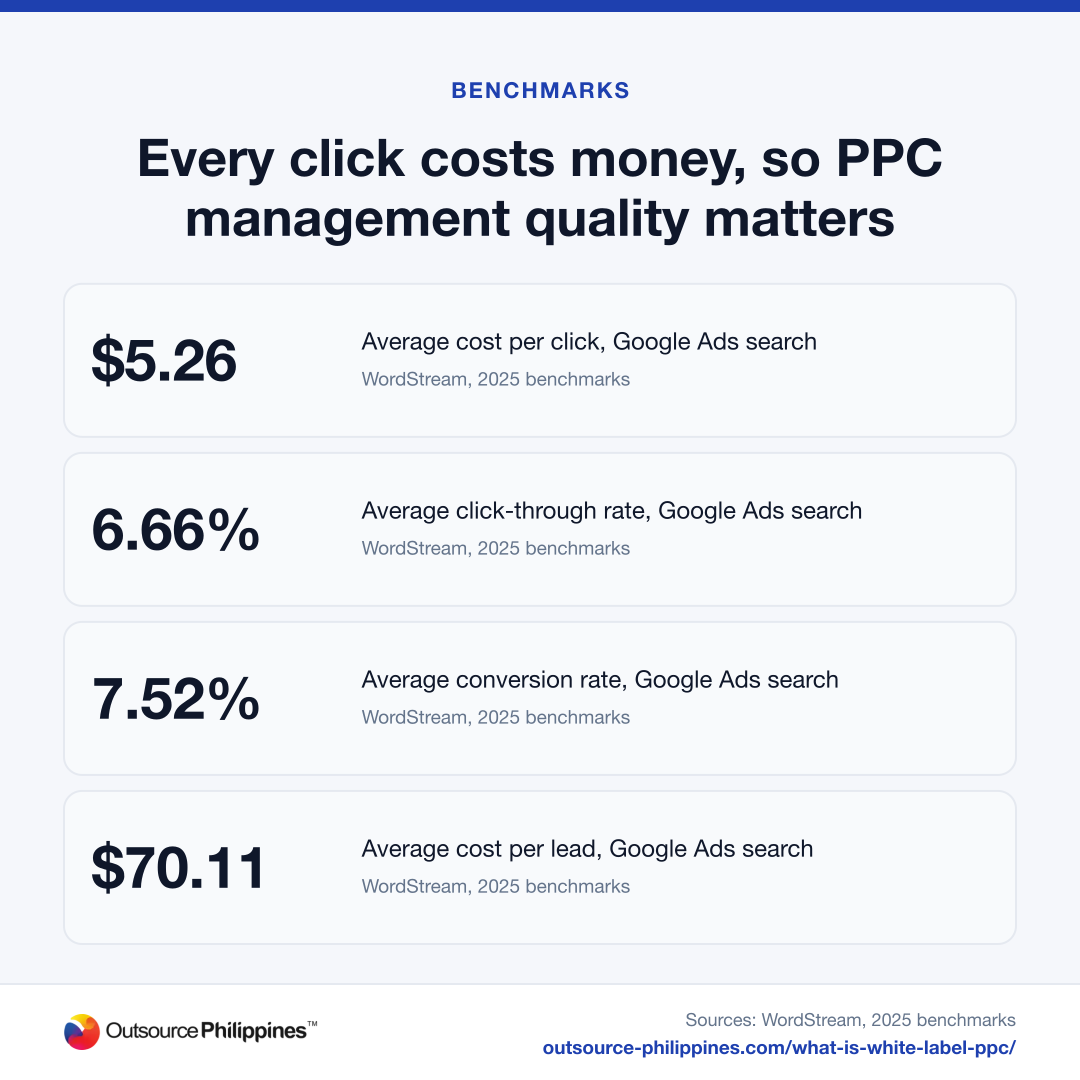
The costs are real, which is why management quality matters. According to WordStream’s 2025 Google Ads benchmarks (campaigns from April 2024 to March 2025), the average search ad had a 6.66% click-through rate, a $5.26 cost per click, a 7.52% conversion rate and a $70.11 cost per lead. Small changes in those numbers decide whether a client’s campaign pays for itself.
Why PPC Management Matters
Four benefits make PPC a core part of most advertising plans:
- Immediate visibility: ads appear at the top of search results or on websites as soon as campaigns go live.
- Cost control: you set the budget and pay only when someone clicks.
- Targeted advertising: you reach people by location, demographics, and interests, so spend goes to the audience you want.
- Quick and measurable results: unlike organic methods that take months, PPC drives traffic right away, and every click and conversion can be measured and fine-tuned.
- $5.26Average cost per click, Google Ads searchWordStream, 2025 benchmarks
- 6.66%Average click-through rate, Google Ads searchWordStream, 2025 benchmarks
- 7.52%Average conversion rate, Google Ads searchWordStream, 2025 benchmarks
- $70.11Average cost per lead, Google Ads searchWordStream, 2025 benchmarks
What Is White Label PPC?
White labeling means buying a product or service from a third party, putting your own brand on it, and reselling it. White label PPC applies that model to paid search and social ads.
In practice, a digital agency contracts with a PPC provider to manage its clients’ ad campaigns. The agency adds PPC management to its menu of services without hiring specialists, and the client sees only the agency’s name on strategy decks, reports, and invoices. Agencies typically give the partner access through a Google Ads manager account, which lets one login view and manage multiple client accounts, set different access levels, and run reports across accounts.
Why Do Agencies Outsource PPC Management?
Agencies use white label PPC to sell a full digital marketing service without carrying the cost and risk of a specialist team. These are the five usual reasons:
- A full digital marketing offer: the agency can sell paid search alongside SEO, content, and social without an internal PPC department.
- Practicality: qualified PPC people at a fraction of the cost of hiring and training a full in-house team.
- Scalability: the partner adds or reduces capacity as client demand changes, without hiring or layoffs.
- Less work pressure: account managers focus on clients while the partner handles builds, bids, and reporting.
- A team of experts: access to people who manage campaigns every day across many accounts and industries.
Paid search often sits next to other channels in the same retainer. If you also outsource organic work, the same briefing and reporting discipline applies to SEO outsourcing in the Philippines.
How Does White Label PPC Work?
The process varies by provider, but most follow five steps from order to ongoing reporting.
- Complete your purchase: sign up with a white label PPC firm and submit orders for one or more clients, by form or email.
- Build the campaign: the partner starts on the requirements, usually with keyword research, tracking codes, and ad copy or creative.
- Launch the campaign: before launch, check every asset against the order, the client’s brand, and the agreed specifications.
- Optimize: the partner refines keywords, bids, ads, and landing pages based on performance to hit the client’s goals.
- Monitor and report: the partner tracks analytics and delivers branded reports, so the agency doesn’t need its own expensive tool subscriptions.
How Do You Protect ROI with White Label PPC?
ROI depends on margins, measurement, and control, not just on campaign performance. Set these up before the first campaign launches:
- Price for margin: know the partner’s fee per account and your own markup, so client growth adds profit instead of only workload.
- Agree on the KPIs that matter to clients: cost per lead, conversion rate, and return on ad spend, not clicks alone.
- Own the accounts: keep client ad accounts under your manager account, so you never lose access if the partnership ends.
- Check conversion tracking first: bad tracking makes every optimization decision wrong.
- Review results monthly: compare each account against its targets and the benchmarks above.
How Do You Choose the Right White Label PPC Partner?
Judge partners on eight factors: credentials, strategic fit, location and hours, tools, pricing, responsiveness, service quality, and cultural match.
- Check their credentials: ask about experience in your clients’ industries and what former clients say. Avoid teams that are too new to have settled processes.
- Confirm strategic fit: make sure their goals, services, and roadmap match the clients you serve.
- Consider location and operating hours: a partner that works your business hours and communicates clearly in your language avoids delays and misunderstandings.
- Look at their tools: reporting platforms, call tracking, and PPC management software affect both cost and results.
- Review their pricing structure: billing cycles and rates should fit your client contracts and leave room for profit.
- Set responsiveness expectations: agree on email turnaround, change requests, and budget updates, and keep them realistic.
- Review service quality: check client feedback, case studies, and performance reports, since their work carries your name.
- Look for a cultural match: notice whether their people listen and respond well, because this is a long-term working relationship.
If a partner can’t show sample reports or explain how they would structure a client account, keep looking. Ask how the provider pays and treats its own staff too, because ethical outsourcing practices affect turnover and, in turn, the quality of your clients’ campaigns.
Is White Label PPC Right for Your Agency?
It is a strong fit if clients ask for paid search, your team lacks the specialists to run it well, and you can price the service with a healthy margin. It is a weaker fit if PPC is your agency’s main product, since that expertise should be built in-house, or if you can’t commit to clear briefs and regular reviews.
Outsource Philippines™ provides digital marketing outsourcing through dedicated staff who work only on one agency's account and in its own tools, from a supervised office in the Philippines.
Frequently Asked Questions
Does the Client Know a White Label Partner Runs Their PPC?
Usually not. In a white label arrangement, the partner works under the agency’s brand, and reports, emails, and invoices carry the agency’s name. Some agencies tell clients they use specialist partners, which is fine as long as the contract covers confidentiality, data handling, and who owns the ad accounts.
How Is White Label PPC Different from Hiring a PPC Freelancer?
A freelancer is one person who works on many projects for different clients, so capacity and coverage depend on their schedule. A white label provider or dedicated team gives you a process, backup when someone is out, and room to scale as you add client accounts, while still delivering the work under your brand.
Who Should Own the Google Ads Accounts in a White Label Setup?
The agency or the end client should own the ad accounts, and the white label partner should get access through a manager account. This keeps billing, data, and campaign history with you, and lets you remove the partner’s access without rebuilding campaigns if the relationship ends.
What Should a White Label PPC Report Include?
A useful report shows spend, clicks, click-through rate, conversions, cost per lead or acquisition, and return on ad spend against each client’s targets. It should explain what changed during the period and what the next optimizations are, and it should carry your agency’s branding so you can send it straight to the client.