How Much Does Customer Service Outsourcing Cost? (2026 Guide)

On This Page
- What Does an In-house Customer Service Agent Really Cost?
- How Much Can You Save by Outsourcing Customer Service?
- What Drives the Cost of Outsourced Customer Service?
- How Do Customer Service Outsourcing Pricing Models Work?
- What Hidden Costs Should You Budget For?
- How Do You Compare Customer Service Outsourcing Quotes?
- Is Outsourcing Customer Service Worth the Cost for Your Business?
- Frequently Asked Questions
Customer service outsourcing cost depends on the role, channel, shift, coverage hours, team size, and pricing model. Outsource Philippines™ quotes costs based on the role, scope, coverage hours, and team size. For comparison, a US customer service representative earns a median $44,770 a year before benefits, payroll taxes, tools, and management.
Most cost articles quote a range of hourly rates and stop there. That is not enough to make a decision, because the rate is only one line of the real comparison. This guide shows what an in-house agent actually costs, what drives the price of an outsourced team, how pricing models work, which hidden costs to budget for, and how to compare quotes fairly.
What Does an In-house Customer Service Agent Really Cost?
An in-house agent costs far more than salary. Benefits, payroll taxes, recruiting, training, software, equipment, space, and supervision all sit on top of the wage.
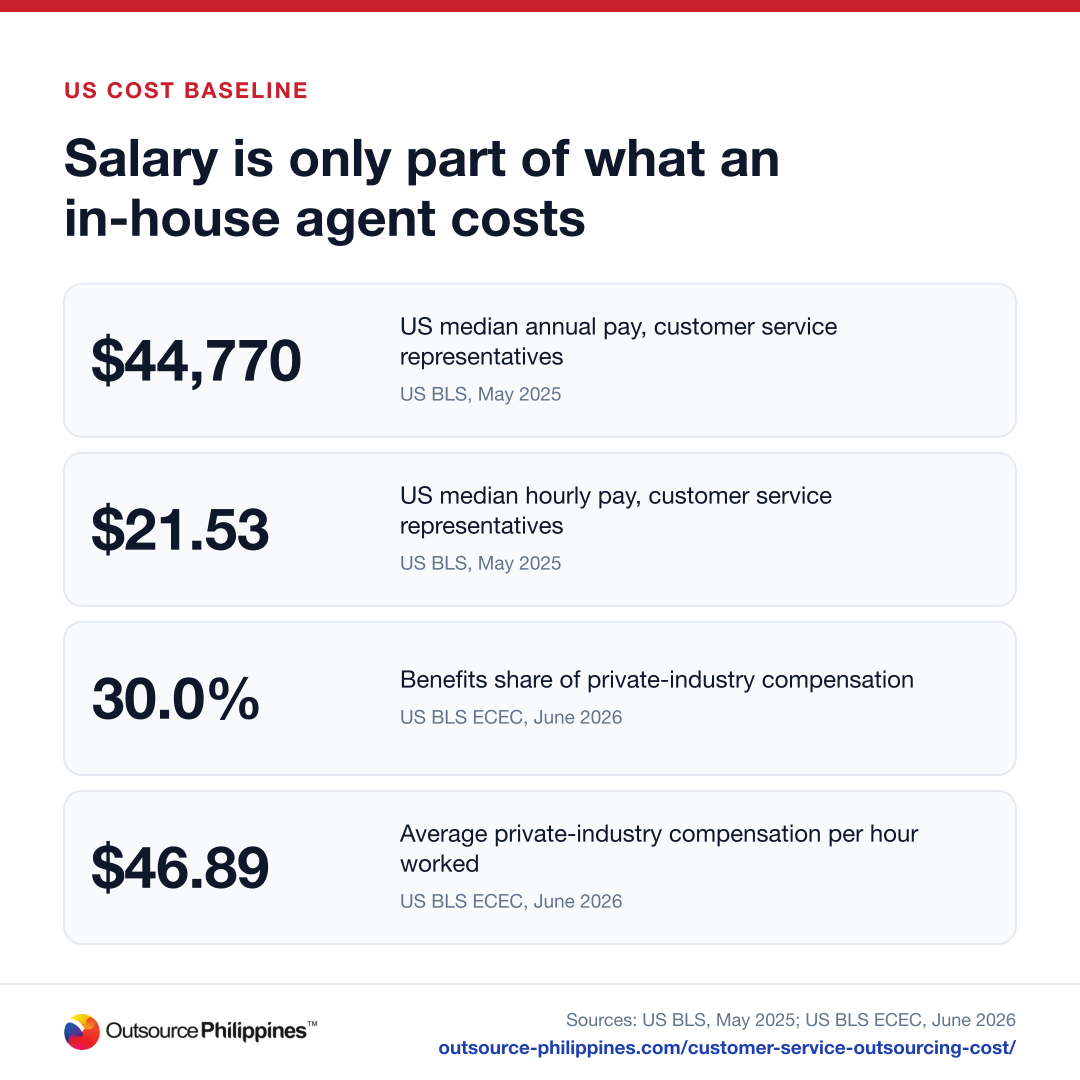
- $44,770US median annual pay, customer service representativesUS BLS, May 2025
- $21.53US median hourly pay, customer service representativesUS BLS, May 2025
- 30.0%Benefits share of private-industry compensationUS BLS ECEC, June 2026
- $46.89Average private-industry compensation per hour workedUS BLS ECEC, June 2026
Start with the wage. The US Bureau of Labor Statistics puts the median pay for customer service representatives at $44,770 a year, or $21.53 an hour (May 2025). Agents in technical, licensed, or bilingual roles usually earn more.
Then add benefits and legally required costs. In the BLS Employer Costs for Employee Compensation release, private employers paid an average of $46.89 per hour worked in total compensation in June 2026: $32.82 in wages and $14.07 in benefits, which were 30.0% of the total. If you apply that same split to a median agent, a $44,770 salary becomes roughly $64,000 a year in employment cost. That is an approximation, since benefits vary by employer, but it is a far more honest baseline than salary alone.
The costs that never show up in payroll come next:
- Recruiting: job ads, screening time, and the weeks a seat sits empty.
- Training: trainer time and the slower productivity of a new hire.
- Tools: help desk, CRM, phone system, and quality assurance software licenses per seat.
- Space and equipment: desks, computers, headsets, and IT support.
- Management: team leads, scheduling, and reporting.
- Turnover: every departure repeats the recruiting and training costs.
How Much Can You Save by Outsourcing Customer Service?
Outsource Philippines™ quotes dedicated staffing costs based on the role, scope, and coverage hours. The savings come from lower labor costs and from the provider carrying recruiting, training, workspace, equipment, and supervision.
The lower cost of labor in the Philippines drives those savings, and the country delivers them without trading away quality because of its English-speaking workforce. The country ranks 28th worldwide on the 2025 EF English Proficiency Index, with a score of 569 against a global average of 488, and its customer support industry has served US companies for decades.
Savings vary. A simple email queue in Philippine daytime hours saves more than a licensed, 24/7 voice program. That is why a written proposal based on your actual roles beats any average.
What Drives the Cost of Outsourced Customer Service?
Six factors set most of the price: role complexity, channel, shift, coverage, team size, and compliance requirements. Changing any one of them changes the quote.
| Cost driver | Lower cost | Higher cost |
|---|---|---|
| Role complexity | Order status, returns, account updates | Technical support or licensed-industry work |
| Channel | Email and chat | Voice, especially outbound |
| Shift | Philippine daytime | US business hours (Philippine night shift) |
| Coverage | Weekdays only | 24/7, including weekends and holidays |
| Team size | Larger teams sharing supervision | One or two seats |
| Compliance | Standard data handling | HIPAA, PCI DSS, or industry-specific controls |
Two more factors matter less but still show up in quotes: language (bilingual agents cost more) and tools (whether the provider supplies software or works inside yours).
How Do Customer Service Outsourcing Pricing Models Work?
Providers use one of four outsourcing pricing models: per agent per month, per hour, per contact, or by outcome. Dedicated monthly pricing is the most common for ongoing support because it gives you a stable team and a predictable bill.
| Model | How you pay | Best for | Watch out for |
|---|---|---|---|
| Dedicated agent (monthly) | Fixed monthly cost per full-time agent | Steady volume, ongoing support | Paying for idle time if volume drops |
| Hourly | Billed hours worked | Variable or seasonal volume | Less predictable monthly totals |
| Per contact or ticket | Fee per call, chat, or email handled | Short, uniform interactions | Pressure to rush contacts |
| Outcome-based | Fees tied to results such as sales or resolutions | Sales and retention programs | Complex contracts and disputes over attribution |
With dedicated customer service outsourcing, your agents work only on your account. Outsource Philippines™ quotes an hourly rate per agent in a written proposal based on the roles and coverage you need.
What Hidden Costs Should You Budget For?
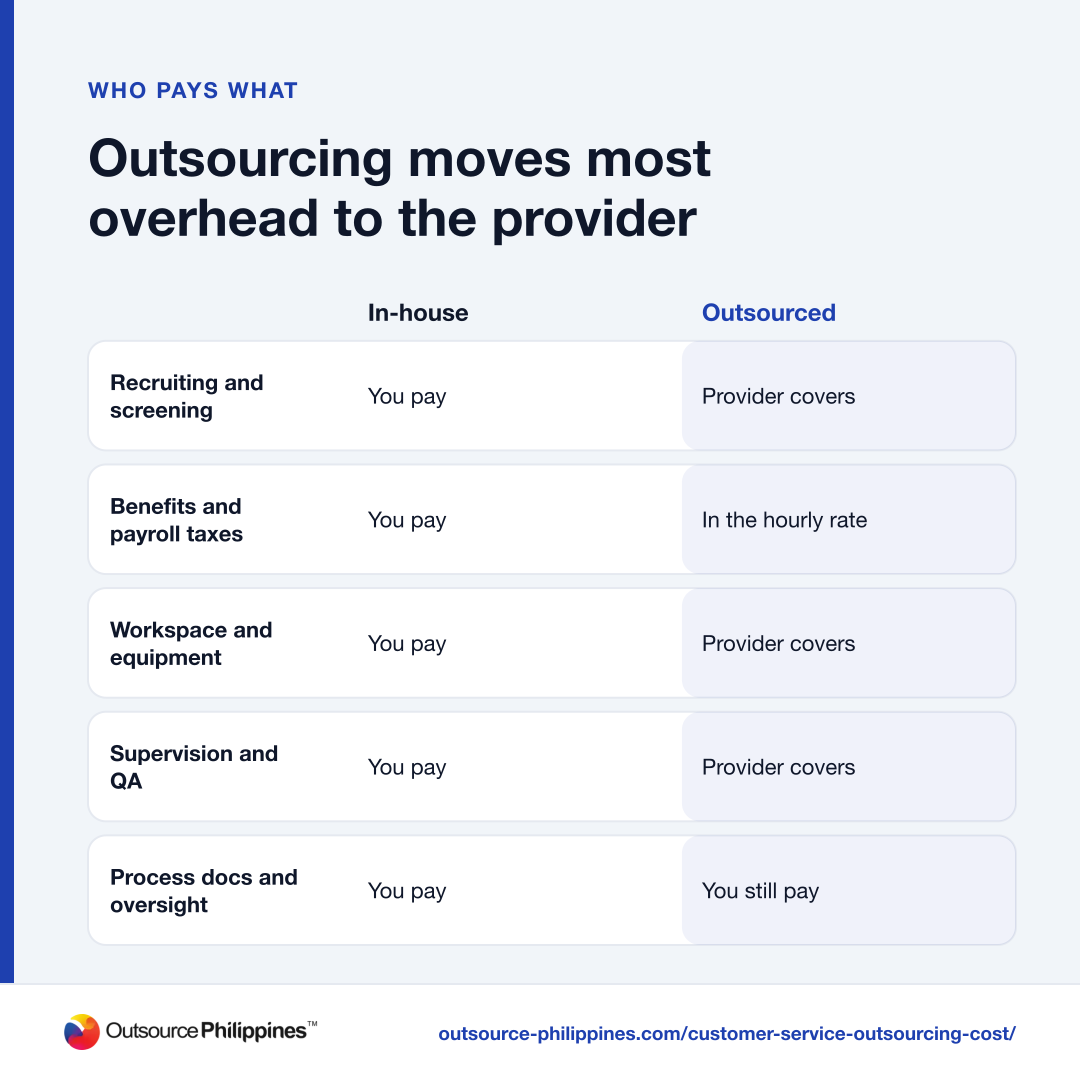
The hidden costs of outsourcing sit mostly on your side: the time your team spends setting up, documenting, and managing the relationship. Budget for them up front and they stay small.
| Cost item | In-house | Outsourced |
|---|---|---|
| Recruiting and screening | You pay | Provider covers |
| Benefits and payroll taxes | You pay | In the hourly rate |
| Workspace and equipment | You pay | Provider covers |
| Supervision and QA | You pay | Provider covers |
| Process docs and oversight | You pay | You still pay |
- Knowledge transfer: writing or updating macros, policies, and escalation rules. Gaps here slow the ramp more than anything else.
- Internal oversight: a manager on your side to review reports, answer escalations, and join weekly calls.
- Software seats: licenses for your help desk or CRM if the team works inside your tools.
- Ramp time: new agents are slower in their first weeks. Most teams go live in 2 to 4 weeks, depending on the role, and productivity builds from there.
- Contract scope changes: adding channels, hours, or languages later changes the price, so plan your first year’s needs up front.
How Do You Compare Customer Service Outsourcing Quotes?
Compare quotes on total cost for the same scope, not on the headline rate. Send every provider the same brief and ask them to price it the same way.
- Same scope: roles, channels, hours, expected volume, and languages.
- What is included: supervision, quality assurance, workstations, internet backup, software, and reporting.
- Dedicated or shared: whether agents work only on your account, as a dedicated team does, or split time across clients.
- Security and compliance: data handling under the Philippine Data Privacy Act of 2012, plus HIPAA or PCI DSS controls if you need them.
- Service levels: response time, resolution, and quality targets written into the agreement.
Is Outsourcing Customer Service Worth the Cost for Your Business?
It is usually worth it if you handle steady or growing contact volume, have documented processes, and need longer hours or more capacity than your in-house team can cover. It is less likely to pay off if volume is very small and irregular, or if most contacts need senior staff to make undocumented judgment calls.
To get a quote for your team, request a proposal with your channels, hours, and volume.
Frequently Asked Questions
How Much Does It Cost to Outsource Customer Service?
The cost depends on the role, channel, shift, coverage hours, team size, and pricing model. Outsource Philippines™ quotes costs based on the role, scope, coverage hours, and team size, and quotes an hourly rate per agent in a written proposal rather than publishing a rate card, because these factors change the price.
What Does an In-house Customer Service Representative Cost in the US?
The US Bureau of Labor Statistics puts the median pay for customer service representatives at $44,770 a year as of May 2025. Benefits made up 30.0% of private-industry compensation in June 2026, so the full employment cost is well above salary, before recruiting, training, software, equipment, and supervision are added.
Is It Cheaper to Pay per Hour or per Agent?
For most ongoing support, an hourly rate per dedicated agent gives the best balance: you keep a stable, trained team and pay for the hours that agent works. Per-contact pricing fits short, uniform interactions but can push agents to rush. Outsource Philippines™ bills per hour per agent. Compare any quote on total monthly cost for the same scope.
What Hidden Costs Come with Customer Service Outsourcing?
Most hidden costs sit on your side: documenting processes and macros, an internal manager to oversee the relationship, software licenses if agents work in your tools, and slower productivity while new agents ramp up. Planning these up front and agreeing on service levels in writing keeps them small and predictable.