Business Process Outsourcing: Ethical or Unethical?

On This Page
Business process outsourcing is ethical when the provider pays fair wages, offers safe and humane working conditions, protects client data, and delivers the quality it promises. It becomes unethical when cost cutting leads to underpaid or overworked staff, poor conditions, careless data handling, or work below the contract. Your choice of provider decides which you get.
Outsourcing means hiring another company to run tasks your own people used to handle, often from another country. Critics point to ethical issues as a reason to avoid it altogether. This guide looks at the ethics of outsourcing from both the US and Philippine sides, six examples of unethical outsourcing, six ethical practices that prevent them, and the wider effects when outsourcing is done badly.
Why Do Ethics Matter in Global Outsourcing?
Ethics matter because your provider’s conduct reflects on your brand. Social media and real-time news mean that labor abuse or a data leak at a vendor can become your headline within hours.
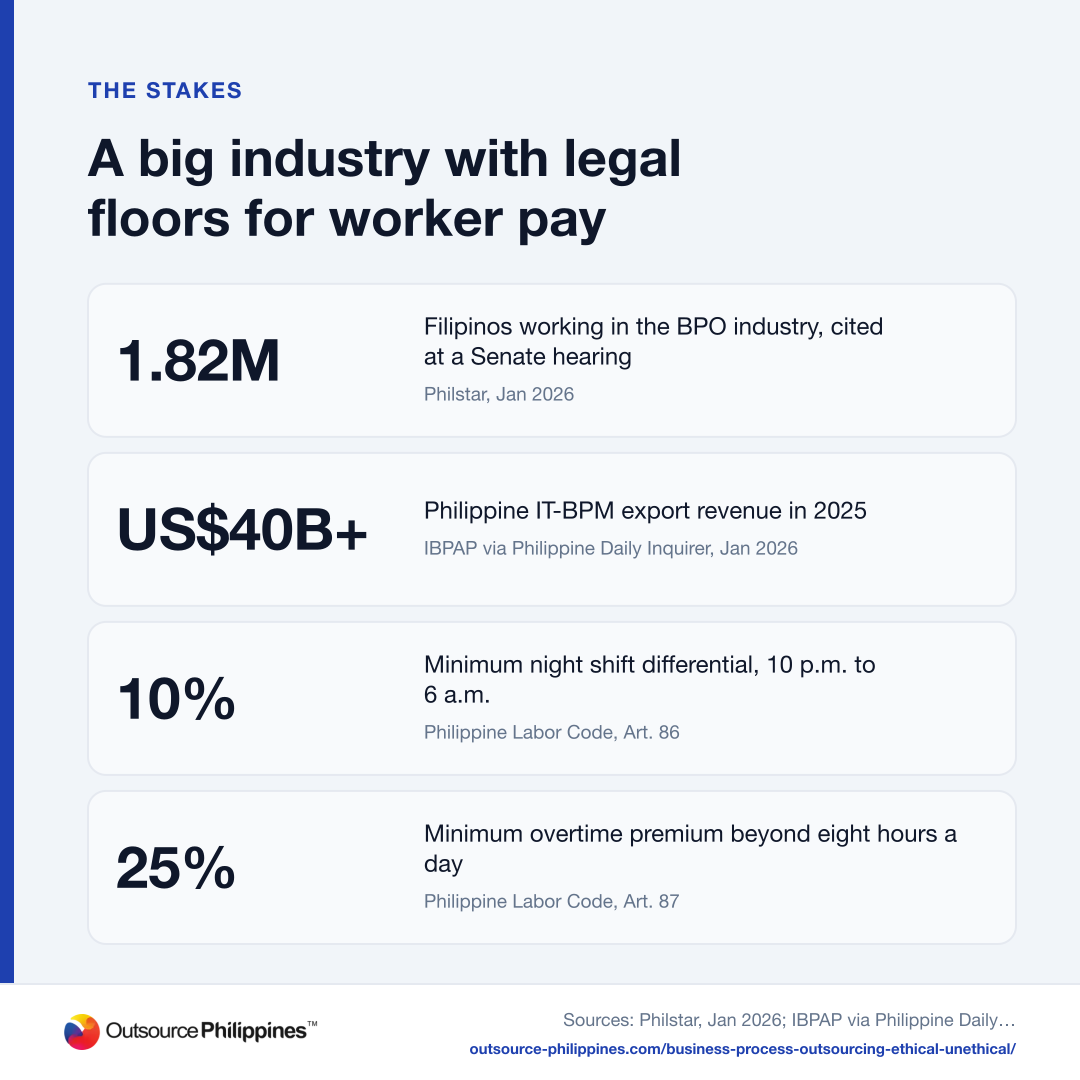
As offshoring grows, so does scrutiny of how providers treat workers and handle data. In the Philippines, BPO workers raised complaints about health coverage, union restrictions, and labor violations at a Senate labor committee hearing in January 2026, where the committee chair cited 1.82 million Filipinos working in the industry. The proposed BPO Workers’ Welfare and Protection Act followed that hearing.
- 1.82MFilipinos working in the BPO industry, cited at a Senate hearingPhilstar, Jan 2026
- US$40B+Philippine IT-BPM export revenue in 2025IBPAP via Philippine Daily Inquirer, Jan 2026
- 10%Minimum night shift differential, 10 p.m. to 6 a.m.Philippine Labor Code, Art. 86
- 25%Minimum overtime premium beyond eight hours a dayPhilippine Labor Code, Art. 87
For buyers, the takeaway is practical: ethical sourcing is now part of vendor due diligence, alongside price and quality. Ask how a provider pays, schedules, and supports its people, and how it protects your customers’ information, before you sign.
Is Outsourcing an Ethical Practice?
Outsourcing itself is neutral; the practices around it make it ethical or not. Critics point to abuse of offshore workers, while supporters point to efficiency, scalability, and access to skilled workers. Both sides are right about different providers.
The US View
In the United States, outsourcing is still a loaded word. Some politicians promise to end it, and some businesses play down their use of it. Supporters argue that companies sometimes must cut costs to stay in business, especially in a downturn, and that saved jobs at home can depend on lower costs elsewhere.
The Philippine View
In the Philippines, outsourcing is ethical when it brings fair wages and acceptable working conditions and does not exploit workers or harm local communities. The industry is large and still growing: the IT and Business Process Association of the Philippines (IBPAP) reported IT-BPM export revenue above US$40 billion in 2025. Philippine BPO work covers human resources, logistics, medical transcription, payroll, customer service, telemarketing, legal database management, and maintenance.
Philippine labor law also sets a floor. The Labor Code (Presidential Decree No. 442, 1974, as amended, Articles 86 and 87) requires a night shift differential of at least 10% of regular wage for work between 10 p.m. and 6 a.m., and an overtime premium of at least 25% for work beyond eight hours a day.
What Are Examples of Unethical Outsourcing?
Unethical outsourcing puts cost ahead of people, quality, or security. These are the six most common examples.
- Not providing fair wages and benefits: lower living costs make outsourcing cheaper, but some providers underpay and overwork staff.
- Poor working conditions: some providers, often new ones, run unsafe or unhealthy workplaces that workers feel they must accept.
- Working in graveyard shifts: staff serving overseas clients often work nights, which carries health risks if schedules, breaks, and pay are not managed well.
- Unfair competition: jobs that could have gone to local workers move abroad, reducing opportunities at home.
- Inferior service quality: without monitoring, a provider may deliver work below the agreed standard and care only about billing.
- Compromised data and information security: some countries have weak protection against intellectual property theft, and some providers take privacy lightly.
Night work is the most misunderstood item on this list. It is the norm for US-facing teams in Manila, and it can be done responsibly with fixed schedules, paid night differential, transport support, and rest days that stay put. The ethical problem is not the shift itself but a provider that ignores its effects.
How Do You Avoid Unethical Outsourcing Practices?
Ethical outsourcing comes down to choosing a provider with fair labor practices and holding it to written standards. These six practices help.
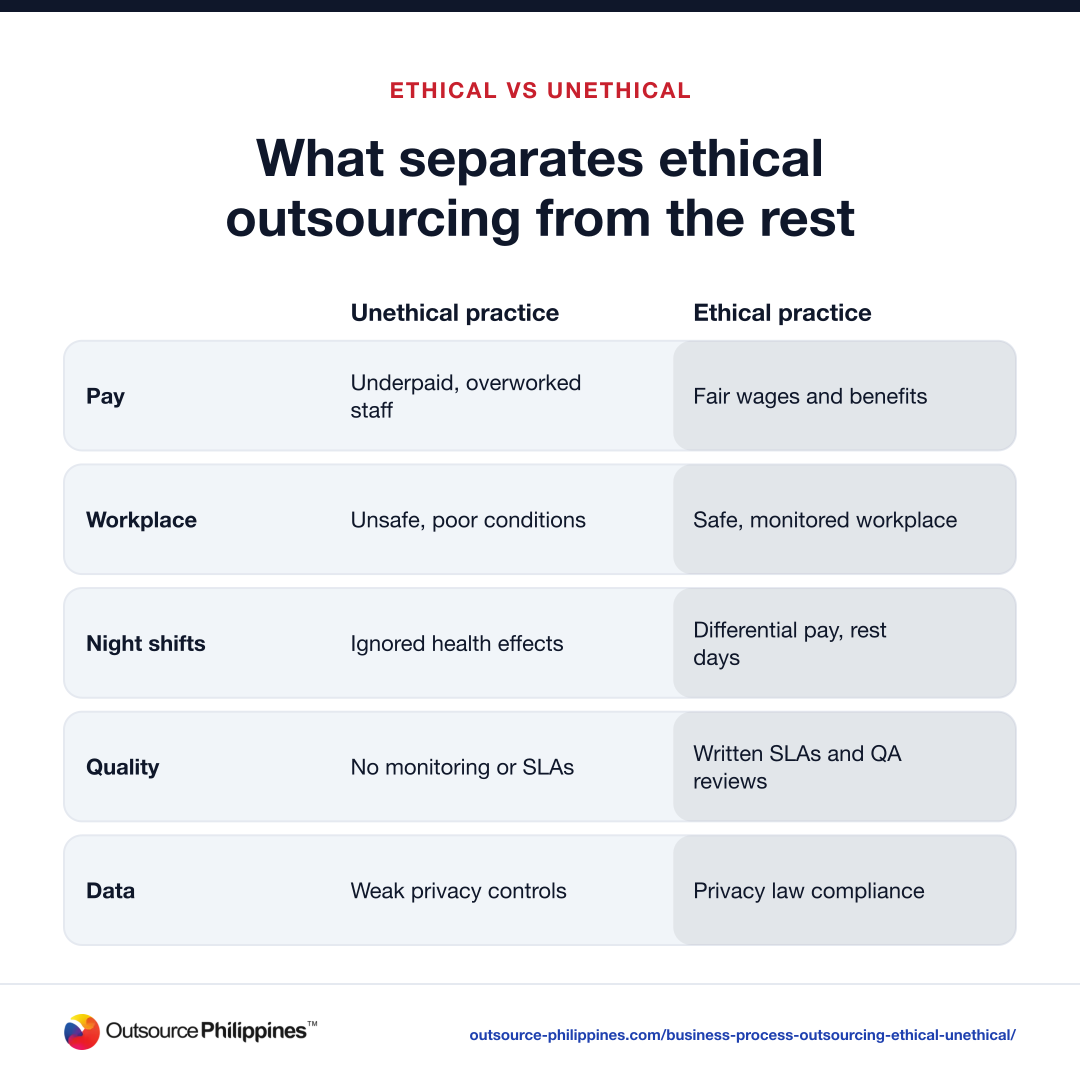
| Area | Unethical practice | Ethical practice |
|---|---|---|
| Pay | Underpaid, overworked staff | Fair wages and benefits |
| Workplace | Unsafe, poor conditions | Safe, monitored workplace |
| Night shifts | Ignored health effects | Differential pay, rest days |
| Quality | No monitoring or SLAs | Written SLAs and QA reviews |
| Data | Weak privacy controls | Privacy law compliance |
1. Perform a Risk Assessment
Understand the risks before you sign: labor practices, workplace safety, data handling, and financial stability. Use what you learn to build a clear risk management plan.
2. Build a Collaborative Relationship with Clear Communication
Keep lines of contact open, agree on transition schedules and costs in writing, and define privacy and ethics standards from the start.
3. Keep Rules and Processes That Protect Employees’ Rights
Plan thoroughly, align contract terms with day-to-day practice, and ask for transparency on pay, schedules, benefits, and workplace safety.
4. Accept That Projects Change
Risks shift as your business changes. Review contract and supplier performance continuously so issues surface and get fixed early.
5. Set Legal Procedures in Place
Write every legal aspect of the arrangement into the service agreement, and make sure workers and third parties sign non-disclosure agreements. Philippine providers must also follow the Data Privacy Act of 2012, which requires security measures and prompt breach notification.
6. Use Strict Employee Selection Criteria
A provider is only as good as its people. Check that it runs background checks, screens carefully for honest and responsible staff, and invests in training and growth so quality holds over time.
What Happens When Outsourcing Is Done Unethically?
Unethical outsourcing can save money in the short term while damaging workers, communities, and the client’s own reputation. Three effects stand out.
It Can Eliminate Jobs from the Domestic Workforce
Outsourcing removes some kinds of work at home, especially repetitive, low-skilled jobs. Some workers move to better jobs through new industries or training, but towns that depended on one employer can suffer high unemployment, slower growth, and weaker worker rights.
It Can Damage Reputation and Trust Inside the Company
Employees who fear their jobs will move offshore may lose faith in their employer. As outsourcing spreads from manual to administrative and professional roles, that worry reaches managers too, and morale and productivity can drop.
It Affects the Countries That Receive the Work
Outsourcing can pull workers away from farming or small businesses toward better-paying city jobs that do little for local development. If providers chase only the cheapest labor, workers in those markets face the next round of job losses when costs rise or work is automated.
How Do You Choose an Ethical Outsourcing Partner?
Outsourcing is right for your business when you can find a provider whose labor, security, and quality practices you would be comfortable defending in public. If a provider cannot explain how it pays, schedules, and supports its people, or how it protects your data, keep looking: ethical outsourcing starts with clear answers to those questions.
Outsource Philippines™ runs dedicated customer service agents and back-office staff from a supervised office in the Philippines, where each employee works only on one client's account and client data is protected under the Data Privacy Act of 2012, a managed firewall, and WorQmate monitoring.
Frequently Asked Questions
Is Outsourcing Jobs Unethical?
Outsourcing is not unethical in itself. It becomes unethical when a company or provider underpays workers, ignores safety and health, mishandles data, or delivers poor work to cut costs. Choosing a provider with fair pay, legal compliance, and transparent working conditions, and holding it to written standards, keeps the practice ethical on both sides.
What Are the Main Ethical Issues in Outsourcing?
The main ethical issues are unfair wages and benefits, poor working conditions, health effects of night shifts, the loss of local jobs, inferior service quality, and weak data security. Each one can be reduced through careful provider selection, clear contracts, regular audits, and attention to how the provider treats its own employees.
Are Night Shifts in Philippine BPOs Unethical?
Night shifts are not unethical when they are managed responsibly. Article 86 of the Philippine Labor Code (Presidential Decree No. 442, 1974, as amended) requires a night shift differential of at least 10% for work between 10 p.m. and 6 a.m. Responsible providers also keep schedules fixed, give regular rest days, and support health and transport for night-shift staff.
How Can I Check If an Outsourcing Provider Is Ethical?
Ask the provider how it pays and schedules staff, what benefits it offers, how it handles overtime and night differential, and how it protects client data. Request its data privacy policy and security controls, review its contract terms, and visit or audit its operations if possible before committing to a long engagement.