How to Build a Winning Outsourcing Strategy

On This Page
- What Is Strategic Outsourcing?
- How Do You Build an Outsourcing Strategy Step by Step?
- What Can You Learn from Companies That Outsource Well?
- How Do You Choose the Right Outsourcing Partner?
- What Are the Common Outsourcing Risks and How Do You Avoid Them?
- Is a Strategic Outsourcing Plan Right for Your Business?
- Frequently Asked Questions
A winning outsourcing strategy is a written plan that decides which work to hand to an outside provider, why, where and how success will be measured. It starts from business goals, keeps core strengths in-house, picks the right location model and partner, and sets contracts and KPIs that protect quality, data, and cost.
This guide explains what strategic outsourcing is and how it differs from offshoring, gives a five-step method for building your strategy, shows what well-known companies got right, and covers how to choose a partner and avoid the most common risks. It is written for US founders and operations leaders planning their first or next outsourcing move.
What Is Strategic Outsourcing?
Strategic outsourcing is a long-term business decision to trust specific functions to specialist providers who do them better or at lower cost. It differs from casual contracting because it is tied to goals, measured, and managed.
Companies used to outsource mainly to cut costs. Today the goal is usually wider: to free leadership time, reach skills that are hard to hire, add capacity quickly, and keep the business running across longer hours. Technology is part of the picture too. In Deloitte’s 2024 Global Outsourcing Survey of more than 500 executives, 83% said they already use AI as part of their outsourced services.
How Outsourcing Differs from Offshoring
People often mix up outsourcing and offshoring, but they answer different questions.
- Outsourcing is about who does the work. You delegate a function to a third-party provider, which may be local or overseas. Apple contracting iPhone assembly to Foxconn is the classic example.
- Offshoring is about where the work happens. You move work to another country, for example by opening your own support center or engineering office abroad, and the staff remain your employees.
The two can combine. Offshore outsourcing, such as a dedicated team run by a provider in the Philippines, gives you both a lower-cost location and a partner that handles hiring and operations.
Why Strategy Matters in Outsourcing Decisions
Without a strategy, companies risk outsourcing their core strengths or keeping work that specialists would do better. Five factors should shape every decision:
- Company image
- Competitiveness of goods and services
- Sales opportunities
- Technical characteristics
- Financial condition
Done well, strategic outsourcing helps organizations:
- Focus on core competencies
- Access specialized expertise and current technology
- Improve operational efficiency
- Scale operations up or down as demand changes
- Spread risk across more than one team or location
- Learn from providers who see many companies’ practices
How Do You Build an Outsourcing Strategy Step by Step?
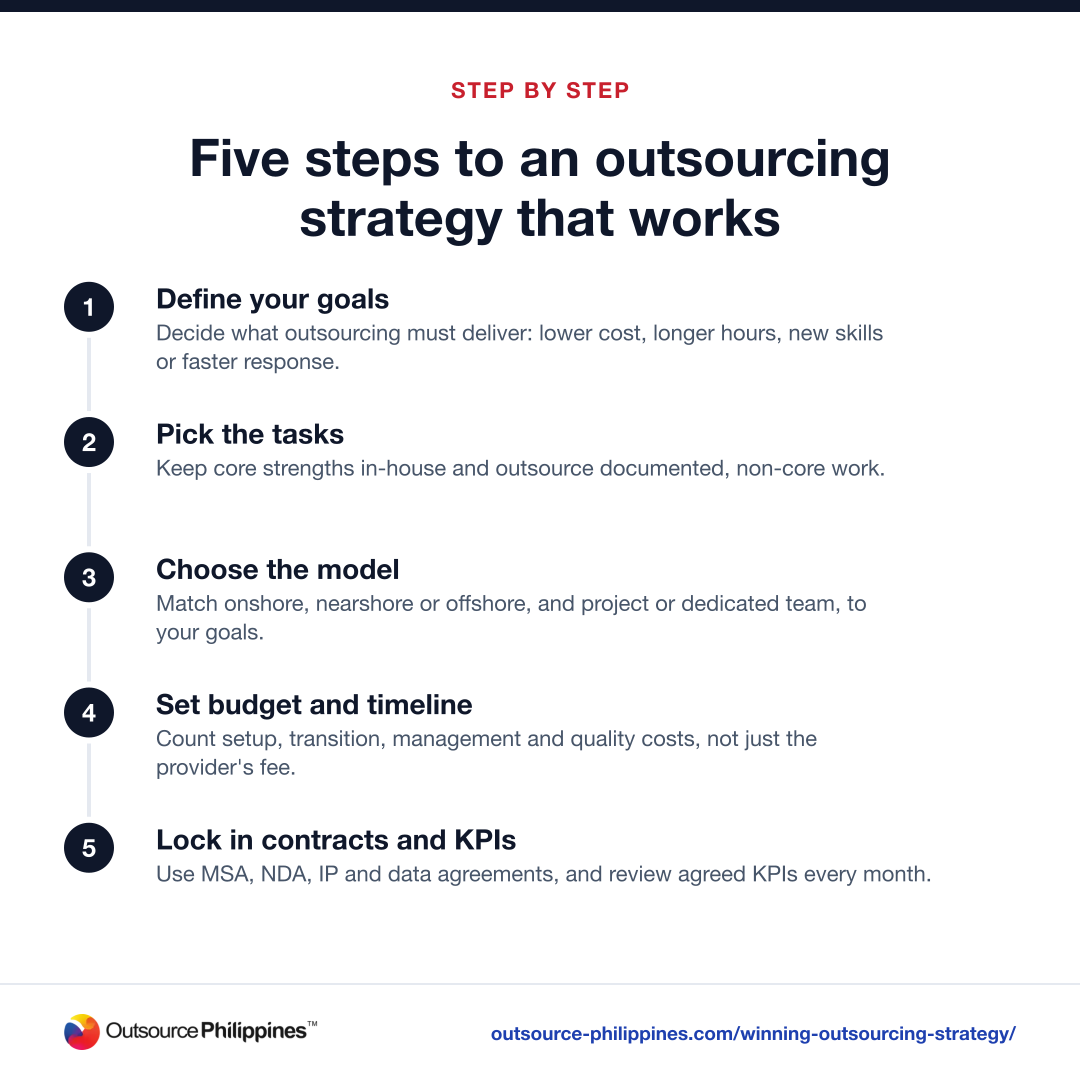
Build the strategy in five steps: define goals, choose the tasks, pick the model, set the budget and timeline, then lock in contracts and KPIs. Skipping a step is the most common reason outsourcing disappoints.
- 1Define your goals
Decide what outsourcing must deliver: lower cost, longer hours, new skills or faster response.
- 2Pick the tasks
Keep core strengths in-house and outsource documented, non-core work.
- 3Choose the model
Match onshore, nearshore or offshore, and project or dedicated team, to your goals.
- 4Set budget and timeline
Count setup, transition, management and quality costs, not just the provider's fee.
- 5Lock in contracts and KPIs
Use MSA, NDA, IP and data agreements, and review agreed KPIs every month.
1. Define Your Business Goals
Know what you want before you outsource anything. Your readiness check should cover:
- Clear objectives, such as lower cost, longer hours, or faster response times
- An honest review of internal capabilities and gaps
- Available resources: budget, people, and technology
- Leadership buy-in
- Likely risks and how you will handle them
Write the goals as numbers where you can, such as a target response time or a cost ceiling, so you can tell later whether outsourcing worked. Name one person who owns the relationship internally, because outsourcing without an owner tends to drift.
2. Identify Tasks to Outsource
Separate core activities, which set you apart from competitors and should stay in-house, from non-core work that a specialist can run. Good candidates include:
- Day-to-day work outside your main strengths
- Roles that need specialist expertise
- Work that does not depend on deep brand or cultural judgment
- Work that can be done at flexible hours
A simple test: if a task has written steps, measurable output and runs through systems you can open to remote staff, it is a strong candidate. If it needs someone on site or depends on know-how that lives in one person’s head, document it first or keep it in-house for now.
3. Choose the Right Outsourcing Model
Pick the location model that fits your goals and budget, then the relationship model. Relationship models range from fixed-price projects and time-and-materials work to staff augmentation and dedicated teams.
| Model | Where the provider is | Strengths | Watch out for |
|---|---|---|---|
| Onshore | Your own country | Same culture and hours, easier communication | Highest cost |
| Nearshore | A nearby country | Small time and cultural differences, lower cost | Moderate savings, smaller talent pools |
| Offshore | A distant country | Largest savings and deep talent pools | Time zone gaps that need planning |
Many companies blend these, an approach called rightshoring that matches each task to the location that suits it best.
4. Set a Realistic Budget and Timeline
Your budget should factor in:
- The size and duration of the work
- What the work requires and covers
- How much you can spend
- How much you trust the provider to run the work without close supervision
Watch for costs beyond the basic fee: setup, transition, your own management time, quality checks, and any extra charges. Ask every provider to show the full cost in writing. Outsource Philippines™ quotes an hourly rate per agent in a written proposal. Most teams go live in 2 to 4 weeks, depending on the role.
5. Create Clear Contracts and KPIs
Write down what everyone expects and how success will be measured. Your contract set should include:
- A master service agreement covering scope and payment terms
- A non-disclosure agreement to protect confidential information
- An intellectual property agreement stating who owns new IP
- A data processing agreement that meets data protection rules
Then agree on KPIs that fit the work, such as accuracy or defect rate, turnaround time, compliance rate, customer satisfaction, and missed deadlines. Review them monthly and adjust the model if the numbers show a poor fit.
What Can You Learn from Companies That Outsource Well?
The best-known outsourcing stories share one pattern: the company kept what made it distinctive and handed the rest to specialists, with strict standards.
Apple: Manufacturing and Supply Chain
Apple designs its products and contracts assembly to partners such as Foxconn, with facilities in several countries. It keeps control through a Supplier Code of Conduct that partners must meet wherever they operate. The lesson: outsource production, keep design and standards.
Slack: Product Design
Before launch, Slack’s founders brought in the design agency MetaLab to shape the product’s interface, logo, branding, and website. A small team got specialist design quality fast, while it focused on the product itself.
Google: IT Services and Support
Google works with outside partners for parts of customer support, data work, and IT operations, under strict guidelines and regular monitoring. That lets it add capacity and skills without growing headcount for every function.
Alibaba: Building for Global Users
In its early years Alibaba used outside developers to build a site that worked for both Chinese and international users, then relied on partners for parts of fulfillment. Outsourcing helped it reach markets faster than building everything in-house.
WhatsApp: A Small Team at Scale
WhatsApp kept its team small and used outside help for early app development. When Facebook agreed to buy it in February 2014, WhatsApp had more than 450 million monthly users, and the deal was valued at about $16 billion plus $3 billion in restricted stock units, according to Meta’s announcement.
The common thread is control. Each company kept the work that made it distinctive, set clear standards for partners, and measured results, rather than outsourcing to escape a problem it did not understand.
How Do You Choose the Right Outsourcing Partner?
Judge partners on relevant experience, communication fit, and security. The wrong partner creates more problems than it solves, so take time over this step.
Review Expertise and Past Work
Look for a provider that understands your industry and works in tools like yours. To check:
- Read case studies and client references
- Review their technology and infrastructure
- Confirm the security attestations and certifications your industry expects
- Ask for real problem-solving examples
Ask them to walk you through their project management, KPI tracking, and escalation process.
Check Cultural and Communication Fit
Cultural fit matters more than geography: shared work habits, communication style, and attitude to feedback. Set up clear channels early, agree on overlap hours, and name one main contact on each side.
Review Security and Compliance Standards
You will share sensitive data, so review the provider’s data protection policies in detail. Check access controls, encryption, monitored workstations, and compliance with the rules that apply to you. Outsource Philippines™ complies with the Philippine Data Privacy Act of 2012 and protects client work with a managed firewall and WorQmate, its in-house project and employee monitoring platform; our security page lists the controls.
What Are the Common Outsourcing Risks and How Do You Avoid Them?
The three biggest risks are data and IP exposure, hidden costs and scope creep, and communication gaps across time zones. Each can be managed with planning.
Data Security and IP Protection
- Assess the provider’s security infrastructure before you sign
- Use non-disclosure agreements and clear IP ownership clauses
- Set policies for data ownership and the handling of shared information
Read any “aggregated data” clauses closely, since some providers reserve the right to use anonymized client data.
Hidden Costs and Scope Creep
Unclear requirements, weak communication, and rushed delivery cause most overruns. Write a detailed scope, set quality standards for every team, and ask for regular progress reports so issues surface early. Agree in advance how changes to scope are requested, priced, and signed off in writing, so new work does not quietly expand the bill or slip past the team’s capacity.
Time Zone and Communication Challenges
Philippine Time is UTC+8 with no daylight saving, per timeanddate.com, so Manila is 12 to 13 hours ahead of US Eastern Time. Most offshore teams serving US clients work a night shift so they are online during your business day, which turns the gap into an advantage for overnight coverage.
Is a Strategic Outsourcing Plan Right for Your Business?
It is a strong fit if you have repeatable, documented work, clear goals, and someone who can own the relationship. It is a weaker fit if your processes are undocumented, volumes are tiny and irregular, or the work depends on judgment only your founders have.
If customer support is your first candidate, explore our customer service outsourcing teams. When you have your roles and hours in mind, request a proposal.
Frequently Asked Questions
What Is an Outsourcing Strategy?
An outsourcing strategy is a plan that decides which business functions to hand to outside providers, why, in which location, and under what terms. It links outsourcing to business goals, keeps core strengths in-house, and sets contracts and KPIs, so outsourcing improves cost, capacity, and quality rather than becoming a series of one-off contracts.
What Are the Steps to Build an Outsourcing Strategy?
There are five steps. Define your business goals, identify the non-core tasks to outsource, choose the right location and relationship model, set a realistic budget and timeline, and create clear contracts with measurable KPIs. Review results regularly and adjust the model if the numbers show it is not working.
What Is the Difference between Outsourcing and Offshoring?
Outsourcing is about who does the work: a third-party provider runs a function for you, at home or abroad. Offshoring is about where the work happens: another country, possibly with your own employees. Offshore outsourcing combines both, with a provider in a lower-cost country running the work for you.
How Do I Choose an Outsourcing Partner?
Check relevant industry experience, client references, technology and security controls, and communication fit. Ask how the provider manages quality, KPIs, and escalations, and get the full cost in writing. A short trial on one well-documented process is a low-risk way to test a partner before expanding the scope.
What Are the Biggest Risks of Outsourcing?
The main risks are data and intellectual property exposure, hidden costs and scope creep, and communication gaps across time zones. Reduce them with security due diligence, clear IP and data clauses, a detailed scope of work, agreed overlap hours, and regular reporting against KPIs.