15 Types of Virtual Assistants You Should Know About, with a Hiring Guide

On This Page
The main types of virtual assistants are administrative, data entry, customer service, social media, digital marketing, real estate, bookkeeping, graphic design, ecommerce, legal, Pinterest, project management, content, technical, and sales assistants. Each handles a different set of tasks, so the right choice depends on which recurring work takes up most of your team's time.
A US administrative assistant earned a median of $48,310 a year in May 2025, according to the US Bureau of Labor Statistics, before benefits, payroll taxes, and a desk. That figure is why many companies in the US, Canada, Australia, and the UK hire virtual assistants in the Philippines for admin, customer, marketing, and back-office work.
Below are the 15 most common virtual assistant roles, the tasks each one handles, and the hiring steps for bringing on a Filipino assistant through an office-based provider.
What Is a Virtual Assistant?
A virtual assistant is a staff member who works for your business from another location, using your email, calendar, CRM, and other tools through secure logins. A dedicated assistant works only on your account, full time, during the hours you set.
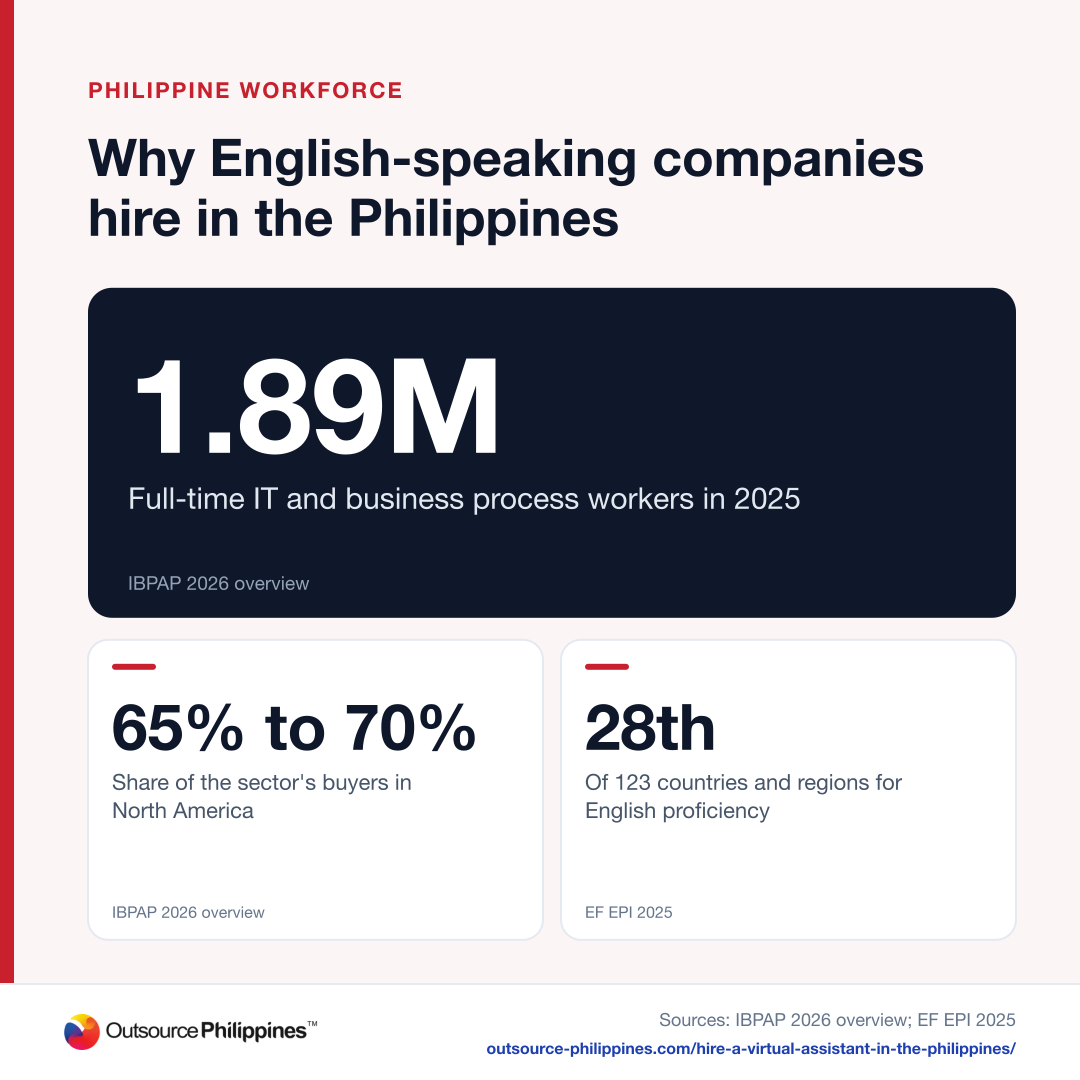
The Philippines is a common choice for English-speaking companies. The IT & Business Process Association of the Philippines reports in its 2026 industry overview that the country's IT and business process sector employed 1.89 million full-time workers in 2025, and that North America accounts for 65% to 70% of its buyers. The Philippines also ranked 28th of 123 countries and regions on the EF English Proficiency Index 2025.
- 1.89MFull-time IT and business process workers in 2025IBPAP 2026 overview
- 65% to 70%Share of the sector's buyers in North AmericaIBPAP 2026 overview
- 28thOf 123 countries and regions for English proficiencyEF EPI 2025
Most of the benefits of outsourcing employees come from three things: lower employment cost than a local hire, extended coverage when the assistant works your evening or overnight hours, and more of your own team's time for sales, clients, and planning.
What Are the 15 Types of Virtual Assistants?
The table gives a quick view of each role. The sections after it cover what each type does in practice.
| Type | Typical tasks | Common tools |
|---|---|---|
| Administrative | Inbox, calendar, travel, expense reports | Google Workspace, Microsoft 365 |
| Data entry | Database updates, record cleanup, transcription | Excel, Google Sheets, CRMs |
| Customer service | Email and chat replies, order questions | Zendesk, Gorgias, Help Scout |
| Social media | Post scheduling, comment replies, reports | Meta Business Suite, Buffer |
| Digital marketing | Email campaigns, keyword research, ad reports | Mailchimp, Google Ads, Semrush |
| Real estate | Listings, showing schedules, CRM updates | MLS portals, Follow Up Boss |
| Bookkeeping | Transaction coding, bills, reconciliations | QuickBooks Online, Xero |
| Graphic design | Social graphics, ads, brochures, brand kits | Canva, Adobe Illustrator |
| Ecommerce | Product listings, inventory, order follow-up | Shopify, Amazon Seller Central |
| Legal | Document formatting, filing calendars, intake | Clio, Microsoft Word |
| Pin design, board setup, keyword titles | Pinterest, Tailwind | |
| Project management | Task tracking, status updates, meeting notes | Asana, Trello, Monday.com |
| Content | Blog drafts, newsletters, content calendars | WordPress, Google Docs |
| Technical | CMS updates, CRM setup, software admin | HubSpot, WordPress, Zapier |
| Sales | Lead research, CRM updates, follow-up emails | HubSpot, Salesforce, LinkedIn |
Administrative, Data Entry, and Project Management Assistants
An administrative assistant runs the inbox, filters and drafts replies, books meetings across time zones, prepares agendas, books travel, and turns receipts into expense reports. This is the most common first hire because the tasks are easy to document.
A data entry assistant updates CRM records, cleans duplicate contacts, enters orders or invoices, and transcribes forms. Accuracy targets, such as an error rate per 1,000 records, make this role easy to measure.
A project management assistant keeps tasks moving in Asana, Trello, or Monday.com, chases status updates, writes meeting notes, and sends a weekly summary to managers. It suits teams running many small projects at once.
Customer Service and Sales Assistants
A customer service assistant answers email and chat, tracks orders, processes returns under your rules, and escalates anything outside them. Clear macros and an escalation list are what make this role work in the first month.
Sales virtual assistants research leads, enrich contact records, send first-touch and follow-up emails, book meetings for account executives, and keep the pipeline clean so forecasts are accurate.
Social Media, Digital Marketing, Pinterest, and Content Assistants
A social media assistant schedules posts, replies to comments and messages, flags complaints, and reports reach and engagement each month. Reply speed and tone matter most when the goal is driving audience engagement.
A digital marketing assistant builds email campaigns, manages subscriber lists, runs keyword research, pulls ad and analytics reports, and handles on-page SEO updates.
A Pinterest assistant designs pins, writes keyword-rich titles and descriptions, organizes boards, and tracks clicks to your site. It is a narrow role that fits ecommerce, food, home, and wedding brands.
A content assistant drafts blog posts and newsletters, formats articles in your CMS, and keeps a content calendar. Strong writing samples matter more than any other skill for content creation roles.
Graphic Design Assistants
A graphic design assistant produces social media graphics, ad creatives, brochures, presentation decks, and brand kits, and can support brand identity work such as logo files and style guides. For ongoing creative design work, ask for a portfolio in your industry and a paid test brief.
Ecommerce Assistants
An ecommerce assistant uploads product listings, updates prices and stock, follows up on late orders, and answers buyer questions. Platform specialists include Amazon virtual assistants, who work in Seller Central on listings, reviews, and inventory, and Shopify virtual assistants, who handle store updates and customer messages. An ecommerce virtual assistant who answers customers should have your return and refund rules in writing from day one.
Real Estate, Bookkeeping, and Legal Assistants
Real estate virtual assistants update listings, schedule showings, log leads in the CRM, and send follow-up emails, which leaves agents more time for clients and closings.
A bookkeeping assistant codes transactions, enters bills, reconciles bank and credit card accounts, and prepares month-end reports for your accountant in QuickBooks Online or Xero. Final review and tax filings stay with your accountant.
A legal assistant formats documents, maintains filing calendars, organizes case files, and handles client intake and scheduling. Legal advice and court filings stay with licensed staff in your office.
Technical Assistants
A technical assistant updates content in WordPress or another CMS, manages email lists, sets up CRM fields and automations, runs software admin tasks, and handles first-line troubleshooting for internal tools. It suits small companies without an IT or operations hire.
How Do You Hire a Virtual Assistant in the Philippines?
There are three common ways to hire a Filipino assistant. They differ in who employs the assistant, where the work happens, and who covers absences.
| Hiring model | Who employs the assistant | Where the work happens | Best for |
|---|---|---|---|
| Freelancer marketplace | You contract the person directly | Usually the freelancer's home | Short, low-risk tasks |
| Office-based provider | The provider | The provider's supervised office | Ongoing roles with customer or financial data |
| Employer of record | The EOR, while you manage daily work | Set by you and the EOR | Companies that already found their candidate |
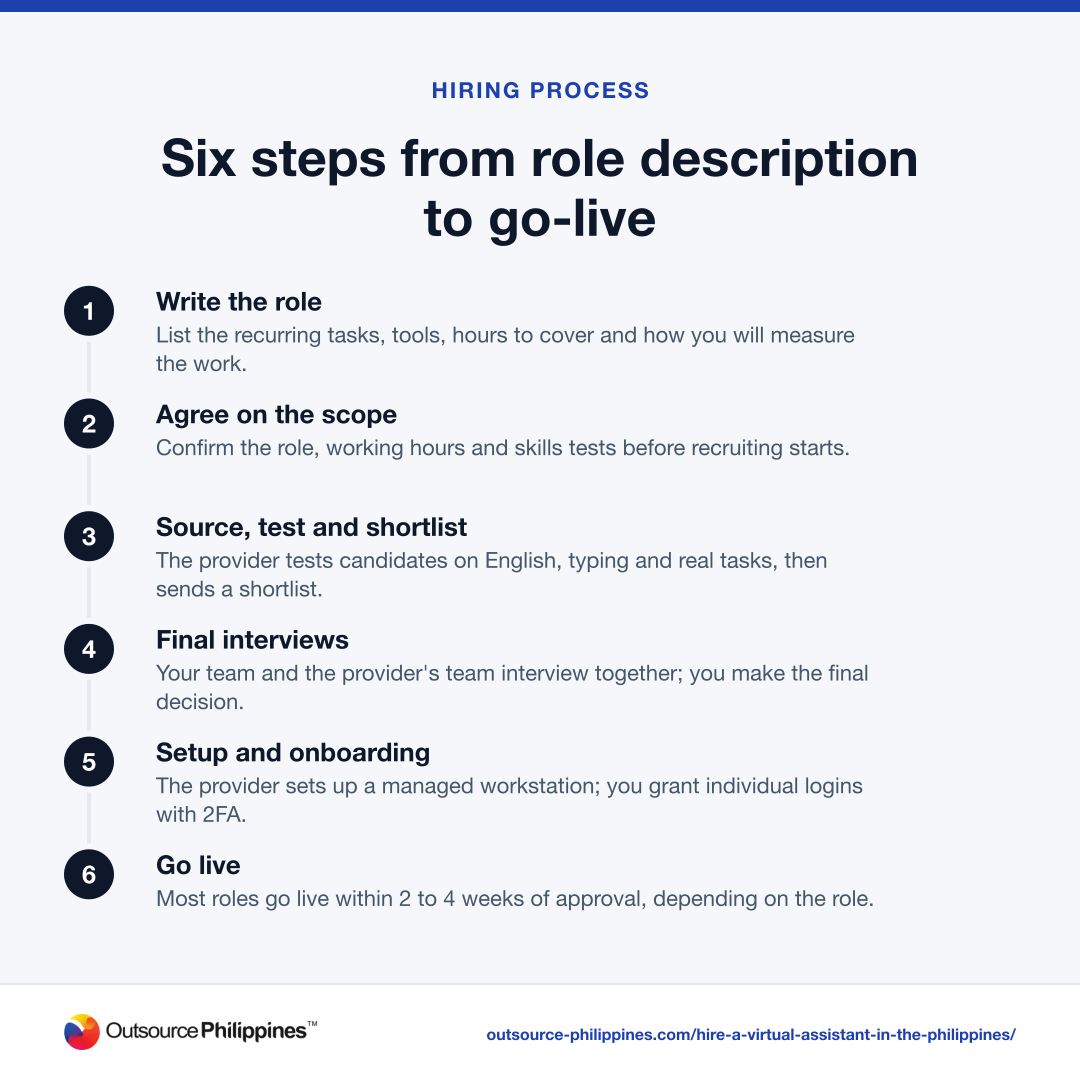
For companies that already have a candidate, an employer of record in the Philippines handles local payroll, benefits, and labor compliance. For companies that need the provider to find, test, and supervise the assistant, an office-based provider is the more common route. The hiring process with an office-based provider usually runs like this:
- 1Write the role
List the recurring tasks, tools, hours to cover and how you will measure the work.
- 2Agree on the scope
Confirm the role, working hours and skills tests before recruiting starts.
- 3Source, test and shortlist
The provider tests candidates on English, typing and real tasks, then sends a shortlist.
- 4Final interviews
Your team and the provider's team interview together; you make the final decision.
- 5Setup and onboarding
The provider sets up a managed workstation; you grant individual logins with 2FA.
- 6Go live
Most roles go live within 2 to 4 weeks of approval, depending on the role.
What Skills Should You Look For?
Test these skills directly rather than relying on a resume:
- Written English: a short email reply or summary written during the interview.
- Organization: how the candidate would plan a day with ten competing tasks.
- Tool experience: hands-on use of your main tools, such as QuickBooks Online, HubSpot, or Shopify.
- Attention to detail: a short data or proofreading test with planted errors.
- Judgment: what the candidate would escalate and what they would handle alone.
Specialized roles need proof of work: bookkeeping assistants should show accounting software experience, and graphic design assistants should show a portfolio.
How Do You Onboard a Virtual Assistant Successfully?
The first 30 days decide whether the hire works. These practices help:
- Written procedures. Record short screen videos or write step-by-step guides for each recurring task before day one.
- Access on day one. Set up email, CRM, help desk, and password manager access before the start date so the first week is not lost.
- Daily check-ins in week one. Fifteen minutes a day to answer questions, then move to two or three check-ins a week.
- Clear measures. Track response time, tasks completed, and error rate, and review them weekly for the first month.
- One point of contact. Name one manager who sets priorities, so the assistant does not get conflicting instructions.
Security matters most when the assistant touches customer or financial data. Ask the provider how it controls devices, networks, and data, and confirm it handles personal data under the Philippine Data Privacy Act of 2012 (Republic Act 10173).
Which Type of Virtual Assistant Is Right for Your Business?
Start with the work that takes up most of your team's time each week. If it is inbox, calendar, and travel, an administrative assistant fits; if it is customer emails and chats, a customer service assistant fits; if it is invoices and reconciliations, a bookkeeping assistant fits. A virtual assistant is a weaker fit for work that is undocumented, changes daily, or needs senior judgment on every task.
Outsource Philippines™ recruits and screens dedicated virtual assistants for admin, customer service roles, and back-office work such as bookkeeping and data entry, and each assistant works only on one client's account from a supervised office in the Philippines.
Frequently Asked Questions
What Does a Virtual Assistant Do?
A virtual assistant completes business tasks from another location using your tools. Depending on the type, that can mean managing email and calendars, entering data, answering customer emails and chats, running social media accounts, keeping books, designing graphics, updating product listings, or supporting sales with lead research. Most businesses start with one clearly defined set of recurring tasks.
How Do I Choose the Right Type of Virtual Assistant?
List the recurring tasks that take the most time, group them by skill, and match the largest group to a virtual assistant type. Then write down the tools, response times, and quality standards for that work. A clear task list makes onboarding faster and gives you a simple way to measure whether the assistant is delivering.
What Skills Should a Good Virtual Assistant Have?
Look for clear written and spoken English, strong organization, time management, attention to detail, and comfort with the tools you already use, such as Google Workspace, Excel, or a CRM. Specialized roles add their own skills: bookkeeping assistants need accounting software experience, and graphic design assistants need a portfolio of relevant work.
How Long Does It Take to Hire a Virtual Assistant in the Philippines?
Through an office-based provider, most roles go live in 2 to 4 weeks. That covers writing the role, sourcing and testing candidates, final interviews with your team and the provider's team, and setting up the workstation and tool access. Specialized roles, such as bookkeeping or technical support, can take longer to fill.
Who Makes the Final Hiring Decision When You Use a Provider?
You do. A good provider sources candidates, tests them on the real tasks of the role, and sends a shortlist. Final interviews are held with your team and the provider's team together, and you choose who joins your account. The provider then employs the assistant and handles payroll, equipment, and the office.