What Is HRO? A Complete Guide to Human Resource Outsourcing

On This Page
- What Is Human Resource Outsourcing (HRO)?
- Which HR Services Can You Outsource?
- What Are the Benefits of HRO?
- What Are the Main Types of HRO?
- How Is HRO Different from a PEO, RPO, or EOR?
- How Do HRO Providers Handle Compliance and Data Security?
- How Do You Choose the Right HRO Partner?
- What Is the Future of HR Outsourcing?
- Is HRO Right for Your Business?
- Frequently Asked Questions
HRO (human resource outsourcing) is contracting an outside provider to run some or all of a company’s HR functions, such as payroll, recruiting, benefits administration, training, compliance, and employee support. The company stays the legal employer and keeps control of its workforce, while the provider supplies the people, processes, and software behind the work.
Executives face steady pressure to manage hiring, payroll, benefits, and labor law while keeping HR costs in check, and those tasks pull time away from running the business. This guide explains what HRO is, which services it covers, the main types of HRO, how it compares with a PEO, recruitment process outsourcing (RPO) and an employer of record (EOR), and how to choose a provider.
What Is Human Resource Outsourcing (HRO)?
Human resource outsourcing is the practice of hiring an external provider to handle some or all HR functions for an organization. The provider acts as a service partner, while the client keeps its employment relationships and final say over people decisions.
Typical HRO scope includes recruiting, payroll processing, benefits administration, employee training, compliance management, and performance tracking. Unlike a professional employer organization (PEO), which enters a co-employment relationship, HRO leaves the employment structure unchanged. That makes it attractive to mid-sized and large companies that want to modernize HR systems, standardize processes across regions, or expand without overloading internal teams.
Modern HRO runs on cloud platforms, analytics, and automation. Combined with specialist staff, these tools give leaders real-time workforce data, help track regional labor law, and speed up answers to employee questions.
Which HR Services Can You Outsource?
Most HRO agreements cover one or more of six functional areas. Every contract is customized, so companies pick the areas where they lack scale, expertise, or time.
- Payroll and compensation management: wage calculations, tax withholding, and statutory filings, including multi-currency payroll for companies with staff in several countries. Many firms start here, and the benefits of payroll outsourcing are usually the easiest to measure.
- Recruitment and talent acquisition: job posting, sourcing, candidate screening, and onboarding, often with access to wider talent pools and applicant tracking systems.
- Benefits administration: health plans, retirement plans, and insurance enrollment managed centrally so employees get consistent, accurate service.
- Training and development: learning platforms and programs designed and delivered at scale, tied to business goals.
- Compliance and risk management: tracking changes in employment law and handling reporting and labor obligations.
- Employee relations and support: HR help desks and employee assistance that answer workforce questions quickly.
Advanced HRO contracts may add analytics-based performance reviews, HR technology consulting, and help with moving HR processes to new systems.
What Are the Benefits of HRO?
HRO lowers fixed HR costs, adds expertise, and lets HR leaders spend time on strategy instead of administration. Structured well, it turns HR from a cost center into a function that supports growth.
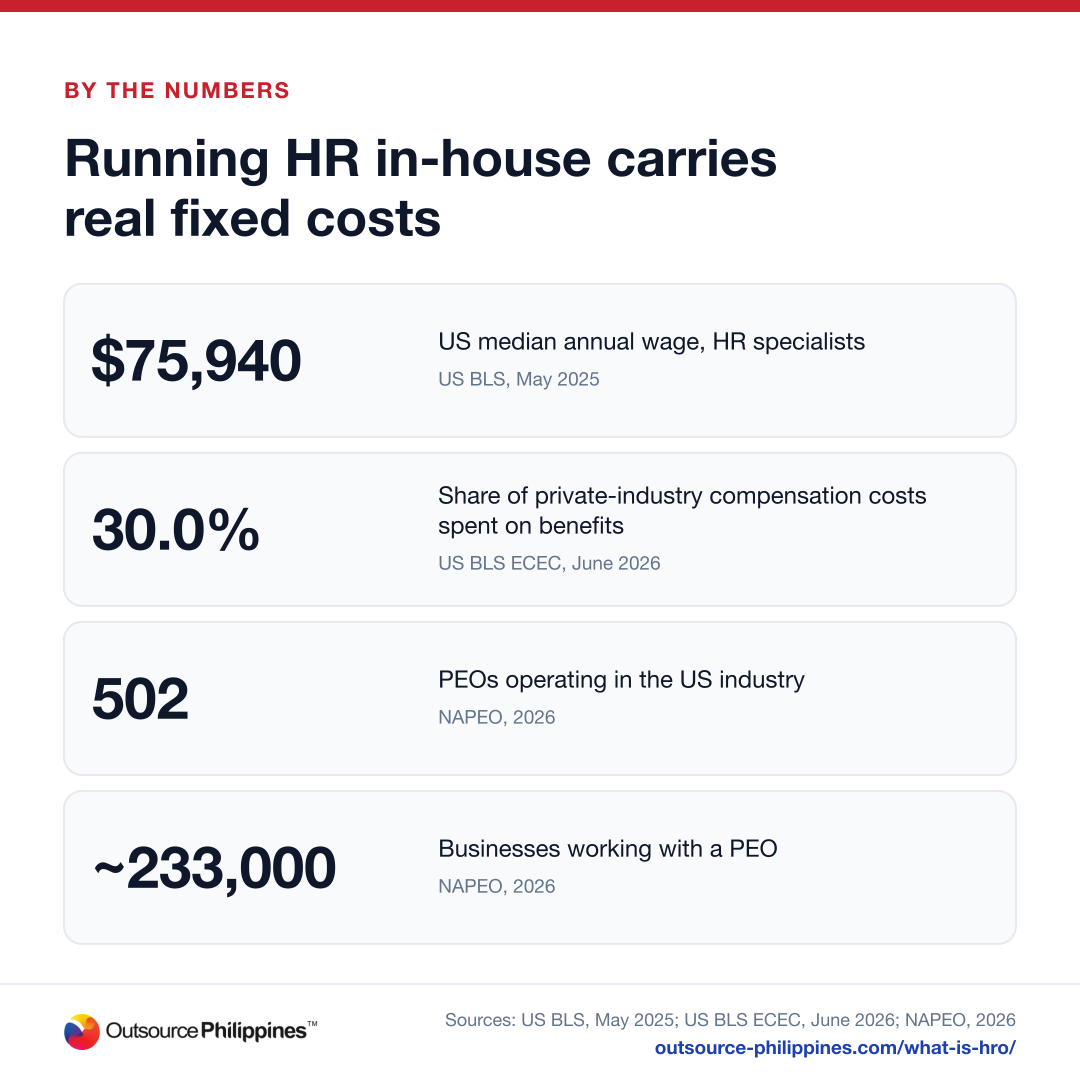
- $75,940US median annual wage, HR specialistsUS BLS, May 2025
- 30.0%Share of private-industry compensation costs spent on benefitsUS BLS ECEC, June 2026
- 502PEOs operating in the US industryNAPEO, 2026
- ~233,000Businesses working with a PEONAPEO, 2026
- Cost efficiency: no need to build and staff your own HR technology and administration at full scale. In-house HR is not cheap: the US Bureau of Labor Statistics puts the median annual wage for HR specialists at $75,940 (May 2025), before benefits, which made up 30.0 percent of private-industry employer compensation costs in June 2026 according to the BLS employer cost survey.
- Scalability and flexibility: hiring, onboarding, and payroll can grow or shrink with demand, without long administrative bottlenecks.
- Improved compliance: providers specialize in employment law across jurisdictions, reducing errors in tax filings, benefits, and workplace rules.
- Access to expertise and technology: specialists who track best practices and tools that would take years to build in-house.
- Better employee experience: central support and faster answers improve satisfaction, which helps retention.
- Strategic focus: HR leaders can concentrate on workforce planning, succession, and culture.
HRO also supports resilience. During mergers, acquisitions, or restructuring, an experienced provider keeps payroll, records, and documentation consistent across locations, and service level agreements set the quality bar during those transitions. Dashboards on turnover, engagement, and compliance exposure let leaders adjust policy or headcount plans quickly when markets shift.
What Are the Main Types of HRO?
There are four common HRO models, and they differ in how much HR the provider runs and how tightly it connects with your team. Companies choose based on size, geographic footprint, and how mature their internal HR function is.
- Comprehensive HRO: one provider handles all core HR functions, from payroll to employee relations. Common in large enterprises pursuing a full HR overhaul.
- Selective HRO: the company outsources only specific areas, such as benefits, recruiting, or compliance, to specialists. This is the most customizable model.
- Technology-enabled HRO: the provider supplies HR software or cloud platforms that digitize workflows, plus ongoing support and analytics.
- Global HRO: central governance for multi-country organizations, with local compliance handled country by country.
Within selective HRO, the work is usually bought by function: payroll outsourcing, benefits administration outsourcing, recruitment process outsourcing, training outsourcing, and outsourced HR help desks. A company expanding across regions often leans toward global HRO, while one focused on modernizing its systems tends to pick a technology-enabled model.
How Is HRO Different from a PEO, RPO, or EOR?
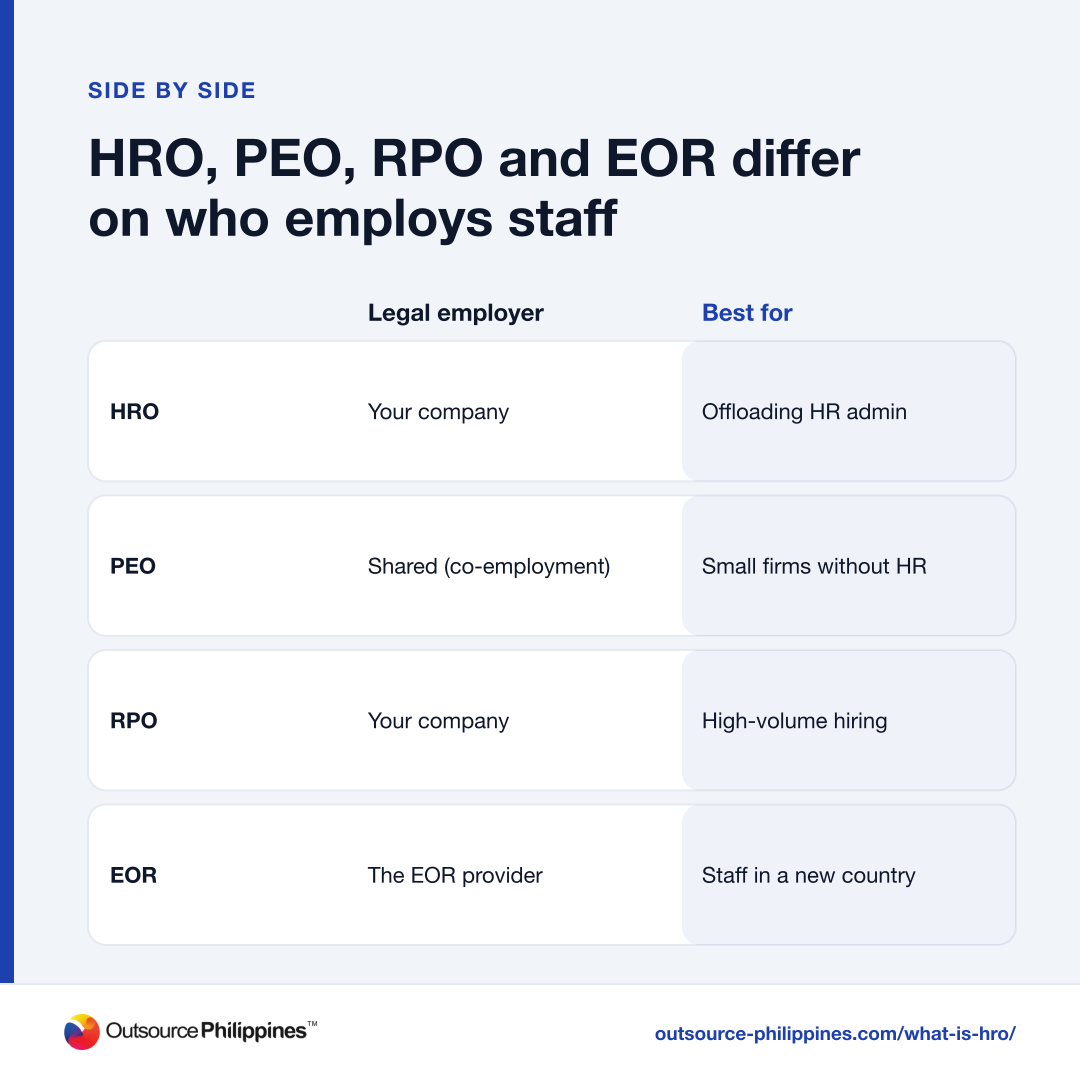
The key difference is who employs the workers and how much of HR the provider owns. With HRO, you stay the employer and buy services; a PEO shares employment with you; an RPO runs only recruiting; and an EOR becomes the legal employer of staff in another country.
HRO vs. PEO
A PEO enters a co-employment arrangement and shares employer responsibilities with you. The PEO industry is sizable: NAPEO counts 502 PEOs working with about 233,000 clients.
| Aspect | HRO | PEO |
|---|---|---|
| Employment relationship | Client stays the sole employer | PEO becomes co-employer for payroll and compliance |
| Scope | Customizable: recruiting, payroll, compliance, or benefits | Bundled package covering most HR areas |
| Flexibility | High: pick the functions to outsource | Lower, because of the shared employment model |
| Best fit | Medium to large companies with HR leadership | Small and mid-sized businesses without HR staff |
| Global reach | Can support international operations by agreement | Mostly domestic, depending on the provider |
Cost and liability also differ between PEO vs. HRO models, because a PEO shares employer liability as a co-employer while an HRO client stays the sole employer.
HRO vs. RPO
Recruitment process outsourcing is a narrower model: the provider takes over all or part of hiring, including sourcing, screening, scheduling, offers, and recruiting analytics, often acting as an extension of your talent team. HRO can include recruiting, but it usually spans payroll, benefits, and compliance as well. Choose RPO when hiring volume or speed is the main problem, and HRO when administration across the employee lifecycle is the burden.
Where an Employer of Record Fits
An employer of record legally employs workers in a country where you have no entity, handling local contracts, payroll, taxes, and statutory benefits while the people work on your business. It solves a different problem from HRO: building a team abroad without setting up a local company.
| Model | Legal employer | Best for |
|---|---|---|
| HRO | Your company | Offloading HR admin |
| PEO | Shared (co-employment) | Small firms without HR |
| RPO | Your company | High-volume hiring |
| EOR | The EOR provider | Staff in a new country |
How Do HRO Providers Handle Compliance and Data Security?
Compliance is one of the top reasons companies use HRO, and data protection is the top risk. A good provider tracks law changes in every country it covers and protects employee records with strict technical controls.
Labor and privacy rules differ by region, including the GDPR in the EU and UK, the CCPA in California, and the Australian Privacy Principles. Providers keep legal and compliance specialists on these changes so each HR transaction follows current rules.
HR data is sensitive: pay, bank details, health information, and performance records. Ask any provider about encryption, role-based access controls, secure cloud hosting, and audit trails, and how breaches are reported. Accurate data also matters for trust, because payroll errors are among the fastest ways to damage employee confidence.
How Do You Choose the Right HRO Partner?
Pick a provider whose expertise, technology, and coverage match your HR goals, and whose reporting you can hold to account. Weigh these five factors:
- Experience and specialization: knowledge of your industry’s compliance and workforce needs.
- Technology capabilities: automation, AI, and employee self-service portals that support data-driven HR.
- Scalability: global or regional coverage with consistent service standards.
- Service transparency: clear communication, service level agreements (SLAs) and reporting metrics.
- Integration support: smooth connections with your HRIS, ERP, or payroll software without major disruption.
Also look at cultural fit and governance. The best relationships work like an adviser partnership rather than a transactional vendor contract, with regular reviews and shared improvement goals.
What Is the Future of HR Outsourcing?
HRO is moving from transactional processing toward strategic workforce support built on AI, cloud platforms, and predictive analytics. AI-assisted recruiting, virtual onboarding, and analytics-based retention programs are becoming standard offerings.
Hybrid and remote work also push demand for providers that can manage distributed teams, automate workflows, and monitor compliance across countries. Employee well-being and inclusion programs are increasingly part of outsourced HR packages as well.
Is HRO Right for Your Business?
HRO is a good fit if you have an HR function that is stretched by administration, operate in several states or countries, or want specialist expertise without hiring for it. A PEO may suit very small firms with no HR staff, and RPO suits companies whose main pain is hiring volume. If your goal is to build a dedicated team in the Philippines without opening a local entity, an employer of record is the model to look at.
Explore our employer of record services in the Philippines to see how that works. You can also talk to our team about the roles you want to fill.
Frequently Asked Questions
What Is Human Resource Outsourcing (HRO)?
Human resource outsourcing is contracting an external provider to manage HR functions such as payroll, recruiting, benefits administration, training, and compliance. The company remains the legal employer and keeps control of its workforce, while the provider supplies specialist staff, processes, and software to run the outsourced work more efficiently.
How Does HRO Differ from a PEO?
With HRO, the provider delivers services under the client’s own employment structure, so the client stays the sole employer. A PEO enters a co-employment arrangement in which both parties share certain employer responsibilities. HRO offers more flexibility for companies that want full control, while PEOs often suit small businesses without HR staff.
What Is the Difference between HRO and RPO?
Recruitment process outsourcing covers hiring only: sourcing, screening, scheduling, offers, and recruiting analytics. HRO is broader and can include recruiting along with payroll, benefits, compliance, and employee support. Companies choose RPO when hiring speed or volume is the main challenge, and HRO when HR administration across the whole employee lifecycle is the burden.
Is HRO Cost-effective for Small Businesses?
It can be. Small businesses often save by outsourcing one function, such as payroll or benefits administration, instead of hiring specialists. Firms with no HR department at all may find a PEO more practical, because it bundles HR infrastructure, benefits, and compliance support into a single co-employment arrangement.
What Trends Are Shaping the Future of HRO?
The main trends are automation, AI-assisted recruiting, predictive analytics for retention, support for hybrid and remote teams, and more focus on employee experience and well-being. Providers are moving from transactional processing toward strategic workforce support delivered through cloud platforms and self-service tools.