How Much Does HR Outsourcing Cost? Pricing Models and What Drives Price

On This Page
- What Does HR Outsourcing Actually Include?
- How Do HR Outsourcing Providers Price Their Services?
- What Makes HR Outsourcing Cost More or Less?
- What Does In-house HR Cost by Comparison?
- What Hidden Costs Should You Budget For?
- Is Outsourcing HR Cheaper than Doing It In-house?
- How Do You Compare HR Outsourcing Quotes?
- Is HR Outsourcing Worth the Cost for Your Business?
- Frequently Asked Questions
HR outsourcing cost depends on how many employees you have, which HR functions you hand over and how the provider bills: per employee per month, as a percentage of payroll, or as a flat fee. Compare any quote with the full cost of in-house HR staff, including benefits, software, and compliance risk, not salary alone.
This guide explains the main types of HR outsourcing, the three common pricing models, what pushes a quote up or down, and how to compare it with the cost of running HR yourself. It also covers the fees that rarely appear on page one of a proposal, and a short checklist for comparing providers on equal terms.
What Does HR Outsourcing Actually Include?
HR outsourcing means paying an outside provider to run some or all of your people operations. What you pay depends heavily on which of four models you choose, because each one takes on a different amount of work and legal responsibility.
- Professional employer organization (PEO): the PEO becomes a co-employer for payroll, benefits, and tax filing, and often gives small firms access to group benefits, a key difference when you compare PEO vs HRO.
- Human resources outsourcing (HRO): you stay the sole employer and buy only the HRO services you need, such as payroll, benefits administration, or compliance support.
- Employer of record (EOR): the provider legally employs workers on your behalf in another country, handling local contracts, payroll, and benefits.
- Offshore HR administration: a dedicated team handles HR data entry, onboarding paperwork, benefits enrollment support, and reporting, while your leaders keep decisions in-house.
Most small and midsize companies start with payroll and benefits, then add recruiting support, compliance, and training once the first services run smoothly. The narrower the scope, the lower the monthly fee.
How Do HR Outsourcing Providers Price Their Services?
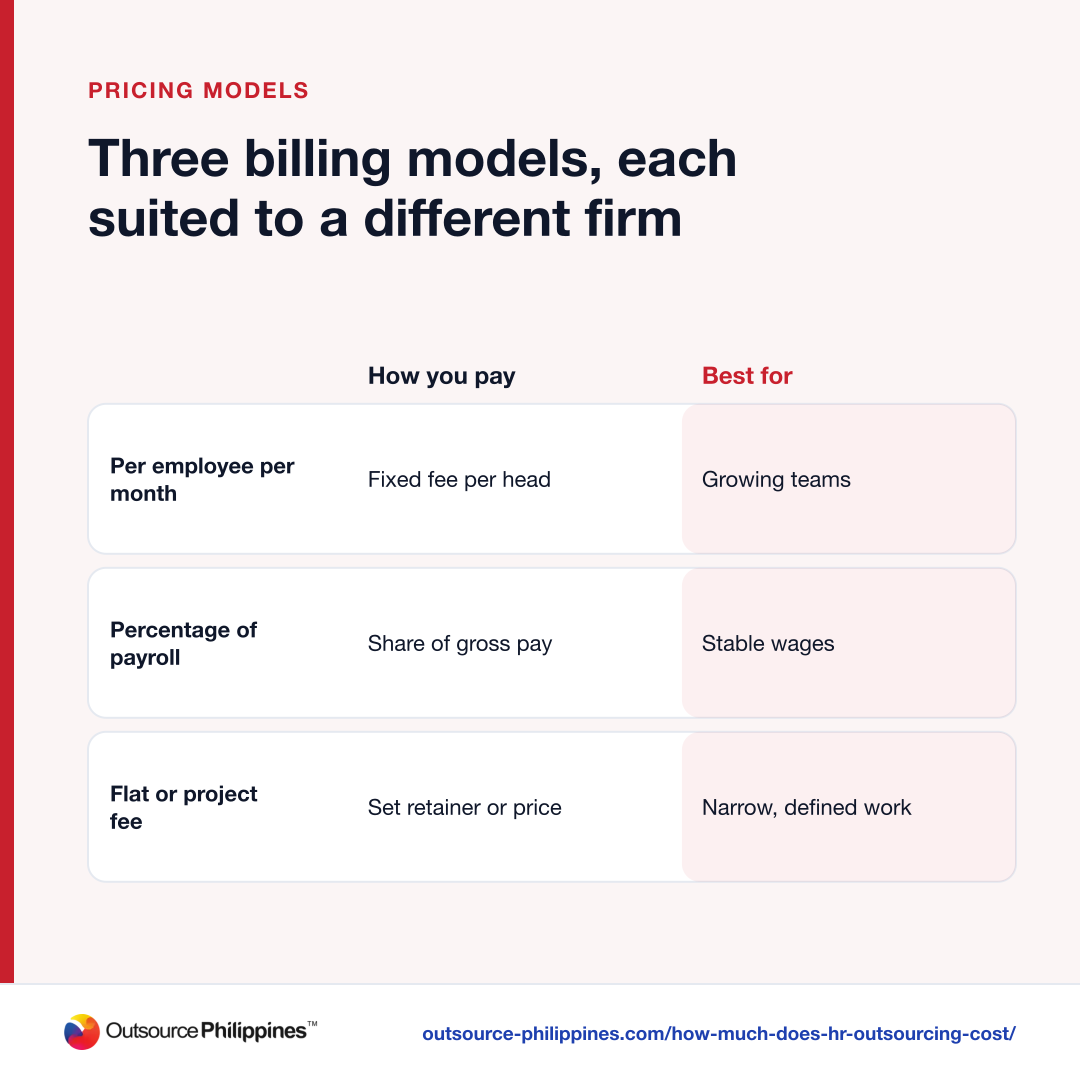
Almost every provider uses one of three billing models. The right one depends on how stable your headcount and payroll are.
| Model | How you pay | Best for |
|---|---|---|
| Per employee per month | Fixed fee per head | Growing teams |
| Percentage of payroll | Share of gross pay | Stable wages |
| Flat or project fee | Set retainer or price | Narrow, defined work |
Per Employee per Month (PEPM)
You pay a fixed amount for each employee on the payroll each month. It is the most common model for PEOs and bundled HR packages, and it is easy to budget because cost grows in line with headcount. Watch for minimum monthly fees that make PEPM pricing expensive for very small teams.
Percentage of Payroll
The fee is a share of your total gross payroll. It suits companies with steady wages, but the cost rises automatically when you give raises or pay bonuses, even if the provider does no extra work. Ask whether bonuses and commissions count toward the base.
Flat Fee or Project Fee
You pay a set monthly retainer or a one-off price for a defined task, such as a handbook rewrite, a compliance audit, or a recruiting project. It works well for narrow, predictable work, but anything outside the written scope is billed separately.
What Makes HR Outsourcing Cost More or Less?
Five factors move the price more than anything else. Knowing them helps you read quotes and decide where to trim scope.
| Cost driver | Lower cost | Higher cost |
|---|---|---|
| Scope of services | Payroll and tax filing only | Full HR, benefits, recruiting, and training |
| Headcount and locations | One state, one pay schedule | Many states or countries, several pay schedules |
| Benefits | Your own plans | PEO group health, retirement, and insurance |
| Customization | Standard package and software | Custom workflows, reports, and integrations |
| Service model | Shared support desk | Named HR advisor or dedicated team |
Benefits deserve special attention. With a PEO, the quote often bundles the administration fee with insurance premiums, which makes the total look much higher than an HRO quote that excludes premiums. Separate the two before you compare.
What Does In-house HR Cost by Comparison?
An in-house HR hire costs far more than the salary on the offer letter. Benefits, payroll taxes, software, training, and management time all sit on top.
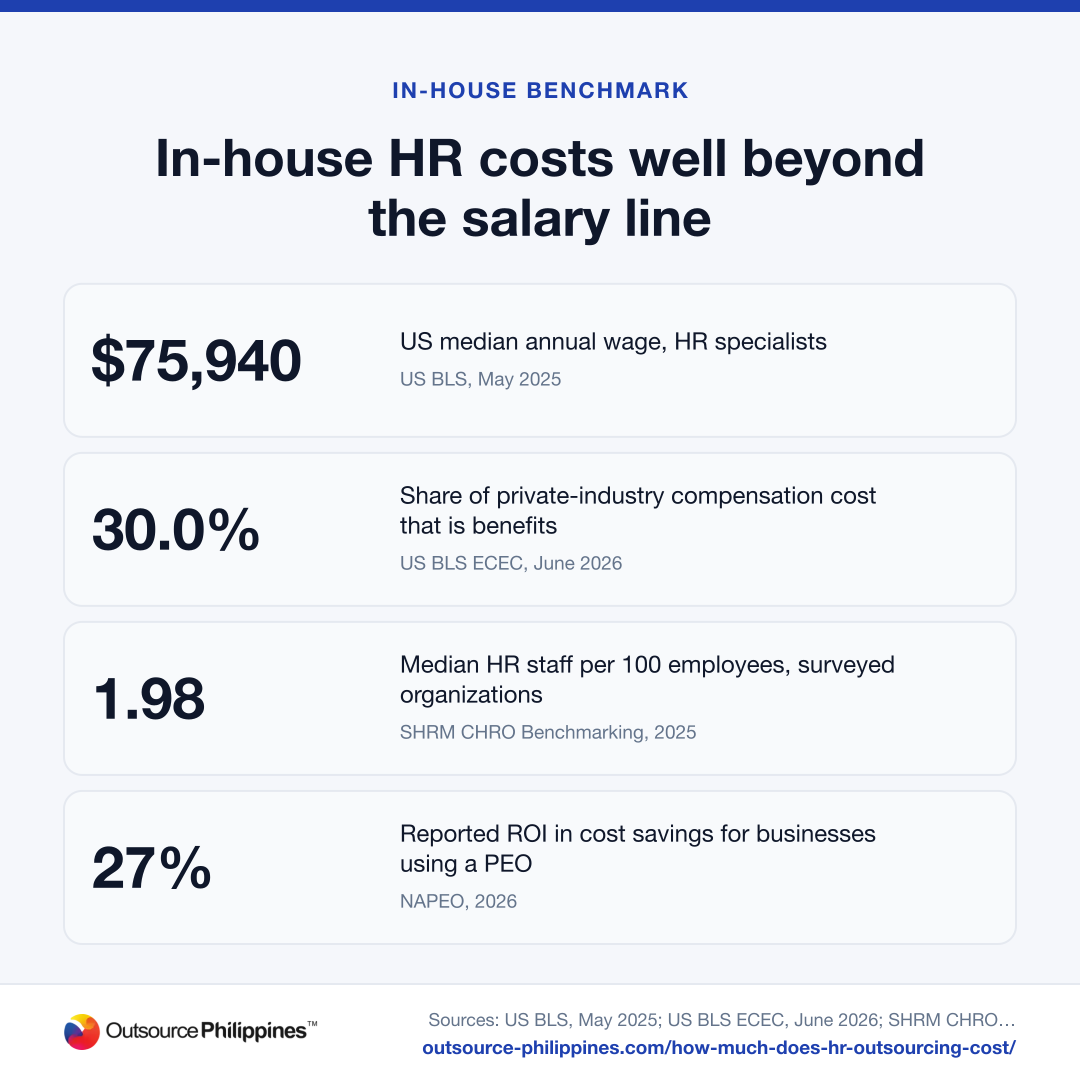
- $75,940US median annual wage, HR specialistsUS BLS, May 2025
- 30.0%Share of private-industry compensation cost that is benefitsUS BLS ECEC, June 2026
- 1.98Median HR staff per 100 employees, surveyed organizationsSHRM CHRO Benchmarking, 2025
- 27%Reported ROI in cost savings for businesses using a PEONAPEO, 2026
The US Bureau of Labor Statistics puts the median annual wage for human resources specialists at $75,940 (May 2025). On top of wages, benefits made up 30.0% of total compensation costs for private industry workers in June 2026, according to the BLS Employer Costs for Employee Compensation release. Put together, one HR specialist at the median wage costs roughly $108,000 a year in wages and benefits, before HR software, recruiting fees, or office space.
Staffing levels add up too. SHRM’s 2025 CHRO benchmarking found a median of 1.98 HR employees per 100 workers among the organizations it surveyed (SHRM). A growing company often needs HR coverage long before it can justify a full-time hire, which is where outsourcing earns its fee.
What Hidden Costs Should You Budget For?
The monthly fee is rarely the whole bill. Ask every provider to list these items in writing.
- Setup and onboarding fees: one-time charges to migrate data, configure software, and enroll employees.
- Year-end and filing fees: W-2 and other tax forms may be billed per form.
- Off-cycle payroll: extra runs for bonuses, corrections, or terminations often carry a per-run charge.
- Add-on modules: time tracking, performance reviews, learning tools, and applicant tracking may cost extra.
- Exit costs: fees to export data or leave a PEO mid-year, plus the work of re-enrolling benefits.
Also budget your own time. Someone in your company still owns HR decisions, signs off on pay changes, and answers to employees. Outsourcing removes the processing work, not the responsibility.
Is Outsourcing HR Cheaper than Doing It In-house?
For most small and midsize companies, yes, especially below the size where a full HR department makes sense. The savings come from skipping a full-time hire, sharing software costs, and reducing compliance mistakes.
Industry data points the same way. The National Association of Professional Employer Organizations (NAPEO) reports a 27% return on investment in cost savings alone for businesses that use a PEO, and 12% lower employee turnover. Treat these as industry figures rather than guarantees; your result depends on scope and price.
There is a second route for administrative HR work. Instead of buying a bundled package, some companies hire a dedicated offshore team to handle HR administration, onboarding paperwork, and payroll support. Outsource Philippines™ estimates most US clients pay 60% to 70% less than an equivalent in-house hire. Teams are dedicated to one client, follow the Philippine Data Privacy Act of 2012, and most teams go live in 2 to 4 weeks, depending on the role. If you need people employed in the Philippines directly, an employer of record in the Philippines is the better fit.
How Do You Compare HR Outsourcing Quotes?
Put every quote on the same basis: the same headcount, the same services, and a full-year total. Then check the points below.
- Annual total: monthly fees, setup fees, and per-item charges added up for twelve months.
- Benefits split: administration fees shown separately from insurance premiums.
- Service levels: response times for employee questions and who your named contact is.
- Compliance responsibility: which filings and errors the provider covers, in writing.
- Exit terms: notice periods, data export, and any early termination fees.
Is HR Outsourcing Worth the Cost for Your Business?
It is usually worth it if you have employees but no dedicated HR staff, operate in several states, or spend leadership time on payroll questions and paperwork. It is less compelling if you already have a capable HR team with spare capacity, or if your needs are mostly strategic, such as culture and leadership development, which an outside provider cannot own for you.
If HR administration and payroll support are eating your team’s time, see how a dedicated team works on our payroll outsourcing services page, read how our pricing works, or request a proposal.
Frequently Asked Questions
How Is HR Outsourcing Usually Priced?
Most providers charge in one of three ways: a fixed fee per employee per month, a percentage of total payroll, or a flat retainer or project fee. Per-employee pricing is the most common for bundled packages. Always ask for a full-year total that includes setup, filing, and add-on fees, so quotes can be compared fairly.
Is a PEO More Expensive than Other HR Outsourcing?
A PEO quote often looks higher because it bundles insurance premiums with the administration fee. Once you separate the two, the gap usually narrows. A PEO can lower benefits costs for small firms through group plans, while an HRO provider suits companies that want to keep their own benefits and stay the sole employer.
What Does an In-house HR Specialist Cost?
The US Bureau of Labor Statistics puts the median annual wage for human resources specialists at $75,940 as of May 2025. Benefits made up 30.0% of private-industry compensation costs in June 2026, so the full cost of one specialist is well above salary, before software, recruiting, and training costs are added.
Can a Small Business Afford HR Outsourcing?
Yes. Many providers build packages for companies with only a handful of employees, and narrow services such as payroll and tax filing cost less than full HR. Start with the function that takes the most time or carries the most compliance risk, then add services as headcount grows and the first services run smoothly.