8 Payroll Outsourcing Benefits and How to Choose a Provider

On This Page
- What Is Payroll Outsourcing?
- Which Payroll Functions Can You Outsource?
- What Are the Benefits of Payroll Outsourcing?
- How Does Payroll Outsourcing Affect Employees?
- How Much Does Payroll Outsourcing Cost?
- How Do You Choose the Right Payroll Outsourcing Provider?
- Is Payroll Outsourcing Right for Your Business?
- Frequently Asked Questions
Payroll outsourcing means handing payroll tasks such as salary calculation, tax withholding, direct deposits, filings, and year-end forms to an outside provider. Its main benefits are fewer errors, less admin work, steadier compliance, and continuity when staff leave. The employer stays legally responsible for payroll taxes, so oversight still matters.
This guide covers what payroll outsourcing includes, the 10 functions a provider can take over, 8 benefits for your business, what it does for employees, what drives cost, and how to choose a provider without losing control of your tax obligations.
What Is Payroll Outsourcing?
Payroll outsourcing is delegating some or all payroll work to an external service provider. The provider calculates pay and deductions, processes payments, prepares tax reports, and keeps payroll records, while you review and sign off on each run and keep ownership of the data.
There are two common setups. A payroll service bureau runs payroll on its own platform. A dedicated offshore payroll specialist works inside your payroll system and processes under your rules. Both reduce the internal workload so finance and HR can focus on higher-value work. If you also need to hire and pay staff in another country, an employer of record takes on the legal employer role, which is a different arrangement.
Which Payroll Functions Can You Outsource?
Almost every repeatable payroll task can move to a provider. These 10 are the most common:
- Salary calculation: pay based on hours worked, overtime, bonuses, and deductions.
- Direct deposits and payments: on-time, secure transfers to employee bank accounts.
- Compliance management: tracking changes to labor and tax rules that affect payroll.
- Tax withholding and reporting: calculating withholdings, preparing tax reports, and supporting filings and deposits.
- Benefit administration: processing deductions and records for health plans, retirement plans, and allowances.
- Leave and attendance tracking: reflecting time off, absences, and timesheets accurately in pay.
- Year-end reporting: preparing W-2s and 1099s for employees, contractors, and tax filing.
- Recordkeeping: keeping current and historical payroll records accurate and accessible.
- Garnishments and deductions: handling wage garnishments, child support, and other court-ordered deductions.
- Payroll analytics and reporting: custom reports on labor cost trends and expenses.
Most businesses start with calculation, payments, and reporting, then add year-end work and analytics once the process is stable.
What Are the Benefits of Payroll Outsourcing?
The main benefits are accuracy, time savings, and lower risk. Here are the 8 that matter most to small and midsize businesses:
- Expertise and accuracy: specialists who process payroll every day know the rules and catch errors before they reach a paycheck.
- Cost savings: you avoid some of the fixed cost of an in-house payroll function, including salaries, software, and training.
- Time efficiency: HR and finance teams get hours back each pay cycle for planning and employee support.
- Reduced administrative burden: calculations, reports, and reconciliations move off your team’s desks.
- Data security: a good provider protects payroll data with access controls, encryption, and monitored systems.
- Compliance and reduced risk: rule changes are tracked and applied, which lowers the chance of late deposits and penalties.
- Risk mitigation: payroll keeps running when an in-house payroll employee leaves or is out.
- Improved employee satisfaction: accurate, on-time pay builds trust and morale.
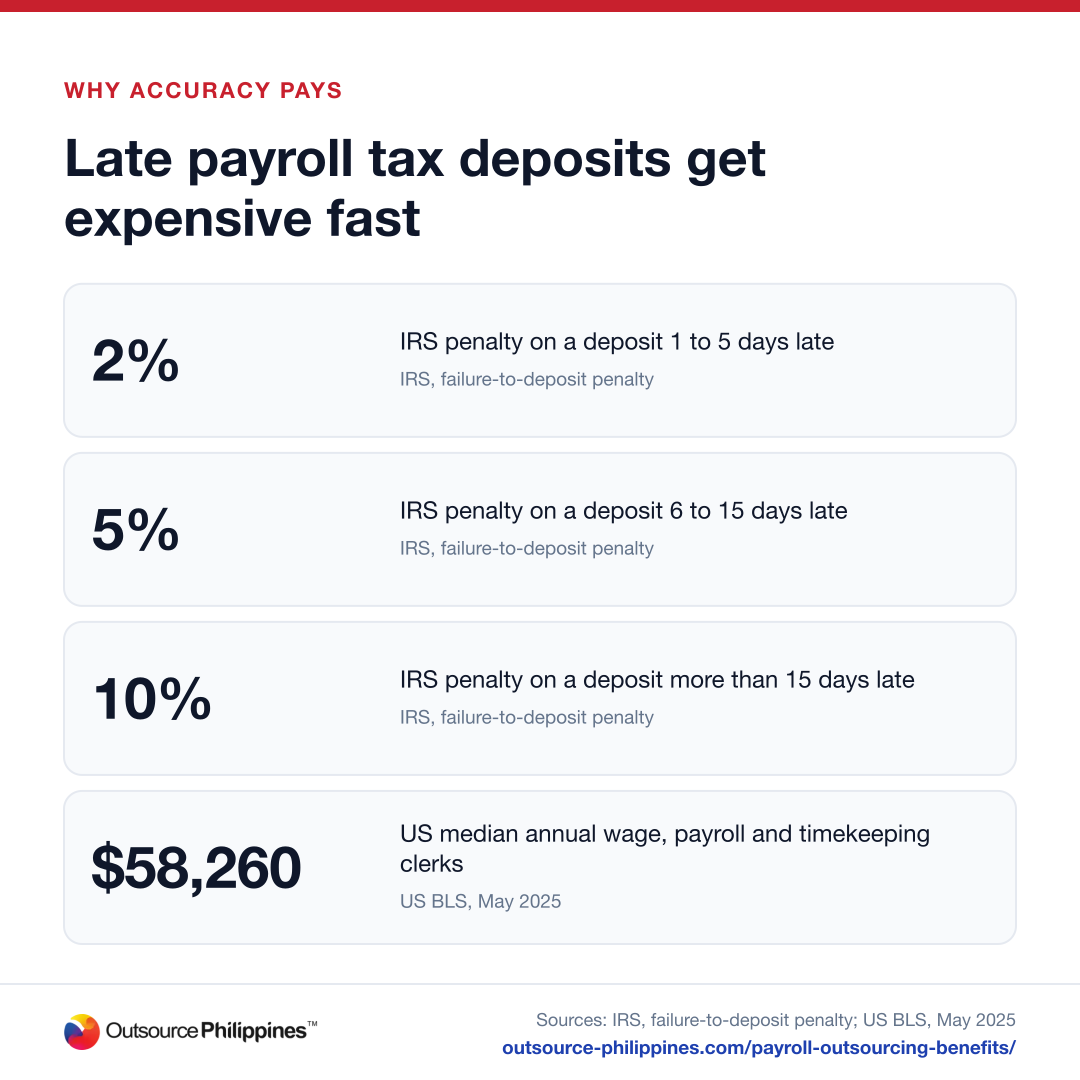
Payroll errors are costly. The IRS failure-to-deposit penalty is 2% of the unpaid deposit when it is 1 to 5 days late, 5% at 6 to 15 days, and 10% after 15 days, rising to 15% after certain IRS notices.
- 2%IRS penalty on a deposit 1 to 5 days lateIRS, failure-to-deposit penalty
- 5%IRS penalty on a deposit 6 to 15 days lateIRS, failure-to-deposit penalty
- 10%IRS penalty on a deposit more than 15 days lateIRS, failure-to-deposit penalty
- $58,260US median annual wage, payroll and timekeeping clerksUS BLS, May 2025
How Does Payroll Outsourcing Affect Employees?
Done well, it makes pay more reliable, and reliable pay is one of the clearest signals of a well-run employer.
Fewer errors and no payment delays reduce financial stress for employees. Many payroll platforms also give staff self-service access to pay stubs and tax forms, which cuts the number of payroll questions HR fields. With routine processing off its plate, HR can spend more time on employee support, which improves trust and the working relationship.
Employees notice three things most:
- Accuracy: overtime, bonuses, and deductions are right the first time, so nobody has to chase a correction on the next check.
- Timing: pay lands on the same day every cycle, including around holidays and year-end.
- Answers: questions about withholding, leave balances, or a missing payment get a clear reply within a set response time.
Set these as written service levels with your provider, then track them alongside error rates. A short employee survey after the first two or three pay cycles will show whether the change is working.
How Much Does Payroll Outsourcing Cost?
Cost depends on headcount, pay frequency, the number of states or countries, and which functions you hand over. Providers usually charge per employee per pay run, a flat fee per period, or by the hour for dedicated staff.
Compare that with the in-house alternative. The US Bureau of Labor Statistics puts the median annual wage for payroll and timekeeping clerks at $58,260 (May 2025), before benefits, software, and management time. Outsource Philippines™ estimates most US clients pay 60% to 70% less than an equivalent in-house hire. Pricing is an hourly rate per agent, set out in a written proposal, and you can read how our pricing works before you ask for one.
Market data on adoption and spending is collected in our roundup of payroll outsourcing statistics.
How Do You Choose the Right Payroll Outsourcing Provider?
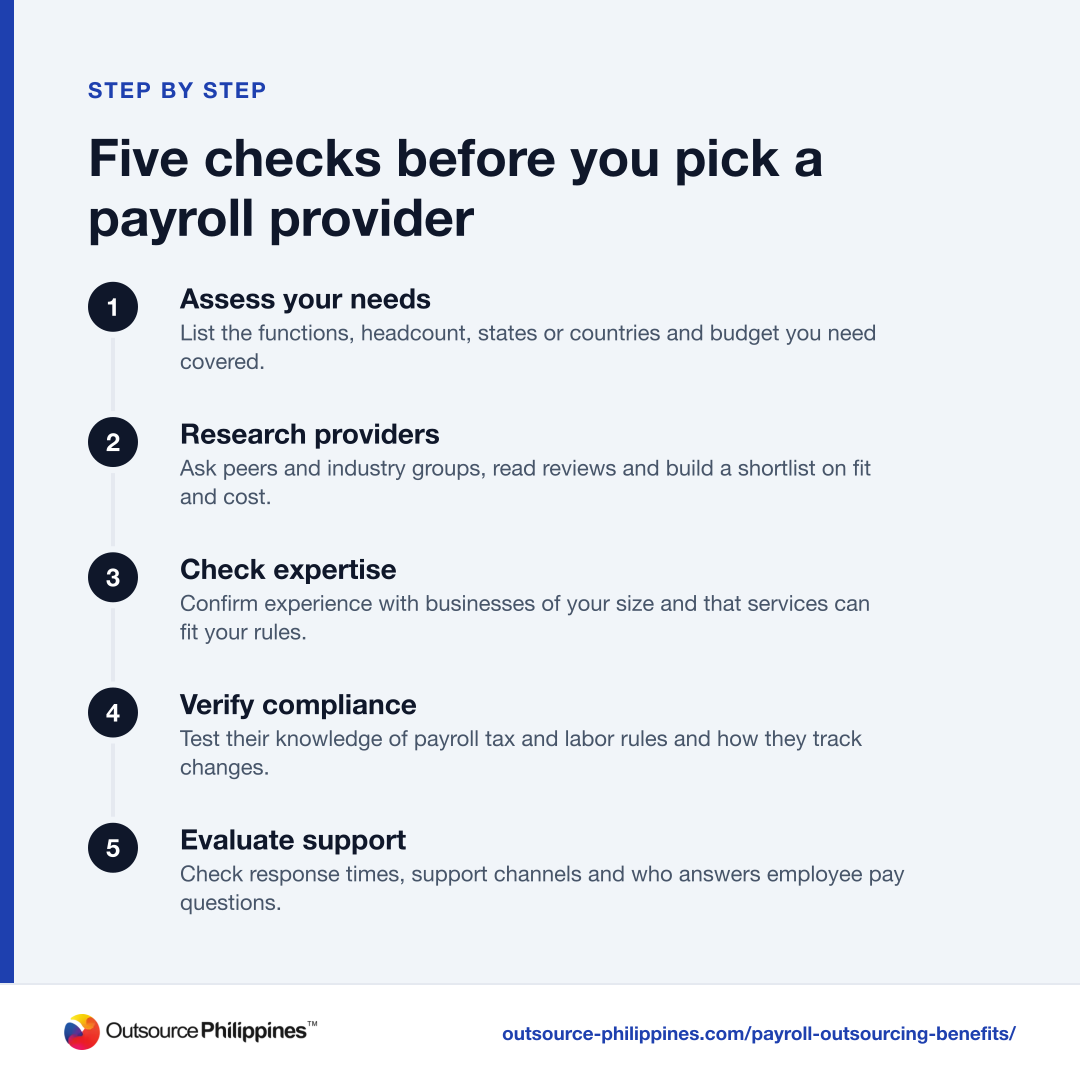
Choose on accuracy, compliance knowledge, and responsiveness, not just price. Work through these five steps:
- 1Assess your needs
List the functions, headcount, states or countries and budget you need covered.
- 2Research providers
Ask peers and industry groups, read reviews and build a shortlist on fit and cost.
- 3Check expertise
Confirm experience with businesses of your size and that services can fit your rules.
- 4Verify compliance
Test their knowledge of payroll tax and labor rules and how they track changes.
- 5Evaluate support
Check response times, support channels and who answers employee pay questions.
Whichever provider you pick, keep control of your tax accounts. The IRS guidance on outsourcing payroll duties states that the employer is ultimately responsible for depositing and paying federal tax liabilities. It recommends enrolling in EFTPS with your own PIN to check that deposits are made, and keeping your own address of record so IRS notices reach you.
Is Payroll Outsourcing Right for Your Business?
It is a strong fit if payroll takes hours of internal time every cycle, you have had errors or late deposits, or you depend on one person who knows the process. It is a weaker fit if you have only a handful of employees on one simple schedule, where good payroll software alone may be enough.
Our payroll outsourcing services give you dedicated staff who work only on your account, with most teams going live in 2 to 4 weeks, depending on the role. To get pricing for your headcount and pay schedule, request a proposal.
Frequently Asked Questions
What Is Payroll Outsourcing?
Payroll outsourcing is hiring an outside provider to handle payroll tasks such as calculating pay and deductions, processing direct deposits, withholding taxes, preparing reports, and year-end forms, and keeping payroll records. The business still signs off on each payroll run and remains legally responsible for its payroll tax obligations.
Am I Still Responsible for Payroll Taxes If I Outsource Payroll?
Yes. The IRS states that the employer is ultimately responsible for depositing and paying federal tax liabilities, even when a payroll provider handles the work. The IRS recommends enrolling in EFTPS with your own PIN to verify deposits and keeping your own address of record with the IRS.
What Are the Main Benefits of Payroll Outsourcing?
The main benefits are expertise and accuracy, cost savings, time efficiency, less administrative work, data security, compliance support, continuity when payroll staff leave, and better employee satisfaction from accurate, on-time pay. The size of each benefit depends on how complex your payroll is today.
What Should I Look for in a Payroll Outsourcing Provider?
Look for a clear scope of services, experience with businesses like yours, solid knowledge of payroll tax and labor rules, strong data security, and responsive support. Ask how errors are caught and corrected, who reviews each run, and how quickly the provider answers payroll questions from you and your employees.