Recruitment Process Outsourcing Services: What RPO Covers

On This Page
- What Is Recruitment Process Outsourcing?
- What Are the Advantages and Disadvantages of Outsourcing Recruitment?
- What Are the Key Benefits of Recruitment Process Outsourcing Services?
- How Do RPO Firms Compare with Traditional Staffing Agencies?
- How Does an RPO Engagement Work?
- How Do You Stay Compliant with an Outsourced Recruitment Process?
- What Mistakes Should You Avoid When Hiring an RPO Provider?
- Is Recruitment Process Outsourcing Right for Your Business?
- Frequently Asked Questions
Recruitment process outsourcing (RPO) is when a business hands all or part of its hiring function to a specialized external provider that works as an extension of its HR team. RPO services can cover job descriptions, sourcing, screening, scheduling, offers, and onboarding support, with the aim of lowering cost-per-hire and filling roles faster and more consistently.
Open roles that sit for weeks, HR teams buried in admin, and hires that do not work out are expensive problems. This guide explains what recruitment process outsourcing services do, the advantages and trade-offs, how RPO compares with a staffing agency, how an engagement runs, how to stay compliant, and the mistakes to avoid when choosing a partner.
What Is Recruitment Process Outsourcing?
Recruitment process outsourcing is a model in which an external provider takes over some or all of the recruiting work, using its own recruiters, tools, and processes under your hiring standards. Unlike a vendor that sends résumés, an RPO partner runs the process alongside your HR team.
Depending on what you need, an RPO provider can handle any of these stages:
- Workforce planning: forecasting which roles you will need and when.
- Job descriptions and postings: writing and publishing roles that attract the right applicants.
- Sourcing: finding candidates through job boards, databases, referrals, and direct outreach.
- Screening and assessment: checking qualifications, testing skills, and building a shortlist.
- Scheduling and candidate communication: keeping applicants informed at every step.
- Offers and onboarding support: preparing paperwork and helping new hires start smoothly.
RPO engagements usually follow one of three models:
- End-to-end RPO: the provider runs the full hiring lifecycle for some or all roles.
- Project-based RPO: the provider handles a defined hiring push, such as staffing a new location.
- Selective or on-demand RPO: the provider covers only the stages that slow you down, such as sourcing or screening.
RPO is one part of the wider field of human resources outsourcing, which also covers payroll, benefits, and employee administration.
What Are the Advantages and Disadvantages of Outsourcing Recruitment?
RPO can lower cost and speed up hiring, but it needs a proper handover, clear service levels, and active management. Here is the full picture:
| Advantages | Disadvantages |
|---|---|
| Lower cost-per-hire | The onboarding and transition period takes time |
| Faster time-to-fill through dedicated sourcing | Risk of poor culture fit if the provider is not briefed properly |
| Scales up or down with your hiring needs | Needs clear service-level agreements to stay accountable |
| Access to recruitment technology and applicant tracking systems | Less direct control over day-to-day recruiting activity |
| Frees internal HR to focus on strategy | Not always ideal for very low-volume or highly niche roles |
| Built-in compliance and documentation support | Communication gaps if expectations are not set early |
RPO works best when both sides treat it as a partnership with shared targets, not a hand-off you forget about.
What Are the Key Benefits of Recruitment Process Outsourcing Services?
The three main benefits are lower hiring costs, faster and more consistent hiring, and access to better talent pools and recruiting technology.
It Lowers Hiring Costs
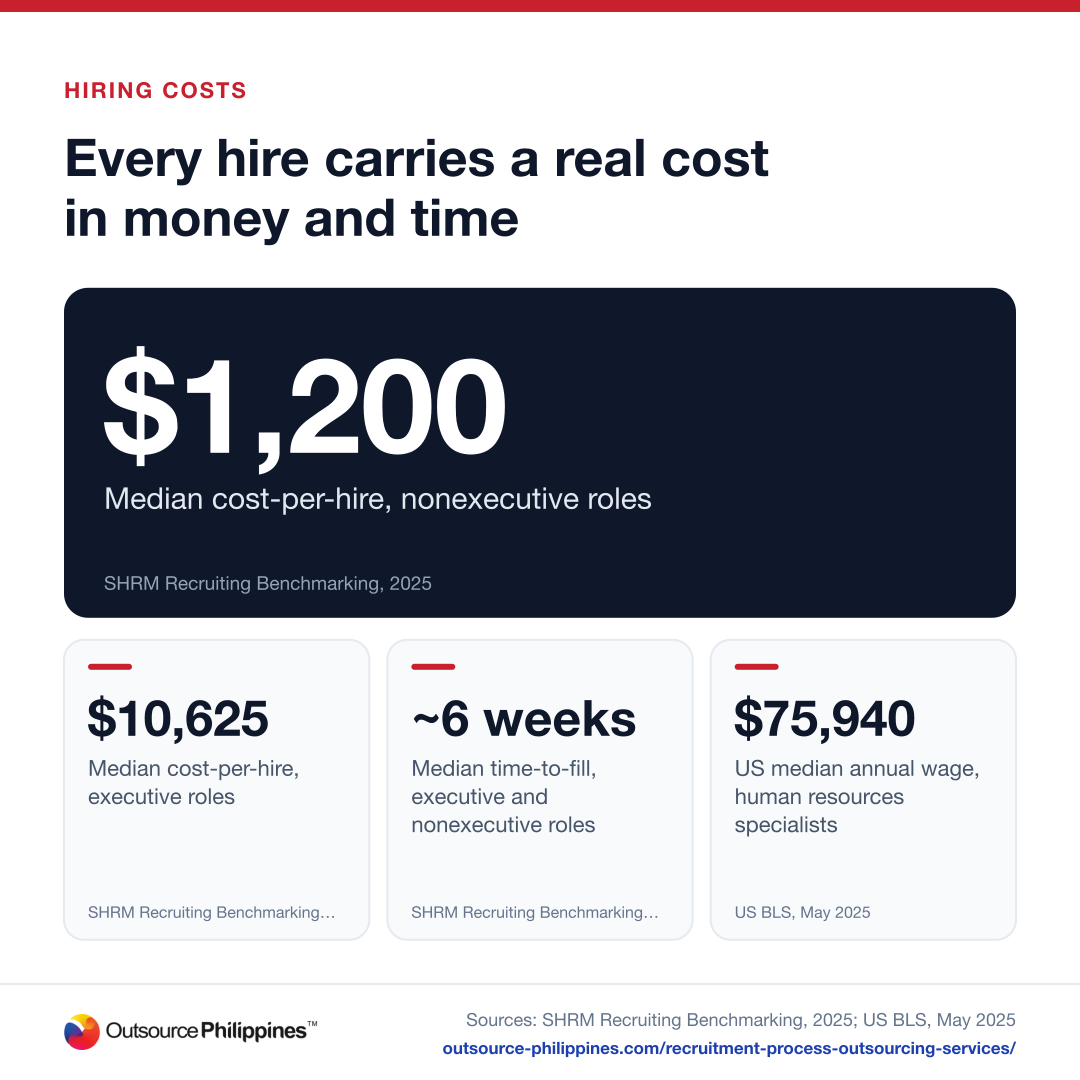
Hiring costs more than most companies track. In the SHRM 2025 Recruiting Benchmarking report, based on 2,371 member responses, the median cost-per-hire was $1,200 for nonexecutive roles and $10,625 for executive roles, and median time-to-fill was about a month and a half for both.
- $1,200Median cost-per-hire, nonexecutive rolesSHRM Recruiting Benchmarking, 2025
- $10,625Median cost-per-hire, executive rolesSHRM Recruiting Benchmarking, 2025
- ~6 weeksMedian time-to-fill, executive and nonexecutive rolesSHRM Recruiting Benchmarking, 2025
- $75,940US median annual wage, human resources specialistsUS BLS, May 2025
Recruiting also takes skilled people. The US Bureau of Labor Statistics puts the median annual wage for human resources specialists, the people who recruit and screen applicants, at $75,940 (May 2025). RPO providers spread their tools, networks, and recruiters across many roles, so you are not rebuilding the same machinery every time a position opens.
It Makes Hiring Faster and More Consistent
When a role stays open, your team absorbs the load and strong candidates accept other offers. A dedicated RPO team runs sourcing, screening, and scheduling in parallel rather than one after another, which shortens time-to-fill. Because the provider follows a structured, repeatable process, results do not swing with how busy your internal team is that week.
It Opens the Door to Better Talent and Technology
Premium job board access, applicant tracking systems, assessment tools, and recruiters with real industry depth are hard for a growing business to justify alone. An RPO partner brings them from day one, giving mid-market companies enterprise-grade hiring capability without enterprise overhead.
How Do RPO Firms Compare with Traditional Staffing Agencies?
An RPO provider runs your hiring process as a long-term partner, while a staffing agency fills individual roles one at a time. Choosing the wrong type for your need is a common and costly mistake.
| Factor | RPO provider | Traditional staffing agency |
|---|---|---|
| Relationship type | Strategic, long-term partnership | Transactional, role by role |
| Scope | Full or partial recruitment lifecycle | Mainly sourcing and placement |
| Integration | Works inside your HR process | Operates independently |
| Pricing model | Per hire, management fee, or hybrid | Usually a percentage of the placed candidate’s pay |
| Technology | Provides and manages the recruiting tech stack | Minimal technology involvement |
| Employer branding | Actively supports your brand voice | Little or no involvement |
| Best suited for | Ongoing, scalable hiring | Quick, one-off placements |
If you need one role filled quickly, an agency can do the job. If you want a reliable, cost-efficient hiring function that grows with you, RPO is the stronger long-term choice.
How Does an RPO Engagement Work?
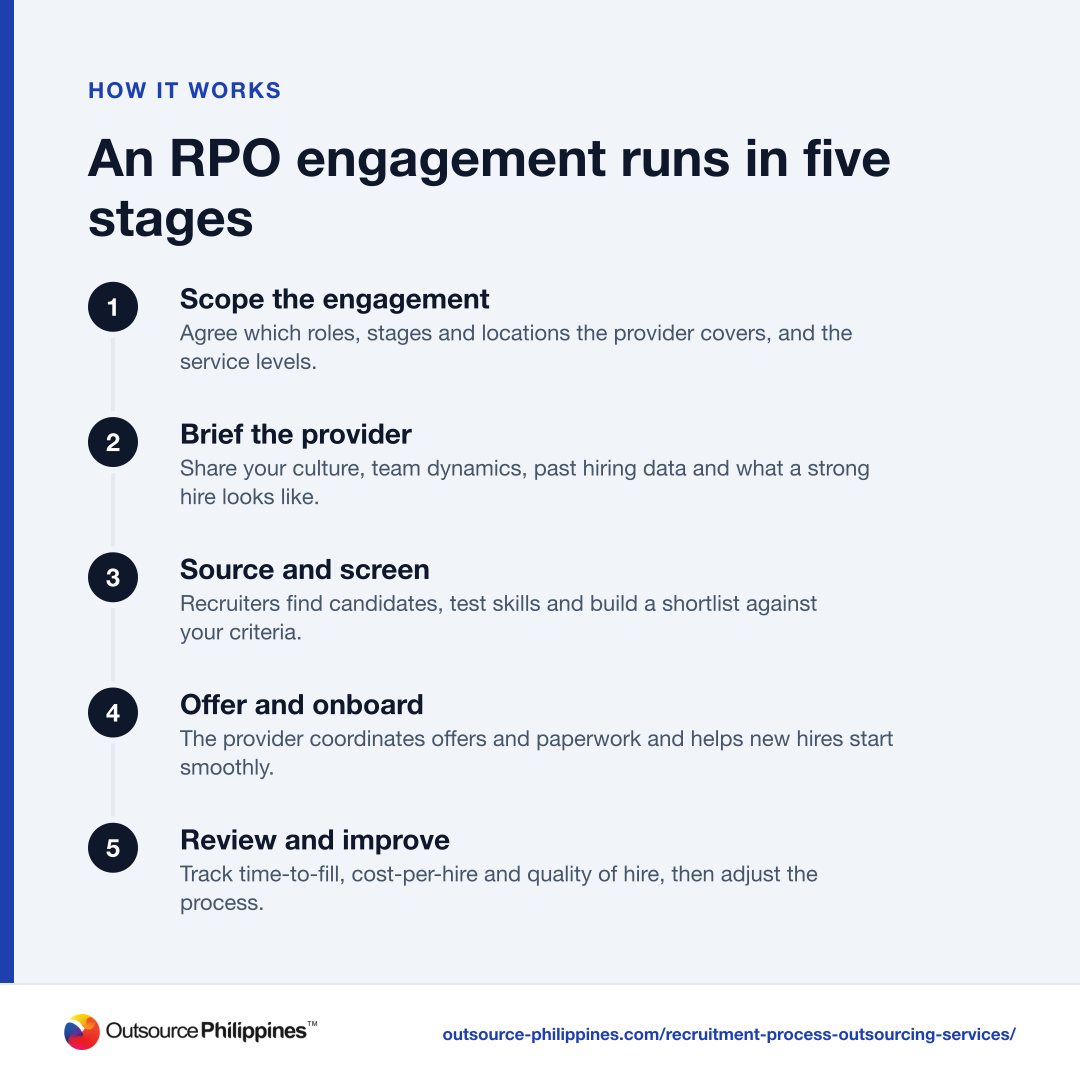
Most engagements follow the same five stages, from scoping the work to reviewing results. The briefing stage has the biggest effect on quality.
- 1Scope the engagement
Agree which roles, stages and locations the provider covers, and the service levels.
- 2Brief the provider
Share your culture, team dynamics, past hiring data and what a strong hire looks like.
- 3Source and screen
Recruiters find candidates, test skills and build a shortlist against your criteria.
- 4Offer and onboard
The provider coordinates offers and paperwork and helps new hires start smoothly.
- 5Review and improve
Track time-to-fill, cost-per-hire and quality of hire, then adjust the process.
The first few weeks are mostly setup: access to your applicant tracking system, standard job templates, and agreed messaging for candidates. Expect the provider to ask detailed questions about why past hires succeeded or failed, because that history shapes its screening criteria more than any job description does.
How Do You Stay Compliant with an Outsourced Recruitment Process?
Compliance depends on clear ownership, knowledge of local labor law, and careful handling of candidate data. Three practices cover most of the risk.
Define Roles, Responsibilities, and Boundaries from Day One
Most compliance problems in RPO trace back to unclear ownership. Document what the provider is responsible for and what stays in-house, and put it in a service-level agreement that covers data handling, candidate communication, documentation standards, and reporting cadence.
Make Sure Your Partner Understands Local Labor Laws
If you hire in several regions or countries, your partner needs to know the employment rules in each. In the Philippines, the Department of Labor and Employment (DOLE) sets requirements for employment contracts, probationary periods, and separation procedures, and a credible provider builds those into every stage.
Protect Candidate Data
Even when a provider runs your hiring, your candidates’ personal data remains your responsibility. In the Philippines, that means following the Data Privacy Act of 2012, enforced by the National Privacy Commission. Ask for a written data retention policy and regular compliance reviews.
What Mistakes Should You Avoid When Hiring an RPO Provider?
The three most common mistakes are choosing on price alone, skipping a proper briefing, and failing to review performance.
Choosing a Provider on Price Alone
The cheapest option is often a false economy. Budget providers tend to rely on generic methods, lack industry expertise, and do little for your employer brand. Compare the value delivered, not just the number on the proposal.
Not Briefing Your RPO Partner Properly
Poor candidate fit is the most frequent complaint about RPO, and it usually starts with a weak briefing. Your partner needs to understand your culture, team dynamics, and what the right person looks like. Onboard them the way you would a senior hire.
Skipping Regular Performance Reviews
Track time-to-fill, cost-per-hire, quality of hire, early attrition, and hiring manager satisfaction on a regular schedule. Without regular reviews, you will not know whether the investment is working or catch early signs that something needs to change.
Is Recruitment Process Outsourcing Right for Your Business?
RPO is a strong fit if you hire steadily across many roles, your HR team spends most of its time on recruiting admin, and you want consistent, measurable hiring. It is a weaker fit if you hire only a few people a year, or if your goal is a dedicated offshore team rather than a better hiring function for your own company.
For a team recruited for your business, dedicated outsourcing is the closer fit. Outsource Philippines™ sources, tests, and shortlists candidates; final interviews include your team and ours, and you make the final hiring decision. Staff work full time on your account from our supervised Philippine office.
An employer of record is a different model for people you have already selected. Our Employer of Record services in the Philippines handle local employment, payroll, statutory contributions, benefits, and HR administration while you direct the employees’ day-to-day work. EoR does not include recruiting.
Frequently Asked Questions
What Is the Difference between RPO and a Traditional Staffing Agency?
A staffing agency fills individual roles on a transactional basis and is usually paid a percentage of the placed candidate’s pay. An RPO provider works inside your HR process as a long-term partner, managing all or part of recruitment with its own recruiters and tools, and focuses on consistent, scalable hiring outcomes.
Is Recruitment Process Outsourcing Only for Large Enterprises?
No. RPO began with large enterprise hiring programs, but many providers now offer project-based and selective models for small and mid-sized businesses. These let a growing company outsource only the stages that slow it down, such as sourcing or screening, and still get enterprise-grade recruiting tools and processes.
How Much Does Recruitment Process Outsourcing Cost?
RPO pricing depends on scope, hiring volume, and the model you choose. Common structures are a fee per hire, a monthly management fee, or a mix of both. Compare the total against your current cost-per-hire, including recruiter salaries, job boards, tools, and the productivity lost while roles stay open.
What Metrics Should You Track in an RPO Engagement?
Track time-to-fill, cost-per-hire, quality of hire, early attrition, and hiring manager satisfaction. Agree on targets and a reporting schedule in the service-level agreement, review results monthly, and use the numbers to adjust the briefing, sourcing channels, or screening criteria before small problems turn into poor hires.
What Is the Difference between RPO and an Employer of Record?
RPO supports recruiting people who join your company’s payroll. An employer of record serves as the local legal employer and handles employment administration while you direct day-to-day work. Outsource Philippines™ EoR is for existing or selected team members and does not include recruiting. If you need us to source, test, and shortlist a team, choose dedicated outsourcing; final interviews include your team and ours, and you make the final hiring decision.