Human Resource Planning: How to Build a Strong Workforce

On This Page
- What Is Human Resource Planning?
- What Are the Benefits of Effective Human Resource Planning?
- What Are the Steps in Human Resource Planning?
- What Are the Common Challenges in HR Planning, and How Do You Overcome Them?
- How Can Outside Support Help with Human Resource Planning?
- Is an Employer of Record Right for Your Workforce Plan?
- Frequently Asked Questions
Human resource planning (HRP) is the process of working out how many people a business needs, with which skills, and when, then closing the gap between today’s workforce and that target. It covers analyzing current staff, forecasting demand, choosing how to hire or train, and reviewing the plan as the business changes.
Hiring only when a position opens keeps things running for a while, but it leads to shortages, skill gaps, and rushed decisions. This guide explains what human resource planning is, the four main types, its benefits, the seven steps to build a plan, the most common challenges, and how outside support can fill gaps faster.
What Is Human Resource Planning?
Human resource planning is the ongoing process of matching a company’s workforce to its business goals. It answers three questions: how many people do we need, which skills must they have, and when do we need them.
HRP starts with an honest look at current employees and their capabilities, then forecasts hiring needs based on growth plans, turnover, and market changes. Because operations, industry trends, and the labor market keep shifting, the plan is reviewed regularly rather than written once and filed away.
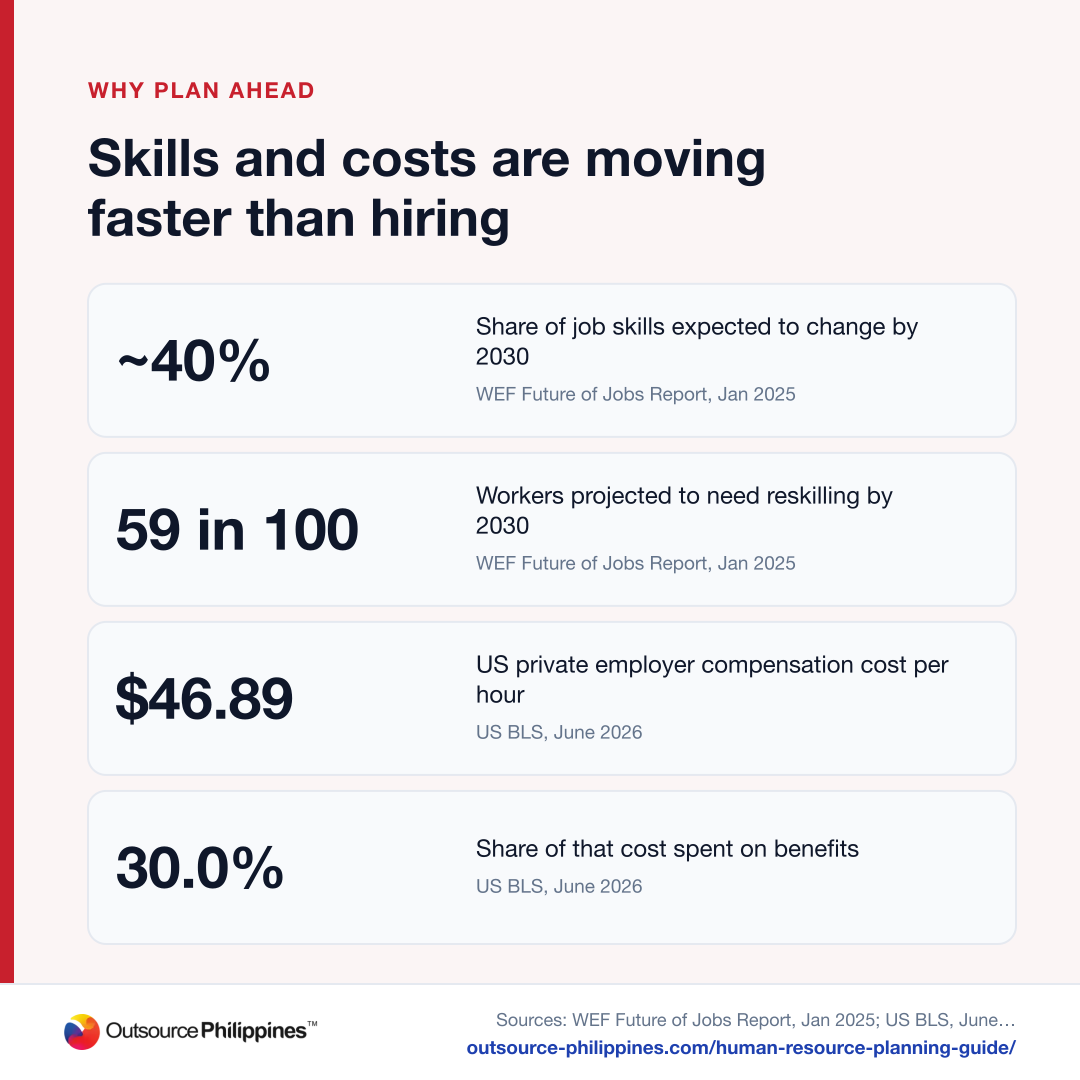
The stakes are rising. The World Economic Forum’s Future of Jobs Report 2025 expects nearly 40% of the skills required on the job to change by 2030, and projects that 59 out of every 100 workers will need reskilling or upskilling by then.
What Are the Types of Human Resource Planning?
The approach depends on your goals and time horizon. Most businesses use a mix of these four types:
- Strategic HR planning: aligns hiring, training, and development with long-term business objectives such as growth or expansion into new markets.
- Operational HR planning: handles short-term needs such as seasonal hiring, sudden vacancies, and project-based teams.
- Workforce planning: makes sure you have the right number of people with the right skills at the right time, so you are neither understaffed nor overstaffed.
- Succession planning: identifies and develops future leaders so key roles are filled smoothly after retirements or departures.
What Are the Benefits of Effective Human Resource Planning?
Good HRP lowers hiring costs, keeps productivity steady, and makes the business more adaptable. The five main benefits:
- ~40%Share of job skills expected to change by 2030WEF Future of Jobs Report, Jan 2025
- 59 in 100Workers projected to need reskilling by 2030WEF Future of Jobs Report, Jan 2025
- $46.89US private employer compensation cost per hourUS BLS, June 2026
- 30.0%Share of that cost spent on benefitsUS BLS, June 2026
- Better talent management: you see current and future talent gaps early, so you can attract the right people and keep them longer.
- Improved workforce productivity: planned training and development keep skills current, so the team works more efficiently.
- Cost savings: fewer rushed hires and less reliance on temporary staff mean lower recruiting and onboarding costs.
- Stronger competitive advantage: a business that plans its workforce can adapt faster when markets or technology change.
- Reduced employee turnover: clear growth paths and regular engagement raise job satisfaction and help keep top performers.
The cost side is easy to underestimate. In the US, the Bureau of Labor Statistics reports that private employers paid an average of $46.89 per hour worked in total compensation in June 2026, with benefits making up 30.0% of that cost. Every unplanned hire, and every early departure, carries that full cost plus recruiting time. Planning ahead lets you spread hiring over the year instead of paying premium rates to fill urgent gaps.
What Are the Steps in Human Resource Planning?
A structured HRP process has seven steps. Each builds on the one before, so skipping the analysis at the start usually shows up as a hiring mistake later.
1. Analyze the Current Workforce
Count your employees, map their skills, and review their performance. This shows where expertise is thin and where teams are already stretched.
2. Conduct a Gap Analysis
Compare your current workforce with what the business will need based on its growth plans. List the roles and skills you will be short of, and when.
3. Develop HR Strategies
Decide how to close each gap: recruit new people, train current staff, redesign roles, or bring in outside support for work that does not need to sit in-house.
4. Implement the HRP Process
Put the plan into action by hiring, launching training programs, and making sure each decision ties back to business goals.
5. Monitor and Adjust Plans
Track workforce performance and the results of each strategy. If something is not working, change it rather than waiting for the next annual review.
6. Foster a Collaborative Environment
Involve managers and employees in planning. People who feel included are more motivated, and they often spot skill gaps before leadership does.
7. Use Technology and Data
HR software and analytics help you track performance, cut manual steps in recruitment, and manage development. Better data leads to better forecasts.
What Are the Common Challenges in HR Planning, and How Do You Overcome Them?
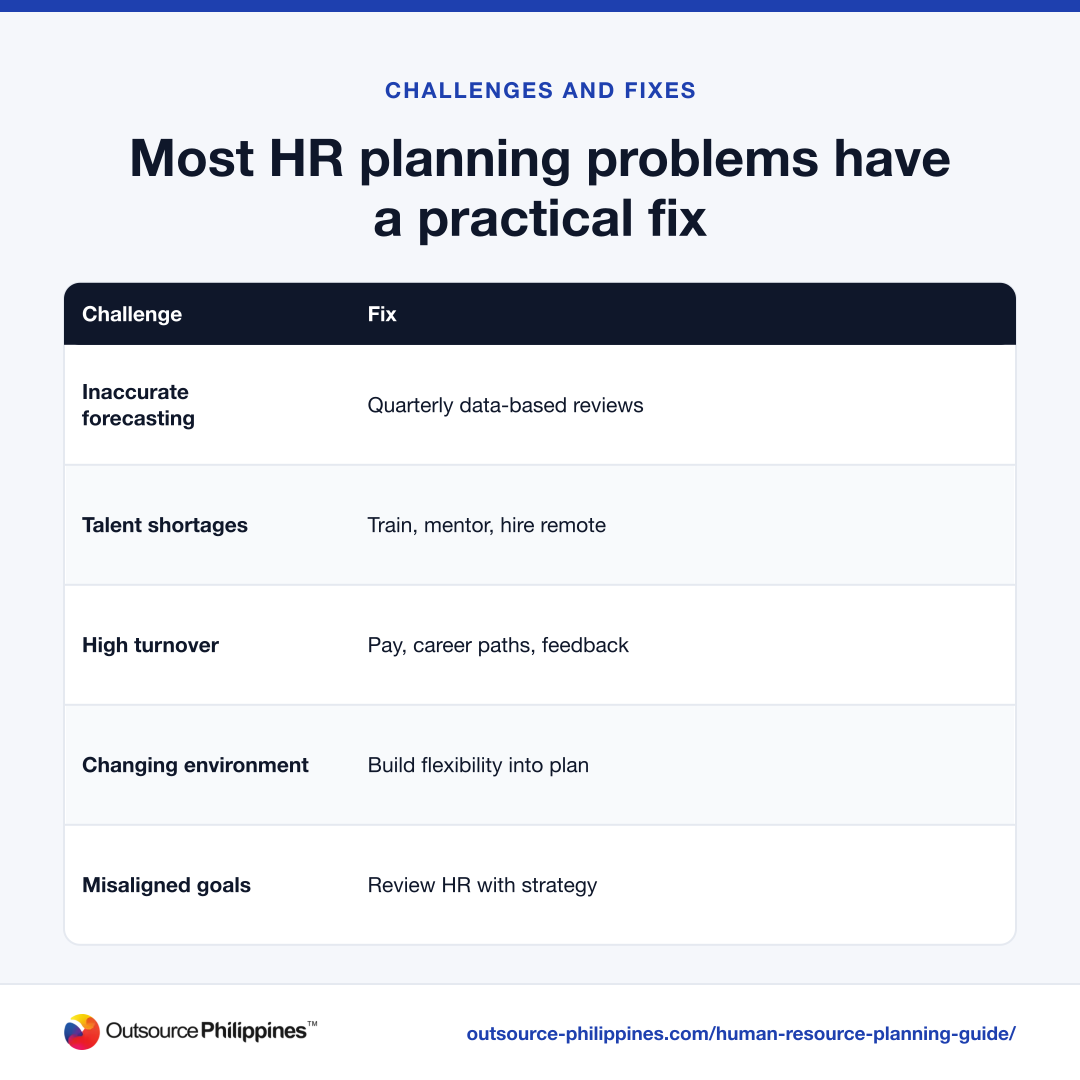
The biggest obstacles are bad forecasts, talent shortages, turnover, a changing business environment, and plans that drift away from business goals. Each has a practical fix.
| Challenge | Fix |
|---|---|
| Inaccurate forecasting | Quarterly data-based reviews |
| Talent shortages | Train, mentor, hire remote |
| High turnover | Pay, career paths, feedback |
| Changing environment | Build flexibility into plan |
| Misaligned goals | Review HR with strategy |
Inaccurate Workforce Forecasting
Wrong predictions lead to labor shortages or too many employees. Fix it by basing forecasts on past hiring patterns, turnover data, economic shifts, and current workforce trends, and by revisiting them every quarter.
Talent Shortages
Niche skills can be hard to find, which slows growth. Invest in internal training and mentoring to build a pipeline of qualified people, and widen your search to remote and offshore talent where the work allows it. Cross-training two people on each critical task also reduces the damage when someone leaves.
High Employee Turnover
Frequent departures disrupt teams, hurt morale, and add recruiting and training costs. Proven employee retention strategies include competitive pay, clear career paths, a healthy culture, and regular feedback.
A Changing Business Environment
Economic swings, new technology, and shifting industry standards change what skills you need. Build flexibility into the plan and be ready to adjust hiring and training as conditions change.
Lack of Alignment between HR and Business Goals
When HR plans run separately from business strategy, effort goes into the wrong roles. Review HR strategy alongside business goals at least twice a year so every recruiting and training decision supports where the company is headed.
How Can Outside Support Help with Human Resource Planning?
When your plan shows a gap you cannot fill quickly or affordably at home, an Employer of Record (EOR) can employ staff in another country on your behalf. The EOR handles local hiring, payroll, benefits, and labor-law compliance, while the employee works on your team.
For US companies, the Philippines is a common choice for roles such as customer support, bookkeeping, and administrative work. A managed team provider recruits and screens candidates against your profile. With Employer of Record, you identify and manage the people. Outsource Philippines™ charges a percentage-based service fee per employee for its EoR service, quoted in a written proposal.
Is an Employer of Record Right for Your Workforce Plan?
An EOR is a good fit if your plan calls for steady, full-time roles that can be done remotely and you want to avoid setting up a foreign entity. It is a weaker fit for roles that need to be on site, or for short projects where a contractor makes more sense.
If your workforce plan points to roles you could fill in the Philippines, explore our Employer of Record services in the Philippines. You can also request a proposal with the roles and start dates you have in mind.
Frequently Asked Questions
What Is the Main Purpose of Human Resource Planning?
The main purpose is to make sure a business has the right number of people, with the right skills, at the right time. It reduces the risk of staff shortages, surplus headcount, and rushed hiring by forecasting needs in advance and choosing whether to recruit, train, or bring in outside support.
How Often Should a Company Update Its HR Plan?
Review the plan at least once a year alongside budgeting, and check progress every quarter. Update it sooner when something significant changes, such as a new product line, a large contract, a merger, rising turnover, or a shift in the labor market that affects the roles you depend on.
What Is the Difference between HR Planning and Workforce Planning?
Workforce planning is one type of human resource planning. It focuses on headcount and skills: having the right number of people with the right abilities when they are needed. HR planning is broader and also covers strategy, succession, employee development, retention, and how HR decisions support long-term business goals.
Can Small Businesses Benefit from Human Resource Planning?
Yes. Small businesses feel the cost of a bad hire or a sudden vacancy more than large ones. A simple plan that lists key roles, likely departures, upcoming growth, and backup options for each role helps owners hire on time, avoid gaps in coverage, and spend their budget on the positions that matter most.