Human Resources Skills and Competencies That Matter

On This Page
- What Is the Difference between HR Skills and HR Competencies?
- How Has the Role of Human Resources Evolved?
- What Core Skills Does an HR Professional Need?
- What Competencies Set Modern HR Professionals Apart?
- How Is Technology Changing HR Work?
- How Can You Build HR Skills and Competencies in Your Team?
- Should You Build HR In-house or Use an Employer of Record?
- Frequently Asked Questions
Human resources skills and competencies are the abilities and behaviors HR professionals need to hire, develop, and keep people while managing risk. Core skills include talent acquisition, communication, conflict resolution, performance management, HR analytics, and legal compliance. Key competencies include strategic thinking, change management, emotional intelligence, technological proficiency, and cultural awareness.
HR has moved from an administrative function to a strategic one, and the skill set has grown with it. This guide explains how the role has changed, the core skills and competencies that matter most, how technology is reshaping the work, how to build these skills in your team, and when it makes sense to hand part of the work to a partner.
What Is the Difference between HR Skills and HR Competencies?
Skills are specific, teachable abilities, such as running payroll or analyzing turnover data. Competencies are broader combinations of skills, knowledge, and behavior, such as strategic thinking or emotional intelligence, that show up in how someone does the whole job.
| Aspect | HR skills | HR competencies |
|---|---|---|
| What they are | Specific abilities | Skills plus knowledge and behavior |
| Examples | Recruitment, HR analytics, compliance | Strategic thinking, empathy, change leadership |
| How you build them | Training and practice | Experience, coaching, and feedback |
| How you measure them | Tests, task results | Behavior over time, outcomes |
Strong HR professionals need both: the skills to get daily work right and the competencies to advise leaders and guide people through change.
How Has the Role of Human Resources Evolved?
HR used to focus on payroll, benefits paperwork, and regulatory compliance. Today it also covers strategic workforce planning, talent management, and building an inclusive culture, driven by three main forces:
- Technological integration: human resource information systems (HRIS), analytics, and artificial intelligence support data-driven decisions and automate routine HR processes.
- Global workforce dynamics: teams that span countries require HR to handle different cultures, labor laws, and economic conditions while keeping the workplace cohesive.
- Employee-centric practices: modern HR focuses on well-being, continuous learning, leadership development, and engagement to raise productivity, retention, and the overall employee experience.
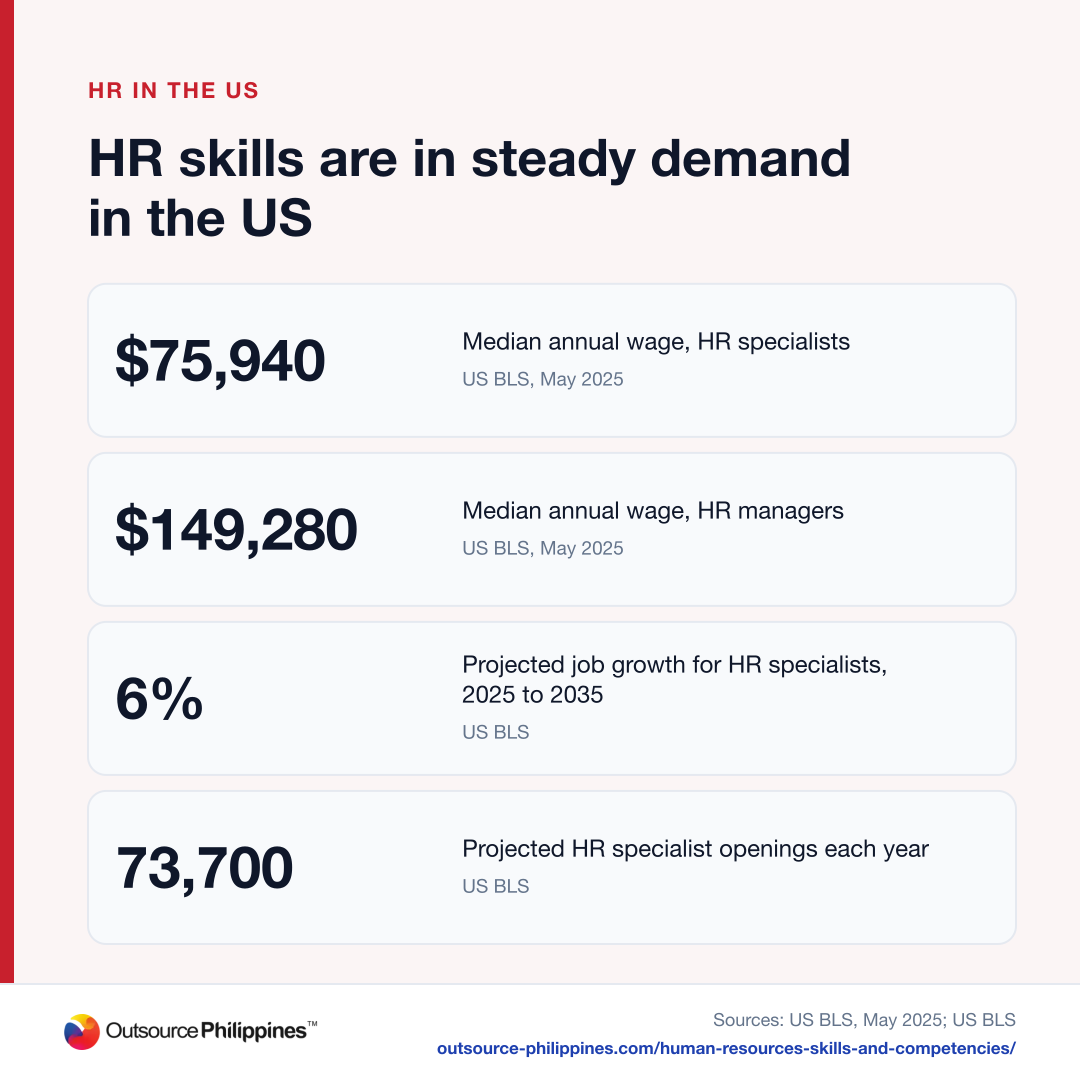
- $75,940Median annual wage, HR specialistsUS BLS, May 2025
- $149,280Median annual wage, HR managersUS BLS, May 2025
- 6%Projected job growth for HR specialists, 2025 to 2035US BLS
- 73,700Projected HR specialist openings each yearUS BLS
Demand for these skills is steady in the US. The US Bureau of Labor Statistics reports a median annual wage of $75,940 for human resources specialists in May 2025, about 939,700 jobs, and employment projected to grow 6% from 2025 to 2035, with about 73,700 openings a year. For human resources managers, the May 2025 median was $149,280.
What Core Skills Does an HR Professional Need?
Five skill groups form the foundation of HR work: talent acquisition, engagement and retention, performance management, data-driven decisions, and compliance. Each has two practical parts.
Talent Acquisition and Workforce Planning
- Strategic recruitment: targeted hiring that matches candidate skills to the organization’s needs and culture.
- Onboarding and career development: structured onboarding plus continuous learning that supports promotion and succession planning.
Employee Engagement and Retention
- Effective communication: clear spoken and written communication that builds trust, transparency, and a culture where feedback is valued.
- Conflict resolution and mediation: addressing disagreements quickly and fairly so the workplace stays productive.
Performance Management and Development
- Assessment and constructive feedback: clear performance metrics and workforce data used to support professional growth.
- Goal alignment: linking individual objectives to business strategy to build accountability.
Data-driven Decision Making
- HR analytics: using metrics such as turnover, time to hire, and engagement scores to spot trends and find improvements.
- Predictive modeling: forecasting skills gaps and future hiring needs before they become urgent, a core part of human resource planning.
Legal, Ethical, and Regulatory Compliance
- Regulatory expertise: keeping up with labor laws, industry standards, and ethical practice to reduce risk and ensure fair treatment.
- Integrity and fairness: high professional standards in every HR decision, which builds a culture of trust and accountability.
What Competencies Set Modern HR Professionals Apart?
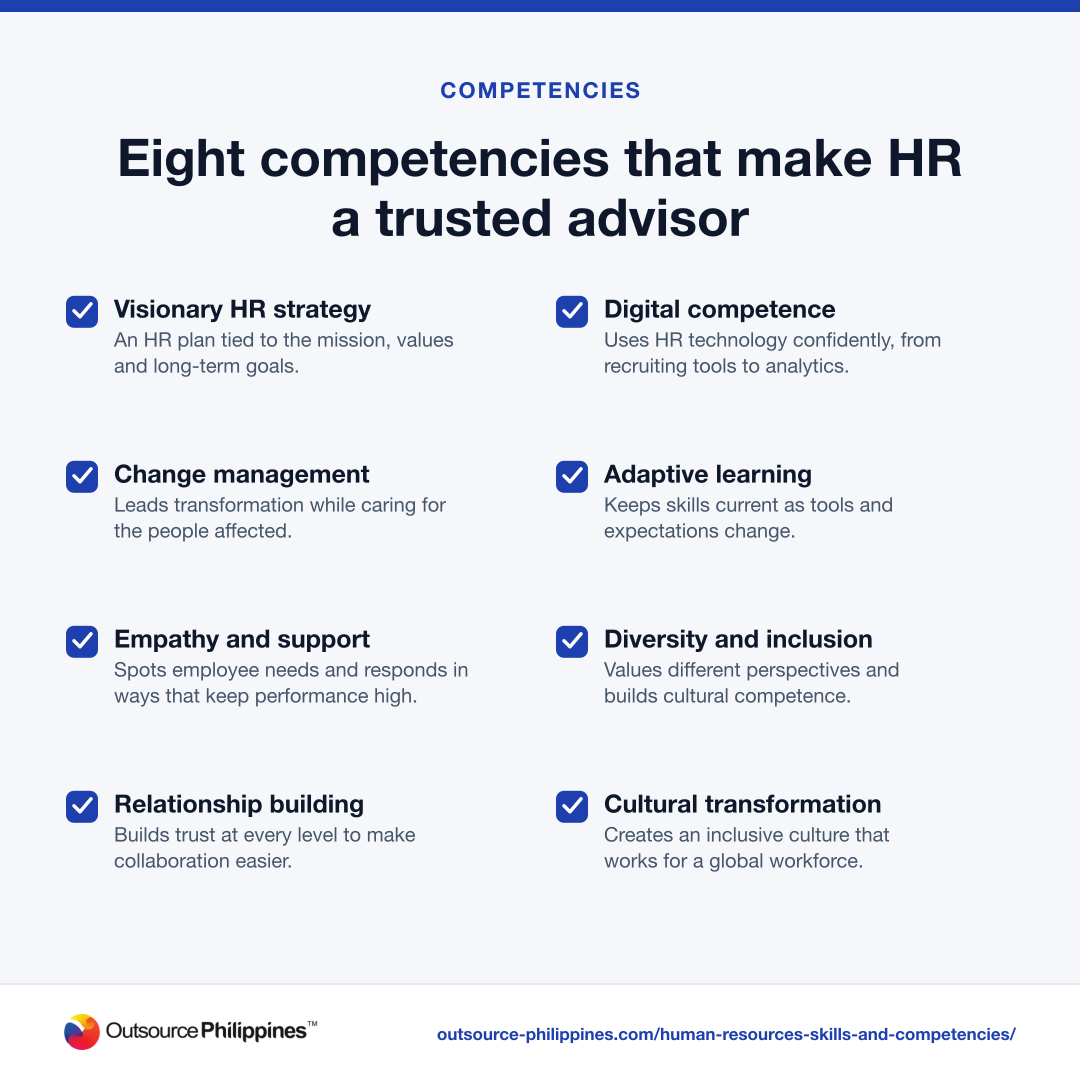
Four competency areas turn a capable HR generalist into a trusted advisor: strategic leadership, emotional intelligence, technological proficiency, and global awareness. These are the behaviors leaders notice, and they take longer to develop than skills, so start building them early.
- Visionary HR strategy
An HR plan tied to the mission, values and long-term goals.
- Change management
Leads transformation while caring for the people affected.
- Empathy and support
Spots employee needs and responds in ways that keep performance high.
- Relationship building
Builds trust at every level to make collaboration easier.
- Digital competence
Uses HR technology confidently, from recruiting tools to analytics.
- Adaptive learning
Keeps skills current as tools and expectations change.
- Diversity and inclusion
Values different perspectives and builds cultural competence.
- Cultural transformation
Creates an inclusive culture that works for a global workforce.
Strategic Thinking and Leadership
- Visionary HR strategy: an HR plan that supports the organization’s mission, values, and long-term goals, communicated clearly.
- Change management: leading transformation by balancing efficiency with the human side of change, so transitions go smoothly.
Emotional Intelligence and Interpersonal Skills
- Empathy and support: recognizing employees’ emotional and practical needs and responding in ways that keep performance high.
- Relationship building: strong working relationships at every level that make collaboration easier.
Technological Proficiency
- Digital competence: confident use of HR technology, from recruitment tools to analytics platforms.
- Adaptive learning: updating skills and methods as tools and workplace expectations change.
Global and Cultural Awareness
- Diversity and inclusion: programs that value different perspectives and build cultural competence.
- Cultural transformation: practices that create an inclusive, adaptable culture, essential for managing a global workforce.
How Is Technology Changing HR Work?
HRIS platforms, analytics, and automation take over routine administration so HR teams can spend more time on people and strategy. Three benefits stand out:
- Operational efficiency: automation cuts manual tasks, freeing time for leadership development and talent management.
- Actionable insights: analytics give a clearer view of workforce trends, so HR can act before small problems grow.
- Personalized employee journeys: software makes it easier to tailor training, performance reviews, and career plans to each person and to business goals.
Technology also raises the bar on judgment. HR professionals need to check what automated tools recommend, protect employee data, and explain decisions in plain language.
How Can You Build HR Skills and Competencies in Your Team?
Build them through a mix of training, real projects, and feedback. Competencies in particular grow from experience, not courses alone.
- Map current skills: compare your team’s skills with the list above and note the gaps that matter most for your plans.
- Train on specifics: use short courses for teachable skills such as employment law updates, HR analytics, or a new HRIS.
- Give stretch assignments: let people lead a change project, a policy rewrite, or a hiring push with a mentor’s support.
- Coach regularly: give feedback on behaviors such as empathy, communication, and decision-making, not just results.
- Free up time: move routine administration, such as payroll and compliance paperwork, to systems or a partner so your HR staff can focus on strategy.
For companies building teams in other countries, the last point often decides how much strategic work HR can take on. Comparing HR outsourcing costs with the cost of adding headcount is a useful first step.
Should You Build HR In-house or Use an Employer of Record?
Keep strategy, culture, and leadership development in-house; those depend on knowing your business. If you want to hire in the Philippines without setting up a local entity, an Employer of Record (EOR) can handle local employment, payroll, and compliance, which lets your HR team stay focused on people strategy. An EOR is a weaker fit if you plan a large, long-term operation that justifies your own legal entity. The trade-offs are laid out in our Employer of Record vs BPO comparison.
To hire Philippine talent with local employment and compliance handled for you, explore our Employer of Record services in the Philippines. When you are ready, contact us for a written proposal.
Frequently Asked Questions
What Are the Most Important Skills for an HR Professional?
The most important HR skills are communication, talent acquisition, conflict resolution, performance management, HR analytics, and knowledge of employment law. The US Bureau of Labor Statistics also lists communication, decision-making, interpersonal, and leadership skills as important qualities for HR managers, along with organizational skills for handling several projects at once.
What Is the Difference between HR Skills and HR Competencies?
HR skills are specific, teachable abilities, such as recruiting, running payroll, or analyzing workforce data. HR competencies combine skills, knowledge, and behavior, such as strategic thinking, emotional intelligence, or change leadership. Skills are built through training and practice, while competencies develop over time through experience, coaching, and feedback on how someone actually works.
How Is Technology Changing HR Skills?
Technology automates much of HR’s routine administration, such as record keeping and scheduling, through HRIS platforms and other tools. That shifts the skills that matter toward data analysis, judgment, change management, and employee experience. HR professionals now need to read analytics, check automated recommendations, and protect employee data.
Can an Employer of Record Replace an In-house HR Team?
Not entirely. An Employer of Record handles local employment, payroll, and compliance for workers in another country, which removes much of the administrative load. Strategy, culture, leadership development, and employee relations still need people who know your business, so most companies keep a core HR team and use an EOR alongside it.