Understanding Telemarketing: What It Is, Its Types, and Why It Matters

On This Page
- What Is Telemarketing?
- What Are the Types of Telemarketing?
- What Are the Pros and Cons of Telemarketing?
- What Rules Apply to Telemarketing in the US?
- How Can You Improve Telemarketing Conversions?
- Why Outsource Telemarketing Services?
- Is Outsourced Telemarketing Right for Your Business?
- Frequently Asked Questions
Telemarketing is a direct marketing method in which businesses use phone calls, and increasingly video and internet calls, to reach prospects, promote products or services, collect information, and generate leads. It is broader than telesales, which focuses on closing a sale during the call, and it often supports longer B2B sales cycles.
Telemarketing is often confused with telesales, and it carries a reputation shaped by unwanted robocalls. This guide explains what telemarketing is and how it differs from telesales, the four main types, its pros and cons, the US rules every program must follow, tips to improve conversions, and why many companies outsource it to the Philippines.
What Is Telemarketing?
Telemarketing is the use of the telephone to build relationships with prospective customers and promote a company’s goods or services. Calls can introduce an offer, gather information, qualify and generate new leads, or raise funds for causes and events.
The method has changed with technology. It started as phone calls from a list, but today it also covers video calls and internet calling, and it usually works alongside email, social media, and a CRM that tracks every conversation.
Telemarketing vs Telesales
The two terms are often used interchangeably, including within the outsourcing industry, but they serve different purposes. Both use the phone to reach potential customers.
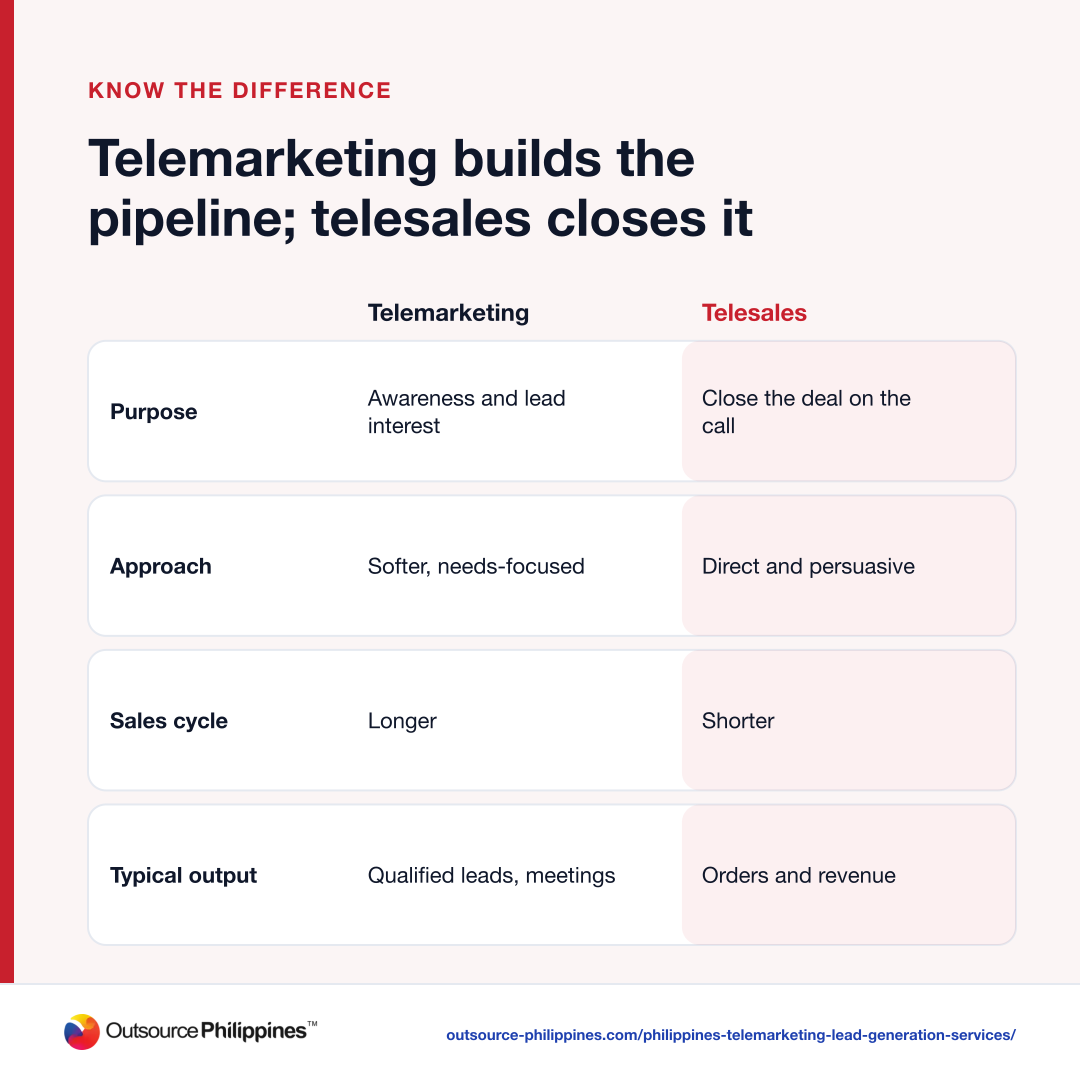
| Factor | Telemarketing | Telesales |
|---|---|---|
| Purpose | Awareness and lead interest | Close the deal on the call |
| Approach | Softer, needs-focused | Direct and persuasive |
| Sales cycle | Longer | Shorter |
| Typical output | Qualified leads, meetings | Orders and revenue |
- Purpose: telemarketing builds relationships, creates awareness, and generates interest. Telesales aims to close a deal during the call through direct sales efforts.
- Approach: telemarketing takes a softer approach focused on understanding needs and nurturing leads. Telesales uses a more direct, persuasive approach to drive an immediate sale.
- Sales cycle: telemarketing generally supports a longer sales cycle, while telesales typically has a shorter one.
In practice, many programs combine both. A telemarketing team qualifies leads and books meetings, then hands warm prospects to telesales or account executives to close.
What Are the Types of Telemarketing?
There are four main types of telemarketing: inbound, outbound, business-to-business (B2B) and business-to-consumer (B2C). Each serves a different audience and goal.
Inbound Telemarketing
Inbound telemarketing handles calls from people who have already shown interest, for example after visiting your website, seeing an ad, or sending an inquiry. The goal is to turn interested callers into customers, and then into loyal customers who recommend the business. It depends on good content and ads, well-trained agents, and follow-up after the purchase.
Outbound Telemarketing
Outbound telemarketing means calling people to tell them about products or services. It is harder because many prospects don’t yet know the offer. Success depends on asking the right questions, setting achievable goals, learning from previous calls, and handling objections well.
Business-to-business (B2B) Telemarketing
B2B telemarketing targets decision-makers at other companies, such as owners and managers. It requires understanding what those businesses need, and it often works alongside helpful content, tailored emails, and added services that set your offer apart.
Business-to-consumer (B2C) Telemarketing
B2C telemarketing connects directly with individual consumers by phone to sell products or services. It focuses on understanding each buyer’s needs, building an emotional connection, and offering incentives, while staying within consumer calling rules, which are stricter than the B2B rules.
What Are the Pros and Cons of Telemarketing?
Telemarketing offers personal, real-time conversations that other channels can’t match. Its downsides are a poor public image, strict regulation, and the cost of trained people.
Pros of Telemarketing
- Personalized engagement: one-on-one conversations allow a tailored pitch.
- Broad outreach: a trained team can reach a large list efficiently.
- Real-time insights: immediate feedback from prospects lets you adjust messaging quickly.
- Relationship building: personal interactions build trust and loyalty.
- Sales potential: a compelling offer can lead to an immediate sale or booked meeting.
Cons of Telemarketing
- Perceived intrusion: some consumers find calls pushy or irritating.
- Negative perception: the volume of unsolicited calls and robocalls hurts the channel’s reputation.
- Regulatory constraints: do-not-call lists and telemarketing laws limit who you can call and how.
- Cost intensive: it requires investment in technology, infrastructure, and trained staff.
- Effectiveness limitations: call blocking, caller ID labeling, and privacy concerns lower answer rates.
The image problem is real. The Federal Trade Commission’s 2025 Do Not Call Registry Data Book recorded 2,618,077 complaints in fiscal year 2025, and about 61% of them were about robocalls rather than live callers. A compliant, well-targeted program with live agents is a different product from the calls consumers complain about.
What Rules Apply to Telemarketing in the US?
US telemarketing is governed mainly by the FTC’s Telemarketing Sales Rule (TSR), the National Do Not Call Registry, and the Telephone Consumer Protection Act. Your outsourcing partner must follow the same rules you do.
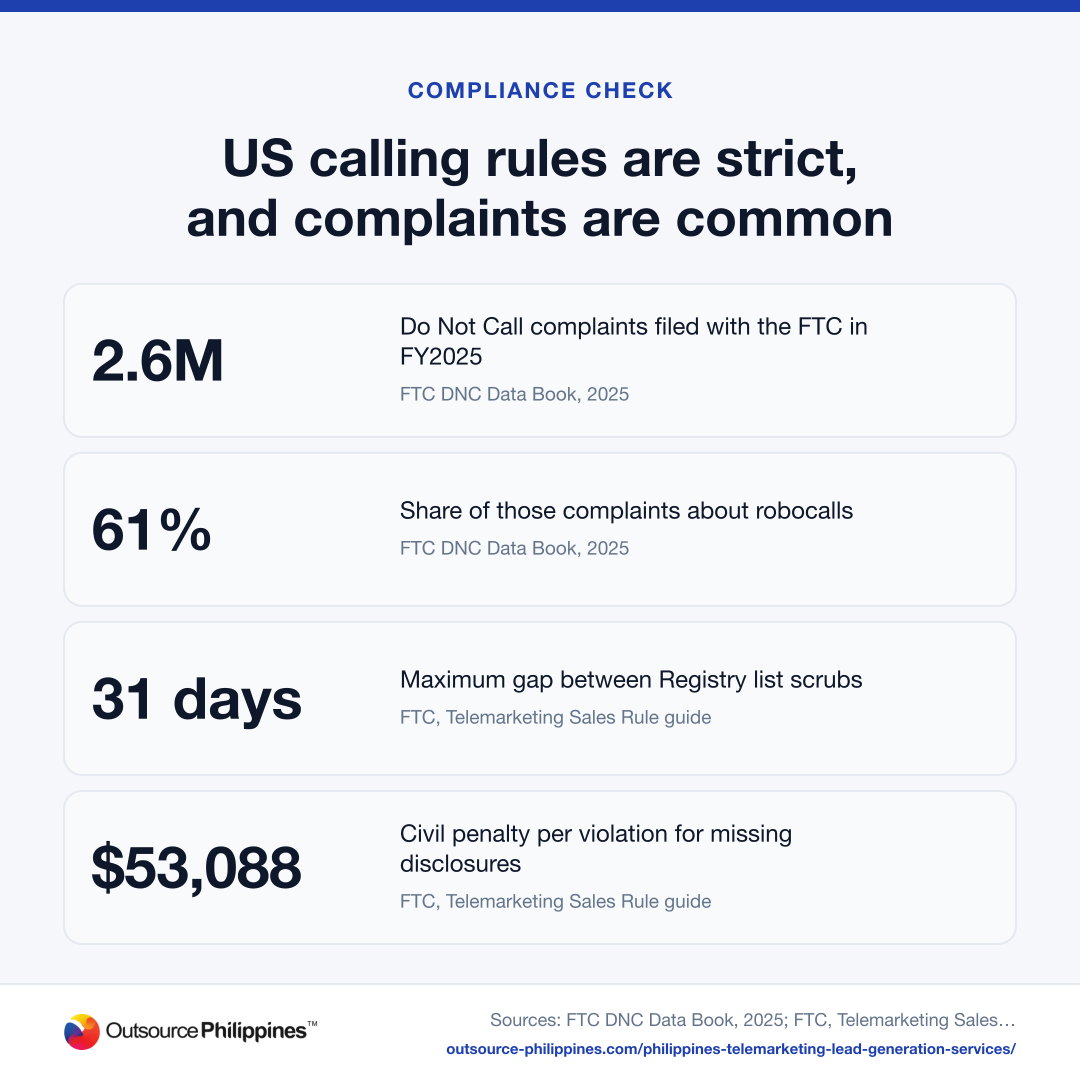
- 2.6MDo Not Call complaints filed with the FTC in FY2025FTC DNC Data Book, 2025
- 61%Share of those complaints about robocallsFTC DNC Data Book, 2025
- 31 daysMaximum gap between Registry list scrubsFTC, Telemarketing Sales Rule guide
- $53,088Civil penalty per violation for missing disclosuresFTC, Telemarketing Sales Rule guide
For covered consumer campaigns, the Telemarketing Sales Rule requires sellers and telemarketers to remove registered numbers from their call lists using an updated version of the National Registry at least every 31 days. Most business-to-business calls are exempt from many TSR provisions, but prohibitions on material misrepresentations and false or misleading statements still apply. Retail sales of nondurable office or cleaning supplies have narrower exemptions. Violations can be costly: failing to make required disclosures can bring a civil penalty of $53,088 per violation.
Consumer calling also has state rules and consent requirements for autodialed and prerecorded calls. Have your counsel review scripts, lists, and dialing technology before launch, especially for B2C campaigns.
How Can You Improve Telemarketing Conversions?
Better targeting, steady call volume, and sharper questions lift conversions more than a longer script does.
- Consider your audience carefully. Segment prospects by demographics, industry, habits, and preferences so each segment hears a message that fits its needs.
- Get ready to place a lot of calls. Telemarketing is a volume game: many calls go unanswered or end in a “no,” so plan staffing and call blocks to generate enough real conversations to secure new leads.
- Prepare smart, interesting questions. Good questions get prospects talking, uncover the information you need, and steer the conversation toward their interests, which builds rapport and trust.
Track connect rate, conversations per hour, leads qualified, and meetings booked, and review call recordings weekly to see which questions and openings work.
Why Outsource Telemarketing Services?
Outsourcing gives you trained callers, flexible capacity, and lower cost than an in-house team. It also frees your own staff to focus on closing and serving customers.
- Adds a personal touch. Many people still prefer talking to a person over a chatbot, and an experienced caller listens and responds in ways a script can’t.
- Increases efficiency without breaking the bank. Outsourcing to a lower-cost country cuts hiring, training, infrastructure, and operating costs. Outsource Philippines™ quotes costs based on the role, scope, coverage hours, and team size.
- Puts the work in experienced hands. Callers from contact centers are trained in sales techniques, communication, and objection handling, and bring lessons from other campaigns.
- Lets you expand operations. You can add callers for a campaign or a new market quickly, while your in-house team stays on core work.
- Helps you reach English-speaking markets abroad. A Philippine team can call prospects in the US, UK, Canada, and Australia during their business hours.
Outsource Philippines™ provides dedicated agents who work only on your account, in English. The provider recruits and screens callers against your profile, and most teams go live in 2 to 4 weeks, depending on the role.
Is Outsourced Telemarketing Right for Your Business?
Outsourced telemarketing fits companies with a defined target market, a clear offer, and a sales process that can turn qualified leads into revenue. It is a poor fit if you have no list strategy, no one to follow up on leads, or campaigns that need callers in languages other than English.
Outsource Philippines™ builds English-language lead generation teams that qualify prospects and book meetings, with dedicated callers who work only on one client's campaign from a supervised office in the Philippines.
Frequently Asked Questions
What Is the Main Purpose of Telemarketing?
The main purpose of telemarketing is to start and build relationships with prospective customers by phone. Calls create awareness of a product or service, gather information, qualify leads, and book meetings. Some campaigns also sell directly, but closing on the call is usually the job of telesales, which telemarketing often feeds.
Is Telemarketing Still Effective?
Yes, when it targets the right people and follows the rules. Live, well-trained callers can qualify leads and book meetings in ways email and ads can’t, especially in B2B. Most consumer complaints concern robocalls and unwanted calls, so a compliant, targeted program with live agents performs very differently from mass dialing.
Is B2B Telemarketing Covered by the Do Not Call Rules?
Under the FTC’s Telemarketing Sales Rule, most business-to-business calls are exempt from many provisions, but prohibitions on material misrepresentations and false or misleading statements still apply. Retail sales of nondurable office or cleaning supplies have narrower exemptions. Other laws, such as state rules and consent requirements for autodialed or prerecorded calls, can still apply, so have counsel review your campaign before launch.
How Much Does It Cost to Outsource Telemarketing to the Philippines?
Cost depends on the campaign type, call volume, hours, and team size. Outsource Philippines™ quotes costs based on the role, scope, coverage hours, and team size. Outsource Philippines™ prices teams as an hourly rate per agent in a written proposal rather than publishing a rate card.