Real Estate Wholesaling Virtual Assistant: Tasks, Scripts and Setup

On This Page
- What Does a Virtual Assistant Do for a Real Estate Wholesaler?
- Which Wholesaling Tasks Should Stay With You?
- What Should a Wholesaling Cold Calling Script Include?
- Which US Calling Rules Apply to Wholesaling Outreach?
- How Do You Set Up a Wholesaling Virtual Assistant?
- What Does a Weekly Wholesaling VA Workflow Look Like?
- When Is a Wholesaling VA Not the Right Fit?
- Frequently Asked Questions
A virtual assistant for wholesale real estate builds and cleans seller lists, runs skip tracing, makes first-touch calls and texts under your scripts and US calling rules, logs every lead in your CRM, keeps follow-up cadences on schedule, and prepares comps and buyer lists. Your acquisitions manager still negotiates and signs every contract.
- A wholesaling VA owns the top of the funnel: lists, skip tracing, first contact, CRM updates and follow-up.
- Offers, contract negotiation and anything that needs a real estate license stay with you or your licensed team.
- The FTC Telemarketing Sales Rule and the FCC's TCPA rules set calling hours, Do Not Call checks and consent rules for automated calls and texts.
- Most wholesalers start with one VA on list work and seller calls, then add follow-up or dispositions once the scripts hold up.
Wholesaling runs on volume: thousands of records pulled, cleaned, traced and called to find a few owners ready to sell below market. That work is repeatable, and like most outsourced real estate work it suits a trained assistant who follows written steps. This post covers the tasks to hand off, a calling script you can adapt, a weekly workflow, the setup steps, and the compliance limits every outbound program needs.
What Does a Virtual Assistant Do for a Real Estate Wholesaler?
A wholesaling virtual assistant handles the lead work between "we have a list" and "this seller wants an offer." That covers list building, skip tracing, first contact, CRM records, follow-up and support for dispositions.
List building. The VA pulls records from your data provider or county sources by the filters you set: absentee owners, high equity, tax delinquent, pre-foreclosure, probate or vacant properties. They remove duplicates, flag properties you already own or passed on, and tag each list by source so you can see later which one produced deals. Much of this is structured data entry and cleanup, done to a written standard.
Skip tracing. The VA runs each list through your skip tracing tool, attaches phone numbers and emails to owner records, and marks numbers as mobile or landline when the tool reports it. They also scrub every list against the National Do Not Call Registry and your internal do-not-call list before anyone dials.
Cold calling and texting. A trained VA works the call list during the owner's local calling hours, follows your script, asks the qualifying questions, and books a callback with your acquisitions manager when a seller is motivated. Texts go out only through a platform and consent process your attorney has approved.
CRM updates. Every dial, text and conversation gets logged in your CRM (Podio, REsimpli, InvestorFuse or a general CRM) with the outcome, notes, and the next task date. Clean records are what keep a lead from being called twice in one day or never called again.
Follow-up cadences. Most sellers are not ready on the first call, so the VA works the follow-up queue each morning on the schedule you set.
Comps prep and dispositions support. For leads that reach the offer stage, the VA pulls recent sold comps from the sources you use and fills in a deal sheet for your review. On the sell side, they keep the cash buyer list current, send deal announcements you approve, and log buyer replies.
Which Wholesaling Tasks Should Stay With You?
Keep every task that sets a price, signs a contract, or needs a real estate license. A VA prepares the inputs; you make the decisions.
- Offers and negotiation. The VA does not quote prices, make offers, or negotiate terms. They pass motivated sellers to your acquisitions manager.
- Contracts and assignments. Purchase agreements, assignment contracts and closing documents are signed and explained by you, your licensed staff, or your attorney.
- Licensed activity. The VA is not a licensed agent and does not act as one. State rules on wholesaling differ, so confirm with a real estate attorney what your own business can do without a license.
Agent and brokerage admin, such as MLS listings and showing schedules, is a different job. Those tasks sit under a general real estate virtual assistant role rather than an acquisitions role.
What Should a Wholesaling Cold Calling Script Include?
A good script identifies the caller and the company in the first sentence, says why you are calling, asks four or five qualifying questions, and ends with a booked callback or a clean do-not-call. Keep it short enough that the VA sounds like a person, not a recording.
Here is a starting script to adapt with your attorney:
Opening: "Hi, this is [first name] calling for [company name]. I'm calling about the property at [street address]. We buy houses in [city or county], and I wanted to ask if you'd consider an offer on it. Do you have a minute?"
Qualifying questions: "What's the condition of the house right now?" "Is anyone living there?" "If the numbers made sense, when would you want to sell?" "What's got you thinking about selling?" "Do you have a price in mind?"
Handoff: "Thanks, that helps. [Acquisitions manager's name] handles our offers. What's a good time today or tomorrow for them to call you back?"
Not interested: "Understood. Would you like me to take this number off our call list?" If yes: "Done. You won't hear from us again."
Three rules keep the script safe. The VA never guesses at a price, never says the company is something it is not, and logs every do-not-call request the moment it is made. Calling teams that already run outbound telemarketing programs use the same discipline: one script, one disposition code per call, and weekly call reviews.
Which US Calling Rules Apply to Wholesaling Outreach?
Two sets of federal rules govern most outbound calling and texting: the FTC Telemarketing Sales Rule and the FCC's rules under the Telephone Consumer Protection Act (TCPA). States add their own. Whether a particular buy-side call counts as telemarketing is a question for your attorney; the safer practice is to run every campaign as if the rules apply.
The key federal requirements, taken from the regulations themselves:
- Calling hours. The Telemarketing Sales Rule at 16 CFR 310.4 limits calls to a person's residence to between 8:00 a.m. and 9:00 p.m. local time at the called person's location, unless the person has consented.
- Do Not Call Registry. The same section's safe harbor calls for scrubbing against a version of the registry obtained no more than 31 days before any call is made. Sellers and telemarketers get access through the FTC's National Do Not Call Registry for telemarketers.
- Caller ID. The TSR requires the telemarketer's phone number, and the name when the carrier makes it available, to be sent to caller ID.
- Company-specific do-not-call requests. The FCC's TCPA rules at 47 CFR 64.1200 require you to record a do-not-call request when it is made and honor it within a reasonable time, not to exceed 10 business days. They also require a written do-not-call policy and trained staff.
- Autodialers, prerecorded messages and texts. Under the same FCC rules, telemarketing calls to mobile numbers made with an autodialer or an artificial or prerecorded voice need the called party's prior express written consent. The do-not-call rules also apply to telemarketing text messages sent to wireless numbers.
- Reassigned numbers. Skip-traced numbers go stale. The FCC's Reassigned Numbers Database shows whether a number has been disconnected and possibly reassigned to someone else.
The FTC's plain-language guide to complying with the Telemarketing Sales Rule also lists the prompt disclosures for sales calls: the seller's identity, that the call's purpose is to sell, and the nature of what is offered. That matters most on the dispositions side, when a VA calls buyers about a contract you are assigning, and it is one reason call center compliance work starts with the script rather than the dialer.
This is general information, not legal advice. Have a lawyer who knows TCPA work review your scripts, dialer settings, text platform and consent language before the first campaign.
How Do You Set Up a Wholesaling Virtual Assistant?
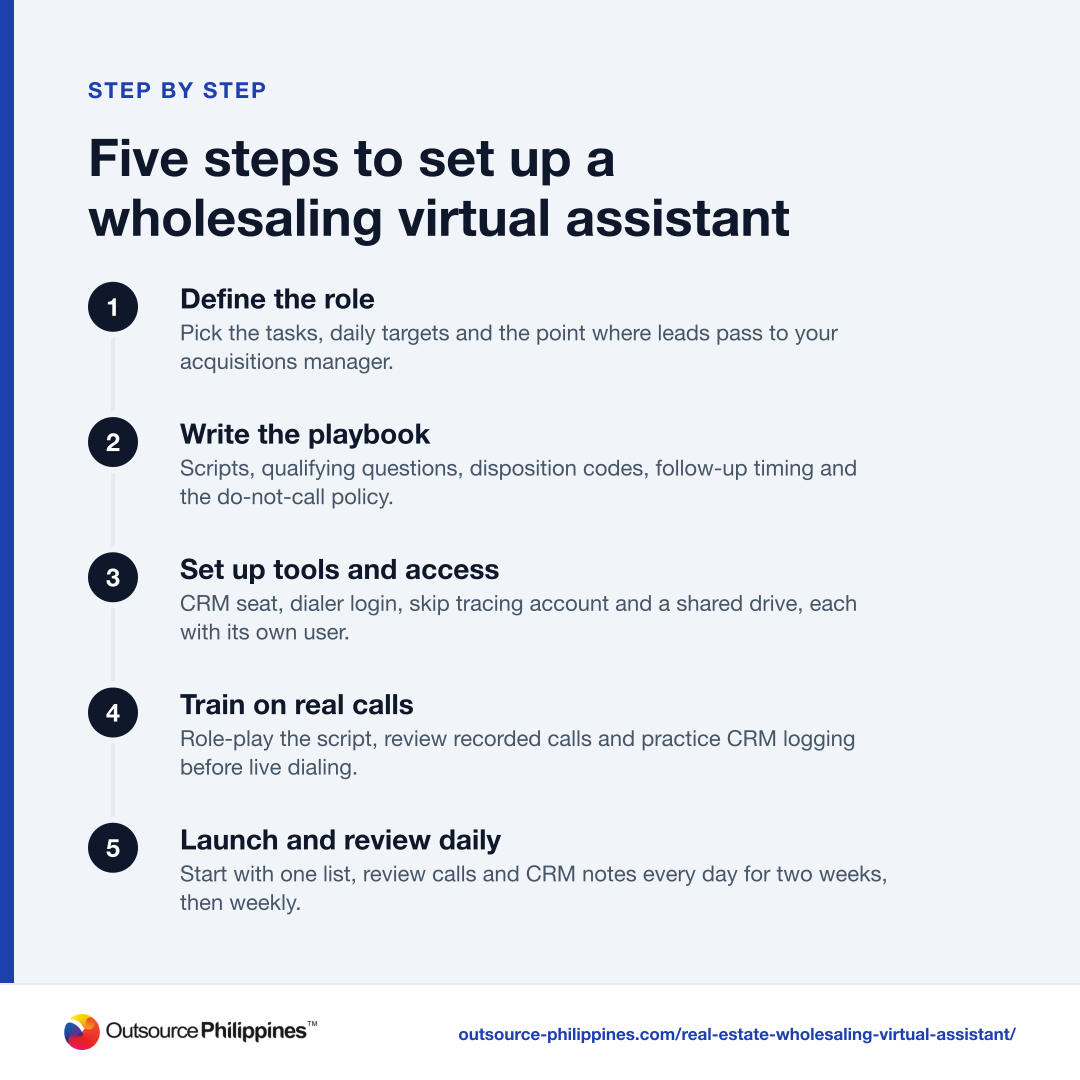
Setup takes five steps: define the role, write the playbook, set up tools and access, train on recorded calls, then launch with daily review. Most of the effort goes into the playbook, because the VA can only follow what is written down.
- 1Define the role
Pick the tasks, daily targets and the point where leads pass to your acquisitions manager.
- 2Write the playbook
Scripts, qualifying questions, disposition codes, follow-up timing and the do-not-call policy.
- 3Set up tools and access
CRM seat, dialer login, skip tracing account and a shared drive, each with its own user.
- 4Train on real calls
Role-play the script, review recorded calls and practice CRM logging before live dialing.
- 5Launch and review daily
Start with one list, review calls and CRM notes every day for two weeks, then weekly.
1. Define the role. Write down which of the tasks above the VA owns, the daily targets (records cleaned, dials, conversations, follow-ups worked), and the exact handoff rule, for example "seller gives a timeline under 90 days and a price range."
2. Write the playbook. One shared document holds the script, objection answers, disposition codes, follow-up timing by lead temperature, and your written do-not-call policy. The structure is the same one used when onboarding appointment setters: scripts, examples of good calls, and clear pass rules.
3 to 5. Tools, training and launch. Give the VA a named login for each tool rather than a shared password, train on recorded calls from your best acquisitions rep, and start with one list in one market.
Time zones need planning too. Manila is 12 or 13 hours ahead of US Eastern time, so an office-based team in the Philippines works a night shift, which puts the Manila and US time difference to use: the VA calls sellers during their afternoon and early evening.
What Does a Weekly Wholesaling VA Workflow Look Like?
A steady week mixes fresh list work, daily calling blocks and a fixed follow-up hour, with one day for reporting. The schedule below assumes one full-time VA working seller leads in one market.
| Day | Main block | Daily constant | Output for your team |
|---|---|---|---|
| Monday | Pull and clean a new list from your data source | Morning follow-up queue | List tagged by source, ready for skip tracing |
| Tuesday | Skip trace and scrub against the Do Not Call Registry | Afternoon seller calling block | Callable list loaded into the dialer |
| Wednesday | Seller calling and texting from the new list | CRM notes after every conversation | Motivated sellers booked for callbacks |
| Thursday | Comps and deal sheets for leads at the offer stage | Afternoon seller calling block | Deal sheets ready for your review |
| Friday | Cash buyer list updates and approved deal announcements | Weekly report on dials, contacts and booked callbacks | Report and clean pipeline for Monday |
Adjust the blocks to your bottleneck. Teams that need a full outbound desk rather than one assistant usually move to a dedicated appointment setting team with a supervisor and call quality reviews.
When Is a Wholesaling VA Not the Right Fit?
A VA is the wrong first hire if you have no list source, no script that has produced a deal, or no one to take the callbacks. The assistant multiplies a working process; it does not build one from scratch.
It is also a poor fit if you want the assistant to negotiate prices, sign contracts, or represent your company as a licensed agent. Those steps need you, a licensed team member, or an attorney. And if your state's wholesaling rules are unclear for your business model, settle that with counsel before you scale outreach.
When you hire a Philippine virtual assistant through Outsource Philippines™, we source, test and shortlist candidates, your team joins the final interviews, and you make the hiring decision. Most teams go live in 2 to 4 weeks, depending on the role.
Outsource Philippines™ assistants work full time on one client's account from a supervised office in San Pedro City, Laguna, on company-managed devices behind a managed firewall.
Frequently Asked Questions
What Does a Virtual Assistant Do for Wholesale Real Estate?
A wholesale real estate virtual assistant builds and cleans seller lists, runs skip tracing, scrubs numbers against the Do Not Call Registry, makes first-touch calls and texts from your script, and logs every outcome in your CRM. They also work the follow-up queue, prepare comps for your review, and keep your cash buyer list current. Offers and contracts stay with you.
Can a Virtual Assistant Negotiate Wholesale Deals?
No. A wholesaling VA qualifies sellers and books callbacks, but your acquisitions manager or a licensed team member makes offers and negotiates. The VA does not act as a licensed real estate agent. Because state rules on wholesaling vary, confirm with a real estate attorney which steps in your business require a license.
Do US Calling Rules Apply to Calls Made From the Philippines?
Plan as if they apply in full. The FTC Telemarketing Sales Rule and the FCC's TCPA rules are written around the person called: calling hours of 8 a.m. to 9 p.m. use the local time at the called person's location, and Do Not Call Registry checks cover US numbers. Have your attorney review your scripts and dialer setup before launch.
What Tools Does a Wholesaling Virtual Assistant Need?
Most need a CRM seat, a dialer or calling platform, a skip tracing account, access to your list data source, and a shared drive for scripts and deal sheets. Give the VA a named login for each tool, keep recordings and records in your accounts, and remove access the day the engagement ends.