Data Entry Outsourcing: Services, Job Types, and Benefits for Your Business

On This Page
- What Is Data Entry?
- What Are the Types of Data Entry Jobs?
- What Does a Data Entry Clerk Do?
- Why Does Accurate Data Entry Matter for Small Businesses?
- Which Industries Outsource Data Entry Most?
- Should You Outsource Data Entry or Keep It In-house?
- How Do You Choose a Data Entry Outsourcing Company in the Philippines?
- Is Data Entry Outsourcing Right for Your Business?
- Frequently Asked Questions
Data entry outsourcing means hiring an outside provider to type, convert, clean, and update your business data, such as orders, invoices, customer records, and forms, in your own systems. Companies outsource it because the work is essential but repetitive and time-consuming, and a trained team can do it accurately at lower cost.
This guide explains what data entry covers, the common types of data entry jobs and how they are paid, what a data entry clerk does day to day, how accurate data supports growth, and how to decide whether to keep the work in-house or send it to an offshore data entry team.
What Is Data Entry?
Data entry is the work of moving information into a computer system accurately: typing it from paper or scans, transcribing it from audio, copying it between systems, or updating records that have changed. It is the first step in nearly every business process that depends on data.
Most companies still receive information in mixed formats, including paper forms, PDFs, emails, spreadsheets, and recordings, and someone has to turn it into clean records. Healthcare, retail, accounting, logistics, research, and government offices all rely heavily on data entry. The work usually requires fast, accurate typing, good English reading and writing, and comfort with specialized software, from spreadsheets and CRMs to accounting and practice management systems.
What Are the Types of Data Entry Jobs?
Data entry is a broad label for several roles that differ by input type and skill level. The most common job titles are:
- Word processor: formats and types documents such as letters, reports, and contracts.
- Data processor: enters, sorts, and updates records in databases and business systems.
- Typist: types text from handwritten or printed sources quickly and accurately.
- Data entry keyer: keys numbers and text from forms and source documents into a system.
- Electronic data processor: handles data in electronic formats, including imports, conversions, and checks.
- Keypunch technician: the historical term for keying data onto punched cards, now used loosely for high-volume keying work.
- Transcriber: converts audio or video recordings into written text.
Data entry work can be paid by the hour, per task, by keystrokes per hour or minute, or per audio minute for transcription. Freelance platforms often pay per task or per keystroke, which rewards speed. Dedicated outsourced teams are usually priced by time, which keeps the focus on accuracy.
In-house Data Entry Clerks
In-house clerks are full-time employees who handle a company’s paper and digital records on site. They know the business well, but the role is costly to staff for work that rises and falls with volume. The US Bureau of Labor Statistics counts data entry as a core duty of general office clerks, an occupation it projects to decline 6% from 2025 to 2035 as more information is captured digitally.
Remote Data Entry Workers
Remote data entry workers, including freelancers and outsourced teams, work from home or a provider’s office using secure access to your systems. Freelancers are often paid per project or per keystroke and judged on output rather than work history. A dedicated outsourced team adds supervision, quality checks, and continuity when someone leaves.
What Does a Data Entry Clerk Do?
A data entry clerk captures, updates, and checks business data so it is accurate and available when people need it. The work follows your formats, rules, and deadlines.
Typical duties include:
- Converting paper documents and scans into computer files or database records.
- Typing in customer, order, and supplier information.
- Transcribing information from phone calls and recordings.
- Building and updating spreadsheets with large volumes of figures, without errors.
- Keeping data rosters and lists current.
- Checking entries against source documents and flagging gaps or duplicates.
Data entry often sits inside broader data processing work, where every batch goes through four basic actions:
- Inspect: review what data has arrived and what the client needs from it.
- Clean: fix formatting, remove duplicates, and fill or flag missing fields.
- Verify: check entries against source documents and look for patterns or outliers that do not match other records.
- Report: compile the results and return them in the agreed format, with a note on any exceptions.
Why Does Accurate Data Entry Matter for Small Businesses?
Accurate data is what every other function runs on. Billing, inventory, sales follow-up, and reporting all break down when records are wrong, incomplete, or duplicated.
1. It Keeps Information Management Reliable
A database full of errors cannot be managed effectively. Accurate entry means data is gathered, stored, and passed to the right system correctly, which improves communication between teams and cuts the time spent fixing records later. Teams that follow consistent data entry accuracy practices, such as double-checking key fields and using validation rules, catch most errors at the source.
2. It Helps Build and Keep Customer Relationships
Clean records of orders, questions, and complaints show where customers struggle and which products they care about most. That lets you fix recurring problems and personalize service instead of guessing.
3. It Supports Marketing and Sales
A clean database lets marketing send the right message to the right segment, and lets sales call active phone numbers instead of outdated ones. Bad data wastes campaign budget and rep time on contacts who will never answer.
Which Industries Outsource Data Entry Most?
Any business with steady paperwork can outsource data entry, but a few industries do it at scale because their records are high in volume and follow fixed formats.
- Healthcare: patient intake forms, insurance details, claims data, and appointment records.
- Ecommerce and retail: product catalog listings, price and stock updates, and order records.
- Accounting and finance: invoices, receipts, bills, and bank transactions keyed into accounting software.
- Logistics: shipping documents, delivery confirmations, and freight records.
- Real estate and property management: listings, lease details, tenant records, and maintenance logs.
- Research and marketing: survey responses, lead lists, and CRM updates.
Regulated data, such as health or financial records, needs stricter access rules and a provider that already works under the privacy laws that apply to you. Start with the least sensitive data set, prove accuracy, then expand.
Should You Outsource Data Entry or Keep It In-house?
Outsource data entry when the volume is steady or growing, the rules can be written down, and your in-house people are spending time on keying that should go to higher-value work. Keep it in-house when the work is tiny, irregular, or inseparable from decisions only your staff can make.
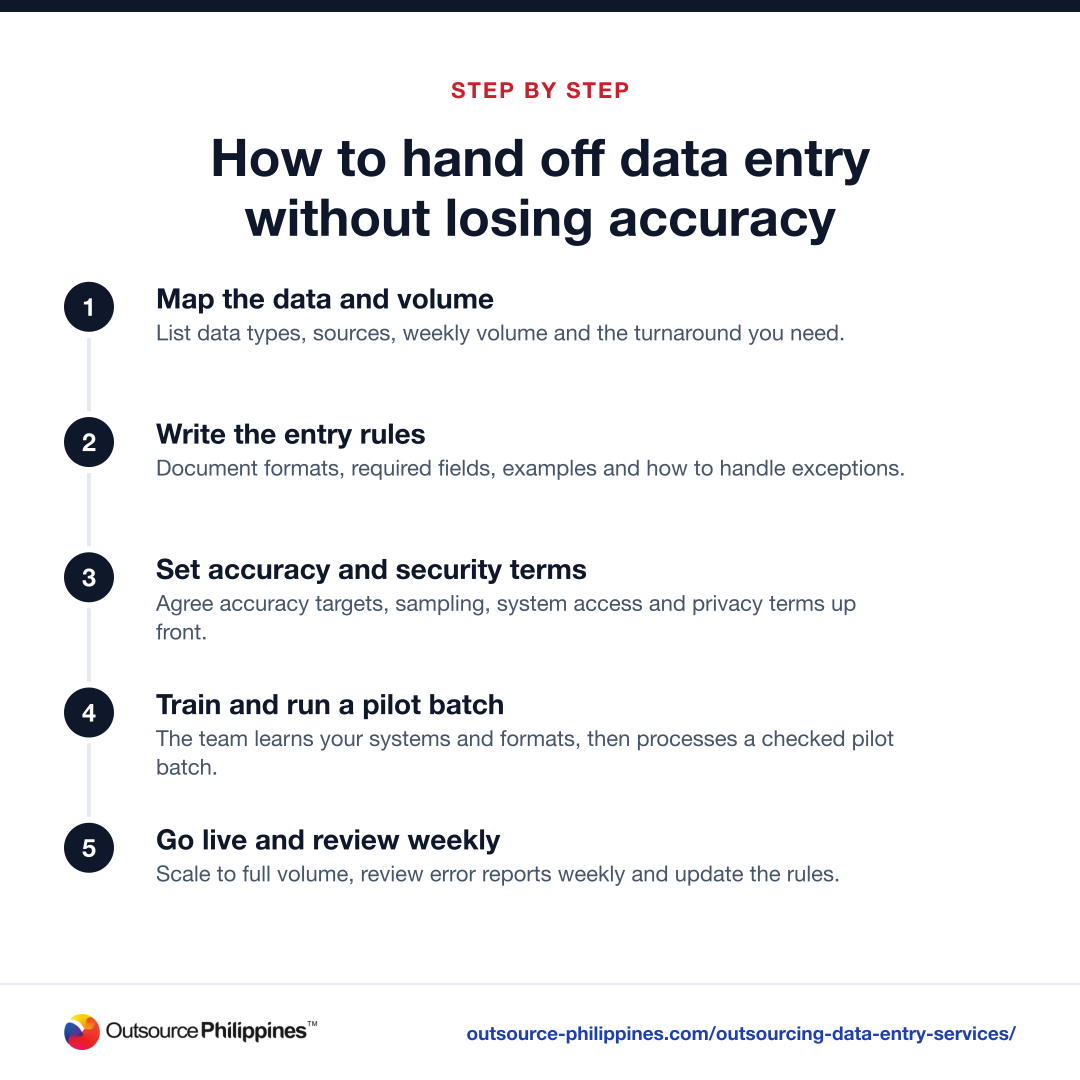
- 1Map the data and volume
List data types, sources, weekly volume and the turnaround you need.
- 2Write the entry rules
Document formats, required fields, examples and how to handle exceptions.
- 3Set accuracy and security terms
Agree accuracy targets, sampling, system access and privacy terms up front.
- 4Train and run a pilot batch
The team learns your systems and formats, then processes a checked pilot batch.
- 5Go live and review weekly
Scale to full volume, review error reports weekly and update the rules.
Ask these questions before you decide:
- How much time does data entry take your team each week?
- Do you have the systems to manage and check data properly?
- Do your employees have the skills and capacity to do it accurately?
If the honest answers point to strain, outsourcing usually brings three gains:
- Time back for core work: your team stops keying data and focuses on customers, products, and growth.
- Better use of your people’s skills: specialists do specialist work instead of routine updates, which raises the quality of both.
- Faster, more consistent output: a trained team with quality checks processes volume steadily and catches errors before they spread.
Outsource Philippines™ estimates most US clients pay 60% to 70% less than an equivalent in-house hire. Pricing is an hourly rate per agent, quoted in a written proposal.
How Do You Choose a Data Entry Outsourcing Company in the Philippines?
Choose a provider you can trust with your data and that can prove how it protects and checks it. Research its background, ask how it measures accuracy, and talk to the people who will run your account.
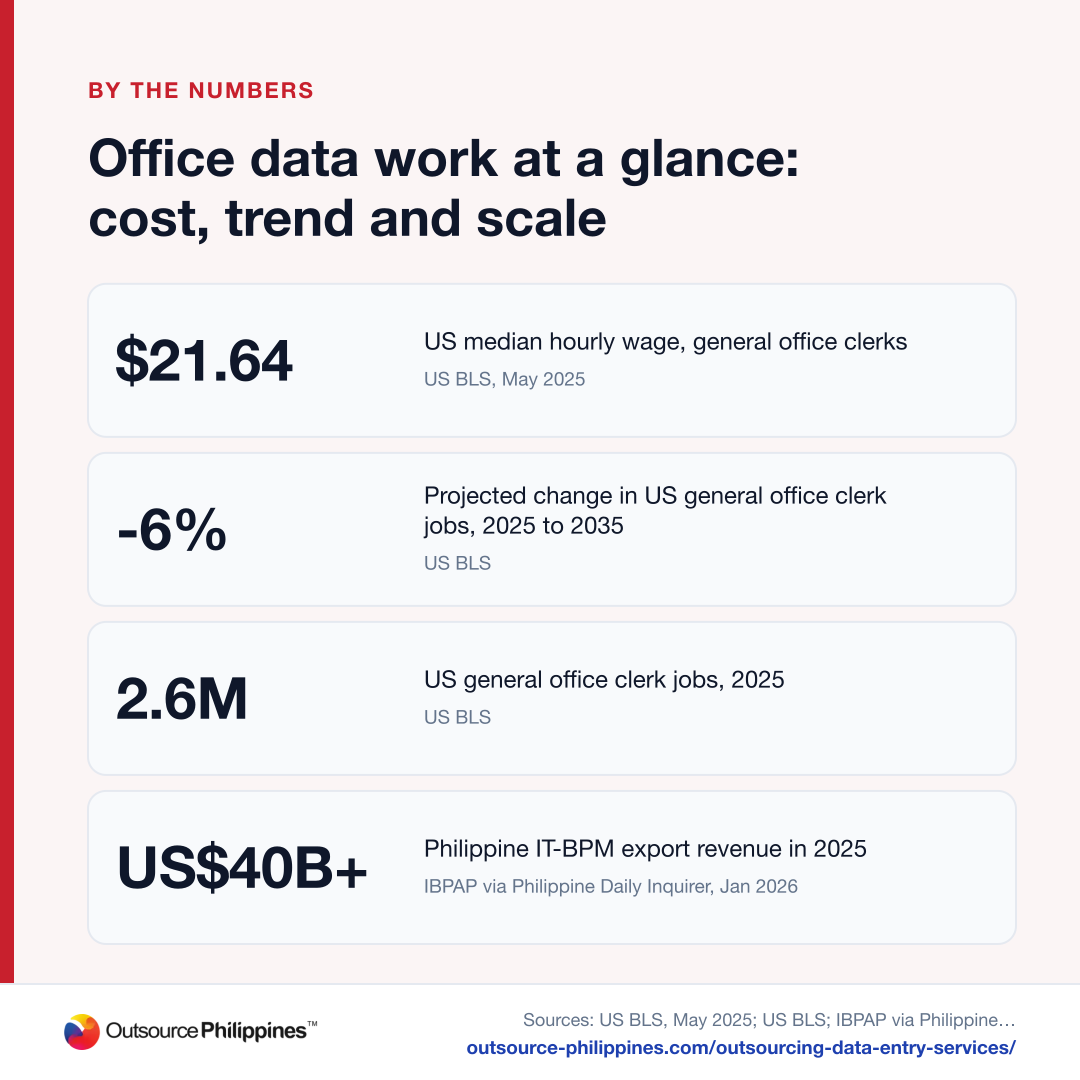
- $21.64US median hourly wage, general office clerksUS BLS, May 2025
- -6%Projected change in US general office clerk jobs, 2025 to 2035US BLS
- 2.6MUS general office clerk jobs, 2025US BLS
- US$40B+Philippine IT-BPM export revenue in 2025IBPAP via Philippine Daily Inquirer, Jan 2026
The Philippines is one of the largest destinations for back-office work: its IT and business process management industry ended 2025 with export revenue above US$40 billion, according to the IT and Business Process Association of the Philippines (IBPAP). When you compare providers, check:
- Accuracy controls: how entries are checked, sampled, and reported.
- Data security: compliance with the Philippine Data Privacy Act of 2012, access controls, and monitored workstations, which Outsource Philippines™ covers with a managed firewall and WorQmate monitoring under its security practices.
- Dedicated staff: agents who work only on your account and learn your formats.
- Ramp-up time: most teams go live in 2 to 4 weeks, depending on the role.
Is Data Entry Outsourcing Right for Your Business?
It is a good fit if you process forms, orders, invoices, or records every day, the rules are clear, and backlogs or errors are slowing other teams down. It is a poor fit if you only have occasional, one-off batches or the data cannot leave a specific on-site system.
If your team is buried in keying work, our data entry outsourcing services give you dedicated agents trained on your systems and formats. Request a proposal with your volumes, data types, and turnaround needs.
Frequently Asked Questions
What Tasks Can Be Outsourced to a Data Entry Team?
Common tasks include typing data from paper forms and scans, entering orders and invoices, updating customer and product records, converting files between formats, transcribing audio, building spreadsheets, and cleaning databases of duplicates and errors. Any task with clear rules, a defined input, and an agreed output format can usually be handed to a trained outsourced team working in your own systems.
How Is Data Entry Outsourcing Priced?
Freelancers often charge per task, per keystroke, or per audio minute, while dedicated teams are usually priced by time. Outsource Philippines™ quotes an hourly rate per agent in a written proposal based on the role, volume, and hours. Outsource Philippines™ estimates most US clients pay 60% to 70% less than an equivalent in-house hire.
Is It Safe to Outsource Data Entry Overseas?
It can be, when the provider protects data at every step. Look for compliance with the data privacy laws that apply, such as the Philippine Data Privacy Act of 2012, plus access controls, monitored workstations, a managed firewall, and confidentiality terms in the contract. Limit access to the systems and fields the team actually needs to do the work.
How Do You Keep Outsourced Data Entry Accurate?
Write clear entry rules and examples, agree on an accuracy target, and have the provider check work against source documents before delivery. Use validation rules in your systems to block common errors, review a sample of entries every week at the start, and share error patterns with the team so the same mistake does not repeat across batches.