13 Types of Outsourcing: Definitions, Examples, and How to Choose

On This Page
- What Is Outsourcing?
- What Are the Main Types of Outsourcing?
- Which Types of Outsourcing Are Defined by the Work?
- Which Types of Outsourcing Are Defined by Location?
- Which Types of Outsourcing Are Defined by How the Work Is Contracted?
- How Do the Types of Outsourcing Compare?
- What Are the Benefits and Risks of Outsourcing?
- How Do You Choose the Right Type of Outsourcing?
- Is Outsourcing Right for Your Business?
- Frequently Asked Questions
The main types of outsourcing are business process outsourcing (BPO), knowledge process outsourcing (KPO), IT, professional, project, manufacturing, operational, process-specific, logistics, multisourcing, offshore, nearshore, and onshore outsourcing. Each one hands a defined piece of work to an outside provider. They differ by what work moves, where it goes and how the contract is structured.
Most companies use more than one type at the same time, often without naming them. This guide defines all 13 types in one line each, explains when each one fits, compares them side by side in a table, and walks through how to pick the right model for your first or next outsourced function.
What Is Outsourcing?
Outsourcing is contracting an outside provider to perform work your own staff would otherwise do, under an agreement that sets the scope, quality targets, and price. You keep ownership of the outcome, and the provider supplies the people, process, or production capacity.
Companies outsource for four practical reasons:
- Cost: paying for capacity in a lower-cost market or only when the work exists.
- Focus: moving repeatable work off the plates of people who should be selling, building, or managing.
- Skills: getting specialist expertise the company could not justify hiring full time.
- Flexibility: adding or removing capacity faster than in-house hiring allows.
The type you choose decides which of these you actually get. A nearshore IT contract buys skills and time-zone overlap. An offshore BPO team buys cost savings and coverage hours, and a one-off project contract buys flexibility. Knowing the categories helps you ask providers the right questions.
What Are the Main Types of Outsourcing?
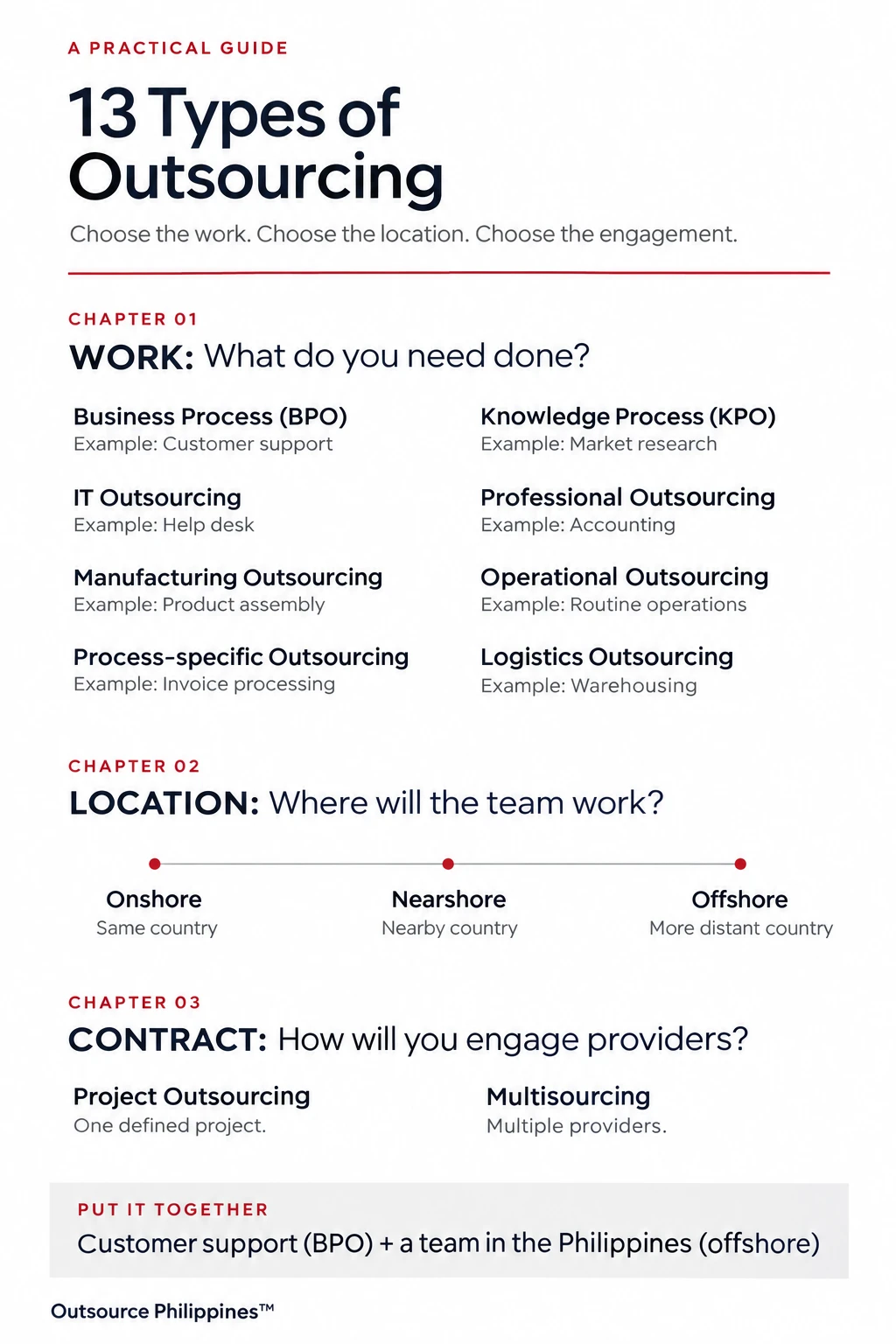
There are 13 common types of outsourcing. Three decisions shape which ones you use.
Work
What will you outsource?
- Business process outsourcing (BPO)
- Customer support
- Knowledge process outsourcing (KPO)
- Market research
- IT outsourcing
- Help desk
- Professional outsourcing
- Accounting
- Manufacturing outsourcing
- Product assembly
- Operational outsourcing
- Equipment maintenance
- Process-specific outsourcing
- Invoice processing
- Logistics outsourcing
- Warehousing
Location
Where will the work happen?
- Onshore outsourcing
- A U.S. business using a U.S. provider
- Nearshore outsourcing
- A U.S. business using a Mexican provider
- Offshore outsourcing
- A U.S. business using a Philippine provider
Contract
How will you engage providers?
- Project outsourcing
- A website redesign
- Multisourcing
- Separate providers for payroll and IT
Example A team in the Philippines handling customer support combines business process outsourcing (BPO) with offshore delivery.
Which Types of Outsourcing Are Defined by the Work?
Eight types are named for the kind of work that moves. The line between them is the level of judgment the work needs and whether it is a service, a product, or a physical flow of goods.
1. Business Process Outsourcing (BPO)
BPO covers repeatable processes that follow documented steps and produce measurable results. Common examples are customer support by phone, email, and chat, data entry, order processing, bookkeeping, and payroll. An ecommerce brand might hand its email and chat queues to a dedicated team, while a logistics company might outsource accounts receivable follow-up. The work splits into front-office (customer-facing) and back-office (internal) processes, the two main models of business process outsourcing.
2. Knowledge Process Outsourcing (KPO)
KPO is outsourcing for work where the value is in analysis and expertise rather than volume. Market research, data analytics, financial modeling, patent research, and some legal and medical review fall here. An investment firm that sends earnings-model updates to an outside analyst team is using KPO. KPO costs more per hour than BPO because the people doing it are specialists, and it needs tighter review because errors are harder to spot. Cost per hour and review effort are the two biggest practical differences between BPO and KPO.
3. IT Outsourcing
IT outsourcing hands technology work to an external firm: software and mobile app development, quality assurance testing, cloud migration, DevOps, infrastructure management, and help desk support. Companies use it to reach skills they cannot hire locally and to pay for development capacity only while a roadmap needs it. The main risks are data security and code quality, so contracts should set access controls, review rights, and acceptance criteria up front.
4. Professional Outsourcing
Professional outsourcing buys specialist services, such as legal, accounting, tax, marketing, or recruiting, from outside firms instead of building those departments. A small company that retains an outside accounting firm or marketing agency is already doing it. The benefit is senior expertise on demand. The trade-off is that the provider’s time is shared with other clients unless you pay for dedicated capacity.
5. Manufacturing Outsourcing
Manufacturing outsourcing uses a contract manufacturer to produce goods or components. It is standard in electronics, apparel, automotive parts, pharmaceuticals, and consumer products, where specialized plants reach economies of scale an individual brand cannot. The best-known example is Apple, which designs its iPhones in-house and contracts most of the assembly to partners such as Foxconn, while keeping control through its own supplier standards. The challenges are quality control, supply chain disruption, local regulation and, for overseas plants, distance and language. Most brands manage these with written specifications, factory audits, and incoming inspection.
6. Operational Outsourcing
Operational outsourcing moves routine operating functions, such as facilities management, equipment maintenance, procurement support, or supply chain administration, to a third party. A hospital that contracts cleaning, security, and equipment maintenance to a facilities firm is outsourcing operations. The goal is steady, predictable execution of work that has to happen every day but does not set the company apart. It works best with clear service levels and regular reporting.
7. Process-specific Outsourcing
Process-specific outsourcing carves out one narrow process, such as invoice processing, delivery scheduling, or claims intake, while the rest of the department stays in-house. A dental group that outsources only insurance eligibility checks is a typical case. It is a common first step because it limits risk: the scope is small, the hand-off points are easy to define and results are simple to measure.
8. Logistics Outsourcing
Logistics outsourcing hands transportation, warehousing, and distribution to specialists with the networks and systems to run them at scale. It comes in several forms:
- Order fulfillment: a provider picks, packs, and ships customer orders.
- Inventory management: a provider stores and tracks stock across locations.
- Freight forwarding: a provider arranges the movement of goods between regions or countries.
Logistics contracts are also described by how much they cover:
- Third-party logistics (3PL): the provider runs physical logistics, such as warehousing and transportation.
- Fourth-party logistics (4PL): the provider manages the wider supply chain, often coordinating several 3PLs.
- Fifth-party logistics (5PL): the provider plans and optimizes whole supply networks, often across ecommerce channels, and adds consulting.
Which Types of Outsourcing Are Defined by Location?
The outsourcing terms offshore, nearshore, and onshore describe where the provider sits relative to you. Location changes cost, time-zone overlap, and how much travel and oversight the relationship needs.
9. Offshore Outsourcing
Offshore outsourcing sends work to a provider in a distant country, usually to lower costs and reach a larger talent pool. For US companies, the Philippines and India are the best-known destinations for services work. The Philippine IT and business process management (IT-BPM) industry ended 2025 with export revenue above US$40 billion, according to the IT and Business Process Association of the Philippines (IBPAP).
- US$40B+IT-BPM export revenue in 2025IBPAP via Philippine Daily Inquirer, Jan 2026
- ~1.9MIT-BPM workforce projected for 2025IBPAP via Context.ph, Dec 2025
- #25Global rank, EF English Proficiency Index 2026EF EPI 2026
The trade-offs are time-zone distance and cultural fit. Philippine teams on US accounts typically work the night shift so their hours match yours, and the country ranks 25th worldwide on the 2026 EF English Proficiency Index. Scale, English skills, and decades of night-shift experience are the main reasons US companies build teams in the Philippines. Outsource Philippines™ quotes costs based on the role, scope, coverage hours, and team size.
10. Nearshore Outsourcing
Nearshore outsourcing uses a provider in a nearby country, such as Mexico or Canada for a US company. A US software company running a development team in Mexico City or Bogotá is a typical case. The main benefit is overlapping working hours, which makes live collaboration and travel easier. Costs usually sit between onshore and offshore, and the talent pool is smaller than in the large offshore markets.
11. Onshore Outsourcing
Onshore outsourcing, sometimes called domestic outsourcing, uses a provider in your own country, such as a US company retaining a US law firm or accounting practice. It offers the simplest communication, the same legal system, and easy on-site visits, but at local wage levels, so the cost savings are the smallest of the three.
| Factor | Onshore | Nearshore | Offshore |
|---|---|---|---|
| Provider location | Same country | Neighboring country | Distant country |
| Time-zone overlap | Full | Close | Night shift needed |
| Relative cost | Highest | Moderate | Lowest |
| Talent pool size | Local market | Regional | Largest |
| Best for | Regulated or on-site work | Live collaboration | Scale and long coverage hours |
Which Types of Outsourcing Are Defined by How the Work Is Contracted?
Project outsourcing and multisourcing describe the shape of the engagement rather than the work or the location.
12. Project Outsourcing
Project outsourcing hands a defined piece of work with a start date, an end date, and deliverables to a provider. Website builds, product design, system migrations, and one-off research studies are typical. Before Slack launched, its founders hired the design agency MetaLab to shape the product's interface, logo, and website, so a small team got specialist design work while it built the product. It suits seasonal peaks and skills you need only once, and it protects permanent staff from overload. Clear scope, milestones, and acceptance criteria written into the contract are what keep project outsourcing on schedule and on budget.
13. Multisourcing
Multisourcing splits work across several specialist providers, for example one for IT infrastructure, one for customer support, and one for logistics. You get the best provider for each function and avoid depending on a single vendor. The cost is coordination: someone on your side has to own governance, shared performance targets, and the hand-offs between vendors.
How Do the Types of Outsourcing Compare?
The table below compares all 13 types by what moves, a typical example, and the situation each one fits best.
| Type | What is outsourced | Typical example | Best fit |
|---|---|---|---|
| BPO | Repeatable business processes | Customer support, data entry | High-volume documented work |
| KPO | Expert, judgment-based work | Market research, analytics | Specialist skills on demand |
| IT | Technology work | App development, help desk | Skills you cannot hire locally |
| Professional | Specialist services | Legal, accounting, marketing | Expertise without a department |
| Project | A defined project | Website build, migration | One-off or seasonal work |
| Manufacturing | Production of goods | Contract manufacturing | Scale without owning plants |
| Operational | Routine operating functions | Facilities, maintenance | Steady background work |
| Process-specific | One narrow process | Invoice processing | A low-risk first step |
| Logistics | Moving and storing goods | 3PL fulfillment | Product businesses |
| Multisourcing | Work split across vendors | IT plus support plus logistics | Large, varied operations |
| Offshore | Any work, far away | Philippine support team | Cost and coverage hours |
| Nearshore | Any work, nearby | Mexican dev team | Same-hours collaboration |
| Onshore | Any work, same country | Domestic law firm | Regulated or on-site work |
What Are the Benefits and Risks of Outsourcing?
The benefits are lower cost, more focus, longer coverage, and faster access to skills and capacity. The risks are loss of control, quality drift, hidden costs, and data exposure, and every one of them is managed in the contract and the setup.
- Benefit, lower cost: you pay for capacity in a lower-cost market or only when the work exists, without the recruiting, training, and overhead an in-house hire carries.
- Benefit, no infrastructure to build: the provider supplies the office, computers, network, software licenses, backup power, and IT support.
- Benefit, focus: in-house staff spend their time on the work that grows the business.
- Benefit, skills and scale: providers bring trained people and add capacity faster than in-house hiring. A retailer can add support seats for the holiday season and return to normal size in January.
- Benefit, longer hours: an offshore team covers nights and weekends, so your staff start each morning with a cleared queue.
- Benefit, outside quality checks: the provider's quality team scores work against agreed standards and reports accuracy and turnaround.
- Risk, less direct control: agree on KPIs, reporting, and escalation rules before work starts.
- Risk, quality drift: use quality reviews against your own rubric and regular performance meetings.
- Risk, hidden costs: get setup, transition, and change requests priced in writing, and count your own management time.
- Risk, data exposure: require access controls, monitored workstations, and compliance with the privacy laws that apply to you.
For services work in the Philippines, that means compliance with the Data Privacy Act of 2012. Outsource Philippines™ follows it and protects client work with a managed firewall and WorQmate, its in-house project and employee monitoring platform.
How Do You Choose the Right Type of Outsourcing?
Start from the problem you need to solve, then pick the type that addresses it. A cost problem points toward offshore BPO, a skills gap toward KPO, IT, or professional outsourcing, and a one-time peak toward project outsourcing.
- 1Name the problem
Cost, a skills gap, coverage hours or a one-time peak each point to a different type.
- 2Pick the first piece of work
Choose one documented, measurable process or project to move first.
- 3Choose the location
Weigh onshore, nearshore and offshore against cost and time-zone needs.
- 4Set KPIs and security terms
Agree targets, reporting, access controls and privacy terms before launch.
- 5Start small, then expand
Run one function until targets hold, then add more work or roles.
What Goes Into a Written Outsourcing Strategy?
A short written plan keeps the choice tied to results. It should cover five things:
- Goals as numbers. Set a target response time, coverage window, or cost ceiling, and name one person in-house who owns the relationship.
- The right tasks. Keep the work that sets you apart in-house. A task with written steps and measurable output, run in systems an offshore team can access, is a strong candidate. If it lives in one person's head, document it first.
- The relationship model. Choose between a fixed-price project, time-and-materials work, staff augmentation, or a dedicated team.
- The contract set. A master service agreement, a non-disclosure agreement, clear IP ownership, and a data processing agreement.
- KPIs and a trial. Start with one documented process, agree targets for the first 30, 60, and 90 days, review them monthly, and expand once the team meets them.
Price the options on the same basis. Outsource Philippines™ quotes an hourly rate per agent in a written proposal, and the role, shift, and team size all shape how our pricing works. Most teams go live in 2 to 4 weeks, depending on the role.
Is Outsourcing Right for Your Business?
Outsourcing is a strong fit when you have repeatable work with clear steps, steady or growing volume, and in-house people whose time is worth more elsewhere. It is a weak fit for work that sets you apart from competitors, depends on unwritten knowledge held by a few senior people, or arrives too irregularly to keep a team busy.
If customer support or back-office work is the first function you want to move, our back-office outsourcing services cover data entry, bookkeeping, payroll, and more with dedicated agents who work only on your account. Request a proposal with the roles, hours, and volumes you have in mind.
Frequently Asked Questions
What Are the Three Main Types of Outsourcing by Location?
The three location-based types are onshore, nearshore, and offshore outsourcing. Onshore uses a provider in your own country, nearshore uses one in a neighboring country with similar working hours, and offshore uses one in a distant country, usually for lower cost and a larger talent pool. Each can be combined with any type of work, such as BPO or IT.
What Is the Difference between BPO and KPO?
BPO, or business process outsourcing, covers repeatable processes such as customer support, data entry, and payroll that follow documented steps. KPO, or knowledge process outsourcing, covers work that depends on expert judgment, such as research, analytics, and financial modeling. KPO typically costs more per hour, needs more specialized staff, and calls for closer review of the output.
Which Type of Outsourcing Is Best for a Small Business?
Most small businesses start with process-specific or BPO work, such as customer support, bookkeeping, or data entry, because the scope is easy to define and results are simple to measure. Offshore delivery keeps the cost low. Once the first function runs smoothly, companies often add more processes or move to a dedicated team covering several roles.
What Is the Difference between Outsourcing and Offshoring?
Outsourcing is about who does the work: a third-party provider runs a function for you, at home or abroad. Offshoring is about where the work happens: another country, possibly with your own employees in your own office. Offshore outsourcing combines both, with a provider in a lower-cost country running the work for you.
What Is Multisourcing?
Multisourcing is splitting outsourced work across several specialist providers instead of one, for example separate vendors for IT, customer support, and logistics. It gives you the strongest provider for each function and reduces dependence on a single vendor. In exchange, you need clear governance, shared performance targets, and someone in-house who owns coordination between the providers.
Is Offshore Outsourcing Safe for Customer Data?
It can be, when the provider follows the data privacy laws that apply to your business and to its own country, such as the Philippine Data Privacy Act of 2012. Look for access controls, monitored workstations, a managed firewall, and data-handling rules written into the contract, plus any industry requirements you must meet, such as HIPAA for health data.