Content Marketing Benefits: 6 Tips to Apply and 7 Mistakes to Avoid

On This Page
- What Are the Benefits of Content Marketing?
- Why Isn’t Your Content Marketing Working?
- What Content Marketing Tips Should You Follow?
- What Content Marketing Mistakes Should You Avoid?
- What Types of Content Grow a Business?
- Is Outsourcing Content Marketing Right for Your Business?
- Frequently Asked Questions
Content marketing is publishing useful articles, videos, emails, and social posts that attract and keep customers instead of interrupting them with ads. Its main benefits are better search visibility, industry authority, steady new leads, and lower long-term acquisition costs. It works when you follow a documented plan, promote what you publish, and measure results.
Traditional advertising on TV, radio, and in newspapers reaches fewer buyers than it used to, while most people now research purchases online. Content marketing, a subset of digital marketing, meets them there. This guide explains the benefits of content marketing, six reasons it may not be working for you, six tips to apply, seven mistakes to avoid, and the content types that grow a business.
What Are the Benefits of Content Marketing?
Content marketing earns attention you would otherwise have to buy. Done consistently, it delivers five benefits:
- Better SEO rankings: useful pages rank for the questions your buyers search.
- Industry authority: expert content builds trust before a sales conversation starts.
- New customers: people who find your content become leads you did not pay per click for.
- Cost-effectiveness: a good article keeps working for months or years after it is published.
- Customer nurturing: content answers questions for buyers who are not ready to purchase yet.
Content now also feeds AI search. A Pew Research Center study of 900 US adults found that users clicked a traditional search result on 8% of visits when Google showed an AI summary, compared with 15% when it did not. Clear, quotable content that answers questions directly gives you a better chance of being cited in those summaries. In practice, that means putting a short, direct answer at the top of each page, using headings phrased as the questions buyers ask, and backing claims with named, current sources that an AI system can verify and quote.
Why Isn’t Your Content Marketing Working?
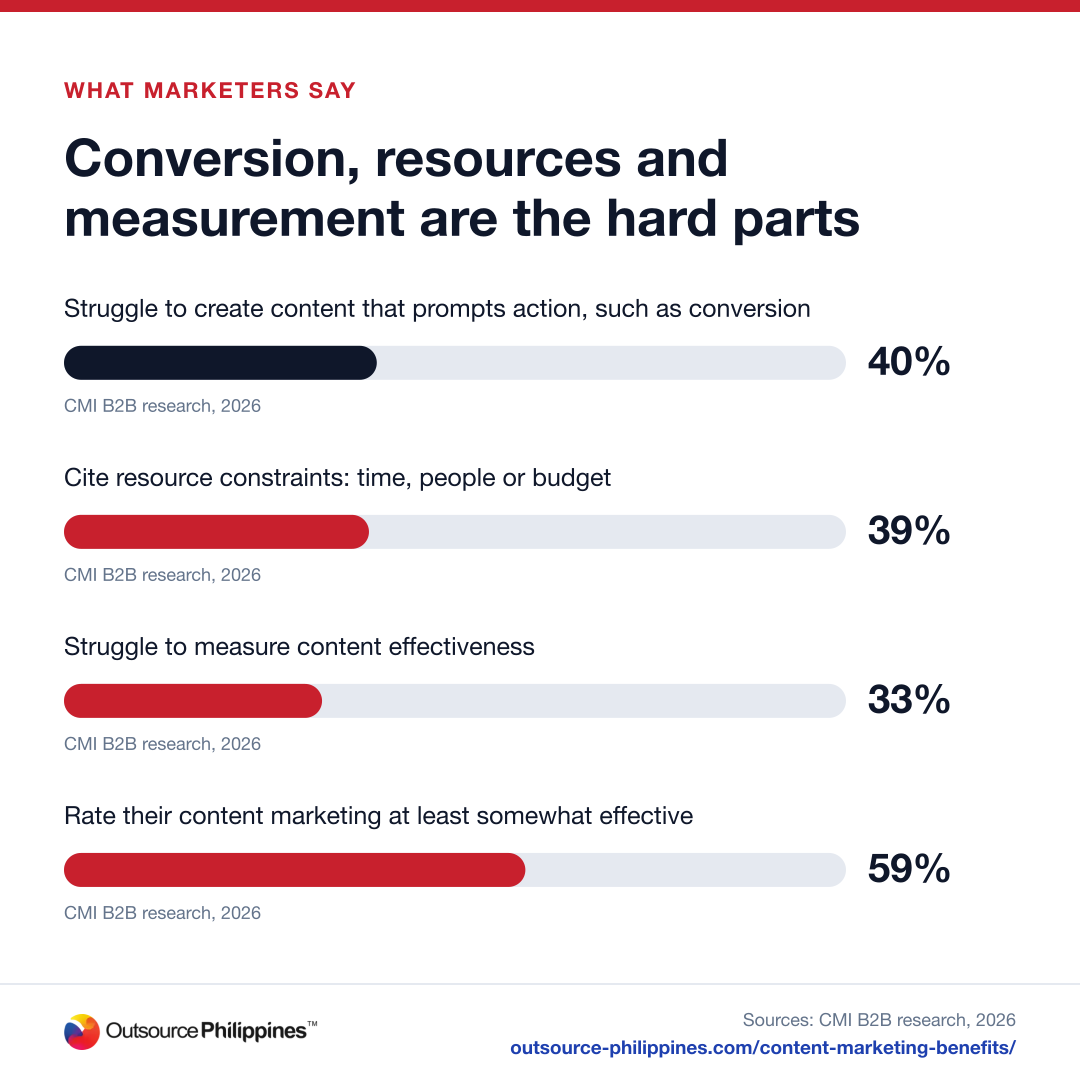
Usually because there is no plan, no budget, no clear audience value, weak SEO, little promotion, or too little patience. As more companies publish, it gets harder to stand out, and results that come slowly can feel like failure. Even experienced teams struggle: the Content Marketing Institute surveyed 1,015 B2B marketers in 2025 for its 2026 research and found that only 59% rated their content marketing at least somewhat effective.
- 40%Struggle to create content that prompts action, such as conversionCMI B2B research, 2026
- 39%Cite resource constraints: time, people or budgetCMI B2B research, 2026
- 33%Struggle to measure content effectivenessCMI B2B research, 2026
- 59%Rate their content marketing at least somewhat effectiveCMI B2B research, 2026
1. You Do Not Have a Formal Content Marketing Plan
Write your plan down before you start: audience, goals, topics, formats, channels, and how you will measure success. A plan does not guarantee results, but it shows you what worked and what to change. Without one, you go in circles and waste time and money.
2. You Do Not Have a Sufficient Budget
Quality content takes time and skill, and businesses with larger budgets see results sooner. On a tight budget, focus on lower-cost tactics such as blogging and social media, track return on investment (ROI) and move spending to what performs. Investing in the right content creators can also cost less than building a full in-house team.
3. Your Content Is Repetitive and Inauthentic
Write for your audience’s needs, interests, and pain points. Content should be original, informative, engaging, and honest, backed by real examples and solid research. Provide value rather than just selling your products.
4. You Are Not Using SEO Effectively
Use keyword research and SEO best practices so people can find your content in search, and relevant hashtags so it is discovered on social media.
5. You Are Not Promoting Enough
Publishing is only half the work. Promote every piece through social media, email newsletters, and other websites where appropriate, and consider influencers who share your target audience.
6. You Are Not Patient with Results
Content marketing is a long-term process. Some pieces perform quickly, but search rankings and audience trust usually build over many months of consistent publishing, so commit to a steady schedule before judging the program.
What Content Marketing Tips Should You Follow?
Know your audience, give every piece a goal, optimize for search, promote across channels, use analytics, and repurpose what works.
1. Identify the Audience You Want to Reach
Build buyer personas to guide your strategy. Your audience includes people who are not ready to buy yet: attract them with helpful content, then follow up with content that shows how you can help when they are ready.
2. Establish the Goal of Each Piece
Give every piece one clear goal and one KPI, such as signups, demo requests, or time on page. Research what your audience cares about, target relevant long-tail keywords, and plan topics in a content calendar.
3. Optimize Your Content for SEO
Without optimization, content will not get the visibility it needs. Use the search terms your audience uses in headings, descriptions, body copy, and image alt text, and answer the main question near the top of the page.
4. Promote Your Content through Multiple Channels
Share across social networks, email, and partner sites, use paid targeting where it makes sense, and build reach through influencer partnerships and the link-building that comes with outsourced SEO.
5. Use Analytics to Drive Your Strategy
Track page views, engagement, conversions, and search rankings. Tools such as Google Search Console, Google Trends, Semrush, and BuzzSumo help you monitor competitors and find new topics.
6. Reuse Successful Content in New Ways
Repurpose a strong article into a video, an infographic, or a social series. Use remarketing to re-engage people who showed interest but did not convert, so you reach them again at the right time.
What Content Marketing Mistakes Should You Avoid?
Most failures come from skipping research, goals, SEO, promotion, or measurement. Avoid these seven mistakes:
- Neglecting audience research: content built without knowing the reader rarely lands.
- Having unclear goals: good writing alone will not stand out without a purpose.
- Writing only for sales: audiences spot thinly disguised ads; high-quality content that solves problems builds trust instead.
- Disregarding SEO: great content is useless if buyers cannot find it, and search engines change what they reward often.
- Neglecting promotion: choose the right keywords, phrases, and channels to reach your audience.
- Failing to adapt to trends: customer preferences and formats change, so research them regularly.
- Not evaluating ROI: track traffic, engagement, and conversions, then adjust toward what pays off.
What Types of Content Grow a Business?
Use a mix of formats, because different buyers prefer different ones and each format suits a different stage of the buying journey. These eleven types are the most common:
- Blog posts.
- Infographics.
- Videos.
- Podcasts.
- E-books.
- Social media posts.
- Case studies.
- Newsletters.
- Memes.
- Courses.
- Free tools.
Staying current with industry trends helps you decide which formats deserve more effort each year. Blog posts and case studies build search traffic and trust, while video, social posts, and newsletters keep your brand in front of people between purchases.
Start with the two or three formats your audience already uses, do them well, and add more once you have a steady publishing rhythm.
Is Outsourcing Content Marketing Right for Your Business?
Outsourcing makes sense if you have a plan but not the hours to execute it consistently, or if promotion and reporting keep slipping. Keep strategy, subject expertise, and final sign-off in-house. It is a weaker fit if you have not yet defined your audience and goals, because no team can fix an unclear strategy.
Outsource Philippines™ provides dedicated, English-language specialists for social media and digital marketing work such as content scheduling and campaign reporting, with graphics handled by its graphic design team.
Frequently Asked Questions
What Are the Main Benefits of Content Marketing?
Content marketing improves search visibility, builds industry authority, attracts new customers, and nurtures buyers who are not ready to purchase yet. Because a strong article or video keeps working long after it is published, it can lower long-term customer acquisition costs compared with paying for every click or impression through advertising alone.
How Long Does Content Marketing Take to Show Results?
Some pieces gain traction within weeks, especially when promoted through email and social media. Search rankings and audience trust usually take many months of consistent publishing to build. Judge a program on trends over at least two quarters, tracking traffic, engagement, and conversions, rather than on the performance of single posts.
What Is the Biggest Content Marketing Challenge?
In the Content Marketing Institute’s 2026 B2B research, the top challenge was creating content that prompts a desired action, such as a conversion, cited by 40% of marketers. Resource constraints followed at 39%, and measuring content effectiveness at 33%. Clear goals per piece and consistent measurement address all three.
Which Content Marketing Metrics Should You Track?
Track metrics tied to each piece’s goal: page views and search rankings for visibility, time on page and social engagement for interest, and leads, signups, or sales for conversion. Review them monthly, compare formats and topics, and shift effort toward the content that moves buyers closer to a purchase.