Synonyms for Outsourcing: Alternative Terms and What Each One Means

On This Page
- Synonyms for Outsource, Outsourced, and Outsourcing
- What Is Another Word for Outsourcing?
- What Do the Main Outsourcing Terms Mean?
- Which Outsourcing Term Fits Which Situation?
- How Is Offshoring Different from Outsourcing?
- Which Terms Are Often Mistaken for Outsourcing?
- Why Does the Right Outsourcing Term Matter?
- Where Does the Philippines Fit among Outsourcing Models?
- Which Outsourcing Model Is Right for Your Business?
- Frequently Asked Questions
Common synonyms for outsourcing include contracting out, subcontracting, farming out, and third-party sourcing. Related terms describe a specific kind of outsourcing: offshoring (another country), nearshoring (a nearby country), onshoring (your own country), business process outsourcing (BPO), managed services, and staff augmentation. Each implies a different location, scope, or level of control.
This guide lists the alternative terms for outsourcing with a one-line definition for each, separates true synonyms from related models, and gives a table of which term fits which situation. It also covers the words that are often confused with outsourcing but mean something else, and why the right term matters when you write a contract.
Synonyms for Outsource, Outsourced, and Outsourcing
The right synonym depends on the word form you need:
| Word | Synonyms | Example |
|---|---|---|
| Outsource (verb) | contract out, farm out, subcontract, offshore, hand off | "We contract out our payroll." |
| Outsourced (adjective) | contracted out, farmed out, subcontracted, third-party, externally sourced, offshored | "Our third-party support team handles weekend calls." |
| Outsourcing (noun) | contracting out, subcontracting, third-party sourcing, external sourcing, outtasking | "Contracting out cut our processing time in half." |
What Is Another Word for Outsourcing?
The closest plain-English synonyms are contracting out, farming out, and subcontracting. All three mean paying an outside party to do work your own staff would otherwise do, which matches the Merriam-Webster definition of outsourcing: to procure goods or services “from outside sources” or to contract work out to outside workers.
- Contracting out: hiring an outside company to deliver a service, the most common synonym in government and public-sector writing.
- Farming out: informal; handing a task to someone outside the team or company.
- Subcontracting: passing part of a job you have already been hired for to another firm.
- Third-party sourcing or external sourcing: procurement language for buying a service from an outside provider.
- Outtasking: outsourcing a single, narrow task rather than a whole function.
- Delegating to a vendor or service provider: everyday business phrasing for the same idea.
What Do the Main Outsourcing Terms Mean?
Beyond simple synonyms, most outsourcing terms add one detail: where the work happens, how much of the process moves, or who manages the people. Grouping them that way makes them easy to tell apart.
Terms About Location
- Offshoring: moving work to another country, often far away, such as a US company using a team in the Philippines.
- Nearshoring: moving work to a nearby country with similar time zones, such as a US company using a provider in Mexico.
- Onshoring (domestic outsourcing): outsourcing to a provider in your own country.
- Rightshoring: choosing the location that best balances cost, skills, and risk for each function, as explained in our rightshoring guide.
- Multishoring: spreading work across several locations or providers to reduce risk.
Terms About Scope
- Business process outsourcing (BPO): handing an entire business process, such as customer service, data entry, or payroll, to a specialist provider.
- Knowledge process outsourcing (KPO): outsourcing analytical or expert work, such as research, financial analysis, or legal review.
- IT outsourcing (ITO): outsourcing software development, infrastructure, or IT support.
- Managed services: a provider takes ongoing responsibility for running a function to agreed service levels, common in IT.
Terms About Staffing and Control
- Staff augmentation: adding outside people to your team temporarily; you direct their work.
- Outstaffing: remote staff stay legally employed by a provider but work full-time under your direction.
- Dedicated team: a provider recruits and manages people who work only on your account.
- Freelancing or contracting: hiring independent individuals per project rather than a company.
- Co-sourcing: your in-house team and an outside provider share a function, such as internal audit.
BPO and KPO are often confused; the difference is routine, rules-based work versus judgment-heavy work.
Which Outsourcing Term Fits Which Situation?
Pick the term that describes what you actually need: the location, the scope of work, and who manages the people. Using the precise word in a proposal or contract avoids paying for the wrong model.
| Your situation | Best-fitting term |
|---|---|
| You want lower labor costs and longer coverage hours | Offshoring |
| You need overlap with your own working hours | Nearshoring |
| Data or contracts must stay in your country | Onshoring |
| A whole process, such as support or bookkeeping, moves out | Business process outsourcing |
| Expert analysis or research work | Knowledge process outsourcing |
| A provider runs a function to service levels | Managed services |
| You need extra hands on your team for a few months | Staff augmentation |
| Full-time remote staff, managed by a provider, only on your work | Dedicated team or outstaffing |
| One defined deliverable | Freelancing, contracting, or outtasking |
| You keep control but need specialist help | Co-sourcing |
Many companies combine the main types of outsourcing: offshore BPO for customer support, a freelancer for a one-off design project and co-sourcing for audit. Mapping each function against these models shows where each one fits.
How Is Offshoring Different from Outsourcing?
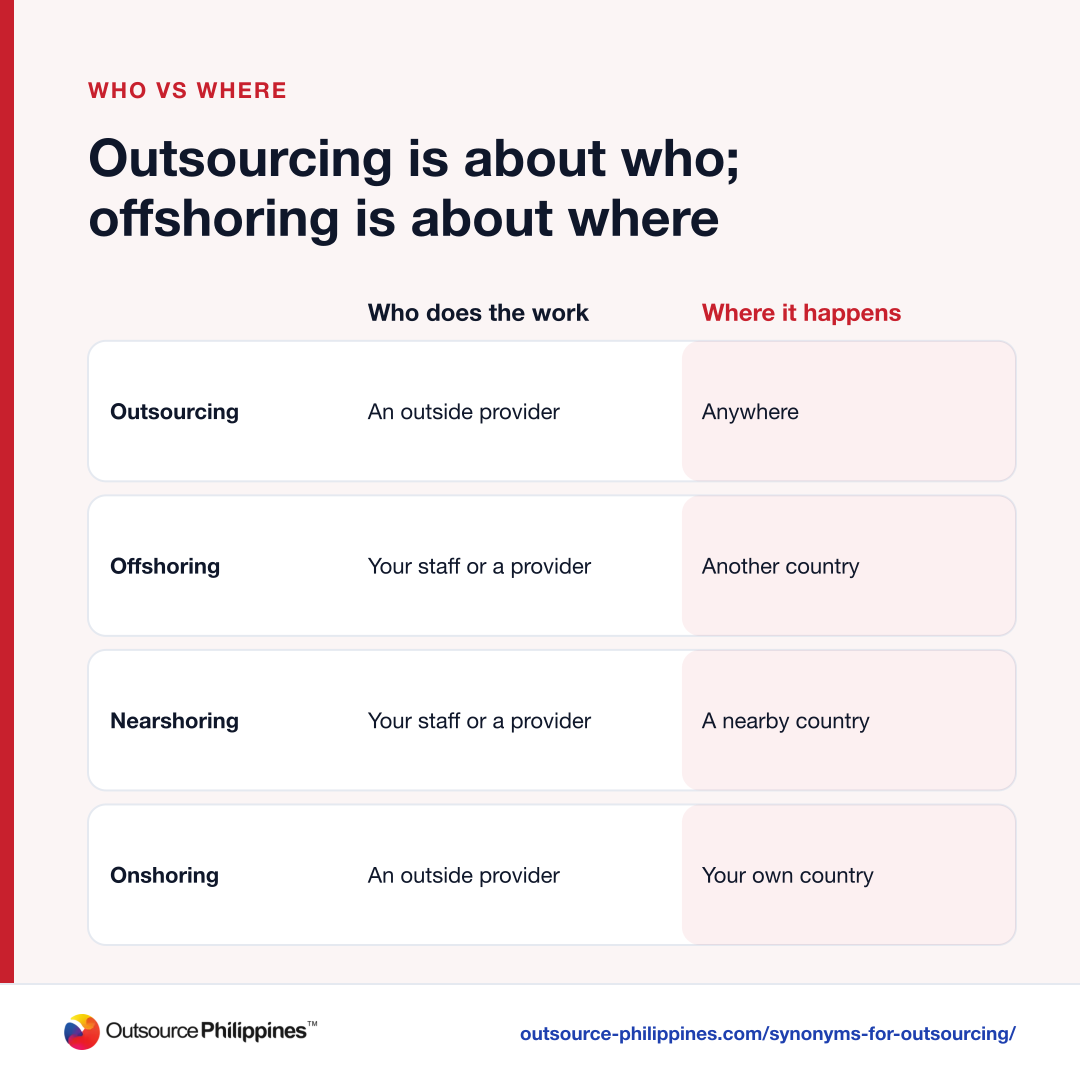
Outsourcing is about who does the work: an outside company. Offshoring is about where the work happens: another country. The two often overlap, but you can offshore without outsourcing by opening your own overseas office, and you can outsource without offshoring by hiring a local provider.
| Term | Who does the work | Where it happens |
|---|---|---|
| Outsourcing | An outside provider | Anywhere |
| Offshoring | Your staff or a provider | Another country |
| Nearshoring | Your staff or a provider | A nearby country |
| Onshoring | An outside provider | Your own country |
The same split explains nearshoring and onshoring: both describe location, not ownership. A company that sets up its own center abroad is offshoring through what is now often called a captive or global capability center, while a company that hires a Philippine provider is both outsourcing and offshoring. When you compare proposals, check which of the two you are actually being offered, because it changes who employs the staff, who carries compliance risk and who manages day-to-day performance.
Staffing terms add a third question: who directs the people. An offshore staffing arrangement gives you remote staff who work only on your tasks, which sits between hiring freelancers yourself and handing over a whole process.
Which Terms Are Often Mistaken for Outsourcing?
Insourcing, shared services, and captive centers are often used as if they meant outsourcing, but all three keep the work inside your own company.
- Insourcing: the opposite of outsourcing; bringing work back in-house or giving it to internal staff. The trade-offs are covered in our insourcing vs outsourcing guide.
- Shared services: one internal unit serves several divisions of the same company, such as a central finance team.
- Captive center or global capability center: a company-owned operation in another country. It is offshoring, not outsourcing.
- Automation: replacing a manual task with software. It can sit inside an outsourced service but is not a synonym for it.
Why Does the Right Outsourcing Term Matter?
The term you use sets expectations for scope, management, and pricing. “Staff augmentation” suggests you manage the people; “managed services” suggests the provider is accountable for results. Write the model into the contract so both sides mean the same thing.
Clear terms matter more as services change. In the 2024 Deloitte Global Outsourcing Survey, 83% of surveyed executives said they use AI as part of their outsourced services. When a provider mixes people and software, the contract should say which tasks are done by dedicated staff, which are automated and how quality is measured.
Where Does the Philippines Fit among Outsourcing Models?
The Philippines is mainly an offshoring and BPO destination for English-language customer support and back-office work. US companies use Philippine providers for dedicated teams that cover US hours from the night shift in Manila.
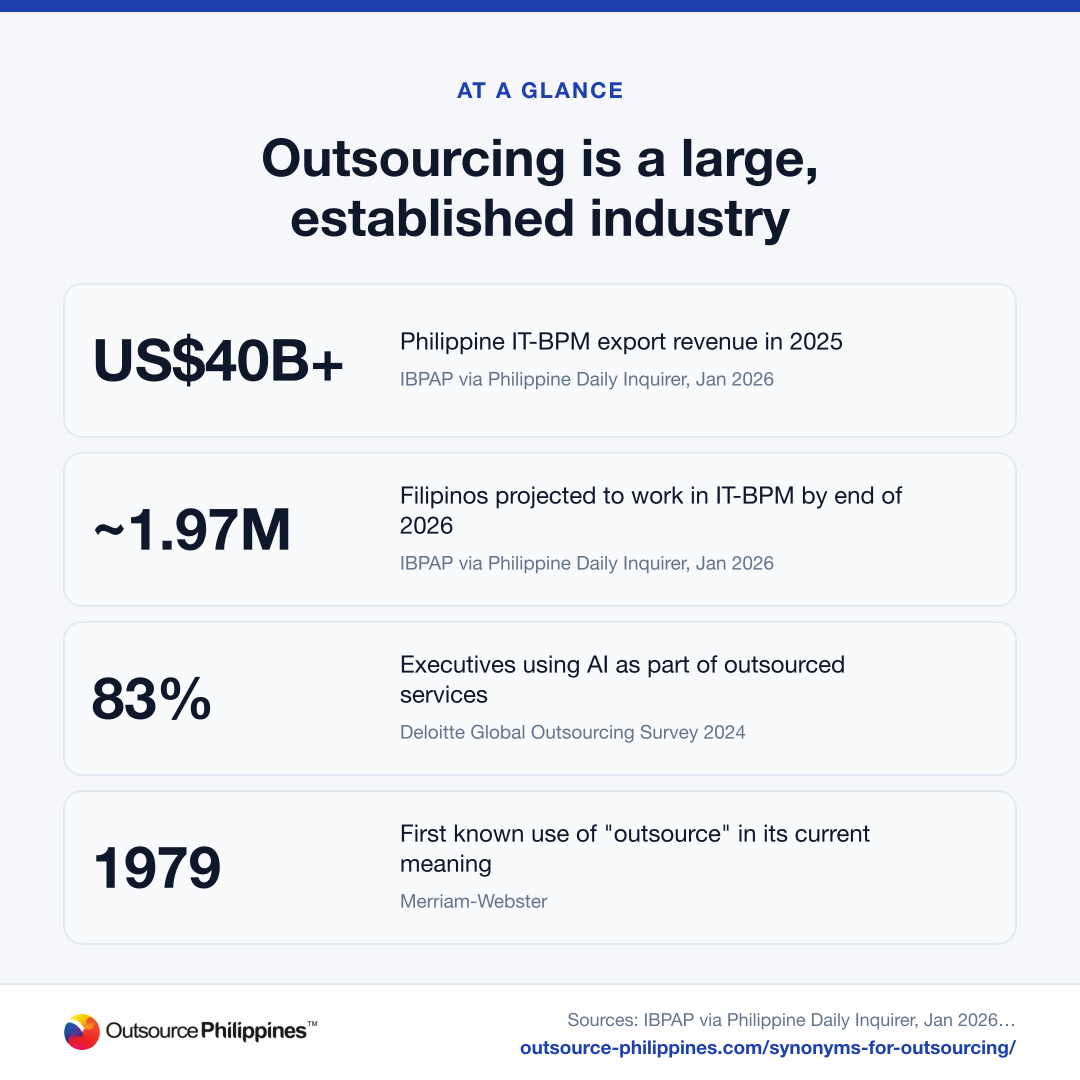
- US$40B+Philippine IT-BPM export revenue in 2025IBPAP via Philippine Daily Inquirer, Jan 2026
- ~1.97MFilipinos projected to work in IT-BPM by end of 2026IBPAP via Philippine Daily Inquirer, Jan 2026
- 83%Executives using AI as part of outsourced servicesDeloitte Global Outsourcing Survey 2024
- 1979First known use of "outsource" in its current meaningMerriam-Webster
The industry’s scale is why the terms “outsourcing” and “BPO” are so closely tied to the country. According to the IT and Business Process Association of the Philippines, reported by the Philippine Daily Inquirer, IT-BPM export revenue passed US$40 billion in 2025, and the sector is projected to employ about 1.97 million Filipinos by the end of 2026. For a US buyer, the practical meaning is a deep pool of experienced agents and team leads, and providers that already run night-shift operations for US clients.
Which Outsourcing Model Is Right for Your Business?
If you need ongoing English-language support or back-office work handled by people who work only on your account, offshore BPO with a dedicated team is usually the strongest fit. If you need a single deliverable, a freelancer or contractor is simpler, and if the work must stay in your country, look at onshore providers.
Outsource Philippines™ is an offshore BPO provider that has run dedicated teams in the Philippines since 2000, with each staff member working only on one client's account from a supervised office.
Frequently Asked Questions
What Is Another Word for Outsourcing?
The closest synonyms are contracting out, subcontracting, farming out, and third-party sourcing. More specific terms describe a type of outsourcing: offshoring and nearshoring refer to location, business process outsourcing and managed services refer to scope, and staff augmentation or outstaffing refer to how the outside people are managed.
Is Offshoring the Same as Outsourcing?
No. Outsourcing means an outside company does the work; offshoring means the work happens in another country. A US company that hires a Philippine provider is doing both. A company that opens its own office abroad is offshoring without outsourcing, and one that hires a local vendor is outsourcing without offshoring.
What Is the Opposite of Outsourcing?
The opposite of outsourcing is insourcing: keeping work in-house or bringing previously outsourced work back to your own employees. Companies insource when a function becomes core to their competitive advantage, when quality or control problems appear, or when internal volume grows enough to justify a permanent in-house team.
What Is the Difference between Staff Augmentation and Outsourcing?
With staff augmentation, outside people join your team and you direct their daily work, usually for a set period. With outsourcing, the provider takes responsibility for delivering a service or process, including supervision and quality. Staff augmentation adds capacity; outsourcing hands over an outcome, often under agreed service levels.