Insourcing vs. Outsourcing: How to Choose

On This Page
- What Is Insourcing, and How Is It Different from Outsourcing?
- What Are the Key Differences between Insourcing and Outsourcing?
- How Much Does Outsourcing Cost Compared with Hiring In-house?
- What Are the Advantages of Insourcing?
- What Are the Advantages of Outsourcing?
- How Do Outsourced Teams Compare with Hiring Local Talent?
- What Should You Keep In-house?
- How Do You Decide between Insourcing and Outsourcing?
- Should You Insource or Outsource?
- Frequently Asked Questions
Insourcing vs outsourcing comes down to who does the work. Insourcing keeps a function inside your company with your own employees, giving you more control but higher fixed costs and slower hiring. Outsourcing hands it to an external provider, which lowers overhead and adds capacity quickly but requires clear processes, service levels, and a partner you trust.
You’re growing, the to-do list is longer, the team is stretched, and someone in the last leadership meeting asked: “Should we just outsource this?” Both answers have real merit and real risks. This guide covers what insourcing and outsourcing mean, the key differences side by side, the true cost of an in-house hire, the advantages of each model, how outsourced teams compare with local hires, which functions to keep in-house, and a simple framework for deciding.
What Is Insourcing, and How Is It Different from Outsourcing?
Insourcing means keeping work inside your organization, whether by giving new duties to existing staff, building a new department, or hiring full-time employees for a function. Outsourcing means paying an external provider to do that work for you, onshore or offshore.
Companies usually choose insourcing when they want:
- Full visibility and control over how work gets done
- Tighter data security, especially for roles that handle sensitive information
- Deep institutional knowledge built within a permanent team
A common example is a business that builds its own marketing team instead of hiring an agency, or staffs its own customer service department instead of contracting a BPO provider. Insourcing gives you alignment and control. The trade-off is higher overhead, a longer ramp-up, and the ongoing cost of managing and keeping full-time staff. Outsourcing reverses that trade: lower overhead and faster scaling, in exchange for managing the work through a contract, KPIs, and regular reviews.
What Are the Key Differences between Insourcing and Outsourcing?
The biggest differences are cost structure, speed, control, and scalability. Insourcing favors control; outsourcing favors flexibility and cost.
| Factor | Insourcing | Outsourcing |
|---|---|---|
| Cost structure | Higher fixed costs (salaries, benefits, equipment) | Variable costs tied to scope or service level |
| Speed to deploy | Slow (weeks to months for hiring and onboarding) | Faster (weeks, with a provider that recruits and screens) |
| Control | High (direct oversight of processes and team) | Moderate (managed through KPIs and SLAs) |
| Scalability | Limited (requires new hires to scale up) | High (adjusted to business needs) |
| Access to talent | Limited to the local or national market | Wider talent pool, including offshore |
| IP and data security | Stronger by default (internal policies apply) | Requires checking the partner’s security practices |
| Cultural alignment | Natural (the team lives your brand daily) | Achievable with proper onboarding and processes |
| Best for | Core, strategic, and sensitive functions | Support, administrative, and specialized functions |
How Much Does Outsourcing Cost Compared with Hiring In-house?
The honest comparison is total employment cost against the output you get, not salary against an outsourcing rate. Most businesses underestimate the in-house side because salary is only the start.
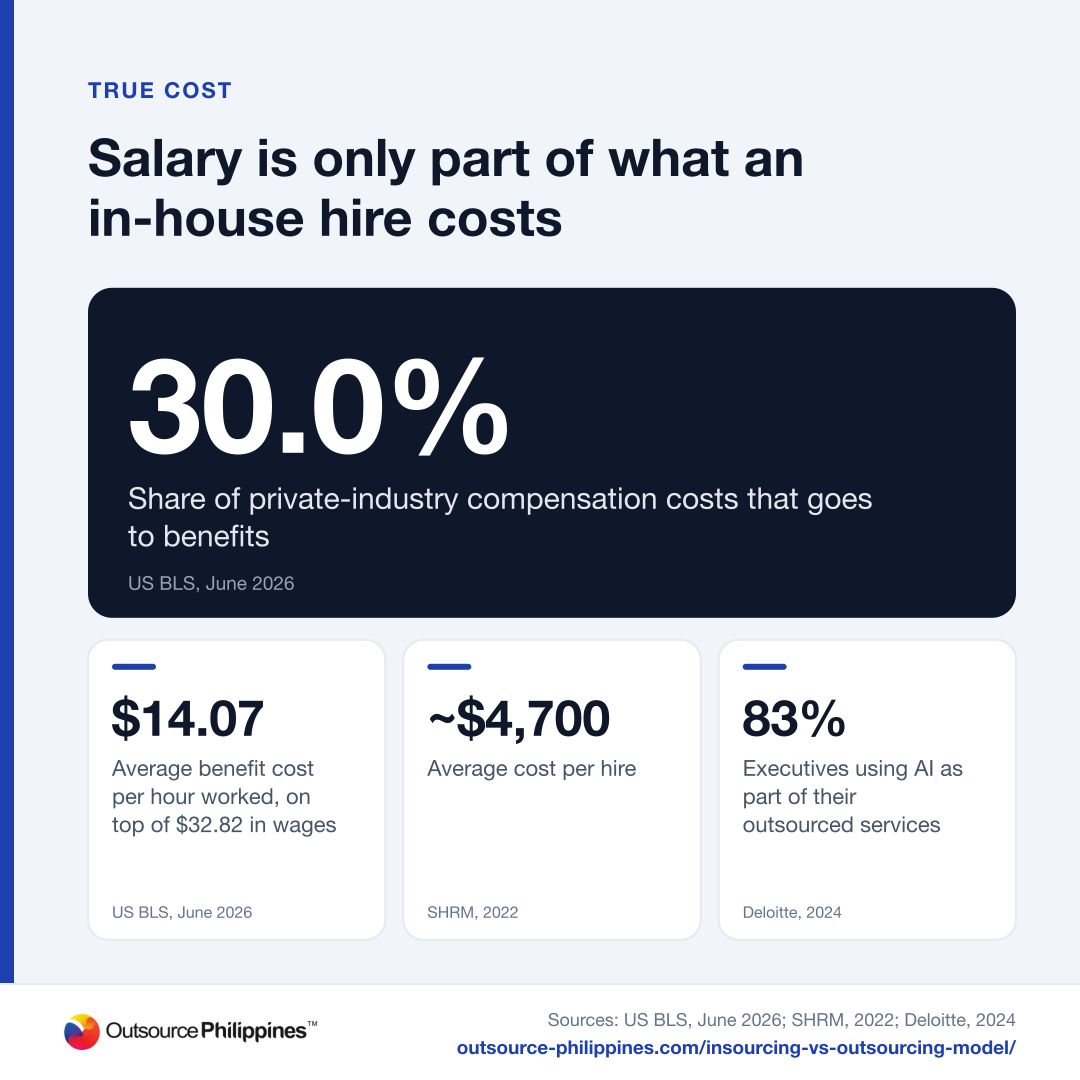
- 30.0%Share of private-industry compensation costs that goes to benefitsUS BLS, June 2026
- $14.07Average benefit cost per hour worked, on top of $32.82 in wagesUS BLS, June 2026
- ~$4,700Average cost per hireSHRM, 2022
- 83%Executives using AI as part of their outsourced servicesDeloitte, 2024
When you hire someone full-time, you also pay for:
- Benefits such as health insurance, paid leave, and retirement contributions
- Recruiting, including job board fees, recruiter commissions, and hours spent screening and hiring
- Onboarding and training time before the hire is fully productive
- Equipment and software licenses
- Office space and overhead for on-site employees
According to the US Bureau of Labor Statistics, benefits made up 30.0% of private-industry employer compensation costs in June 2026: $14.07 an hour on top of $32.82 in wages. That means benefits alone add roughly 43 cents for every dollar of pay, before recruiting, equipment, and office costs. A SHRM report on recruiting costs put the average cost per hire at nearly $4,700 (2022), and specialized or senior roles cost more.
Outsourcing shifts that model: you pay for the work without carrying most of the overhead. Outsource Philippines™ quotes costs based on the role, scope, coverage hours, and team size. Pricing is an hourly rate per agent, quoted in a written proposal.
What Are the Advantages of Insourcing?
Insourcing is not just a fallback for companies that don’t trust outsiders. There are solid strategic reasons to keep some functions internal.
- Full control over quality and direction: you set the standards, correct course in real time, and make fast decisions without waiting on an external team.
- Stronger data security and IP protection: for roles that touch sensitive data, legal matters, or proprietary processes, your internal policies and employment agreements apply directly.
- Deeper institutional knowledge: long-tenured employees build expertise about your customers, product history, and culture that compounds over time.
- Stronger team cohesion: people working toward the same goals in the same environment build a stronger culture and collaborate more easily across departments.
What Are the Advantages of Outsourcing?
Done well, outsourcing is less about cutting costs and more about gaining capacity and skills you would not otherwise have.
- Access to specialized talent, fast: a bookkeeper, a technical support team, or a paid media specialist, without a months-long hiring cycle.
- Lower overhead and operating costs: no benefits packages, office equipment, or workspace to fund, which frees budget for growth.
- Scalability without headcount risk: outsourced teams grow or shrink with demand, without layoffs or rushed hiring.
- Faster time to deployment: an experienced provider recruits, screens, and trains people for you. Most teams go live in 2 to 4 weeks, depending on the role.
- More focus for your core team: when support, administrative, and repetitive work is handled externally, your in-house team can concentrate on strategy and growth.
The trend is toward smarter outsourcing, not less of it. In Deloitte’s 2024 Global Outsourcing Survey of more than 500 leaders, skilled talent and agility joined cost reduction as key reasons to outsource, and 83% of executives said they use AI as part of their outsourced services.
How Do Outsourced Teams Compare with Hiring Local Talent?
The quality gap many businesses fear rarely appears when the provider is well chosen and the onboarding is thorough. Four factors decide the outcome.
Skills and Expertise
Outsourcing destinations, particularly the Philippines, have large pools of educated professionals across customer service, technical support, finance, digital marketing, and creative work. The Philippines ranks 28th worldwide on the 2025 EF English Proficiency Index, with a score of 569 against a global average of 488.
Communication and Collaboration
Shared project tools, structured check-ins, and overlapping or US-aligned work hours let an outsourced team be as responsive as an internal one.
Cultural Fit and Alignment
A good provider onboards people to your values, tone, and expectations. It does not happen automatically, but with clear guidelines and feedback, alignment is achievable.
Retention and Consistency
Well-run providers invest in retention through fair pay, training, and career paths, so people stay longer and learn your business. Dedicated agents who work only on your account build that familiarity faster than staff shared across clients.
What Should You Keep In-house?
Outsourcing is a strategic tool, not a blanket solution. Some functions are too central to your business to hand off.
Core Strategic Functions
Company direction, product roadmaps, investor relations, and key partnerships need deep knowledge of where the business is going and why. Keep them internal.
Roles That Handle Highly Sensitive Information
Legal, compliance, and senior finance roles may be better kept internal or given only to carefully vetted outsourcing partners with strong data governance.
Leadership and Management
Managers, department heads, and team leads shape your culture. Keep these roles in-house, even when the teams they oversee include outsourced professionals.
Functions That Define Your Brand Identity
Depending on your brand, some customer-facing roles may belong in-house. Many businesses still outsource customer service successfully when training and brand guidelines are thorough and consistent.
How Do You Decide between Insourcing and Outsourcing?
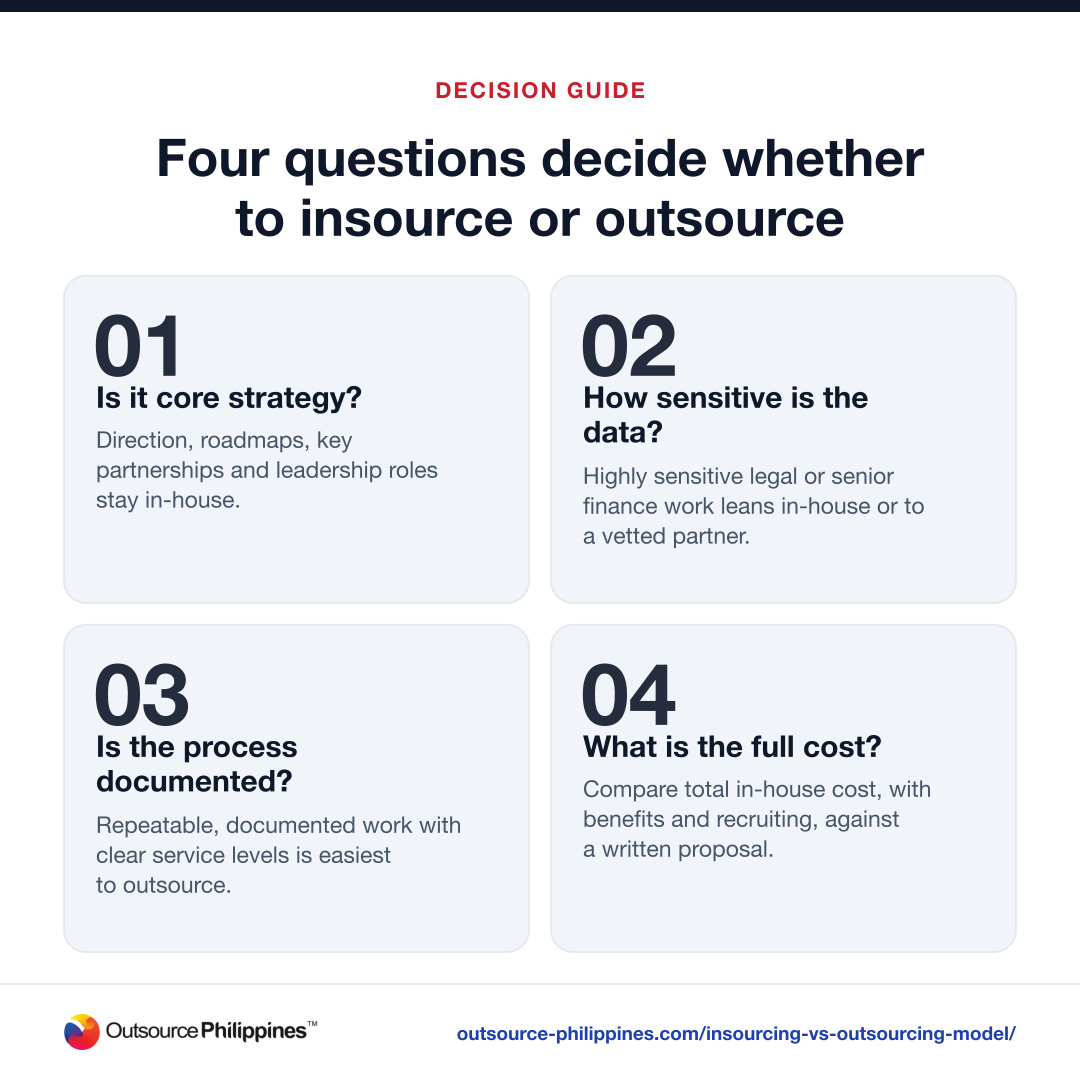
Score each function on how strategic it is, how sensitive its data is, and how well its process is documented. Core, sensitive, or undocumented work leans in-house; repeatable, measurable work leans outsourced.
- 1Is it core strategy?
Direction, roadmaps, key partnerships and leadership roles stay in-house.
- 2How sensitive is the data?
Highly sensitive legal or senior finance work leans in-house or to a vetted partner.
- 3Is the process documented?
Repeatable, documented work with clear service levels is easiest to outsource.
- 4What is the full cost?
Compare total in-house cost, with benefits and recruiting, against a written proposal.
Revisit the decision as you grow. A function you outsource today may be worth bringing in-house once it becomes central to your advantage or its volume justifies a full internal team, and many businesses run both models at once.
Should You Insource or Outsource?
Outsource when the work is repeatable, can be measured through service levels, and would cost far more to staff in-house, such as customer service, technical support, bookkeeping, or data entry. Insource when the work is strategic, highly sensitive, or still changing too fast to document. Most growing businesses end up with a mix.
Outsource Philippines™ has staffed dedicated, office-based teams in the Philippines since 2003 for repeatable functions such as outsourced customer service, technical support, back office, digital marketing, and creative design.
Frequently Asked Questions
What Is the Main Difference between Insourcing and Outsourcing?
Insourcing means using your own employees and resources to handle a task or business function. Outsourcing means hiring an external provider, onshore or offshore, to do that work for you. The core differences are control, cost structure, and where the talent sits: insourcing keeps work under your roof, while outsourcing extends your capacity beyond it.
Is Outsourcing Cheaper than Hiring In-house?
Usually, once you count the full cost of an in-house hire. US BLS data for June 2026 shows benefits made up 30.0% of private-industry compensation costs, before recruiting, equipment, and office space. Outsource Philippines™ quotes costs based on the role, scope, coverage hours, and team size, priced as an hourly rate per agent.
What Types of Tasks Are Best Suited for Outsourcing?
Outsourcing works best for repeatable, well-defined work or tasks that need skills your team lacks. Common examples include customer service, technical support, digital marketing, bookkeeping, data entry, and graphic design. The key is that the scope can be clearly documented and measured through agreed deliverables or service levels, with regular reviews of results.
Can Outsourced Teams Really Match the Quality of In-house Employees?
Yes, with the right partner and proper onboarding. The Philippines, for example, has a large pool of English-proficient professionals across many industries. Quality depends less on location and more on how clearly you set expectations, give feedback, and align the team to your standards, ideally with dedicated people who work only on your account.
How Do I Know When to Stop Outsourcing and Bring a Function In-house?
Consider insourcing when the work becomes central to your competitive advantage, involves increasingly sensitive data, or has grown large enough that an internal team costs less than the outsourced arrangement. Many businesses run both models at once, outsourcing support and operational work while keeping strategy and leadership in-house.