Is Friendshoring the Smarter Outsourcing Strategy for Your Business?

On This Page
- What Is Friendshoring?
- How Does Friendshoring Compare with Offshoring, Nearshoring, and Reshoring?
- What Are the Pros and Cons of Friendshoring?
- Why Should You Consider Friendshoring for Your Business?
- What Risks of Friendshoring Should You Plan For?
- Is the Philippines a Good Friendshoring Destination?
- How Do You Start a Friendshoring Outsourcing Strategy?
- Is Friendshoring Right for Your Business?
- Frequently Asked Questions
Friendshoring is moving outsourcing, supply chains, or operations to countries that are political allies and share your trade ties, legal standards, and values. It trades some cost savings for lower geopolitical risk. For US companies, allied hubs such as the Philippines offer both stability and lower labor costs for service work.
Trade wars, pandemic lockdowns, and sanctions have shown what happens when a key supplier or outsourcing partner sits in a country that suddenly becomes a flashpoint: restrictions arrive overnight, operations slow, and customers notice. This guide explains what friendshoring means, how it compares with offshoring, nearshoring, and reshoring, its real pros and cons, the risks to plan for, and how to decide whether it fits your outsourcing strategy.
What Is Friendshoring?
Friendshoring, sometimes called ally-shoring, means choosing outsourcing and sourcing partners in countries that are geopolitical allies of your own. The goal is not the lowest possible cost but a trusted partner country where sudden sanctions, export controls, or political disruption are unlikely.
The term went mainstream after US Treasury Secretary Janet Yellen used it in an April 13, 2022 speech at the Atlantic Council, where she called for “friend-shoring” of supply chains to “trusted countries” as a way to lower risk for the US economy and its trading partners.
In outsourcing, friendshoring means picking a BPO, back-office, or support partner in a country that:
- is politically aligned with your home country,
- has a stable trade relationship with it, and
- operates under compatible legal, data protection, and labor rules.
How Does Friendshoring Compare with Offshoring, Nearshoring, and Reshoring?
Friendshoring makes political alignment and trust a primary selection criterion. Distance matters less: an allied country on the other side of the world can qualify.
| Model | Core focus | Where the work goes | Risk priority | Cost priority |
|---|---|---|---|---|
| Offshoring | Maximum cost savings | Any country | Low | High |
| Nearshoring | Proximity and time zones | Neighboring countries | Medium | Medium |
| Reshoring | Bringing work back home | Your own country | High | Low |
| Friendshoring | Political alignment and trust | Allied countries, any distance | High | Medium |
| Bestshoring | Best overall fit for each task | Wherever fits the task | Variable | Variable |
In practice, many companies blend these models. A business might keep strategy and senior roles at home, nearshore some work for time-zone overlap, and friendshore high-volume service work to an allied country with a large, English-speaking workforce, usually one of the best countries for back-office outsourcing.
What Are the Pros and Cons of Friendshoring?
Friendshoring buys resilience and regulatory comfort at the cost of a smaller list of destinations and, sometimes, higher prices. Here is an honest look at both sides.
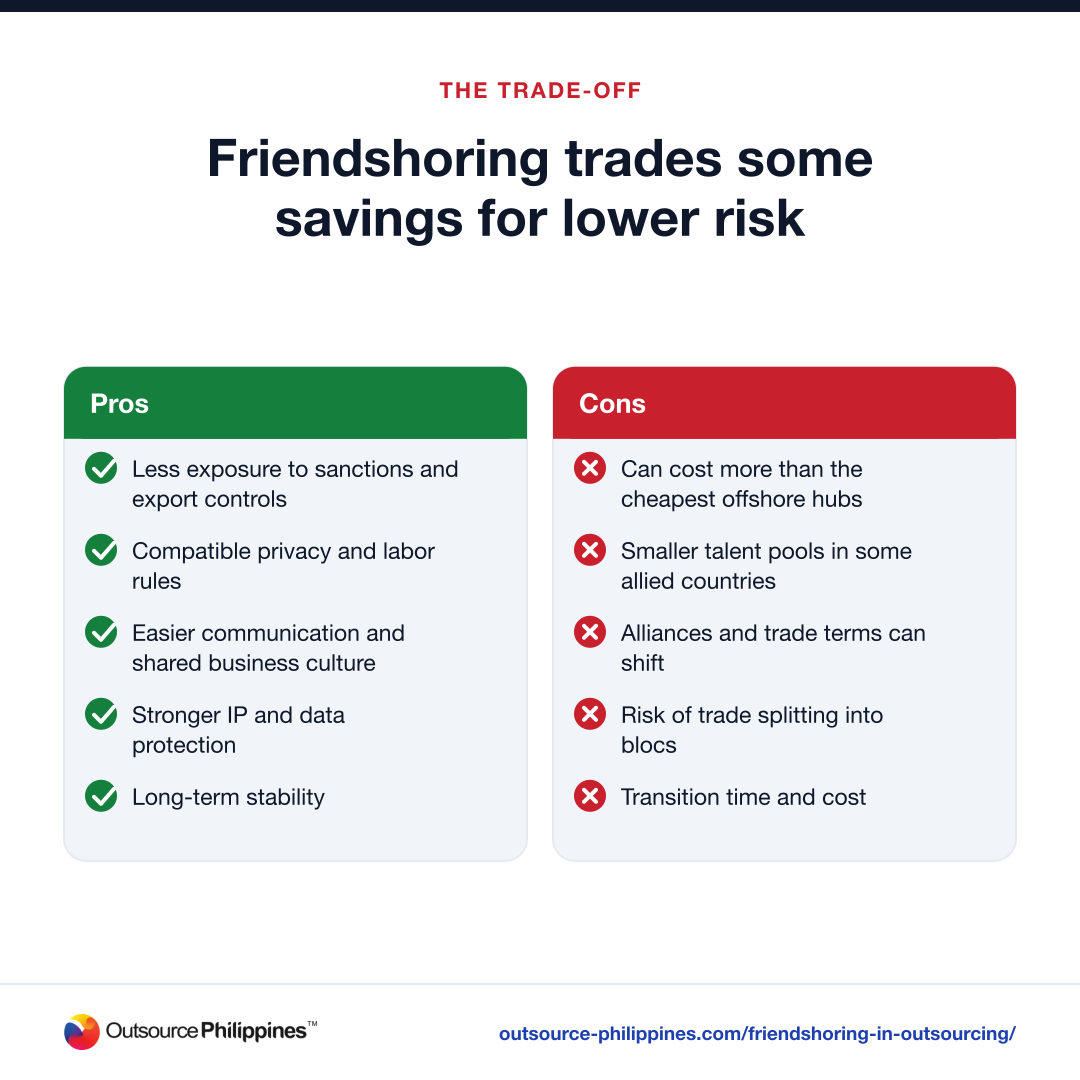
Pros
- Less exposure to sanctions and export controls
- Compatible privacy and labor rules
- Easier communication and shared business culture
- Stronger IP and data protection
- Long-term stability
Cons
- Can cost more than the cheapest offshore hubs
- Smaller talent pools in some allied countries
- Alliances and trade terms can shift
- Risk of trade splitting into blocs
- Transition time and cost
The Pros of Friendshoring
- Operational resilience: less exposure to sudden tariffs, sanctions, or export controls that can halt work overnight.
- Regulatory compatibility: allied countries often have similar data protection practices, labor standards, and compliance frameworks, which makes requirements such as HIPAA or GDPR easier to meet.
- Easier communication: shared business culture and strong English reduce day-to-day friction.
- Better IP and data protection: partners operate under privacy and intellectual property laws you can rely on.
- Long-term stability: trade and security alliances tend to create lasting business environments.
The Cons of Friendshoring
- Higher costs than pure offshoring: some allied countries have higher wages than the cheapest destinations.
- Smaller talent pools: not every allied country has depth in every function.
- Alliances can shift: today’s partner may face new trade friction tomorrow.
- Trade fragmentation: if everyone friendshores, global trade splits into blocs and costs can rise.
- Transition costs: moving work to a new country takes planning, time, and money.
Why Should You Consider Friendshoring for Your Business?
Friendshoring turns geopolitical risk into something you can plan for. It is most valuable for work that touches sensitive data or needs to run without interruption for years.
It Protects You from Geopolitical Shocks
The past few years have shown that geopolitical risk is business risk. Concentrating your outsourcing in one politically sensitive country is a liability; spreading work across allied countries reduces it.
It Fits Growing Compliance Demands
Regulators in the US, EU, UK, and Australia are paying closer attention to where companies send customer data. Choosing a partner country with compatible privacy law is becoming a practical requirement in healthcare, finance, and legal services, and a key part of ethical outsourcing.
It Builds Customer and Stakeholder Trust
Customers and investors notice where companies operate. A values-aligned partner signals responsibility and long-term thinking.
It Future-proofs Operations and Opens Access to Talent
An outsourcing setup built on trust and regulatory alignment is more likely to survive the next disruption. Several allied countries also have large, well-educated, English-speaking workforces, so you do not have to give up talent quality to reduce risk.
What Risks of Friendshoring Should You Plan For?
Friendshoring lowers risk but does not remove it. Plan for these five issues before you move work.
- Alliance instability: even close allies impose tariffs. In 2025 the US and the Philippines agreed a framework setting a 19% US tariff on Philippine goods exports, according to the Congressional Research Service (September 2025). Goods tariffs do not apply to remote service work, but the example shows why you should watch the trade relationship.
- Higher operating costs: moving from the cheapest destination to an allied one can raise cost per head. Compare total cost, including the cost of disruption, not just hourly labor.
- Limited scale in newer destinations: smaller or emerging partner countries may lack the talent depth and infrastructure to support fast growth.
- Relying on politics alone: alliance status is one filter in your outsourcing strategy, not the only one. Vet the provider’s talent, security, and service quality too.
- Transition risk: knowledge transfer, training, and workflow integration take time. Put clear service levels and reporting in the contract before the move.
Is the Philippines a Good Friendshoring Destination?
Yes, for US companies the Philippines is one of the strongest friendshoring options for service work. It is a long-standing US security ally, has strong data privacy law, and runs one of the world’s largest English-language outsourcing industries.
- Security alliance: the 1951 Mutual Defense Treaty commits both countries to help defend each other, and the 2014 Enhanced Defense Cooperation Agreement allows rotational US forces in the Philippines (CRS, September 2025).
- Trade ties: the US is the Philippines’ largest export market (CRS).
- Data protection: the Data Privacy Act of 2012 (Republic Act No. 10173) sets rules for handling personal information.
- Industry scale: IT-BPM export revenue passed US$40 billion in 2025, according to IBPAP via the Philippine Daily Inquirer. IBPAP’s 2026 Industry Overview forecasts about 1.94 million full-time-equivalent workers in 2026.
Friendshoring does not have to mean giving up savings. Outsource Philippines™ quotes costs based on the role, scope, coverage hours, and team size, with dedicated agents who work only on your account, a managed firewall, and WorQmate monitoring.
How Do You Start a Friendshoring Outsourcing Strategy?
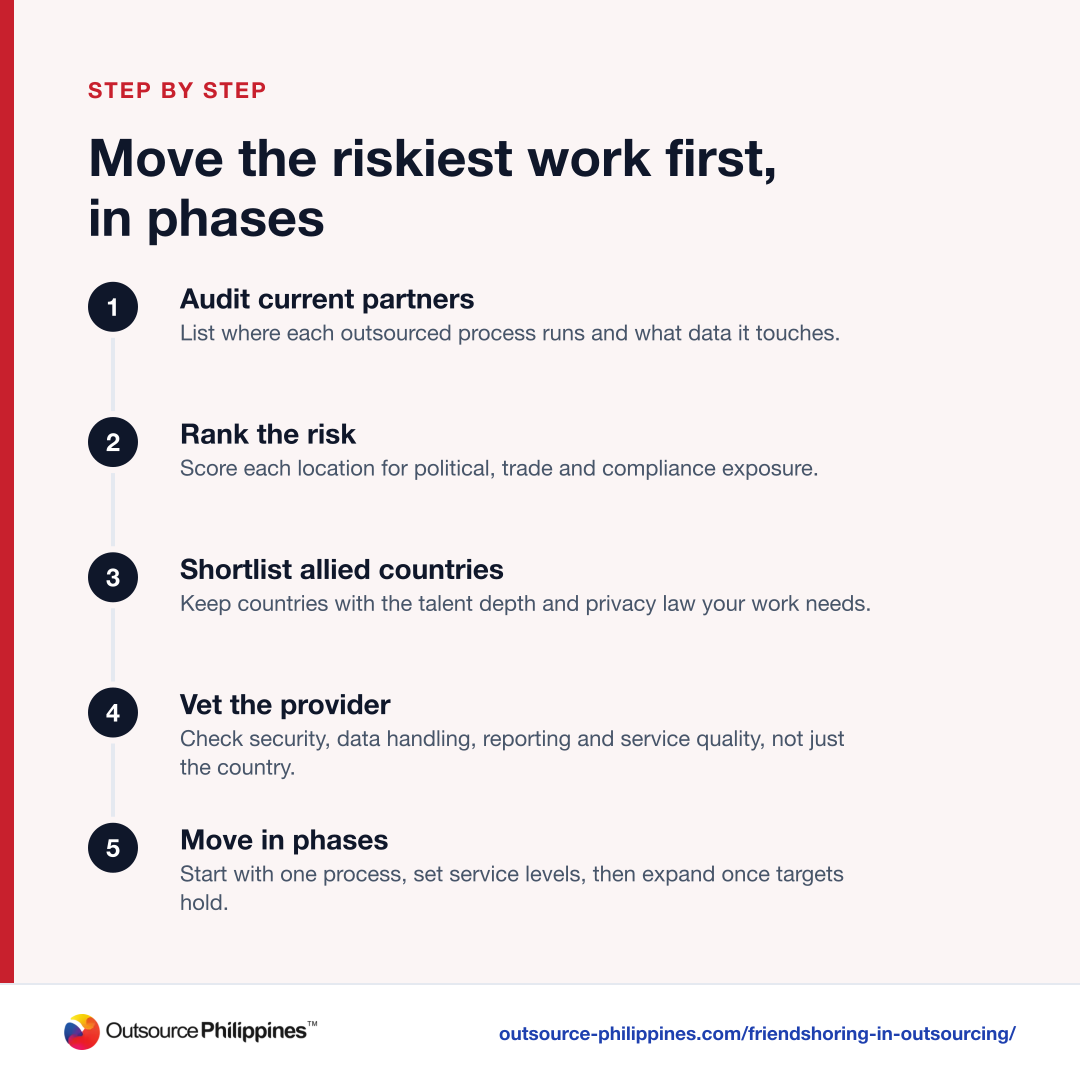
Start with the work where geopolitical and compliance risk is highest, then move it in phases. Most teams go live in 2 to 4 weeks, depending on the role.
- 1Audit current partners
List where each outsourced process runs and what data it touches.
- 2Rank the risk
Score each location for political, trade and compliance exposure.
- 3Shortlist allied countries
Keep countries with the talent depth and privacy law your work needs.
- 4Vet the provider
Check security, data handling, reporting and service quality, not just the country.
- 5Move in phases
Start with one process, set service levels, then expand once targets hold.
Is Friendshoring Right for Your Business?
Friendshoring is a strong fit if your outsourced work handles customer or financial data, your current partner sits in a politically sensitive country, or a disruption would hurt customers quickly. It matters less for small, short-term projects with no sensitive data, where cost and speed may outweigh country risk.
If you want a stable, allied base for service work, explore our back-office outsourcing services. When you are ready, request a proposal with the roles, hours, and volume you want to move.
Frequently Asked Questions
What Is the Difference between Friendshoring and Nearshoring?
Nearshoring moves work to a nearby country to reduce time-zone gaps and travel. Friendshoring moves work to a politically and economically aligned country, regardless of distance. A US company can friendshore to the Philippines on the other side of the world, because the two countries are long-standing allies with close trade ties.
Is the Philippines Considered a Friendshoring Destination?
Yes, for US companies. The two countries have been bound by the 1951 Mutual Defense Treaty for decades, and the US is the Philippines’ largest export market. The Philippines also has the Data Privacy Act of 2012 and a large English-speaking outsourcing workforce, which makes it a practical choice for service work.
Is Friendshoring More Expensive than Traditional Offshoring?
It can be, depending on the destination, because some allied countries have higher wages than the lowest-cost hubs. For Philippine service teams, Outsource Philippines™ quotes costs based on the role, scope, coverage hours, and team size. Compare the full proposal with your in-house costs while considering the benefits of an allied partner country.
What Business Functions Are Best Suited to Friendshoring?
Friendshoring suits any function that handles sensitive data, carries compliance requirements, or needs to run without interruption for years. Common examples include customer service, technical support, finance and accounting, healthcare support, and back-office operations such as data entry and payroll processing.