Offshore Staffing: The Definitive Guide to Global Workforce Optimization

On This Page
- What Is Offshore Staffing?
- What Are the Benefits of Offshore Staffing?
- Which Countries Lead Offshore Staffing?
- How Does Offshore Staffing Work?
- How Is Offshore Staffing Different from Traditional Outsourcing?
- Which Industries Use Offshore Staff the Most?
- How Do You Manage an Offshore Team Well?
- Is Offshore Staffing Right for Your Business?
- Frequently Asked Questions
Offshore staffing means building a dedicated team of professionals in another country who work only on your business, while a local provider handles recruiting, employment, payroll, workspace, and compliance. Companies use it to cut labor costs, reach skills that are scarce at home and cover longer hours, while keeping control of daily work and quality.
This guide explains how offshore staffing works, the benefits and trade-offs, which countries lead the market, how it differs from traditional outsourcing, which industries use it most, and how to manage an offshore team so it performs like an in-house one. It is written for US founders and operations leaders weighing their first or next offshore hire.
What Is Offshore Staffing?
Offshore staffing is hiring skilled people overseas to do work that can be done remotely, through a provider that employs them locally. The staff are dedicated to your account and work as an extension of your team.
Traditional outsourcing hands a whole process to a vendor, which decides who does the work and how. Offshore staffing is different: you get named people who learn your systems, follow your processes, and report against your targets. The provider takes care of the parts that are hard to do from abroad, such as hiring, local employment contracts, payroll, benefits, equipment, office space, and labor-law compliance.
Companies usually choose offshore staffing to bring labor costs down without losing control of quality. Common functions include customer service, technical support, finance and accounting, healthcare administration, ecommerce operations, and professional services support. Because the team works your hours, offshore staffing can also give you round-the-clock coverage and keep the business running through peaks, holidays, and time-zone gaps.
What Are the Benefits of Offshore Staffing?
The main benefits are lower cost, access to skills, flexibility, and longer coverage. Each one depends on picking the right roles and the right provider.
- Cost reduction: lower spending on wages, benefits, office space, and equipment. Outsource Philippines™ estimates most US clients pay 60% to 70% less than an equivalent in-house hire.
- Access to specialized skills: accountants, support agents, healthcare administrators, marketers, and other specialists who are hard or slow to hire locally.
- Business agility and flexibility: add or reduce seats as seasonal or project demand changes, without a long local hiring cycle.
- 24/7 productivity: teams in other time zones keep customer support, ticket queues, and data work moving overnight.
- Talent retention: the provider manages HR, training, and local compliance, which helps keep people engaged and attrition low.
- Global market expansion: an offshore base makes it easier to serve customers in new regions and new hours.
For a US benchmark, the US Bureau of Labor Statistics puts the median annual wage for customer service representatives at $44,770 (May 2025). Benefits, payroll taxes, recruiting, office space, and management time come on top of that, which is why the total in-house cost is usually much higher than the salary line.
The benefits are strategic as well as financial. When routine, well-documented work moves offshore, senior staff at home get time back for product, sales, and customer relationships.
Which Countries Lead Offshore Staffing?
The Philippines, India, Eastern Europe, and Latin America are the four main offshore staffing regions. Each is strongest at a different kind of work.
1. The Philippines
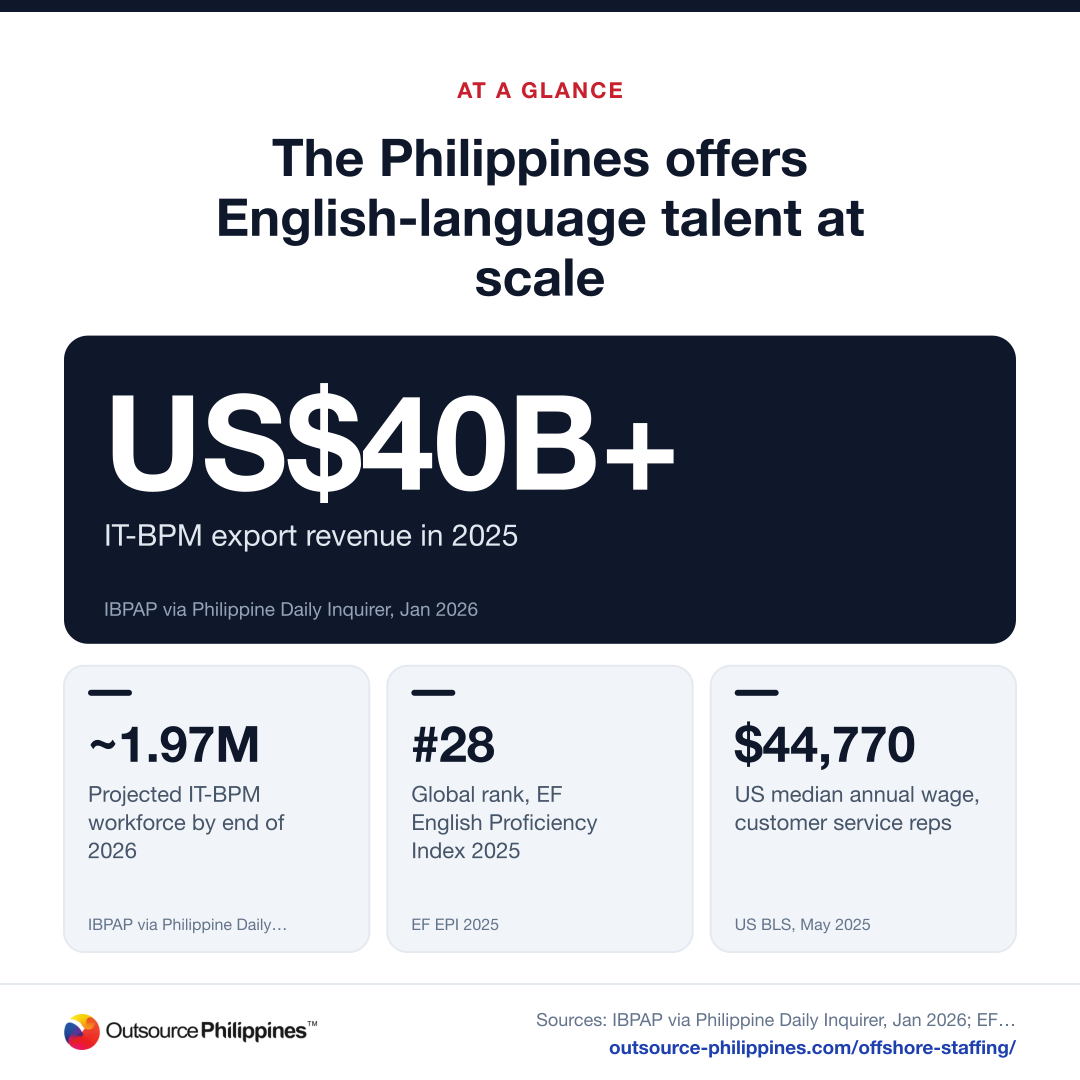
The Philippines is the leading choice for English-language customer-facing and back-office work. Its IT and business process management (IT-BPM) industry earned more than US$40 billion in export revenue in 2025, and the industry association IBPAP projects about 1.97 million workers by the end of 2026, according to the Philippine Daily Inquirer. Teams in Manila, Cebu, and Davao handle customer experience, finance, healthcare administration, and ecommerce roles for US, UK, and Australian companies.
- US$40B+IT-BPM export revenue in 2025IBPAP via Philippine Daily Inquirer, Jan 2026
- ~1.97MProjected IT-BPM workforce by end of 2026IBPAP via Philippine Daily Inquirer, Jan 2026
- #28Global rank, EF English Proficiency Index 2025EF EPI 2025
- $44,770US median annual wage, customer service repsUS BLS, May 2025
English is the main draw. The Philippines ranks 28th worldwide on the 2025 EF English Proficiency Index, with a score of 569 against a global average of 488. Cultural familiarity with US customers and a service-minded workforce are other reasons companies build teams in the Philippines.
2. India
India is the largest base for offshore IT work, with a deep pool of engineers and technical institutions. Many US and UK companies run software development, data analytics, and cloud engineering from Indian delivery centers.
3. Eastern Europe
Poland, Romania, and other Eastern European countries suit Western European companies that want close time zones and strong technical skills, especially in software engineering, cybersecurity, and research and development.
4. Latin America
Mexico, Colombia, and Argentina share or overlap US time zones, which helps with real-time collaboration such as project management and design. Some North American companies pair a Latin American team with a Philippine team to cover more of the day.
How Does Offshore Staffing Work?
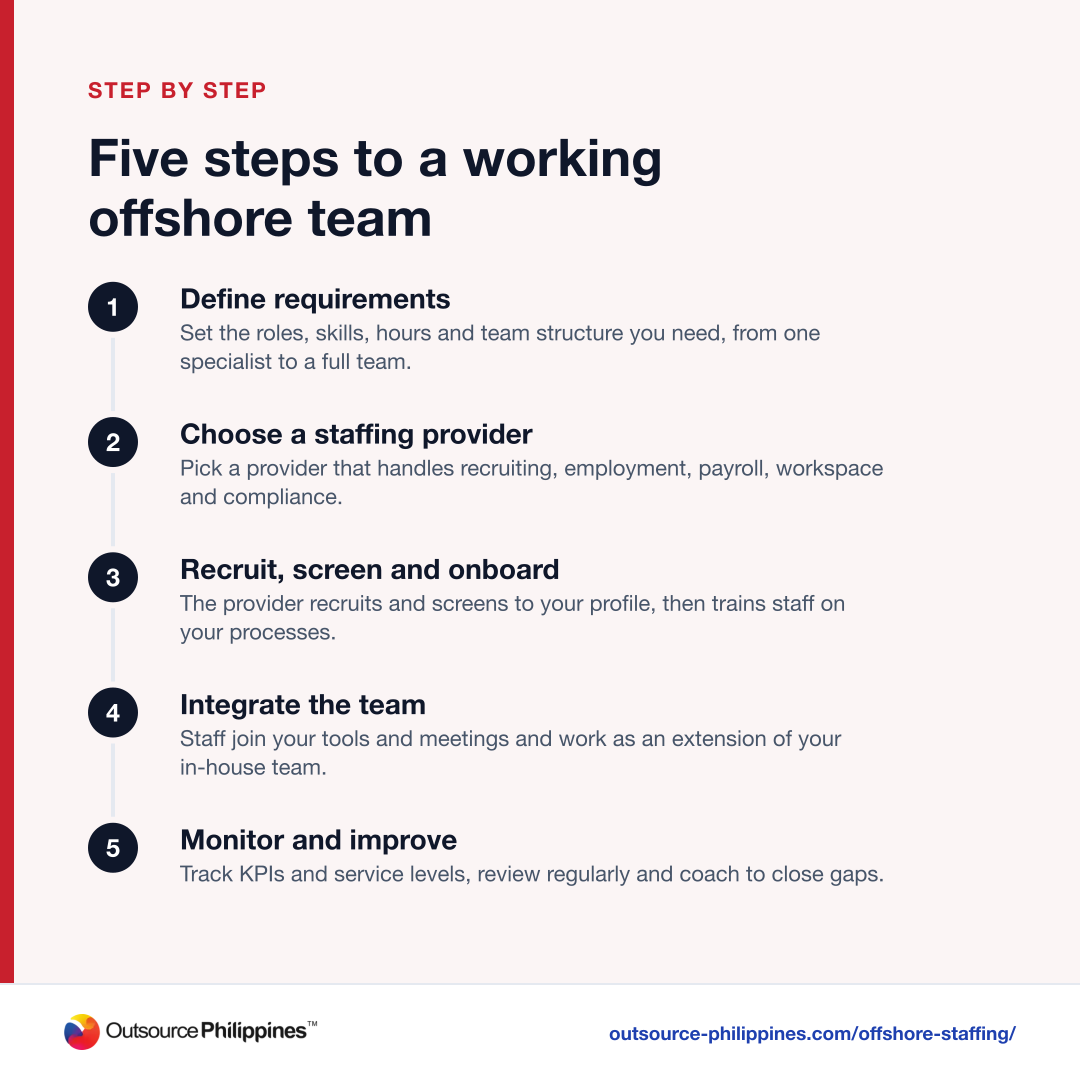
Offshore staffing follows five steps, from defining the role to ongoing performance reviews. The provider runs recruiting and employment; you set the work and the targets.
- 1Define requirements
Set the roles, skills, hours and team structure you need, from one specialist to a full team.
- 2Choose a staffing provider
Pick a provider that handles recruiting, employment, payroll, workspace and compliance.
- 3Recruit, screen and onboard
The provider recruits and screens to your profile, then trains staff on your processes.
- 4Integrate the team
Staff join your tools and meetings and work as an extension of your in-house team.
- 5Monitor and improve
Track KPIs and service levels, review regularly and coach to close gaps.
The provider recruits and screens candidates against the profile you agree on, then onboards them with training that mirrors your internal processes. Staff usually work from the provider’s secure facility and collaborate with your managers through your own tools, such as Slack, Microsoft Teams, or your help desk and CRM. Most teams go live in 2 to 4 weeks, depending on the role.
What Drives the Cost of an Offshore Team?
Five things move the price: the complexity of the role, the shift (US daytime is a night shift in Manila, which carries a legal night-shift premium), the channel or type of work, the size of the team, and the coverage you need, from weekdays only to 24/7. Tools, licenses, and specialist training add to the total. A good provider explains each line in its proposal so you can compare it with the full cost of an in-house hire, not just the salary.
Plan for a ramp-up period too. New staff need time on your systems before they reach full productivity, so set 30, 60, and 90-day targets and review them together. The provider also covers payroll, tax, and local compliance, so your team can focus on output. Hiring freelancers directly is the main alternative, and the choice between dedicated teams and freelancers comes down to continuity and control.
How Is Offshore Staffing Different from Traditional Outsourcing?
The difference is control and continuity. With offshore staffing you direct a dedicated team; with traditional outsourcing the vendor owns the process and the people.
| Aspect | Offshore staffing | Traditional outsourcing |
|---|---|---|
| Management control | You set daily priorities and talk to staff directly | The vendor runs the process with limited client oversight |
| Team structure | Dedicated people who act as an extension of your workforce | Shared teams that may serve several clients |
| Cost visibility | Clear, per-person pricing in a written proposal | Project or output-based pricing that is harder to compare |
| Knowledge retention | Long-term continuity on your systems and culture | Knowledge often lost at the end of a project or contract |
| Scalability | Add or remove seats as the business changes | Limited to the agreed scope and contract period |
Offshore staffing fits when continuity, control, and cultural fit matter. Project-based outsourcing fits one-off or specialist work that needs little oversight. Many companies run both. An Employer of Record is a third option: the provider legally employs staff for you while you direct the work.
Which Industries Use Offshore Staff the Most?
Any industry with repeatable, documented work can use offshore staff. These six sectors use it most.
- Information technology: help desk, tier 1 and tier 2 technical support, QA testing, and IT administration.
- Finance and accounting: bookkeeping, accounts payable and receivable, reconciliations, and reporting, so finance leaders can focus on forecasting and compliance.
- Customer service: English-language voice, email, and chat support across long hours.
- Healthcare: billing, claims and insurance processing, and patient scheduling, handled under the privacy rules US providers must follow.
- Ecommerce and retail: product listings, order management, returns, and live chat, with extra seats for peak seasons.
- Professional services: administrative, research, and back-office support for law firms, consultancies, and agencies.
Across these sectors the value comes from reliable staffing, industry-specific training, and tools that plug into the client’s own systems.
How Do You Manage an Offshore Team Well?
Treat the offshore team as part of your company, with clear targets, proper onboarding, and regular feedback. Most problems trace back to unclear expectations, not distance.
Best Practices
- Set clear expectations: define KPIs, quality standards, and communication norms from day one.
- Invest in onboarding: walk new staff through your products, policies, tools, and tone of voice.
- Use shared collaboration tools: Slack, Microsoft Teams, Jira, or Asana keep work visible across time zones.
- Encourage cross-cultural understanding: recognize local holidays and include offshore staff in team rituals.
- Keep reporting transparent: regular check-ins and dashboards catch issues early.
- Reward performance fairly: recognition builds loyalty and reduces turnover.
Common Challenges and How to Handle Them
- Time zone coordination: agree on overlap hours. Philippine Time is 12 to 13 hours ahead of US Eastern Time, so most US-facing teams work a night shift.
- Data security compliance: match controls to your rules, such as HIPAA, CCPA, or GDPR, and confirm the provider follows the Philippine Data Privacy Act of 2012.
- Performance visibility: hold regular reviews against agreed metrics.
- Employee engagement: training, recognition, and career paths keep morale up and burnout down.
- Cultural alignment: share context on your customers and expectations, and ask for feedback both ways.
Outsource Philippines™ protects client work with a managed firewall and WorQmate, its in-house project, and employee monitoring platform. You can review the full set of controls on our security page.
Trends to Watch
Offshore teams increasingly work alongside automation, with people handling exceptions, judgment calls, and customer relationships while software handles routine steps. Buyers are also asking more about data protection and security, and more companies are combining offshore and nearshore teams in one operating model.
Is Offshore Staffing Right for Your Business?
Offshore staffing is a strong fit if you have steady, documented work, managers who can set clear targets, and roles that do not need someone on site. It is a weaker fit for very small or irregular workloads, or for roles that rely on undocumented judgment from senior staff.
Outsource Philippines™ has run office-based teams in the Philippines since 2000 and offers Employer of Record services in the Philippines for companies that want compliant, full-time staff they direct themselves.
Frequently Asked Questions
What Is Offshore Staffing?
Offshore staffing is a workforce model in which a company hires dedicated employees in another country to do work remotely. A local provider employs them and handles recruiting, payroll, compliance, and workspace, while the company directs their daily work and sets their targets, much as it would for an in-house team.
How Does Offshore Staffing Differ from Outsourcing?
Outsourcing hands a whole process to a vendor, which decides who does the work and how. Offshore staffing gives you a dedicated team that works only on your account, follows your processes, and reports to your managers. That brings more control and better knowledge retention, while the provider still handles employment and administration.
Why Do Companies Choose Offshore Staff in the Philippines?
The Philippines combines strong English, cultural familiarity with US customers, and a large, experienced IT-BPM workforce. It ranks 28th worldwide on the 2025 EF English Proficiency Index. Outsource Philippines™ estimates most US clients pay 60% to 70% less than an equivalent in-house hire.
What Roles Are Most Commonly Hired for Offshore Teams?
Companies most often hire customer service agents, technical support specialists, bookkeepers and accountants, data entry and back-office staff, healthcare administrators, digital marketers, and designers. The model suits ongoing roles with documented processes and measurable output, whether that is a single specialist or a full team covering several channels and shifts.
Is Offshore Staffing Secure and Compliant?
It can be, when the provider runs proper controls. Look for compliance with the Philippine Data Privacy Act of 2012, access controls, monitored workstations, a managed firewall, and data-handling rules written into the contract, plus whatever your own industry requires, such as HIPAA for healthcare or PCI DSS for card payments.