Payroll Outsourcing Statistics for 2026: Costs and Penalties

On This Page
- How Big Is the Payroll Outsourcing Market?
- How Common and Costly Are Payroll Errors?
- Why Does Paying Employees on Time Matter so Much?
- What Do Payroll Tax Penalties Cost Employers?
- What Do These Statistics Mean for the Outsourcing Decision?
- What Should You Look for in a Payroll Outsourcing Provider?
- Is Payroll Outsourcing Right for Your Business?
- Frequently Asked Questions
Payroll outsourcing statistics point to a growing market and a costly in-house problem. IMARC Group valued the global payroll outsourcing market at US$10.2 billion in 2025. An EY survey found the average company makes 15 payroll corrections per pay period, at about $291 each, and late tax deposits can trigger IRS penalties under 26 U.S.C. § 6656.
This page collects verified payroll statistics for US business owners and finance leads who are deciding whether to keep payroll in-house. Each figure links to its source. After the numbers, you will find what they mean for the outsourcing decision and what to check before you choose a provider.
How Big Is the Payroll Outsourcing Market?
The global payroll outsourcing market was worth about US$10.2 billion in 2025 and is projected by IMARC Group to grow 4.94% annually from 2026 to 2034. Growth comes from tighter compliance rules, more remote and multi-state teams, and companies moving payroll to cloud platforms.
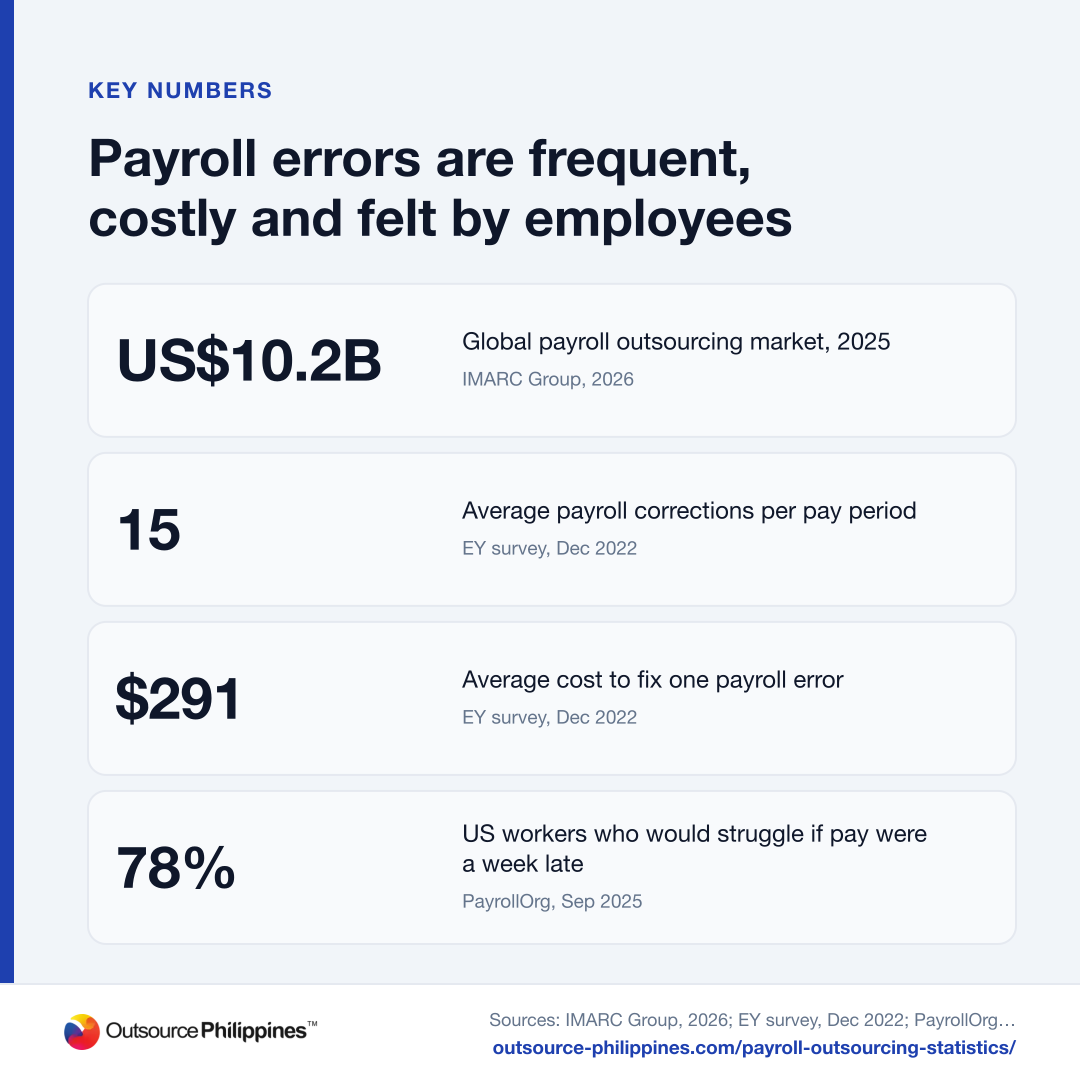
- US$10.2BGlobal payroll outsourcing market, 2025IMARC Group, 2026
- 15Average payroll corrections per pay periodEY survey, Dec 2022
- $291Average cost to fix one payroll errorEY survey, Dec 2022
- 78%US workers who would struggle if pay were a week latePayrollOrg, Sep 2025
IMARC Group projects the market will reach US$16.1 billion by 2034, a compound annual growth rate of 4.94% from 2026 to 2034. Market-size estimates differ between research firms because each defines the market slightly differently, so treat any single figure as a direction, not a precise count.
What drives the growth is practical, not fashionable:
- Compliance load: federal, state, and local tax rules, wage laws, and filing deadlines change every year.
- Distributed teams: employees in several states mean several sets of withholding, unemployment insurance, and filing rules.
- Software shifts: moving to cloud payroll is often the moment companies ask whether to keep the processing in-house.
- Staff turnover: when the one person who knows payroll leaves, the knowledge leaves too.
How Common and Costly Are Payroll Errors?
Very common. In an EY survey of 508 payroll and HR professionals at US companies with 250 to 10,000 employees, the average organization made 15 payroll corrections per pay period, and each error cost an average of $291 to fix (EY via Business Wire, December 2022).
Those numbers add up fast. A company that runs payroll every two weeks and makes 15 corrections each time is fixing hundreds of errors a year, before counting the time managers spend answering employee questions about them. The most common causes are familiar:
- Time and attendance mistakes: missed punches, wrong overtime calculations, and unauthorized hours.
- Data entry errors: wrong pay rates, bank details, or tax withholding settings.
- Late changes: new hires, terminations, and pay changes that reach payroll after the cutoff.
- Misclassification: treating employees as contractors, or exempt staff as non-exempt.
Most of these are process problems, not software problems. A provider with fixed cutoffs, checklists, and a second-person review catches costly payroll errors before the pay run.
Why Does Paying Employees on Time Matter so Much?
Because most workers cannot absorb a late paycheck. A payroll mistake that looks minor to the business can be a missed rent payment for an employee.
In the 2025 Getting Paid in America survey by PayrollOrg, 78% of US workers said they would face financial difficulty if their paycheck were delayed by one week. The survey drew more than 25,900 responses nationwide (PayrollOrg survey via The Denver Gazette, September 2025).
That is why payroll accuracy is a retention issue as much as an accounting one. Repeated errors erode trust quickly, and employees rarely separate “the payroll system made a mistake” from “my employer paid me wrong.”
What Do Payroll Tax Penalties Cost Employers?
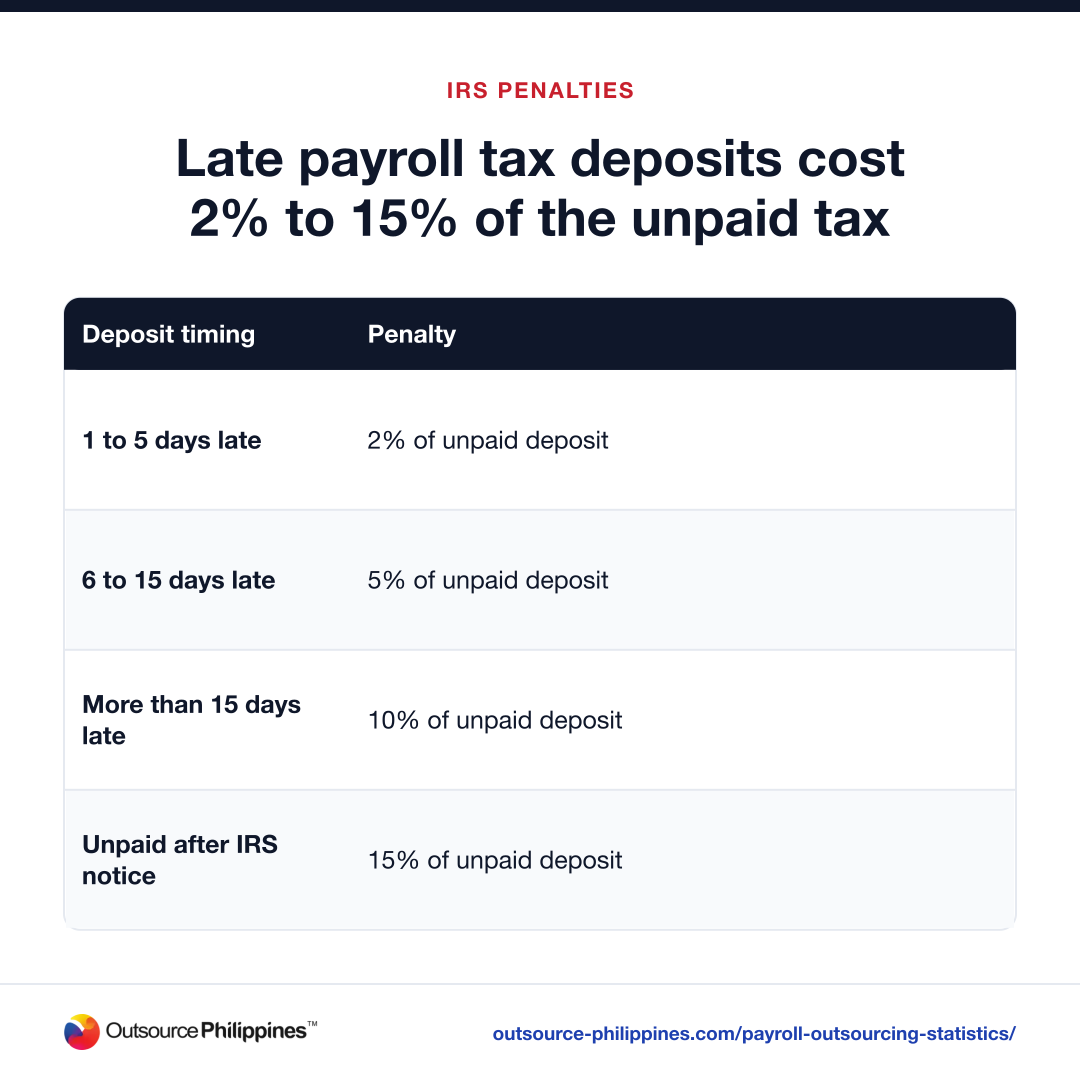
Under 26 U.S.C. § 6656, the IRS penalty for late federal payroll tax deposits ranges from 2% to 15% of the unpaid amount, depending on when it is paid. The penalty applies even when the delay is an honest mistake.
| Deposit timing | Penalty |
|---|---|
| 1 to 5 days late | 2% of unpaid deposit |
| 6 to 15 days late | 5% of unpaid deposit |
| More than 15 days late | 10% of unpaid deposit |
| Unpaid after IRS notice | 15% of unpaid deposit |
The IRS failure to deposit penalty is 2% for deposits 1 to 5 days late, 5% for 6 to 15 days late and 10% for more than 15 days late. It rises to 15% when the amount is still unpaid after the IRS has sent a notice demanding payment. The tiers do not stack: a deposit that is 20 days late carries 10%, not 17%.
The bigger risk is personal. Withheld income tax and the employee share of FICA are “trust fund” taxes, and the IRS can assess the Trust Fund Recovery Penalty against the individuals responsible for paying them, including owners and officers. In other words, unpaid payroll taxes can follow you home.
What Do These Statistics Mean for the Outsourcing Decision?
They show that the main cost of in-house payroll is not processing time but errors, late deposits, and the trust lost when people are paid wrong. Outsourcing makes sense when a provider can reduce those risks at a lower total cost than your current setup.
Outsourcing usually helps most when:
- one person runs payroll and there is no backup or second review;
- you pay employees in several states or have frequent pay changes;
- corrections, off-cycle runs, and employee pay questions take hours every cycle;
- tax deposits and filings depend on someone remembering a deadline.
The benefits of payroll outsourcing do not include removing your responsibility. The business still owns the accuracy of the data it sends, and the IRS can hold responsible people liable for unpaid trust fund taxes even if a provider was involved. Choose a provider that shows you the deposit confirmations, not just the pay stubs.
What Should You Look for in a Payroll Outsourcing Provider?
Look for documented controls, clear deadlines, and visibility into every pay run. Price matters, but a cheap provider that misses a deposit costs more than it saves.
- Review process: a maker-checker step on every pay run before funds move.
- Deposit and filing proof: confirmations for each tax deposit and quarterly filing.
- Clear cutoffs: written deadlines for hours, new hires, and pay changes.
- Data security: role-based access, monitored workstations, and a written data-handling policy.
- Named contacts: people who know your company, not a rotating support queue.
A dedicated offshore payroll team is one option for companies that want their own people on the work without a US hire. Compare a quote for the same payroll scope with your total in-house cost. Teams are dedicated to one client and work in your payroll platform. Client work is protected by a managed firewall and WorQmate, Outsource Philippines™’ in-house project and employee monitoring platform, and handled in line with the Philippine Data Privacy Act of 2012.
Is Payroll Outsourcing Right for Your Business?
It is a strong fit if payroll depends on one person, if you pay people in several states, or if corrections and pay questions take up time every cycle. It is less urgent if you have a small, stable team in one state, a reliable payroll platform, and a second person who reviews every run.
To see what a dedicated payroll team would look like for your company, explore our payroll outsourcing services, read how our pricing works or request a proposal.
Frequently Asked Questions
How Big Is the Payroll Outsourcing Market in 2025?
IMARC Group valued the global payroll outsourcing market at about US$10.2 billion in 2025 and projects it will reach US$16.1 billion by 2034, growing at 4.94% a year from 2026. Other research firms publish different estimates because they define the market differently, so treat any single number as a guide.
How Much Do Payroll Errors Cost a Business?
An EY survey of US companies with 250 to 10,000 employees found that the average organization makes 15 payroll corrections per pay period, and each error costs about $291 to fix. Errors also carry hidden costs, including tax penalties, staff time spent on corrections, and lost employee trust.
What Is the IRS Penalty for Late Payroll Tax Deposits?
Under 26 U.S.C. § 6656, the IRS failure-to-deposit penalty is 2% for deposits 1 to 5 days late, 5% for 6 to 15 days late and 10% for more than 15 days late. It rises to 15% if the tax is still unpaid after an IRS notice demanding payment. The tiers do not add together.
Does Outsourcing Payroll Transfer Liability to the Provider?
Not completely. The employer remains responsible for accurate data and for making sure payroll taxes are deposited. The IRS can hold owners and officers personally liable for unpaid trust fund taxes through the Trust Fund Recovery Penalty. Choose a provider that shares deposit confirmations and filing records with you after every cycle.