Outsourced Accounting in the Philippines: Services, Costs, and Setup

On This Page
- What Is Outsourced Accounting and What Does It Include?
- What Are Offshore Accounting Services?
- Why Choose the Philippines for Accounting Outsourcing?
- What Are the Benefits of Outsourcing Accounting and Bookkeeping?
- How Much Does Outsourced Accounting in the Philippines Cost?
- How Do You Outsource Your Accounting to the Philippines?
- What Challenges Come with Outsourced Accounting, and How Do You Solve Them?
- What Is the Future of Outsourced Accounting in the Philippines?
- Is Outsourced Accounting in the Philippines Right for Your Business?
- Frequently Asked Questions
Outsourced accounting in the Philippines means hiring a Philippine provider to handle bookkeeping, accounts payable and receivable, payroll support, financial statements, and reporting for your business, usually inside your own accounting software. US companies use it to cut costs, add capacity, and keep their books current, while their CPA or controller keeps final review.
This guide explains what outsourced accounting includes, what offshore accounting services are, why the Philippines is a leading destination, the benefits and costs, a 10-step plan for outsourcing your accounting, the common challenges, and how to solve them, and where the industry is heading.
What Is Outsourced Accounting and What Does It Include?
Outsourced accounting is delegating accounting and bookkeeping tasks to an external team, often in a country with a strong accounting workforce and lower labor costs. The team works in your systems and to your close calendar, while you keep ownership of the books and decisions.
A Philippine accounting team typically handles these seven areas:
- Bookkeeping: recording daily transactions, reconciliations, and maintaining the general ledger.
- Financial statement preparation: balance sheets, income statements, and cash flow statements.
- Accounts payable and receivable: processing invoices and bills and tracking payments.
- Payroll processing: calculating wages and deductions and supporting on-time payment, a common reason for payroll outsourcing.
- Tax preparation support: organizing records and schedules so your CPA can prepare and file returns.
- Financial analysis and reporting: management reports on performance and trends.
- Budgeting and forecasting: building and updating budgets and projections.
Bookkeeping, the first item, records the transactions the other six areas rely on, which is the main line between bookkeeping and accounting.
How Has Outsourced Accounting Changed?
Cloud accounting software made it practical. Because the books, documents, and sign-offs all live online, an offshore accountant can work in the same file as your in-house team in real time, with access controls and an audit trail. That shift turned outsourcing from batch work sent by email into an integrated part of the finance team.
How Does Outsourcing Compare with In-house Accounting?
Outsourcing offers four main advantages over an all in-house department:
- Cost savings: lower overhead than full-time local employees.
- Access to expertise: trained accountants without recruiting each one yourself.
- Scalability: add or reduce capacity as your business changes.
- Focus on core business: leadership time goes to growth instead of data entry.
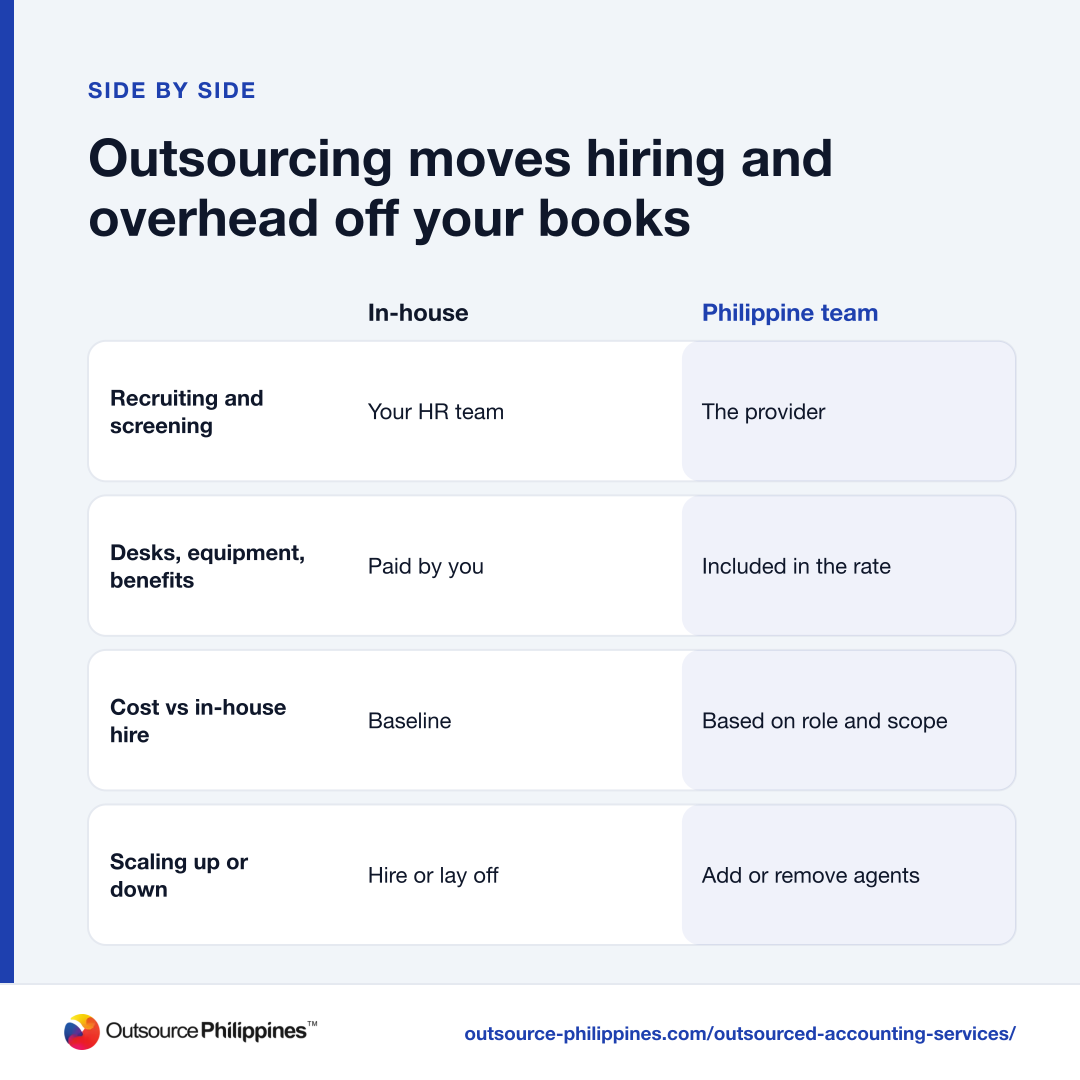
| Factor | In-house | Philippine team |
|---|---|---|
| Recruiting and screening | Your HR team | The provider |
| Desks, equipment, benefits | Paid by you | Included in the rate |
| Cost vs in-house hire | Baseline | Based on role and scope |
| Scaling up or down | Hire or lay off | Add or remove agents |
What Are Offshore Accounting Services?
Offshore accounting services are accounting and bookkeeping work done by a team in another country, such as the Philippines or India, for a business based in the US, UK, Australia, or Canada. It is a subset of outsourced accounting: all offshore accounting is outsourced, but outsourced accounting can also be done by a local firm.
Offshore models come in two main forms. A project or firm model has the provider’s accountants share work across several clients. A dedicated model gives you accountants who work only on your account, in your software, following your procedures. Dedicated teams suit businesses with steady monthly work such as reconciliations, payables, and month-end close, because the same people learn your chart of accounts and vendors. The rest of this guide focuses on the Philippines, the most common destination for English-language offshore accounting. Businesses that only need bookkeeping can start with outsourced bookkeeping in the Philippines, a narrower and simpler scope.
When you compare offshore accounting providers, ask four questions: who exactly will work on your books, whether those people work only on your account, which software they already know, and how your data is secured and audited.
Why Choose the Philippines for Accounting Outsourcing?
The Philippines combines a deep pool of accounting graduates, strong English, and lower costs, with decades of experience serving Western clients. Seven factors explain its position:
- Strong educational foundation: accounting is a popular degree, and Philippine CPAs are licensed by the Professional Regulation Commission after passing a board exam.
- English language proficiency: English is an official language and the language of business. The Philippines ranks 28th worldwide on the 2025 EF English Proficiency Index, with a score of 569 against a global average of 488.
- Cost-effective services: labor costs are well below US levels. Outsource Philippines™ quotes costs based on the role, scope, coverage hours, and team size.
- Cultural compatibility: long exposure to Western business practices makes collaboration and expectations easier to align.
- Technological infrastructure: major cities have reliable connectivity and modern offices, and outsourcing firms work in cloud accounting tools.
- Government support: the Philippine Economic Zone Authority (PEZA) registers businesses in special economic zones, including IT parks and centers, and grants them incentives.
- Time zone advantage: US business hours fall on the Philippine night shift, so a team can work your hours, or work while you sleep and have reconciliations ready each morning.
What Are the Benefits of Outsourcing Accounting and Bookkeeping?
The main benefits are lower cost, more capacity, and books that close on time. Seven stand out:
- Cost efficiency: lower labor cost, less overhead for desks, equipment and software seats, and capacity you can scale.
- Access to expertise: trained, English-speaking accountants with experience across industries and ongoing training from the provider.
- Improved accuracy and compliance: specialists who follow current standards, work in modern software, and apply review steps and internal controls.
- Focus on core business functions: owners and managers spend time on strategy, staff on their main roles, and decisions come faster with timely reports.
- Scalability and flexibility: add support as you grow or during busy season without long hiring cycles, and tailor the arrangement to your needs.
- Enhanced financial visibility: regular, timely reports and cloud access to your numbers at any time.
- Risk mitigation: continuity when an employee leaves, support with compliance, and security controls many small businesses could not build alone.
Faster reporting depends on a reliable financial close process, and an outsourced team can take over its monthly steps.
How Much Does Outsourced Accounting in the Philippines Cost?
Cost depends on the role, the work volume, the software you use, and the hours you need covered. The in-house benchmark is the easiest place to start.
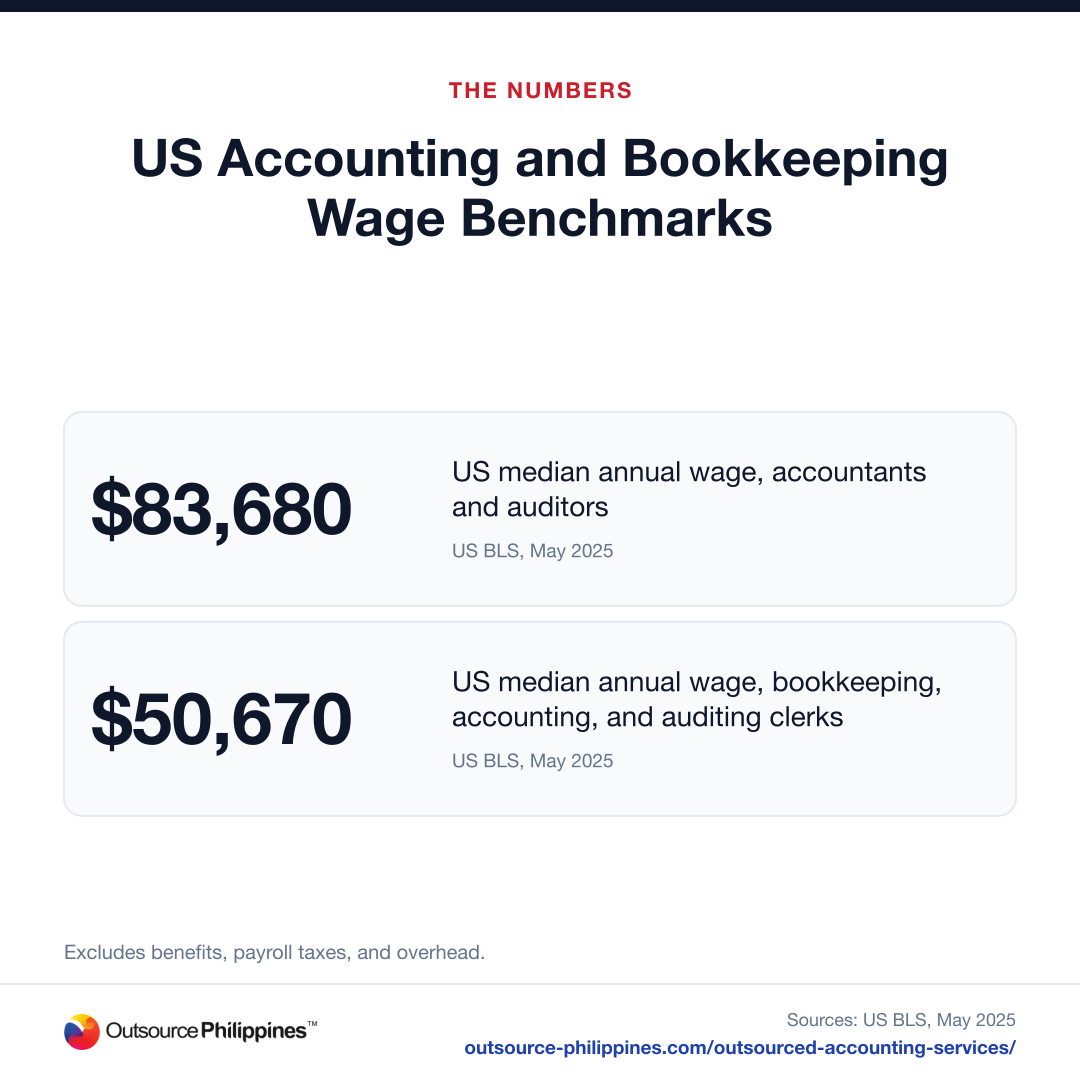
- $83,680US median annual wage, accountants and auditorsUS BLS, May 2025
- $50,670US median annual wage, bookkeeping, accounting, and auditing clerksUS BLS, May 2025
The US Bureau of Labor Statistics puts the median annual wage for accountants and auditors at $83,680 (May 2025). For bookkeeping, accounting, and auditing clerks the median is $50,670, and BLS projects employment in that group to decline 6% from 2025 to 2035 as software automates routine tasks. Both figures exclude benefits, payroll taxes, recruiting, and software.
Outsource Philippines™ prices each role as an hourly rate per agent in a written proposal, with no published rate card, and most teams go live in 2 to 4 weeks, depending on the role.
How Do You Outsource Your Accounting to the Philippines?
Start small, document everything, and keep review in-house. These 10 steps cover the full process:
- Assess your needs and goals: list the functions to outsource, your budget and expected savings, and what you want to improve, such as accuracy or faster reporting.
- Research and select the right partner: check track record, references, industry experience, and data security practices.
- Start with a pilot project: begin with a non-critical task, assess quality and communication, then adjust before scaling.
- Establish clear communication channels: set check-ins and reporting schedules, shared tools, and one point of contact on each side.
- Implement strong security measures: encryption, secure file sharing, role-based access, and regular reviews.
- Provide training and documentation: write down procedures, train on your systems, and share relevant policies.
- Integrate technology and systems: use cloud accounting software, confirm compatibility, and automate where possible.
- Monitor performance and quality: set KPIs, run periodic audits, and gather feedback from your internal team.
- Cultivate a partnership mentality: include the team in relevant meetings, share goals, and welcome process suggestions.
- Plan for scalability and growth: review scope regularly and discuss growth plans so capacity keeps up.
Outsource Philippines™ recruits and screens accountants against your requirements, and they work only on your account. Client work is protected by a managed firewall and WorQmate, our in-house project and employee monitoring platform, and handled in line with the Philippine Data Privacy Act. Our security and data protection page explains the controls in detail.
What Challenges Come with Outsourced Accounting, and How Do You Solve Them?
Most problems come from unclear processes, not distance. These are the eight common challenges and their fixes:
- Cultural and communication differences: give context with every task, encourage questions, and use regular video calls.
- Time zone differences: agree on overlap hours, use asynchronous tools for non-urgent items, and set clear handoff times.
- Data security and confidentiality: use strict access controls and encryption, and audit security and risks regularly.
- Quality control and accuracy: set quality standards and metrics, review deliverables, and give ongoing feedback.
- Integration with existing systems: choose a team experienced in your software, use cloud tools, and test the workflow before going live.
- Resistance from internal staff: explain the reasons, involve staff in the transition, and move them toward review and analysis work.
- Regulatory compliance: keep your CPA responsible for filings, update the team on rule changes, and run periodic compliance checks.
- Dependency on the outsourcing partner: keep in-house oversight, document processes, and have a contingency plan.
Track a few simple measures in the first 90 days to catch problems early: how many days after month-end the books close, how many reconciliation items stay open, how many review comments each deliverable gets, and how quickly questions are answered. If those numbers improve month over month, the process is working. If they stall, the cause is usually missing documentation or unclear ownership, both of which you can fix without changing providers.
What Is the Future of Outsourced Accounting in the Philippines?
Expect more automation, more analysis work, and wider use of AI in outsourced finance. In the 2024 Deloitte Global Outsourcing Survey, 83% of surveyed executives said they use AI as part of their outsourced services. Five trends are shaping the work:
- Technological advancements: AI and automation take over more data capture and matching, and accountants spend more time reviewing exceptions.
- Focus on value-added services: providers move from routine bookkeeping toward financial analysis, planning support, and management reporting.
- Increasing global demand: remote work has made businesses more comfortable outsourcing core finance functions.
- Government support: continued investment in infrastructure, economic zones, and education for the outsourcing sector.
- Sustainability and ESG reporting: growing reporting demands create new work in data collection and preparation.
Is Outsourced Accounting in the Philippines Right for Your Business?
It is a strong fit if you have steady monthly accounting work, use cloud accounting software, and want your books closed on time without adding local headcount. It is a weaker fit if your records are badly behind with no one in-house to explain past transactions, or if you need someone to sign tax returns or audit opinions, which must stay with a licensed US professional.
Explore our accounting outsourcing services to see the roles we staff. To get a written proposal for your volume and software, contact our team.
Frequently Asked Questions
How Much Can I Save by Outsourcing Accounting to the Philippines?
Savings depend on the role, volume, and hours you need. Outsource Philippines™ quotes costs based on the role, scope, coverage hours, and team size. For comparison, the US Bureau of Labor Statistics puts the median annual wage for accountants and auditors at $83,680 in May 2025, before benefits and overhead.
What Is the Difference between Offshore and Outsourced Accounting?
Outsourced accounting is any accounting work done by an outside provider, local or abroad. Offshore accounting is outsourced work done by a team in another country, such as the Philippines. Offshore teams usually cost less and can work US hours, while local firms can offer in-person meetings and US-licensed sign-offs.
Can a Philippine Accounting Team Work in QuickBooks or Xero?
Yes. Offshore accounting teams commonly work directly in cloud accounting software such as QuickBooks Online or Xero, using logins you control. Give each team member their own user account with role-based permissions so you can track changes and remove access quickly if needed.
Is It Safe to Give an Offshore Team Access to My Financial Data?
It can be, with the right controls. Look for a provider that complies with the Philippine Data Privacy Act of 2012, uses a managed firewall and monitored workstations, and limits access by role. Keep admin rights and bank payment authority in-house, and review user access every quarter.
Which Accounting Tasks Should I Outsource First?
Start with high-volume, rules-based work that has a clear review step: transaction coding, bank and credit card reconciliations, accounts payable entry, and invoicing. Once those run smoothly for two or three months, add month-end close support, management reports, and budgeting, keeping final review with your controller or CPA.