Mastering the Medical Billing Process: A Step-by-Step Guide

On This Page
The medical billing process is the series of steps that turns a patient visit into payment: patient registration, insurance verification, documenting the encounter, medical coding, charge entry, claim submission, payer adjudication, patient statements, payment posting, denial management, and collections and follow-up. Done accurately, it gets providers paid faster with fewer denied claims.
Medical billing is the financial backbone of a healthcare practice. It makes sure providers are paid for the care they give and that patients are billed correctly. When one step slips, claims are denied, payments stall, and patients get confusing bills. This guide explains what medical billing is, walks through all 11 steps of the medical billing process, lists the essential tools, covers HIPAA and filing rules, and explains which parts of billing practices commonly outsource.
What Is Medical Billing?
Medical billing is the process of creating claims and sending them to insurance companies so healthcare providers get paid for the services they deliver. It turns the details of a visit, such as diagnoses and treatments, into standardized codes and claims that payers can process.
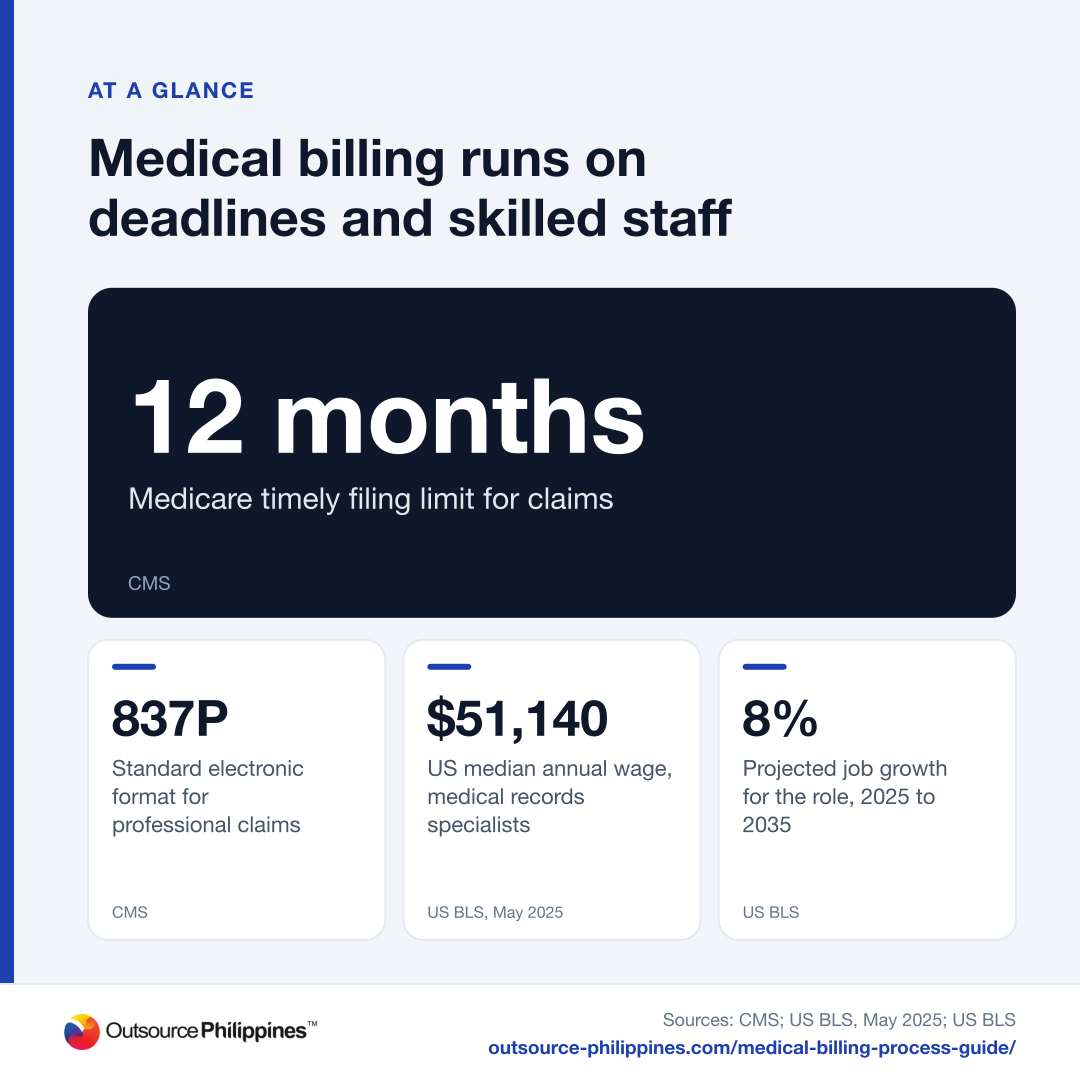
- 12 monthsMedicare timely filing limit for claimsCMS
- 837PStandard electronic format for professional claimsCMS
- $51,140US median annual wage, medical records specialistsUS BLS, May 2025
- 8%Projected job growth for the role, 2025 to 2035US BLS
Several people take part: medical billers, medical coders, front-desk staff, patients, and insurance companies. Medical billers are the key players. They collect and check insurance information, prepare and send claims, track each claim’s status, and handle payments and follow-ups.
To do the job well, billers need to know medical terminology, coding systems such as the International Classification of Diseases (ICD) and Current Procedural Terminology (CPT), payer rules, and privacy law. They act as the bridge between the provider’s office and the insurer. The US Bureau of Labor Statistics groups much of this work under medical records specialists, a role with a median annual wage of $51,140 (May 2025) and employment projected to grow 8% from 2025 to 2035.
What Are the Steps in the Medical Billing Process?
The medical billing process has 11 steps, from patient registration before the visit to collections after the payer responds. Each step feeds the next in the revenue cycle, so an error at the front desk often surfaces weeks later as a denial.
1. Patient Registration
Registration collects the patient’s demographics, insurance details, and reason for the visit, and checks whether prior authorization is needed. Accurate data here prevents most front-end claim rejections. Electronic intake forms and automated data entry reduce typing errors. For returning patients, update the file with the latest visit reason and any changes to address or coverage.
2. Insurance Verification
Verification confirms active coverage before treatment. Staff check coverage dates, benefits, deductibles, copays, and whether the service is covered, then explain the patient’s expected financial responsibility. If coverage is partial, they check for secondary insurance or tell the patient before the visit. Eligibility errors are among the easiest denials to prevent, so many practices run checks two or three days ahead of scheduled appointments and again at check-in for walk-ins.
3. Documenting the Patient Encounter
The provider documents diagnoses, treatments, prescriptions, and services in the electronic health record (EHR). The encounter form lists the services delivered and supports every code that follows. Voice-recorded notes must be transcribed before coding.
4. Medical Coding
Coders translate the encounter into standard codes: ICD codes for diagnoses, CPT codes for procedures, and HCPCS codes for supplies and other services. A superbill then summarizes what is needed for the insurance claim. A typical superbill includes:
- Patient demographics
- Services provided
- Diagnoses
- Date of service
- Provider information
- National Provider Identifier (NPI)
5. Charge Entry
Charge entry assigns the practice’s fee to each coded service in the billing system. Billers enter procedures, consultations, equipment, and medications, and ask the provider for missing details, such as a diagnosis left off the encounter form. A charge capture review confirms nothing was missed.
6. Claim Preparation and Submission
Claims built from the superbill must be accurate and correctly formatted to be accepted. Three checks matter most:
- Claim scrubbers catch errors before claims are filed.
- Clearinghouses review claims for payer rules and return those that need correction.
- Claims go out in the payer’s required format, usually electronic.
For Medicare, CMS sets the 837P as the standard electronic format for professional claims, requires initial claims to be filed electronically unless an exception applies, such as having fewer than 10 full-time equivalent employees, and sets a 12-month timely filing limit.
7. Adjudication
Adjudication is the payer’s review of the claim to decide whether, and how much, to pay. A claim can be paid, denied, or rejected. Billers should monitor claim status, know each payer’s requirements, and recognize common denial codes.
8. Generating Patient Statements
Once the payer responds, the practice bills the patient for the remaining balance. A clear patient statement includes:
- Financial responsibility after insurance payment
- Balance due
- Due date
- Payment methods
Include the explanation of benefits and instructions for questions or disputes, so patients understand what they owe and why.
9. Payment Posting
Payment posting records insurer and patient payments against each account. It covers five tasks:
- Matching payments to patient accounts
- Reconciling payments against claims
- Confirming that data matches
- Recording payments from insurers or patients
- Updating the account balance
Post payments on the day they arrive, including zero-dollar remittances and denial codes.
10. Managing Denied Claims
When a claim is denied, investigate the reason on the remittance advice, correct the error or add documentation, and resubmit or appeal. Coding errors and missing information are frequent causes. Track denials by reason so the root cause gets fixed upstream. A denial caused by a missing authorization, for example, is a front-desk problem, while repeated modifier errors point to coding training. Working denials quickly matters, because appeal windows close.
11. Collections and Follow-up
Follow up on unpaid insurance claims and patient balances promptly. Payment plans and online payment options help patients pay in full and on time, and the practice’s written policy should define when an unpaid balance is sent to collections.
What Tools Are Essential for Medical Billing?
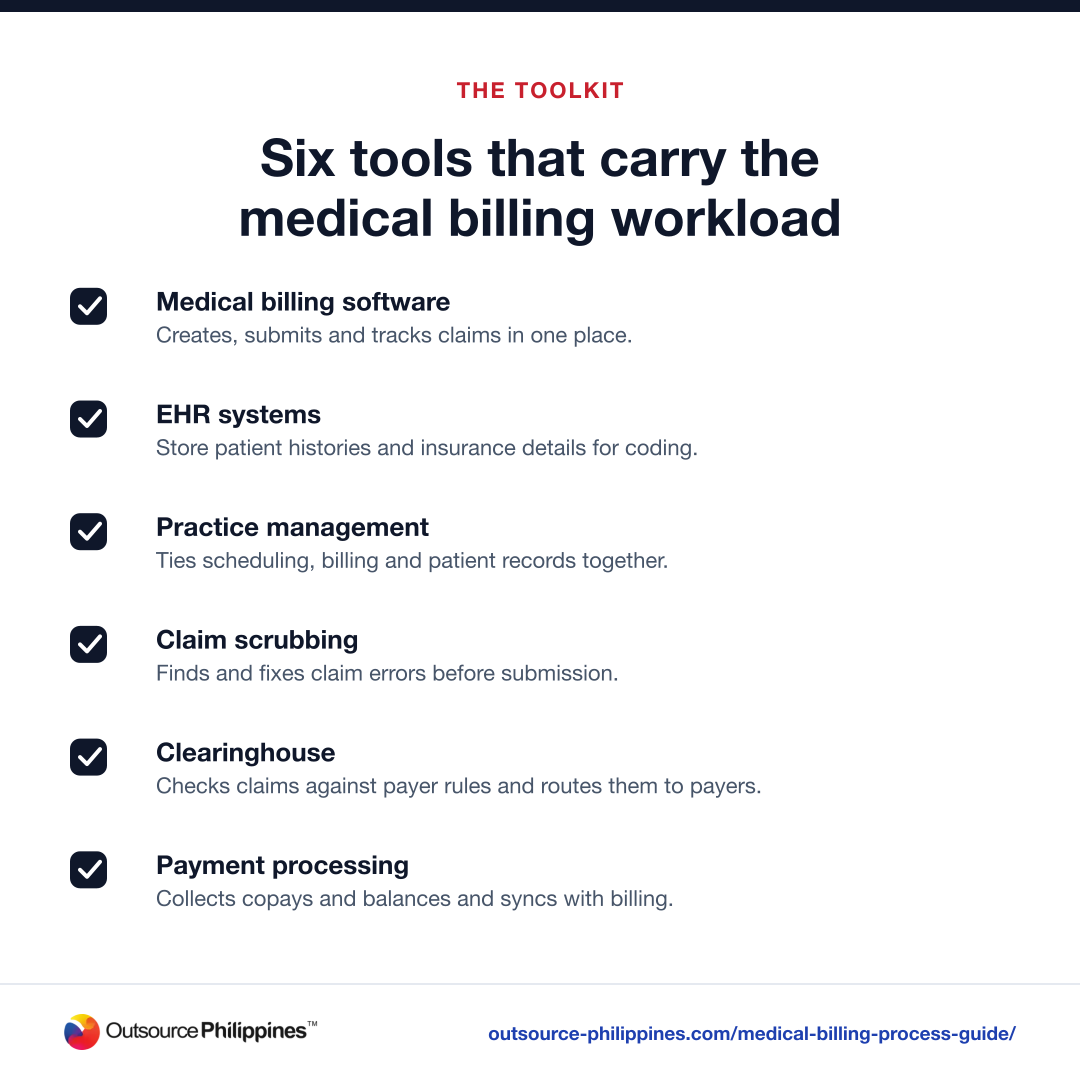
Six tools carry most of the billing workload. Together they cut manual entry, catch errors before submission, and give staff one view of each patient account.
- Medical billing software
Creates, submits and tracks claims in one place.
- EHR systems
Store patient histories and insurance details for coding.
- Practice management
Ties scheduling, billing and patient records together.
- Claim scrubbing
Finds and fixes claim errors before submission.
- Clearinghouse
Checks claims against payer rules and routes them to payers.
- Payment processing
Collects copays and balances and syncs with billing.
Most practices run billing inside their practice management system or EHR, with a clearinghouse connection and a patient payment portal. When choosing tools, check that they share data automatically. Every manual re-entry between systems is a chance for a wrong code, a mistyped policy number, or a missed charge, which is exactly what scrubbers and clearinghouses then have to catch.
What Compliance Rules Apply to Medical Billing?
Medical billing must follow HIPAA, because claims carry protected health information (PHI), and payer rules such as Medicare’s filing requirements. Practices handling billing in-house are covered entities and must comply directly.
The US Department of Health and Human Services includes billing, claims processing, and practice management among the services a business associate performs for a covered entity. Key compliance points:
- An outside billing provider is a business associate and needs a business associate agreement (BAA) that limits how it uses and discloses PHI.
- The BAA must require the provider, and its subcontractors, to follow the HIPAA Security Rule and report security incidents and breaches.
- Providers must keep administrative, physical, and technical safeguards in place to protect patient information.
- Regular risk assessments identify and address security threats to patient data.
Should You Outsource Medical Billing?
Outsourcing medical billing makes sense when claims back up, denials climb, or billing staff are hard to hire and keep. Many practices outsource the repeatable, rules-based steps and keep decisions that need clinical or front-desk judgment in-house.
| Billing step | Commonly outsourced | Usually kept in-house |
|---|---|---|
| Insurance verification | Eligibility and benefits checks before visits | Conversations with patients at check-in |
| Coding and charge entry | Coding review and charge entry | Clinical documentation by the provider |
| Claims | Scrubbing, submission, and status tracking | Payer contract negotiation |
| Payments and denials | Payment posting and denial research | Write-off and refund decisions |
Ask any billing provider these questions before you sign:
- Which billing and EHR systems will your staff work in, and with what access level?
- Who reviews coding and claims before they go out?
- How often will we see reports on denials, days in accounts receivable, and collections?
- How do you train staff on our payers and specialty?
Then confirm three things in writing: a signed BAA, how the provider restricts access to PHI, and how performance will be measured, for example by days in accounts receivable, denial rate, and clean claim rate. Start with one or two steps, measure for a few months, then expand. Outsource Philippines™ estimates most US clients pay 60% to 70% less than an equivalent in-house hire.
Is Outsourcing Your Medical Billing Process Right for Your Practice?
It is a strong fit for practices with steady claim volume, documented billing procedures, and in-house staff stretched thin by follow-up work. It is a weaker fit for a very small practice with few claims, or one whose billing problems come mainly from incomplete clinical documentation, which has to be fixed at the source first.
Outsource Philippines™ provides non-clinical healthcare outsourcing services, including medical billing, through HIPAA-trained staff who work only on one practice's account under a signed BAA.
Frequently Asked Questions
What Are the Main Steps in the Medical Billing Process?
The main steps are patient registration, insurance verification, documenting the encounter, medical coding, charge entry, claim preparation and submission, payer adjudication, patient statements, payment posting, denial management, and collections and follow-up. Front-end steps prevent errors, middle steps get claims paid, and back-end steps make sure every balance is resolved.
What Is the Difference between Medical Billing and Medical Coding?
Medical coding translates diagnoses and procedures from the clinical record into standard codes such as ICD, CPT, and HCPCS. Medical billing uses those codes to build claims, submit them to payers, post payments, follow up on denials, and bill patients for remaining balances. Coding feeds billing, and errors in either delay payment.
How Long Do Providers Have to Submit a Medicare Claim?
Medicare’s timely filing limit is 12 months for both paper and electronic claims, according to CMS. Claims that arrive after the deadline are denied, and that denial cannot be appealed. Commercial payers set their own filing limits, often shorter, so practices should track each payer’s deadline in their billing system.
Is It Safe to Outsource Medical Billing?
It can be, when the provider signs a business associate agreement, follows the HIPAA Privacy and Security Rules, restricts access to patient data, and reports incidents promptly. Ask how staff are screened and monitored, where data is stored, and which systems they access. Offshore providers should also follow their own national privacy law.
Why Are Medical Claims Denied?
Common reasons include incorrect patient or insurance details, inactive coverage, missing prior authorization, coding errors, missing documentation, duplicate submissions, and late filing. Many denials are preventable with accurate registration, eligibility checks before the visit, and claim scrubbing before submission. Tracking denials by reason shows which upstream step needs fixing.