Insurance Claims Management: How to Improve the Process

On This Page
- What Is Claims Management in Insurance?
- Why Does Claims Management Matter?
- What Are the Steps in the Claims Management Process?
- What Are the Common Claims Management Challenges?
- Which Claims Tasks Can an Insurer Outsource?
- Is Outsourcing Claims Management Right for Your Business?
- Frequently Asked Questions
Claims management is the process of handling an insurance claim from first report to final settlement: logging the claim, collecting documents, verifying coverage, investigating, screening for fraud, approving or denying it, and paying approved amounts. A well-run process pays valid claims faster, explains every denial, and keeps the insurer within state claims-handling laws.
Claims handling is regulated conduct, not just a service function. The NAIC Unfair Claims Settlement Practices Act, a model law written for states to adopt, lists failing to acknowledge claim communications with reasonable promptness, refusing to pay without a reasonable investigation, and failing to explain a denial among the practices regulators can penalize.
That makes the operational side of claims, the intake, document chasing, data entry and status updates, more than back-office housekeeping. Slow intake and missing files are what turn a routine claim into a late one.
What Is Claims Management in Insurance?
Claims management is the set of steps an insurer, health plan or third-party administrator (TPA) follows from the moment a loss or bill is reported until the file is closed. It applies policy terms to the facts of each claim and records why the claim was paid, reduced or denied.
Two groups of people do the work:
- Licensed decision-makers. The US Bureau of Labor Statistics counts about 376,100 claims adjusters, examiners and investigators in 2025. Adjusters inspect damage and gather evidence, examiners review files for correct procedure and reasonable costs, and investigators look into suspected fraud.
- Claims support staff. Processors and assistants log first notice of loss, index documents, enter data into the claims system, request missing items, and answer status calls, so adjusters spend their hours on decisions.
On the health side, the work looks different but follows the same logic. A health plan receives a medical claim from a provider, checks eligibility and benefits, applies coding and authorization rules, and pays or denies it with a reason code.
Why Does Claims Management Matter?
The volume is large and the errors are visible. In the KFF analysis of 2024 ACA marketplace claims, published in March 2026, HealthCare.gov insurers received about 496 million claims and denied an average of 19% of in-network claims, with individual insurers ranging from 3% to 36%.
A claims process affects four things an insurer cares about:
- Policyholder trust. A claim is the moment a customer finds out what the policy is worth. Clear updates and a well-run insurance customer service line reduce complaints and repeat calls.
- Regulatory exposure. Under the NAIC model, failing to send claim forms within 15 calendar days of a request, or failing to affirm or deny coverage within a reasonable time after investigating, are unfair claims practices when done flagrantly or often enough to amount to a general business practice.
- Loss costs. Paying claims that should have been flagged for fraud, or overpaying through data entry errors, raises loss ratios.
- Operating cost. Every missing document and every status call adds handling time to the file.
What Are the Steps in the Claims Management Process?
Most property, casualty and health claims follow five steps. The table shows who usually owns each one.
| Step | What happens | Usually handled by |
|---|---|---|
| Intake | The claim is logged with policy details, incident facts and first documents | Claims processors |
| Coverage check and investigation | Staff confirm the policy was active and gather statements, photos or records | Processors gather; adjusters investigate |
| Fraud and risk screening | The file is checked against fraud indicators and prior claims | Rules engines and processors flag; investigators review |
| Decision | The claim is approved, reduced or denied under the policy terms | Licensed adjusters or examiners |
| Payment and closing | Approved amounts are paid and the file is documented and closed | Claims and finance staff |
1. Intake and First Notice of Loss
The claim arrives by phone, portal, email or app. The first record needs the policy number, date and description of the loss, contact details and any photos or bills. Incomplete intake is the most common reason a file stalls later.
2. Coverage Check and Investigation
Staff confirm the policy was in force on the date of loss and that the loss type is covered. Adjusters then inspect damage, take statements or request records. The NAIC model treats refusing to pay without a reasonable investigation as an unfair practice, so this step needs a documented trail.
3. Fraud and Risk Screening
Files are compared against fraud indicators: a policy bought days before the loss, repeated claims from the same address, inflated repair estimates. Support staff and software flag files; trained investigators decide what is actually suspicious.
4. Decision
The adjuster or examiner approves, reduces or denies the claim under the policy terms. A denial or compromise offer needs a prompt, accurate explanation of the basis for it, one of the NAIC model's listed requirements.
5. Payment and Closing
Approved amounts are paid, each payment is tied to the coverage it falls under, and the file is closed with its notes and documents attached. The NAIC model also lists paying a claim without indicating the coverage it falls under as an unfair practice.
What Are the Common Claims Management Challenges?
- Backlogs after catastrophes. A storm or a seasonal spike can multiply intake volume in days, and files waiting for first contact age quickly.
- Document chasing. Adjusters lose hours requesting police reports, repair estimates and medical records, then matching them to the right file.
- Staffing. BLS projects employment of claims adjusters, examiners and investigators to fall about 5% from 2025 to 2035, as automation takes over simpler files. The remaining work concentrates on complex claims and the support tasks around them.
- Fixed costs. Keeping enough in-house staff for peak volume means paying for idle capacity the rest of the year.
- Inconsistent communication. Policyholders who cannot get a status update call again, email again and eventually complain to the state insurance department.
Which Claims Tasks Can an Insurer Outsource?
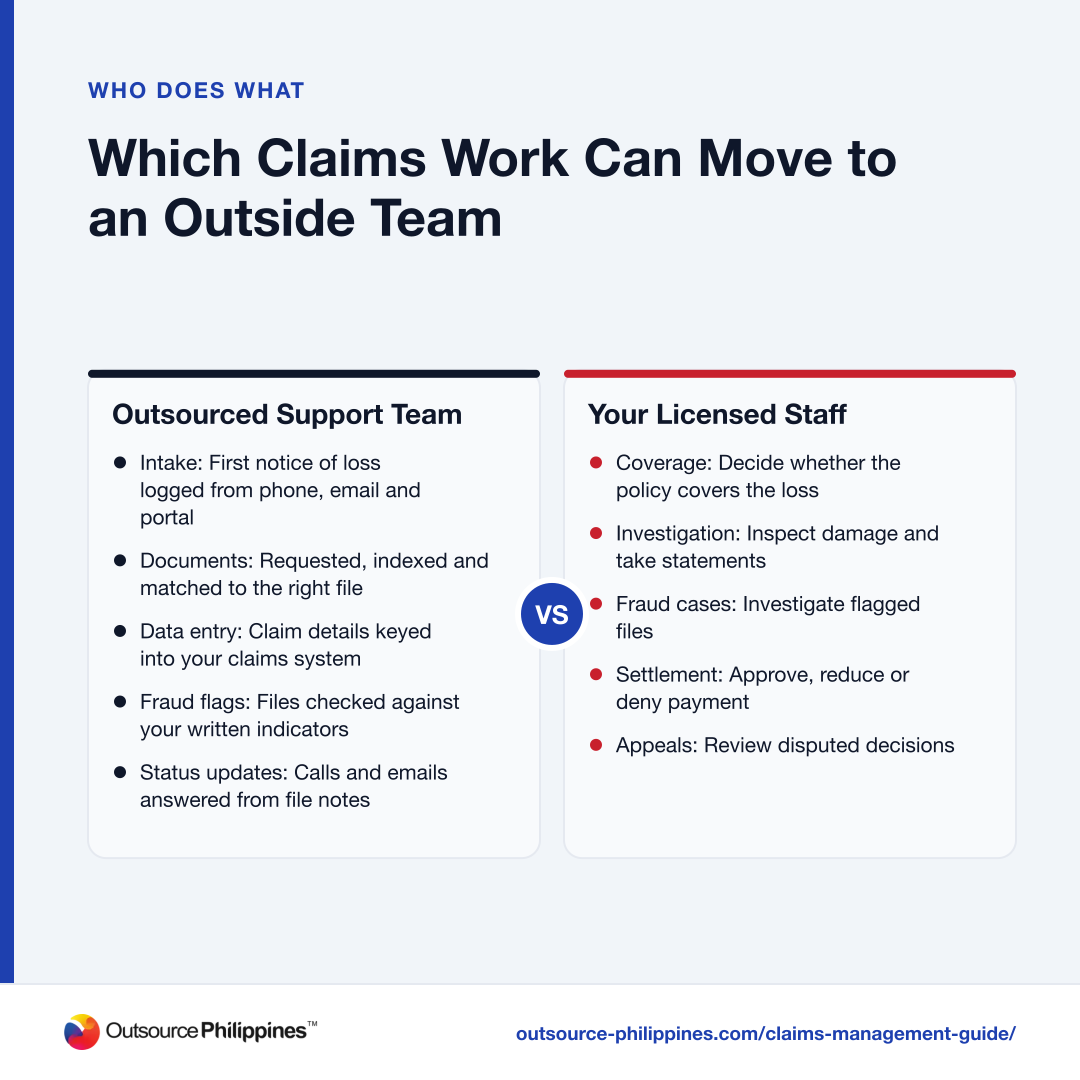
The dividing line is licensing and authority. Tasks that follow written rules can move to an outside team; decisions that require a license or settlement authority stay with your staff.
Outsourced Support Team
- Intake
- First notice of loss logged from phone, email and portal
- Documents
- Requested, indexed and matched to the right file
- Data entry
- Claim details keyed into your claims system
- Fraud flags
- Files checked against your written indicators
- Status updates
- Calls and emails answered from file notes
Your Licensed Staff
- Coverage
- Decide whether the policy covers the loss
- Investigation
- Inspect damage and take statements
- Fraud cases
- Investigate flagged files
- Settlement
- Approve, reduce or deny payment
- Appeals
- Review disputed decisions
Outsourcing employees for the support column frees adjusters for decisions and gives the insurer a way to add capacity for peak periods without hiring permanent licensed staff. The team works inside your claims system, follows your written procedures and authority limits, and escalates anything outside them.
Status calls and emails are a large share of claims contact volume. Staff trained in handling customer inquiries can answer them from file notes, which cuts the repeat calls that reach adjusters.
For health plans and TPAs, outsourced medical claims processors handle eligibility checks, claim data entry and coding edits as non-clinical work. Because medical claims contain protected health information, the vendor must sign a Business Associate Agreement and follow the HIPAA Security Rule.
Is Outsourcing Claims Management Right for Your Business?
It is a strong fit if your claims volume is steady or growing, your intake steps are documented, and your adjusters lose hours to data entry, document chasing and status updates. It is a weaker fit if nearly every file needs licensed judgment or your process changes often. Coverage decisions and payouts stay with your licensed staff either way.
Before you start, write down the claim types, monthly volume, systems and authority limits the team will work within, then request a proposal based on that list.
Outsource Philippines™ provides dedicated insurance claims processing teams and back-office outsourcing staff who work from a supervised office in the Philippines, only on one client's account, while your adjusters keep every coverage and settlement decision.
Frequently Asked Questions
What Is Claims Management in Insurance?
Claims management is the end-to-end handling of an insurance claim, from the moment it is reported until the file is closed. It covers intake, document collection, coverage checks, investigation, fraud screening, the coverage decision and payment of approved amounts, all in line with policy terms and the state laws on claims handling.
What Are the Main Steps in the Claims Management Process?
Most processes follow five steps: intake and first notice of loss, coverage check and investigation, fraud and risk screening, the decision to approve, reduce or deny, and payment and closing. Each decision needs a documented reason, and a denial needs a prompt, accurate explanation to the claimant.
What Laws Govern How Insurers Handle Claims?
In the US, each state regulates claims handling through its insurance department. The NAIC Unfair Claims Settlement Practices Act is the model law written for states to adopt, and it prohibits practices such as refusing to pay without a reasonable investigation, failing to acknowledge claim communications promptly, and failing to explain the basis for a denial.
Which Claims Tasks Can Be Outsourced?
Insurers commonly outsource high-volume, rule-based work: first notice of loss intake, data entry, document indexing, first-pass fraud flags and policyholder status updates. Coverage decisions, settlement approvals, fraud investigations and any task that requires an adjuster's license stay in-house. Health claims work also requires a signed Business Associate Agreement.
How Do Health Insurance Claims Differ From Property Claims?
Health claims usually come from providers rather than policyholders, arrive electronically in standard formats, and are decided by applying eligibility, coding and authorization rules. KFF found HealthCare.gov insurers denied 19% of in-network claims in 2024. Property and casualty claims more often need an inspection, statements and a negotiated settlement.