Outsourced Bookkeeping in the Philippines: Costs, Tasks, and How to Start

On This Page
- What Is Bookkeeping?
- What Does an Outsourced Bookkeeping Team in the Philippines Handle?
- Why Outsource Bookkeeping to the Philippines?
- How Much Does Outsourced Bookkeeping in the Philippines Cost?
- Which Countries Are Best for Outsourcing Bookkeeping?
- How Do You Keep Financial Data Secure Offshore?
- How Do You Move Your Bookkeeping to a Philippine Team?
- How Do You Choose a Bookkeeping Partner?
- Is Outsourced Bookkeeping in the Philippines Right for Your Business?
- Frequently Asked Questions
Outsourced bookkeeping in the Philippines means hiring a Philippine provider to keep your books with a dedicated bookkeeper or team: recording transactions, managing payables and receivables, reconciling accounts, and preparing monthly reports in QuickBooks, Xero, or your own system. US companies use it to keep books current at lower cost than an in-house hire.
Bookkeeping is one of the easiest finance functions to move offshore, because the work is rule-based, cloud-based, and measurable. This guide explains what bookkeeping is, what a Philippine bookkeeping team handles, what drives cost, how the Philippines compares with other countries, how to keep financial data secure, and how to transition in about four weeks.
What Is Bookkeeping?
Bookkeeping is the day-to-day recording and organizing of a business’s financial transactions, so that income, expenses, assets, and liabilities are accurate and up to date. It is the foundation for financial statements, tax returns, and every financial decision.
The US Bureau of Labor Statistics describes the core bookkeeping tasks as:
- Using bookkeeping software, spreadsheets, and databases
- Posting financial transactions into the accounting software
- Receiving and recording cash, checks, and vouchers
- Recording costs (debits) and income (credits) to the right accounts
- Producing reports such as balance sheets, income statements, and totals by account
- Checking figures, postings, and reports for accuracy
- Reconciling records and reporting any differences
Good records also matter for taxes. The IRS says you must keep records as long as needed to prove the income or deductions on a tax return, and records of employment taxes for at least four years.
Single-entry vs Double-entry Bookkeeping
- Single-entry: each transaction is recorded once, like a check register. It suits very small, cash-based businesses.
- Double-entry: each transaction is recorded as a debit in one account and a credit in another, so the books always balance. It is the standard for growing businesses and is built into QuickBooks, Xero, and NetSuite.
Bookkeeping is not the same as accounting. Bookkeepers record and organize; accountants interpret, advise, file complex returns, and sign off on statements. The difference between bookkeeping and accounting matters when you decide which roles to outsource and which to keep with your CPA.
What Does an Outsourced Bookkeeping Team in the Philippines Handle?
A Philippine bookkeeping team handles the recurring work that keeps your books closed on time, working inside your accounting software under your rules.
- Transaction recording: categorizing bank, card, and payment transactions.
- Accounts payable: entering bills, matching them to purchase orders, and scheduling payments for your approval process.
- Accounts receivable: issuing invoices, applying payments, and chasing overdue balances.
- Bank and card reconciliations: matching records to statements every month.
- Expense tracking: receipts, reimbursements, and expense reports.
- Month-end close support: accruals, adjustments, and a clean trial balance for your accountant.
- Financial reports: monthly profit and loss, balance sheet, and cash flow summaries.
- Tax-season preparation: organized, categorized records ready for your CPA.
These tasks map onto the accounting cycle, from recording transactions to closing the books. Final tax filing and financial advice usually stay with your US accountant.
Software Philippine Bookkeepers Commonly Use
- QuickBooks Online and QuickBooks Desktop
- Xero
- NetSuite
- SAP Business One
- FreshBooks and Wave for very small businesses
- Document and approval tools such as Hubdoc, Dext, and ApprovalMax
Cloud tools let your team and the offshore bookkeeper see the same live data, with automated bank feeds, receipt capture, and approval workflows. If you are still choosing a platform, compare bookkeeping software solutions on bank feeds, multi-entity support, and price before onboarding a bookkeeper.
Why Outsource Bookkeeping to the Philippines?
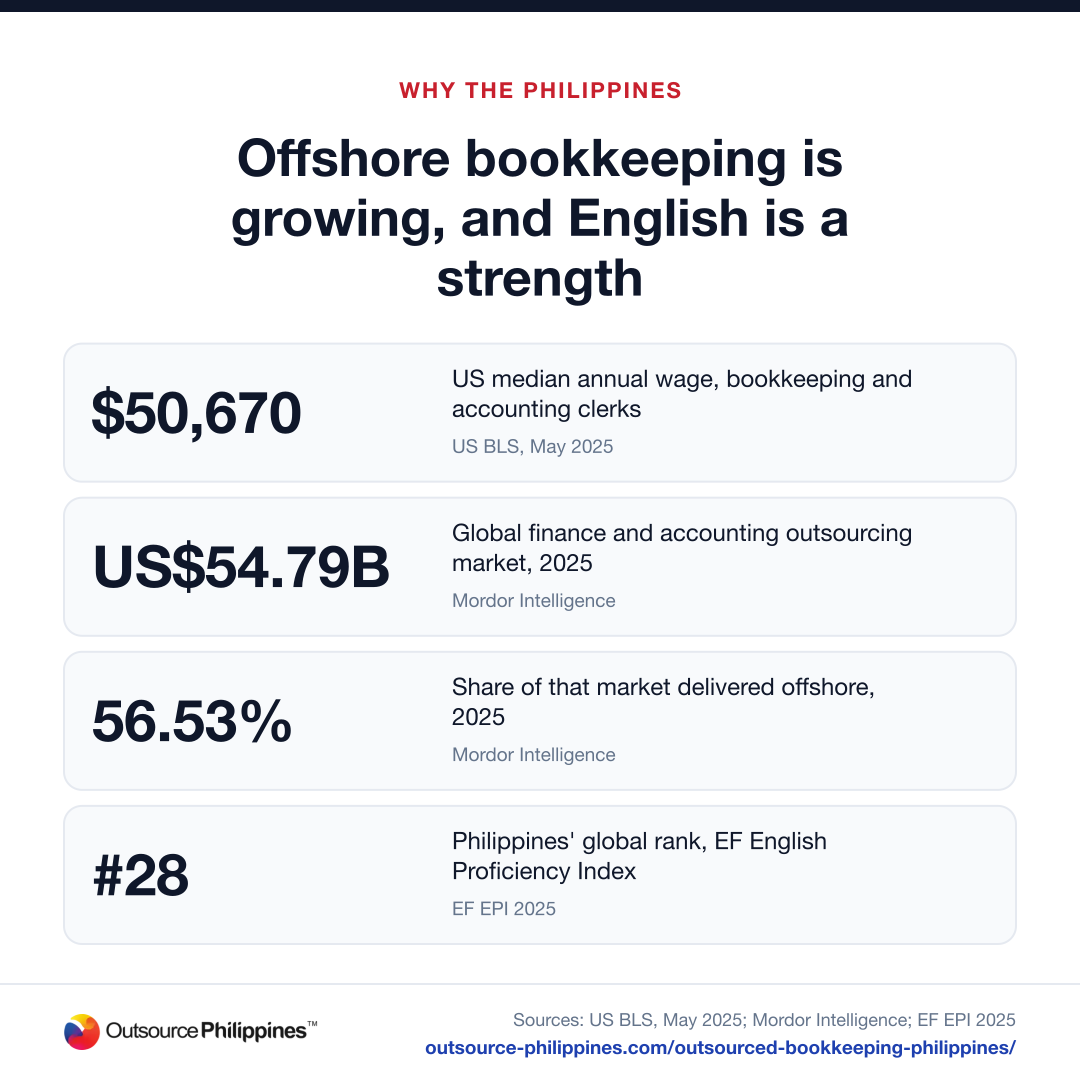
Companies choose the Philippines for lower cost, strong English, familiarity with US business practices, and the ability to process work overnight so the books are updated when your team logs on.
- $50,670US median annual wage, bookkeeping and accounting clerksUS BLS, May 2025
- US$54.79BGlobal finance and accounting outsourcing market, 2025Mordor Intelligence
- 56.53%Share of that market delivered offshore, 2025Mordor Intelligence
- #28Philippines' global rank, EF English Proficiency IndexEF EPI 2025
- Cost: Outsource Philippines™ estimates most US clients pay 60% to 70% less than an equivalent in-house hire.
- English proficiency: the Philippines ranks 28th in the 2025 EF English Proficiency Index, with a score of 569 against a global average of 488.
- Accounting talent: a large pool of accounting graduates and CPAs familiar with US GAAP and cloud software.
- Overnight processing: transactions are recorded while you sleep, which shortens the month-end close.
- Dedicated staff: a bookkeeper who works only on your account learns your vendors, chart of accounts, and approval rules.
Demand for outsourced finance work is growing. The global finance and accounting outsourcing market is expected to grow from US$54.79 billion in 2025 to US$85.92 billion by 2031, a 7.78% annual growth rate from 2026, and offshore delivery held 56.53% of revenue in 2025, according to Mordor Intelligence.
How Much Does Outsourced Bookkeeping in the Philippines Cost?
Cost depends on transaction volume, complexity, software, and whether you need a full-time bookkeeper or a team. Outsource Philippines™ prices bookkeeping as an hourly rate per agent, quoted in a written proposal.
For a US benchmark, the median annual wage for bookkeeping, accounting, and auditing clerks was $50,670 (May 2025), according to the BLS. Benefits, payroll taxes, recruiting, software seats, and management time come on top of that.
| Cost driver | Lower cost | Higher cost |
|---|---|---|
| Transaction volume | A few hundred per month | Thousands per month across entities |
| Complexity | Single entity, cash basis | Multiple entities, accrual, inventory, or job costing |
| Skill level | Bookkeeper | CPA-supervised or senior finance analyst |
| Scope | Recording and reconciliations | Full AP, AR, payroll support, and month-end close |
| Coverage | Philippine daytime | US business hours overlap |
Compare the full cost of an in-house hire, not just salary, against the proposal. Every quote is built for your scope, and how our pricing works describes the process from scoping to written proposal.
In-house vs Outsourced Bookkeeping
| Factor | In-house bookkeeper | Outsourced Philippine bookkeeper |
|---|---|---|
| Cost | Salary, benefits, payroll taxes, equipment, and software seats | One hourly rate per agent in a written proposal |
| Hiring | You recruit, train, and replace staff | The provider recruits, screens, and trains |
| Control | Direct, same office and hours | Managed through agreed processes, reports, and cut-off times |
| Coverage | Your business hours; gaps during leave | Overnight processing, with backup during leave |
| Best for | Work needing daily in-person judgment | Recurring, rule-based bookkeeping in cloud software |
Many companies keep a part-time controller or outside CPA for review and tax, and outsource the daily recording and reconciliation. That split gives you oversight without paying senior rates for routine work.
Which Countries Are Best for Outsourcing Bookkeeping?
The Philippines, India, and Latin America are the most common bookkeeping destinations for US companies. The Philippines leads on English communication and cultural fit, India on scale, and Latin America on time zone overlap.
| Factor | Philippines | India | Latin America |
|---|---|---|---|
| Best fit | Day-to-day bookkeeping with lots of client communication | Large-volume processing and accounting firms | Work that needs live, same-hours collaboration |
| English communication | Strong | Strong in specialist roles; varies | Varies by country |
| Time zone with the US | Overnight processing or US-hours shifts | Overnight processing | Same or close hours |
| Familiarity with US business practices | High | Moderate to high | Moderate to high |
| Relative cost | Low | Low | Moderate |
If your owners and managers want to message the bookkeeper often and get clear written answers, the Philippines is usually the strongest fit. Between the two largest offshore markets, the Philippines vs India outsourcing choice usually comes down to communication style versus sheer scale.
How Do You Keep Financial Data Secure Offshore?
Keep data secure with strict access controls, a provider that follows recognized security frameworks, and contracts that cover confidentiality and data handling.
- Least-privilege access: give the bookkeeper only the software roles they need, and keep payment approval with your team.
- Recognized frameworks: ask whether the provider aligns with ISO 27001 or holds a SOC 2 report.
- Privacy law: Philippine providers must comply with the Data Privacy Act of 2012.
- Monitored workstations: secure networks, monitored devices, and no local copies of client files.
- Contracts: confidentiality, data handling, and incident reporting written into the agreement.
Separate duties as you would in-house: the offshore bookkeeper prepares bills and payment batches, but someone on your team releases payments and confirms new vendors’ bank details. That single control blocks most payment fraud, wherever the bookkeeper sits.
Outsource Philippines™ complies with the Data Privacy Act and protects client work with a managed firewall and WorQmate, its in-house project, and employee monitoring platform.
How Do You Move Your Bookkeeping to a Philippine Team?
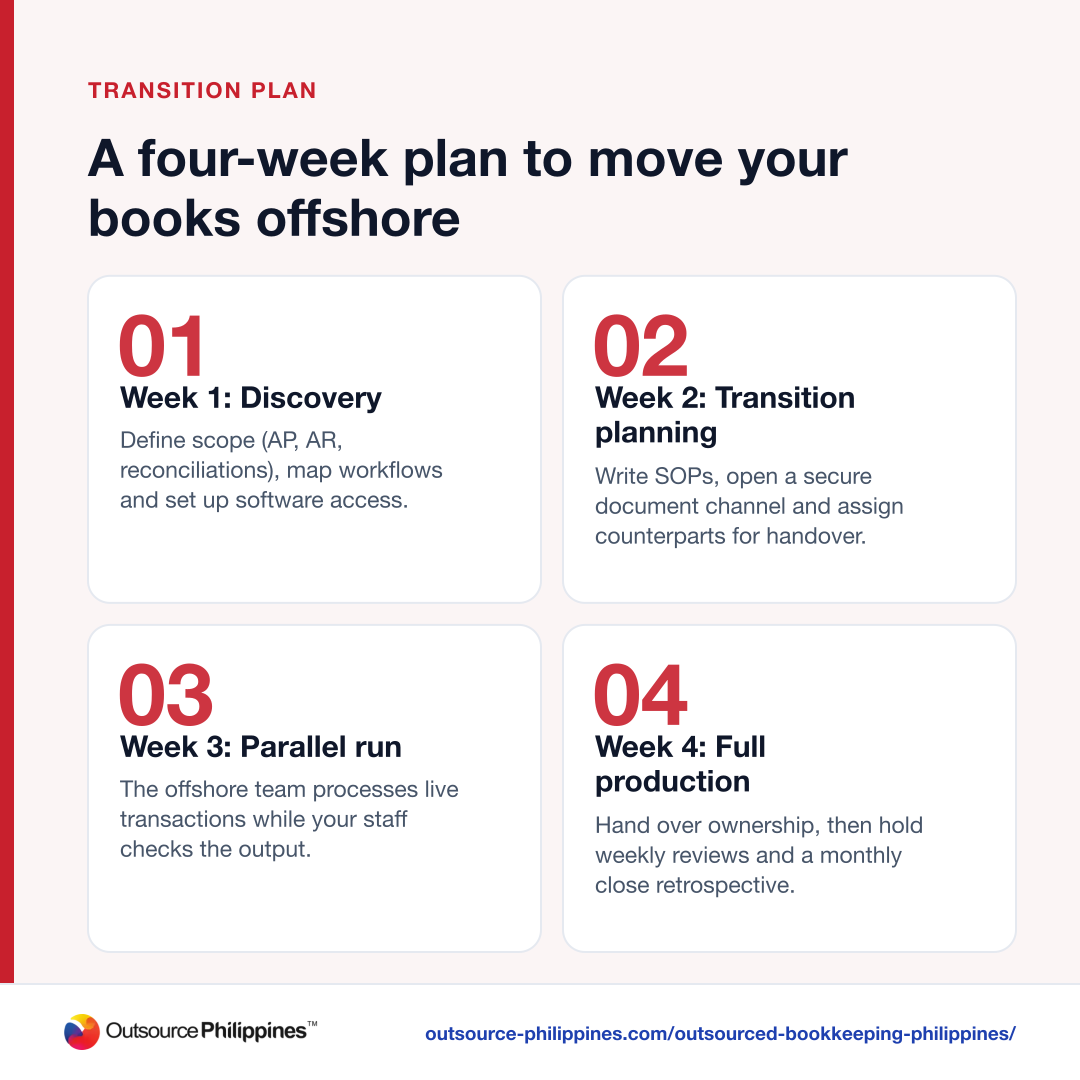
Move in stages: define the scope, document the process, run in parallel, then hand over. Most teams go live in 2 to 4 weeks, depending on the role.
- 1Week 1: Discovery
Define scope (AP, AR, reconciliations), map workflows and set up software access.
- 2Week 2: Transition planning
Write SOPs, open a secure document channel and assign counterparts for handover.
- 3Week 3: Parallel run
The offshore team processes live transactions while your staff checks the output.
- 4Week 4: Full production
Hand over ownership, then hold weekly reviews and a monthly close retrospective.
Once the team is live, track outcomes rather than hours:
- Transaction turnaround time: how quickly entries are recorded.
- Error rate: adjustments needed after review.
- Days to close the month: from month-end to final reports.
- Cash application lag: time from payment received to payment applied.
- Cost per transaction: total cost divided by volume processed.
Common starting points by industry:
- Ecommerce: matching orders, payouts, and refunds across sales channels, plus inventory adjustments.
- SaaS: subscription billing records and deferred-revenue schedules ready for investor review.
- Property management: rent ledger reconciliations, tenant deposits, and owner statements.
- Professional services: time-based invoicing, collections, and expense tracking by client.
A typical day looks like this: your team uploads bills and receipts and flags questions before the end of the US workday; the Philippine bookkeeper records, reconciles, and answers overnight; and a short summary with any open items is waiting in your inbox the next morning.
How Do You Choose a Bookkeeping Partner?
Choose a partner with relevant experience, clear reporting, dedicated staff, and documented security. Watch for red flags before you sign.
- Experience: bookkeepers who know your software and industry.
- Dedicated team: named staff who work only on your account.
- Reporting: monthly statements delivered on a fixed schedule, with a clear review process.
- Communication: responsive contacts and agreed cut-off times.
- Security: documented access controls and privacy compliance.
Questions worth asking every provider:
- Who reviews the bookkeeper’s work before reports reach us?
- What happens to our books when our bookkeeper is on leave?
- Which of our systems will your team access, and with what permissions?
- What does a monthly report package include, and when is it delivered?
- How do you handle a question that needs our accountant’s input?
Red flags include vague pricing, no sample reports, frequent staff changes, slow responses during the sales process, and reluctance to explain security controls.
Is Outsourced Bookkeeping in the Philippines Right for Your Business?
It is a strong fit if you have steady monthly transaction volume, use cloud accounting software, and want current books without adding US headcount. It is a weaker fit if your books need a licensed US professional’s judgment daily, or if your records are so disorganized that a cleanup project should come first.
Explore our bookkeeping outsourcing services to see how a dedicated Philippine bookkeeper fits your finance team. When you are ready, request a proposal with your software, entities, and monthly volume.
Frequently Asked Questions
What Is Bookkeeping?
Bookkeeping is the process of recording and organizing a business’s financial transactions, including sales, purchases, payments, and receipts. Bookkeepers post transactions to the right accounts, reconcile bank and card statements, and produce reports such as balance sheets and income statements, giving owners and accountants accurate records for decisions and tax returns.
How Much Can I Save by Outsourcing Bookkeeping to the Philippines?
Savings depend on volume, complexity, and the skill level you need. Outsource Philippines™ estimates most US clients pay 60% to 70% less than an equivalent in-house hire. Pricing is an hourly rate per agent, quoted in a written proposal after the provider reviews your software, entities, and monthly volume.
Is My Financial Data Secure with an Offshore Bookkeeper?
It can be, when you limit access to the roles the bookkeeper needs and keep payment approval in-house. Choose a provider that complies with the Philippine Data Privacy Act of 2012, uses monitored workstations and secure networks, and writes confidentiality, data handling, and incident reporting into the contract. Ask about ISO 27001 alignment or SOC 2 reports.
Which Country Is Best for Outsourcing Bookkeeping?
For most US small and mid-sized businesses, the Philippines is the strongest fit for day-to-day bookkeeping because of its strong English, familiarity with US business practices, and overnight processing. India suits very large-volume processing, and Latin America suits companies that need live collaboration during US hours at a higher cost.
How Do I Manage Time-zone Differences with a Philippine Bookkeeper?
Set agreed cut-off times for documents and approvals, so work submitted by the end of your day is processed overnight and ready when your team logs on. Use shared folders, a chat channel, and a weekly call for questions. If you need live collaboration, the bookkeeper can work a shift that overlaps US business hours.