What Is ESG? Environmental, Social, and Governance Explained

On This Page
- What Is ESG?
- What Does Each Part of ESG Mean?
- Why Does ESG Matter to Businesses and Investors?
- How Is ESG Measured and Reported?
- What Are the Most Common Mistakes in ESG Implementation?
- How Do You Build an ESG Strategy?
- What Are the Best Practices for ESG Integration?
- How Does ESG Affect Performance across Industries?
- Is Outsourcing ESG Data Work Right for Your Business?
- Frequently Asked Questions
ESG (environmental, social, and governance) is a set of criteria used to judge how responsibly a company operates beyond its financial results. Environmental covers emissions, energy, water, and waste. Social covers how it treats employees, customers, suppliers, and communities. Governance covers board oversight, executive accountability, ethics, and transparent reporting.
Investors, regulators, customers, and employees now look at all three when they decide whom to fund, buy from, or work for. This guide explains what ESG means, what each pillar covers, why it matters, how it is measured and reported under current rules, the mistakes companies make, a seven-step way to build an ESG strategy, and how the focus shifts by industry.
What Is ESG?
ESG is a framework for assessing a company’s sustainability performance and ethical practices across three areas: environmental stewardship, social responsibility, and corporate governance. It measures the non-financial factors that shape long-term risk, reputation, and value.
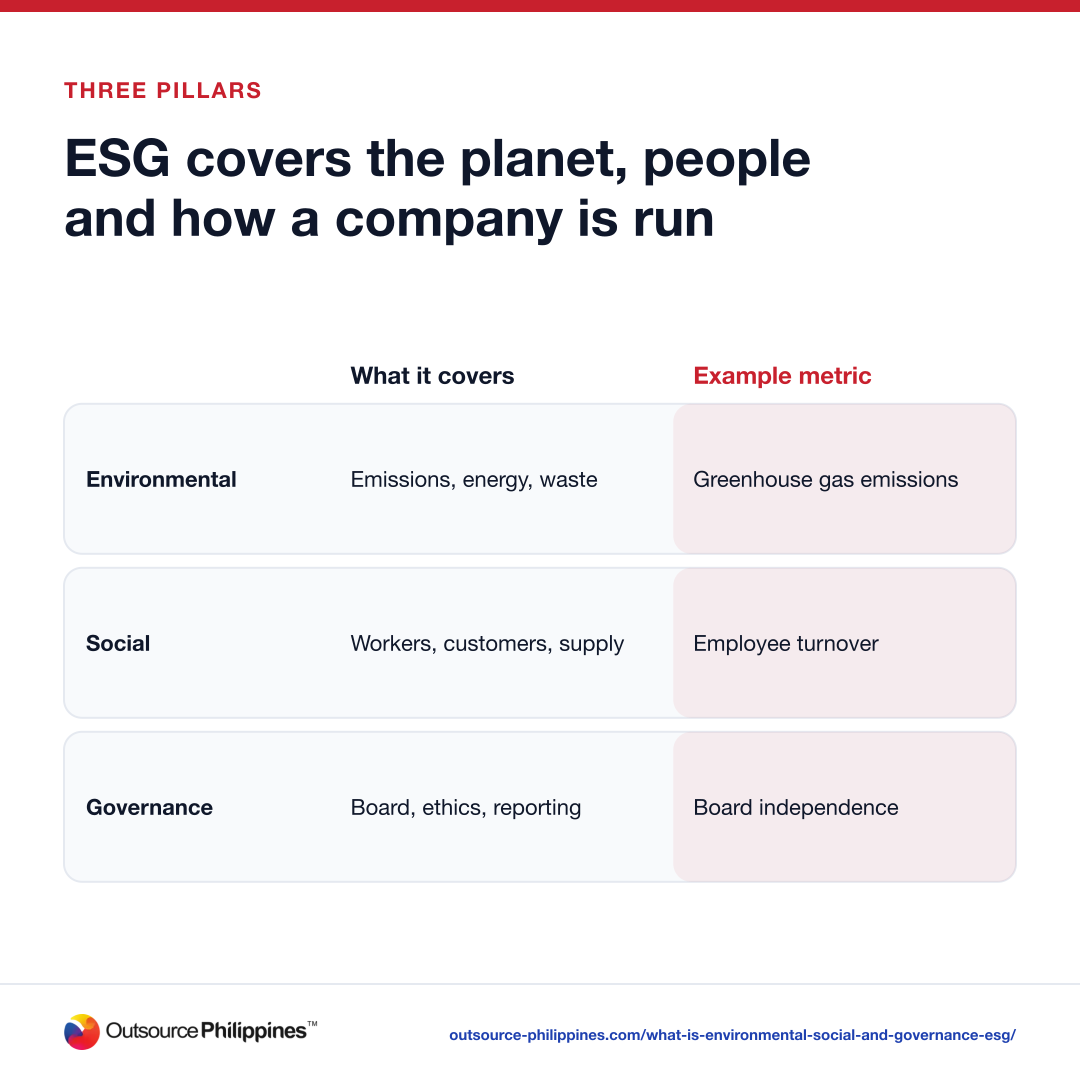
| Pillar | What it covers | Example metric |
|---|---|---|
| Environmental | Emissions, energy, waste | Greenhouse gas emissions |
| Social | Workers, customers, supply | Employee turnover |
| Governance | Board, ethics, reporting | Board independence |
Traditional financial metrics show how a company performed last quarter. ESG asks how it gets those results: how much it pollutes, how it treats people, and how well it is run. Those factors affect operational resilience, investor trust, and brand integrity, which is why ESG criteria now sit alongside financial analysis in many investment and procurement decisions.
ESG is often confused with corporate social responsibility (CSR). CSR is usually a voluntary program of social contributions and philanthropy. ESG is measured with defined metrics, tied to business strategy, and reported to investors and, increasingly, to regulators.
What Does Each Part of ESG Mean?
Each pillar covers a different kind of accountability. Together they give a full view of how a company affects the world and how well it manages the risks that come back to it.
1. Environmental: Protecting Natural Resources
- Focus: energy use, greenhouse gas emissions, water stewardship, waste reduction, and sustainable sourcing.
- Why it matters: companies that manage these issues reduce environmental and regulatory risk and often find cost savings through efficiency.
Common moves include switching to renewable energy, tightening supply chains, and adopting circular-economy models that reuse materials. For a service business with no factories, the environmental footprint is mostly office energy, business travel, hardware, and the emissions of its suppliers, so the data work is smaller but still needs a clear owner.
2. Social: Prioritizing People and Communities
- Focus: fair labor standards, workplace safety, diversity and inclusion, human rights, data privacy, and ethical supply chains.
- Why it matters: companies whose social practices match their stated values tend to see stronger employee retention, customer loyalty, and stakeholder trust.
The social pillar also reaches beyond your own payroll to suppliers and outsourcing partners, which is why ethical outsourcing practices are part of many ESG reviews.
3. Governance: Accountability and Transparency
- Focus: executive accountability, board independence and ethics, risk oversight, executive pay, and transparent reporting.
- Why it matters: good governance protects investor trust and prevents scandals caused by mismanagement or noncompliance. The OECD Principles of Corporate Governance are a widely used reference.
The three pillars connect. Weak governance can undermine social commitments, and strong environmental performance can attract investors looking for responsible companies.
Why Does ESG Matter to Businesses and Investors?
ESG has moved from an ethical preference to a business requirement because investors, lenders, regulators, large customers, and job seekers all ask about it. It affects four areas directly.
Competitive Advantage
Companies with credible ESG performance win partnerships and customers that screen suppliers on sustainability. Many large buyers now send ESG questionnaires as part of procurement.
Operational Efficiency
Cutting waste and energy use lowers costs. Tracking ESG data also exposes inefficiencies that financial reports miss.
Reputation Management
Ethical governance protects against scandals and compliance violations. Weak ESG performers can face tighter scrutiny from regulators, lenders, and the public.
Stakeholder Relations
Investors use ESG ratings to judge long-term risk, while customers and employees want clarity on environmental and ethical standards. Clear ESG reporting builds trust with all of them.
How Is ESG Measured and Reported?
ESG is measured against published reporting frameworks that set out what to disclose and how. Which ones apply depends on where you operate, raise capital, and sell.
- Global Reporting Initiative (GRI): detailed standards for environmental and social impact disclosures.
- Sustainability Accounting Standards Board (SASB): industry-specific standards that link ESG disclosure to financial materiality.
- Task Force on Climate-related Financial Disclosures (TCFD): a framework for climate risk strategy, governance, and metrics.
- ISSB standards (IFRS S1 and S2): global sustainability and climate disclosure standards. IFRS S1 was issued in June 2023 and applies to annual periods beginning on or after January 1, 2024, where a jurisdiction adopts it.
- Corporate Sustainability Reporting Directive (CSRD): the EU law requiring sustainability reporting from large companies.
Mandatory rules are changing fast, so check the current status before you plan a report:
| Jurisdiction | Rule | Current status |
|---|---|---|
| United States | SEC climate disclosure rules | On March 27, 2025, the SEC voted to end its defense of the rules in court |
| European Union | CSRD, as amended by the Omnibus package | Scope narrowed to companies with more than 1,000 employees and over €450 million in net turnover, for financial years starting on or after January 1, 2027 (PwC Luxembourg) |
| Other markets | ISSB-based local standards | Adopted country by country; check each market where you report |
Even without a legal mandate, US companies that sell to European customers or large enterprises are often asked for ESG data through supplier questionnaires.
What Are the Most Common Mistakes in ESG Implementation?
Most ESG programs stumble on credibility and data, not intent. These four mistakes come up most often.
1. Greenwashing
Overstating sustainability claims without verifiable action destroys credibility. It often happens when ESG goals clash with short-term financial targets and companies announce commitments they cannot back with measurable progress.
2. Fragmented Data Collection
Emissions, workforce, and governance data sit in different systems, suppliers, and countries. Without standard collection processes, disclosures end up incomplete or inconsistent.
3. Missing Materiality Alignment
Reporting metrics that do not matter to your business dilutes the report. Focus on the factors that genuinely affect your risks and long-term value.
4. Insufficient Governance Oversight
ESG needs a named executive owner and board oversight. Without them, it becomes a side project that stalls when budgets tighten.
All four mistakes share a root cause: treating ESG as a compliance exercise rather than part of strategy.
How Do You Build an ESG Strategy?
Build it in seven steps, from an honest baseline to published disclosures. A structured strategy improves compliance and positions the company for better capital access and employee engagement.
- Evaluate your current baseline. Assess existing sustainability practices and governance structures.
- Map your stakeholders. Identify priorities among investors, employees, and customers.
- Define measurable goals. Set quantifiable targets for climate, diversity, and ethics.
- Choose a reporting framework. Pick recognized standards such as GRI or SASB.
- Implement data systems. Put tools in place to track energy, waste, and social metrics.
- Engage leadership and the board. Build ESG into performance reviews and governance oversight.
- Publish transparent disclosures. Share annual sustainability reports with investors and regulators.
Step five is where most of the ongoing effort sits. Collecting, checking, and entering utility bills, supplier data, and HR metrics every month is steady, process-driven work, which is why many companies assign it to a dedicated back-office team.
What Are the Best Practices for ESG Integration?
Successful ESG integration needs commitment at the executive, operational, and supply chain levels. Five practices separate programs that last from those that fade.
- Leadership alignment: build ESG goals into the corporate vision and executive incentives, then cascade targets to every function, from procurement to customer service.
- Materiality assessment: identify the ESG factors that genuinely affect results. Manufacturers usually prioritize sourcing and supply chains; service firms focus on workforce development and ethics.
- Cross-functional collaboration: connect finance, operations, HR, and supply chain teams so ESG data and decisions are shared.
- Transparent reporting: disclose challenges as well as achievements, and tie initiatives to measurable KPIs such as emission reductions or workforce inclusion scores.
- Technology support: use ESG data tools and dashboards to automate collection and reduce manual errors.
Outsourcing partners count too. If you use offshore teams, choose providers whose labor and data practices hold up to your own ESG standards, and make ESG integration in outsourcing part of how you select vendors.
How Does ESG Affect Performance across Industries?
ESG principles apply everywhere, but the material issues differ by industry, and so does the link to financial performance. Lower energy use cuts operating costs, strong governance reduces fraud and compliance risk, and fair labor practices improve retention.
| Industry | Key ESG focus areas |
|---|---|
| Manufacturing | Energy efficiency, pollution control, supply chain standards |
| Financial services | Ethical lending, transparency, diversity in leadership |
| Technology | Data privacy, cybersecurity governance, digital inclusion |
| Healthcare | Access to medicine, clinical ethics, patient safety |
| Retail | Fair labor practices, sustainable sourcing, waste reduction |
Knowing which issues are material in your industry keeps the program focused and the report credible. A software company that reports at length on water use while saying little about data privacy will lose credibility with the readers who matter most.
Is Outsourcing ESG Data Work Right for Your Business?
Outsourcing fits the repetitive side of ESG: gathering utility and supplier records, entering and checking data, and keeping trackers current. It does not replace the strategy, materiality decisions, or sign-off, which should stay with your leadership. Outsource Philippines™ provides dedicated staff who work only on your account, with data handled under the Philippine Data Privacy Act of 2012 and protected by a managed firewall and WorQmate monitoring.
If your ESG reporting is slowed by data collection, explore our data entry outsourcing services. You can also request a proposal; pricing is an hourly rate per agent, set out in writing.
Frequently Asked Questions
What Is the Main Purpose of ESG?
ESG evaluates how responsibly a business operates across three pillars: environmental protection, social responsibility, and ethical governance. It helps investors, lenders, customers, and employees judge performance beyond profit by looking at sustainability, transparency, and accountability, which signal long-term risk and resilience that financial statements alone do not show.
Is ESG Reporting Mandatory for All Companies?
No. Rules vary by jurisdiction and are changing. The EU’s CSRD requires reporting from large companies, though recent amendments narrowed its scope. In the US, the SEC voted in March 2025 to stop defending its climate disclosure rules. Many companies still report voluntarily because investors and large customers ask for the data.
How Does ESG Benefit Investors?
Investors use ESG data to spot companies with lower long-term risk, such as exposure to climate regulation, labor disputes, or governance failures. It adds information that financial statements miss. Many investors combine ESG ratings with traditional analysis when building portfolios, especially for long holding periods where these risks have more time to surface.
What Is the Difference between ESG and CSR?
Corporate social responsibility (CSR) focuses on voluntary social contributions, such as philanthropy and community programs. ESG integrates measurable environmental, social, and governance metrics into business strategy and reports them to investors and regulators. CSR describes what a company chooses to give; ESG measures how the company itself operates.
How Can Companies Start Implementing ESG?
Start by assessing current practices, then identify the ESG issues most material to your business and stakeholders. Set measurable goals, choose a reporting framework such as GRI or the ISSB standards, and put data collection in place. Assign an executive owner and board oversight so the program does not stall.