ESG Integration in Outsourcing: How to Choose Vendors
On This Page
- What Is ESG Integration?
- Which ESG Frameworks and Rules Apply in 2026?
- Why Does Outsourcing Create ESG Risk and Opportunity?
- How Do You Build ESG Into an Outsourcing Relationship?
- What Are the Most Common ESG Mistakes in Outsourcing?
- Is ESG-Aligned Outsourcing Right for Your Business?
- Frequently Asked Questions
ESG integration in outsourcing means choosing, contracting, and managing outsourcing partners on their environmental, social, and governance performance as well as cost and capability. In practice it covers ESG due diligence before signing, ESG clauses in the contract, data the vendor can document, workforce checks, environmental targets, and ESG items in every vendor review.
- The EU's Omnibus I directive, published February 26, 2026, limits CSRD sustainability reporting to companies with more than 1,000 employees and more than €450 million in net turnover.
- The US SEC proposed on May 29, 2026 to rescind its 2024 climate disclosure rules, which have been stayed since April 2024; no final rescission had been published as of November 10, 2026.
- In Australia, climate reporting under AASB S2 became mandatory for the largest (Group 1) entities for financial years starting on or after January 1, 2025.
- The UK published final UK SRS S1 and S2 standards for voluntary use in February 2026; the FCA consulted on making climate reporting mandatory for listed companies.
Sustainability rules moved in opposite directions in 2025 and 2026. The EU cut the number of companies that must report, the US SEC moved to withdraw its climate rule, and Australia and the UK went the other way with new standards based on the ISSB's. For a buyer outsourcing work to a vendor, the practical question is narrower: which ESG facts will your customers, lenders, or regulators ask you about, and can your vendor document them?
This article covers what ESG integration means in an outsourcing contract, where each major rule stood on November 10, 2026, and the checks and contract terms that hold up in a procurement review.
What Is ESG Integration?
ESG integration is the practice of building environmental, social, and governance standards into business decisions, including which vendors you hire and how you manage them. Environmental, social, and governance (ESG) factors are usually grouped like this:
- Environmental: energy use, greenhouse gas emissions, water, and waste, including electronic waste from retired devices.
- Social: pay, working hours, health and safety, freedom from forced labor, diversity, and community impact.
- Governance: business ethics, anti-corruption controls, data security and privacy, and honest reporting.
In outsourcing, integration means scoring vendors on these factors before you sign, writing the standards into the contract, and checking them at each review, not once at onboarding.
Which ESG Frameworks and Rules Apply in 2026?
The frameworks most buyers reference are the GRI Standards, the ISSB's IFRS S1 and S2 (which build on SASB and TCFD), and national rules built on them. We list below the frameworks and laws that are named most often in supplier questionnaires and that apply to companies in the US, Canada, Australia, the UK, and companies selling into the EU. Status was checked against official sources on November 10, 2026.
| Framework or rule | Who it covers | Status on November 10, 2026 |
|---|---|---|
| GRI Standards | Any organization, voluntary | In use; free to download |
| IFRS S1 and S2 (ISSB) | Adopted country by country | Effective for periods from January 1, 2024 |
| EU CSRD and ESRS | EU companies over 1,000 employees and €450 million turnover | Narrowed by Directive (EU) 2026/470 |
| EU CSDDD (CS3D) | Very large EU and non-EU companies | Narrowed by Directive (EU) 2026/470 |
| US SEC climate rule | SEC registrants | Stayed; rescission proposed May 29, 2026 |
| Australia AASB S2 | Large entities, phased in by size | Mandatory for Group 1 since January 1, 2025 |
| UK SRS S1 and S2 | Any entity, voluntary for now | Final standards published February 2026 |
The GRI Standards are free and modular: Universal Standards for every organization, Sector Standards, and Topic Standards. The ISSB issued IFRS S2 in June 2023, effective for annual periods beginning on or after January 1, 2024, and the IFRS Foundation now maintains the SASB Standards as industry guidance. The TCFD disbanded in October 2023 and handed its work to the ISSB.
What Changed in the EU?
The EU narrowed both of its main sustainability laws in 2026. Directive (EU) 2026/470, known as Omnibus I, was adopted on February 24, 2026 and published in the Official Journal on February 26, 2026. It limits the Corporate Sustainability Reporting Directive (CSRD) to companies with more than 1,000 employees and more than €450 million in net turnover. Its recitals raise the thresholds for the Corporate Sustainability Due Diligence Directive (CSDDD) to 5,000 employees and €1.5 billion in turnover.
Fewer companies now report directly, but the ones that still do are the largest buyers, and they send ESG questionnaires to their suppliers. A midsize US or Australian company selling to them will still be asked for data.
What Is the Status in the US, Australia, and the UK?
The US has no federal climate disclosure rule in force. The SEC adopted climate disclosure rules on March 6, 2024, stayed them on April 4, 2024 during litigation, and on May 29, 2026 proposed rescinding them in their entirety. The SEC's press release list showed no final rescission as of November 10, 2026. State laws, such as California's climate disclosure laws, are separate from the SEC rule.
Australia went ahead. The Australian Securities and Investments Commission states that sustainability reporting under AASB S2 is mandatory for Group 1 entities with financial years beginning on or after January 1, 2025, with smaller groups phased in later.
In the UK, the government published final UK Sustainability Reporting Standards S1 and S2, based on the ISSB standards, for voluntary use, with the guidance page last updated February 25, 2026. The FCA consulted until March 20, 2026 on listing rule changes that would require listed companies to report against them. Canada and the UK both appear on the IFRS Foundation's list of jurisdictions using ISSB Standards, last updated November 4, 2026.
Why Does Outsourcing Create ESG Risk and Opportunity?
Outsourcing a task does not outsource responsibility for how it is done. Customers, investors, and regulators that assess your ESG performance look at your value chain, which includes the vendors who handle your customers, data, and processes. A vendor with unpaid overtime, a data breach, or a bribery case becomes your problem in a customer audit.
The upside is real when the vendor can document its practices. A good partner can give you:
- Ready answers for questionnaires: written labor, privacy, and security policies you can attach to a customer's supplier survey.
- Auditable workforce data: headcount, turnover, training hours, and pay compliance for the team serving you.
- Clear governance: named data protection officers, access controls, and incident reporting.
- Local employment impact: formal, full-time jobs with statutory benefits in the vendor's country.
Workforce shifts such as the 2026 workforce trends toward AI-assisted roles also raise social questions buyers now ask, for example how a vendor retrains staff whose tasks are automated.
How Do You Build ESG Into an Outsourcing Relationship?
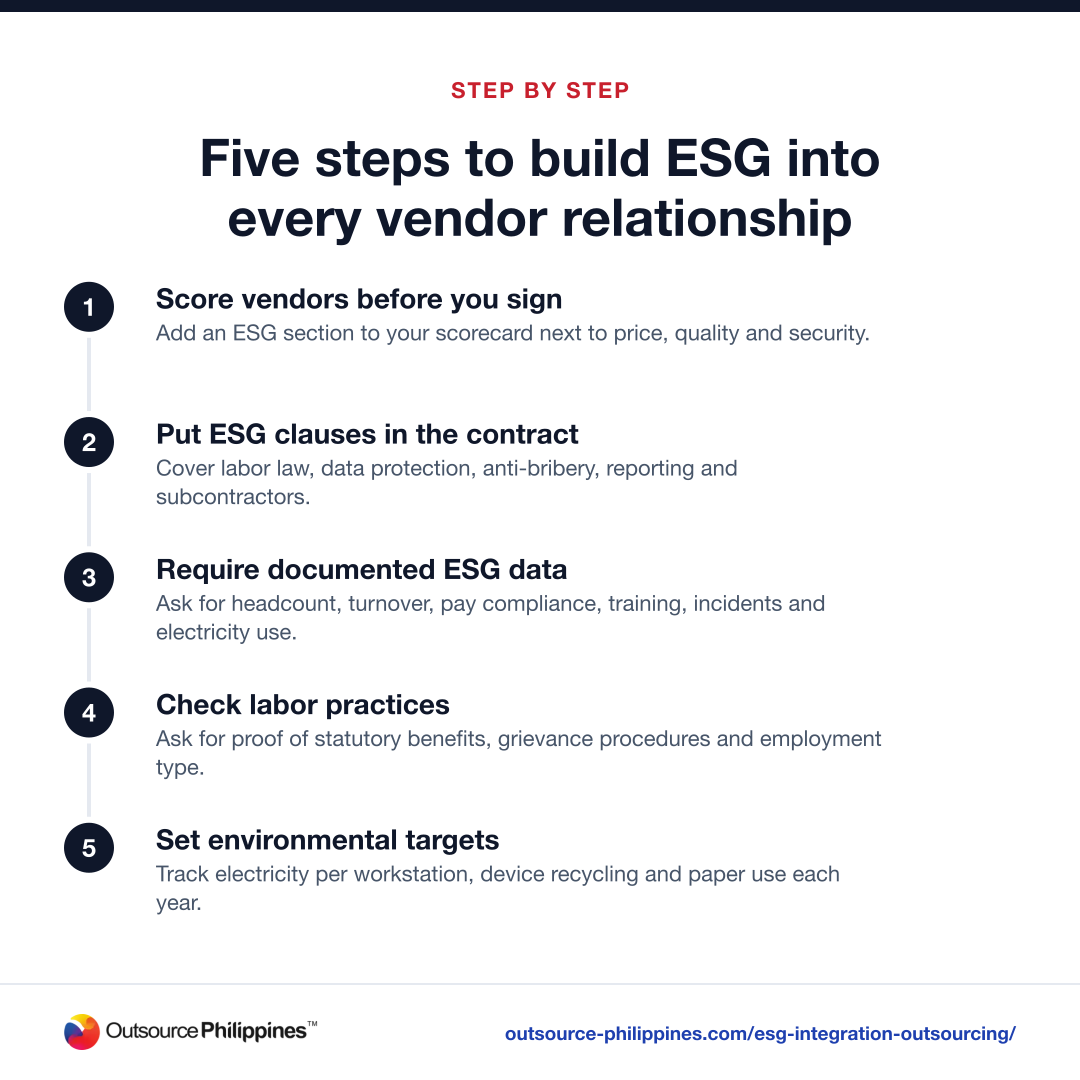
You build ESG into outsourcing in five steps: score vendors before signing, write the standards into the contract, require documented data, check labor practices, and set environmental targets you can track.
- 1Score vendors before you sign
Add an ESG section to your scorecard next to price, quality and security.
- 2Put ESG clauses in the contract
Cover labor law, data protection, anti-bribery, reporting and subcontractors.
- 3Require documented ESG data
Ask for headcount, turnover, pay compliance, training, incidents and electricity use.
- 4Check labor practices
Ask for proof of statutory benefits, grievance procedures and employment type.
- 5Set environmental targets
Track electricity per workstation, device recycling and paper use each year.
1. Score Vendors on ESG Before You Sign
Add an ESG section to your vendor scorecard alongside price, quality, and security when you evaluate potential outsourcing partners. Weight it to match what your own customers ask about. Third-party ratings such as EcoVadis and participation in the UN Global Compact are useful signals, but ask for the underlying policies and reports, not just a badge.
2. Put ESG Clauses in the Contract
ESG requirements that are not in the contract cannot be enforced. The agreement should cover:
- Compliance with labor law and stated standards on wages, hours, and safety.
- Data protection duties, breach notice deadlines, and audit rights.
- An anti-bribery and corruption clause.
- The ESG data the vendor will report and how often.
- Corrective action plans, and termination rights for serious or repeated breaches.
- Flow-down of the same terms to any subcontractor.
3. Require Documented ESG Data
Ask what the vendor measures, who checks it, and how often it is reported. A reasonable minimum for an outsourced team is headcount and turnover, pay compliance with local minimum wage law, training records, security incidents, and electricity use for the site serving you. If you report under GRI or ISSB-based rules, ask the vendor to map its data to the disclosures you use.
4. Check Labor Practices
The "S" in ESG carries the highest risk in labor-heavy outsourcing. The International Labour Organization's labour standards are the global reference for forced labor, child labor, freedom of association, and non-discrimination. Ask for proof of statutory benefits, written grievance procedures, and the employment type of your team members. For companies outsourcing to the Philippines, check that staff are formal employees with government-mandated benefits rather than unregistered freelancers.
5. Set Environmental Targets You Can Track
For office-based services, the environmental footprint comes mostly from electricity, equipment, and e-waste. The ISO 14001 environmental management standard shows that a vendor runs a structured, auditable system. Where a vendor is not certified, agree on a few measurable items, such as electricity per workstation, device recycling records, and paper use, and review them each year.
What Are the Most Common ESG Mistakes in Outsourcing?
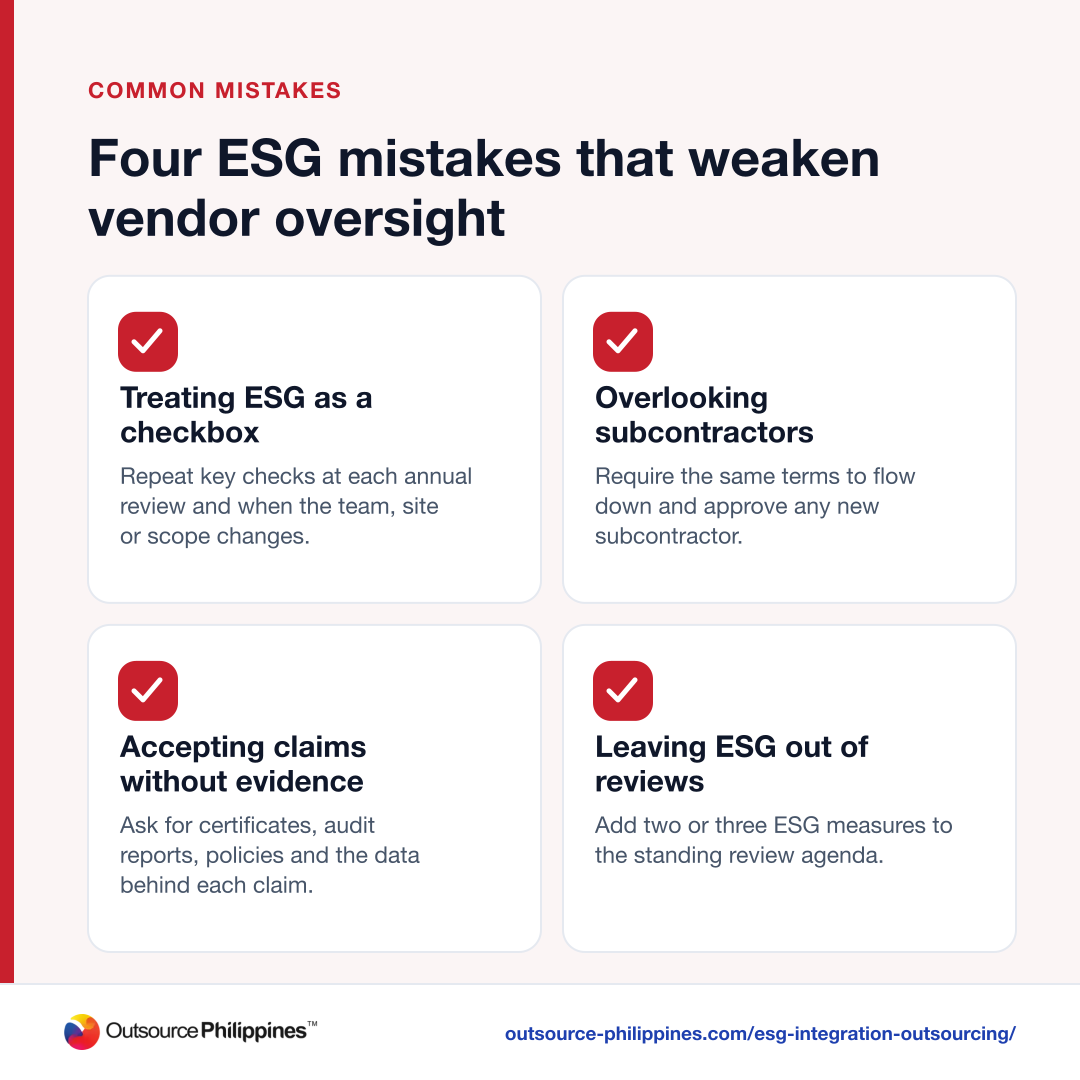
The most common mistakes are treating ESG as a one-time checkbox, ignoring subcontractors, accepting claims without evidence, and leaving ESG out of performance reviews.
- Treating ESG as a checkbox
Repeat key checks at each annual review and when the team, site or scope changes.
- Overlooking subcontractors
Require the same terms to flow down and approve any new subcontractor.
- Accepting claims without evidence
Ask for certificates, audit reports, policies and the data behind each claim.
- Leaving ESG out of reviews
Add two or three ESG measures to the standing review agenda.
Treating ESG as a Compliance Checkbox
A questionnaire at onboarding tells you little about how the vendor operates in year two or three. Repeat the key checks at each annual review and whenever the team, site, or scope changes.
Overlooking Subcontractors
Your direct vendor may meet your standards while its subcontractors do not. Ask who else touches your work or data, require the same terms to flow down, and keep the right to approve new subcontractors.
Accepting ESG Claims Without Evidence
"Sustainable" and "ESG-aligned" mean nothing without documents. Ask for certificates, audit reports, policies, and the data behind any claim. Repeating a vendor's unsupported claim in your own reporting creates greenwashing risk for you.
Leaving ESG Out of Vendor Reviews
If quarterly reviews track cost, speed, and quality but never ESG, the vendor will treat ESG as optional. Add two or three ESG measures to the standing review agenda and track them over time.
Is ESG-Aligned Outsourcing Right for Your Business?
ESG checks matter most if you report under a sustainability framework, sell to large enterprises that score their suppliers, or answer investor questions about your value chain. Smaller businesses still benefit from the basics: written labor and data standards, a vendor that can document its practices, and ESG items in regular vendor reviews.
When This Is Not the Right Fit
A services vendor cannot produce your sustainability report for you or take responsibility for your own disclosures; that stays with your finance team and auditors. Outsource Philippines™ provides office-based staff for support, back-office, and other services, not ESG assurance or carbon accounting.
When we build a team, we source, test, and shortlist candidates, your team joins the final interviews, and you make the final hiring decision. Outsource Philippines™ has run office-based teams in the Philippines since 2003, with dedicated staff who work only on one client's account, data handled under the Philippine Data Privacy Act of 2012, and security and data protection practices that cover the governance questions procurement teams ask first.
Frequently Asked Questions
What Does ESG Integration in Outsourcing Mean?
It means selecting, contracting, and managing outsourcing partners on their environmental, social, and governance practices, alongside cost and capability. In practice you add ESG criteria to vendor scoring, write ESG duties into the contract, collect documented data from the vendor, and review it at every performance review, so your own standards extend to the work done for you.
How Do I Know If an Outsourcing Provider Is Genuinely ESG-Compliant?
Ask for documents, not statements: labor and privacy policies, proof of statutory benefits, security audit results, certifications such as ISO 14001, and any third-party ratings such as EcoVadis. Check certificates against the issuer's registry and UN Global Compact membership against its participant list. A provider that cannot produce evidence should score lower, whatever its marketing says.
Which ESG Frameworks Should I Reference for Outsourcing Decisions?
Use the framework your own reporting or your largest customers use. The GRI Standards are the most common voluntary framework; IFRS S1 and S2 from the ISSB underpin rules in Australia, the UK, and other jurisdictions; and the EU's CSRD with its ESRS applies to the largest EU companies after the 2026 Omnibus I changes. The ILO labor standards are the usual reference for workforce questions.
Does the SEC Require ESG Disclosures From US Companies in 2026?
No federal climate rule is in force. The SEC's 2024 climate disclosure rules were stayed in April 2024, and on May 29, 2026 the SEC proposed rescinding them entirely; no final rescission had been published as of November 10, 2026. Public companies must still disclose material risks, including climate-related ones, and state laws such as California's are separate from the SEC rule.
Do Small and Midsize Businesses Need ESG Checks for Vendors?
Often yes, even when no law requires it. Large customers in the EU, Australia, and the UK send ESG questionnaires to their suppliers, and those questions reach the vendors you use. Written labor, privacy, and security policies from your outsourcing partner, plus a few tracked measures, are usually enough for a midsize company to answer them.