The Accounting Cycle: 8 Steps Explained for Small Businesses

On This Page
- What Is the Accounting Cycle?
- What Are the 8 Steps of the Accounting Cycle?
- How Often Should You Run the Accounting Cycle?
- How Is the Accounting Cycle Different from the Budget Cycle?
- What Are the Most Common Accounting Cycle Mistakes?
- How Does Accounting Software Change the Accounting Cycle?
- Should You Run the Accounting Cycle In-house or Outsource It?
- Frequently Asked Questions
The accounting cycle is the eight-step process a business repeats every period to turn transactions into financial statements: identify transactions, record journal entries, post to the general ledger, run an unadjusted trial balance, make adjusting entries, prepare financial statements, close temporary accounts, and start the next period with clean books.
Whether you keep the books yourself, manage a bookkeeper, or work with an outside accountant, knowing the cycle tells you where errors creep in and what a good month-end close looks like. This guide explains each of the eight steps with examples, how often to run the cycle, how it differs from the budget cycle, the most common mistakes, and what software can and can’t do for you.
What Is the Accounting Cycle?
The accounting cycle is the standard sequence for recording a business’s financial activity during an accounting period and summarizing it in financial statements. Each step checks or builds on the one before it, so errors get caught before they reach the reports.
Those statements are what owners, lenders, investors, and tax preparers rely on to judge how the business is doing. The cycle also depends on your accounting method. The IRS (Publication 538) describes the cash method, where income is reported when received and expenses are generally deducted when paid, and the accrual method, where income is reported when earned and expenses when incurred. Accrual accounting is also the basis of US GAAP, and it makes the adjusting step more important, because revenue and expenses must land in the period they belong to.
What Are the 8 Steps of the Accounting Cycle?
The eight steps run from the first transaction of a period to the reset for the next one. The first three happen throughout the period; the last five happen at period-end.
- 1. Identify transactions
Capture every sale, purchase and payment with a source document.
- 2. Record journal entries
Log each transaction in date order with equal debits and credits.
- 3. Post to the ledger
Move entries into the general ledger, grouped by account.
- 4. Run a trial balance
List all account balances and confirm debits equal credits.
- 5. Make adjusting entries
Record accruals, deferrals and depreciation, and fix errors.
- 6. Prepare statements
Produce the income statement, balance sheet and cash flow statement.
- 7. Close temporary accounts
Move revenue and expense balances into retained earnings.
- 8. Start the next period
Carry permanent balances forward and begin recording again.
Step 1: Identify Transactions
Every sale, purchase, payment, loan, and expense is a transaction that needs a source document, such as an invoice, receipt, bank record, or contract. Under accrual accounting, you record a transaction when it occurs, not only when cash moves. Missing documents at this stage cause most of the problems later in the cycle.
Step 2: Record Journal Entries
Each transaction is recorded in the journal in date order. Under the double-entry system, every entry has at least one debit and one credit of equal value, which keeps the accounting equation (assets equal liabilities plus equity) in balance. For example, a $300 cash sale is recorded as a $300 debit to Cash and a $300 credit to Sales Revenue.
Step 3: Post to the General Ledger
Journal entries are posted to the general ledger, which groups every transaction by account, such as Cash, Accounts Receivable, or Rent Expense. The ledger shows the running balance of each account. Accounting software does this posting automatically as soon as a transaction is entered.
Step 4: Prepare an Unadjusted Trial Balance
At period-end, list every ledger account and its balance to confirm that total debits equal total credits. A balanced trial balance doesn’t prove the books are right; a transaction posted to the wrong account, or missed entirely, still balances. It only confirms the math.
Step 5: Make Adjusting Entries
Adjusting entries move revenue and expenses into the correct period and fix errors found in review. Common adjustments include accrued expenses, unearned revenue, depreciation, and prepaid items being used up. For example, when one month of prepaid rent is used, record a $1,000 debit to Rent Expense and a $1,000 credit to Prepaid Rent. Running an adjusted trial balance afterward confirms everything still balances.
Step 6: Prepare Financial Statements
From the adjusted trial balance, prepare the financial statements: the income statement, the balance sheet, and the cash flow statement. The cash flow statement groups cash movements into operating, investing, and financing activities.
Step 7: Close Temporary Accounts
Revenue, expense, and dividend or draw accounts are temporary. At period-end, their balances are closed into retained earnings, a permanent balance sheet account, so the next period starts at zero. A post-closing trial balance then confirms that only permanent accounts carry balances forward.
Step 8: Start the Next Period
With temporary accounts at zero and permanent balances carried forward, the cycle begins again. Some businesses also post reversing entries at the start of the new period to undo certain accruals and keep later entries simple.
How Often Should You Run the Accounting Cycle?
Most small businesses run a full cycle every month, with a deeper close at quarter-end and year-end. Monthly closes catch errors while they are still easy to trace.
Your annual cycle follows your tax year. According to IRS Publication 538, a calendar year runs from January 1 to December 31, while a fiscal year is 12 consecutive months ending on the last day of any month except December. Some businesses, often retailers, use a 52-53-week year that always ends on the same day of the week. Whatever you choose, keep your books on that same accounting period.
How Is the Accounting Cycle Different from the Budget Cycle?
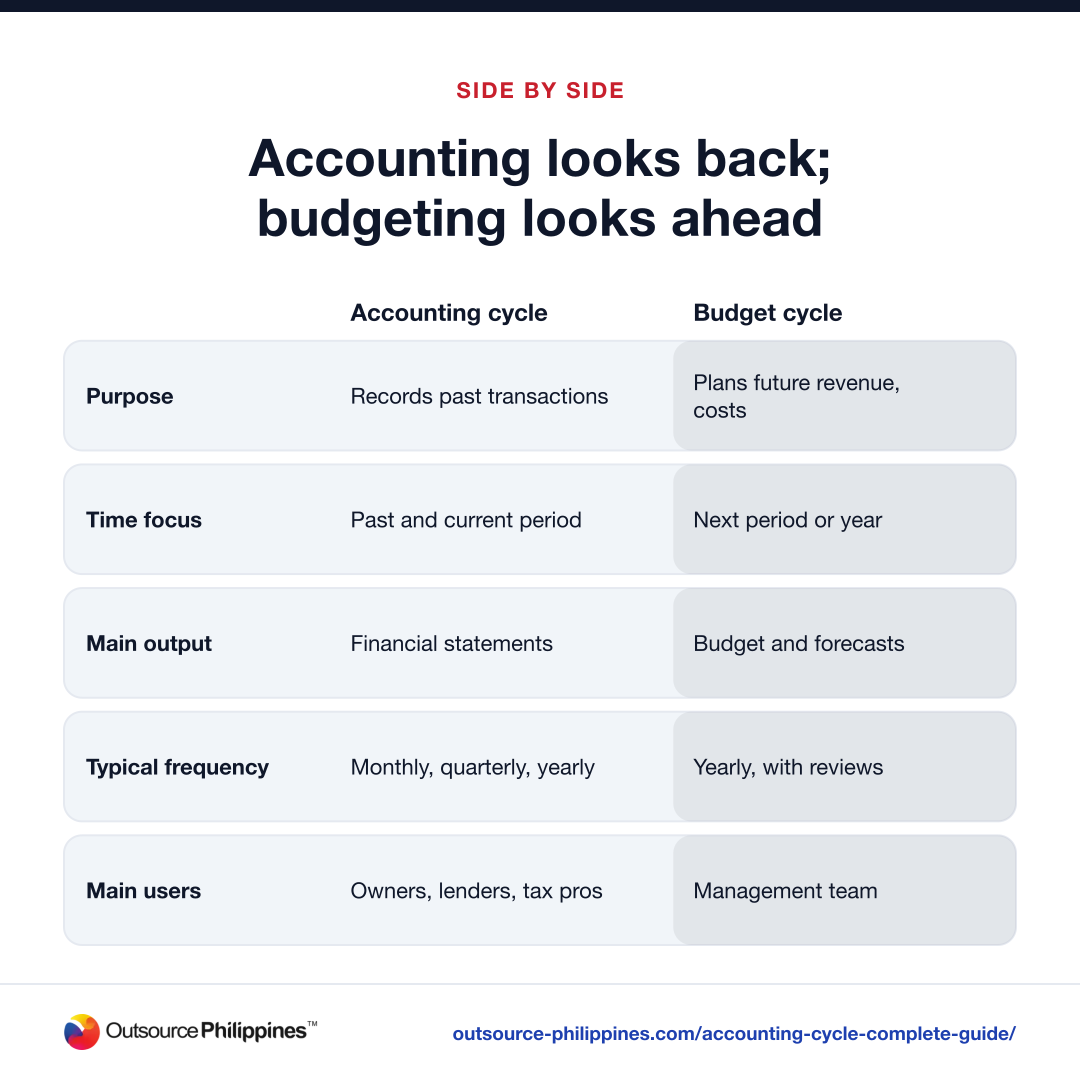
The accounting cycle records what already happened; the budget cycle plans what should happen next. You need both, and the first feeds the second.
| Aspect | Accounting cycle | Budget cycle |
|---|---|---|
| Purpose | Records past transactions | Plans future revenue, costs |
| Time focus | Past and current period | Next period or year |
| Main output | Financial statements | Budget and forecasts |
| Typical frequency | Monthly, quarterly, yearly | Yearly, with reviews |
| Main users | Owners, lenders, tax pros | Management team |
Comparing actual results from the accounting cycle against the budget each month shows where spending or revenue is drifting, which is where most useful management conversations start.
What Are the Most Common Accounting Cycle Mistakes?
Most errors come from missing or misclassified transactions, not from math. These are the ones to watch for:
- Unrecorded transactions: cash purchases, reimbursements, and bank fees that never make it into the books.
- Wrong account: a capital purchase recorded as an expense, or a loan payment recorded entirely as expense instead of split between principal and interest.
- Skipped reconciliations: bank, credit card, receivable, and payable balances that are never matched against statements.
- Missing adjustments: accruals, deferrals, and depreciation left out at period-end.
- Closing errors: temporary accounts not closed, so last year’s revenue inflates this year’s numbers.
- Inconsistent policies: treating the same type of transaction differently from month to month.
A short financial close checklist, signed off by a second person, catches most of these.
How Does Accounting Software Change the Accounting Cycle?
Software automates the mechanical steps, posting, trial balances, statements, and closing entries, but people still handle identification, classification, adjustments, and review.
Bank feeds in modern bookkeeping software import transactions daily, rules suggest categories, and posting to the ledger happens the moment an entry is saved. That removes most arithmetic errors. What software can’t do is know that a transfer between your own accounts isn’t income, or that a large purchase should be capitalized. The US Bureau of Labor Statistics notes that software has automated many bookkeeping tasks, shifting clerks toward review and advisory work.
Should You Run the Accounting Cycle In-house or Outsource It?
Run it in-house if you have enough volume to keep a qualified bookkeeper or accountant busy and someone senior to review their work. Outsource it if the books are falling behind, the close keeps slipping, or the cost of a full-time hire doesn’t fit. The BLS puts median pay at $50,670 for bookkeeping, accounting, and auditing clerks and $83,680 for accountants and auditors (May 2025), before benefits. Outsource Philippines™ estimates most US clients pay 60% to 70% less for outsourced accounting in the Philippines than for an equivalent in-house hire.
To see how a dedicated team would handle your monthly close, explore our accounting outsourcing services or request a proposal with your transaction volume and software.
Frequently Asked Questions
What Are the 8 Steps of the Accounting Cycle in Order?
The eight steps are: identify transactions, record journal entries, post to the general ledger, prepare an unadjusted trial balance, make adjusting entries, prepare financial statements, close temporary accounts, and start the next period. The first three run throughout the period, and the remaining five happen at period-end, usually during the monthly close.
How Long Is an Accounting Cycle?
An accounting cycle matches your accounting period. Most small businesses close their books monthly and also complete quarterly and annual cycles. The annual cycle follows your tax year, which the IRS allows to be a calendar year, a fiscal year ending on the last day of another month, or a 52-53-week year that ends on the same weekday.
What Is the Difference between the Accounting Cycle and the Budget Cycle?
The accounting cycle records and reports transactions that already happened, producing financial statements for owners, lenders, and tax preparers. The budget cycle plans future revenue and spending, usually once a year with periodic reviews. Comparing actual results from the accounting cycle against the budget shows where the business is ahead of or behind plan.
Does Accounting Software Complete the Accounting Cycle Automatically?
Partly. Software posts entries to the ledger, produces trial balances and statements, and handles closing entries automatically. People still need to make sure every transaction is captured and classified correctly, record adjusting entries, reconcile accounts, and review the results before the books are closed. Those judgment steps are where most errors are caught.