Live Chat Outsourcing: A Complete Guide to Better Customer Support

On This Page
- What Is Live Chat Outsourcing?
- Why Do Companies Outsource Live Chat Support?
- How Does Live Chat Outsourcing Work, Step by Step?
- What Are the Main Benefits of Live Chat Outsourcing?
- What Are the Challenges, and How Do You Overcome Them?
- What Best Practices Get the Most from Outsourced Live Chat?
- How Do You Choose a Live Chat Outsourcing Provider?
- What Trends Are Shaping Live Chat Outsourcing?
- Is Live Chat Outsourcing Right for Your Business?
- Frequently Asked Questions
Live chat outsourcing means hiring an external provider to answer the chats on your website or app, using your chat software, knowledge base, and escalation rules. Companies do it to cover more hours, absorb volume spikes, and lower support costs, while customers still get fast, on-brand answers from trained agents.
Customers expect instant help while they shop, sign up, or troubleshoot, and live chat is often where they look first. This guide covers what live chat outsourcing includes, the business case, how setup works, the main benefits and challenges, best practices, how to choose a provider, and the trends shaping the channel.
What Is Live Chat Outsourcing?
Live chat outsourcing is handing your real-time chat support to a provider’s trained team instead of staffing it entirely with your own employees. The provider’s agents work inside your tools and follow your policies.
In practice, the outsourced team:
- Works in your chat platform and CRM, with access to order or account systems where needed.
- Follows your guidelines, FAQs, macros, and escalation protocols.
- Covers the hours you choose: business hours, evenings, and weekends, or 24/7.
- Scales up or down with your volume, full-time or for seasonal peaks.
Typical chat queues include order status and tracking, returns and exchanges, billing and account changes, product questions before purchase, and tier 1 troubleshooting with escalation to tier 2. Many companies start with one of these, prove the quality, then hand over more.
Done well, customers cannot tell where the agent sits. They see your brand, your tone, and quick, accurate answers.
Why Do Companies Outsource Live Chat Support?
Most companies outsource live chat for cost, coverage, flexibility, and expertise. Cost gets the conversation started, but coverage and consistency are usually why they stay.
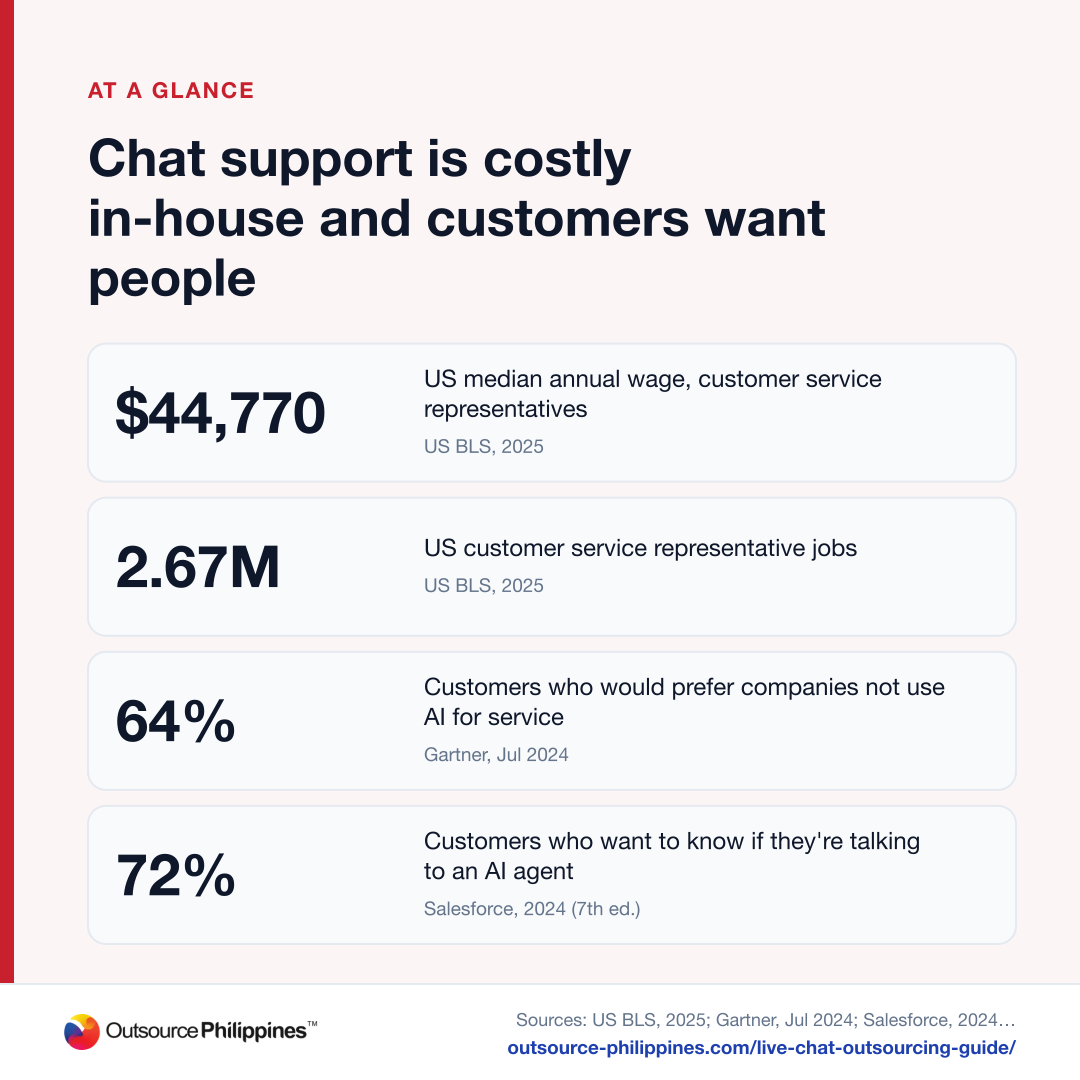
- $44,770US median annual wage, customer service representativesUS BLS, 2025
- 2.67MUS customer service representative jobsUS BLS, 2025
- 64%Customers who would prefer companies not use AI for serviceGartner, Jul 2024
- 72%Customers who want to know if they're talking to an AI agentSalesforce, 2026
Cost Savings and Financial Efficiency
An in-house chat team carries hiring, training, payroll, benefits, equipment, software licenses, and management time. The US Bureau of Labor Statistics puts the median annual wage for customer service representatives at $44,770 (2025), before benefits and overhead. Outsourcing turns much of that fixed cost into a flexible operating expense. Outsource Philippines™ estimates most US clients pay 60% to 70% less than an equivalent in-house hire.
24/7 Coverage
Round-the-clock chat in-house means night shifts, overtime, and complex scheduling. A Philippine team can cover US evenings, nights, and weekends as its normal shift, so customers reach a person whenever they open the chat window. This matters most in ecommerce, SaaS, travel, and financial services.
Scalability and Flexibility
Chat volume swings with promotions, launches, and seasons. Adding and training in-house agents for Black Friday, then letting them go in January, is slow and expensive. A provider can add trained agents for peaks and scale back afterward.
Access to Specialized Expertise
Providers recruit, train, and coach chat agents for a living. Good chat agents type fast, handle several conversations at once, de-escalate calmly, and write clearly, and the provider brings quality processes that would take years to build internally.
Better Customer Experience
Trained agents backed by quality control give consistent, empathetic answers. That shows up in satisfaction scores, repeat purchases, and fewer customers leaving for a competitor after a frustrating wait.
How Does Live Chat Outsourcing Work, Step by Step?
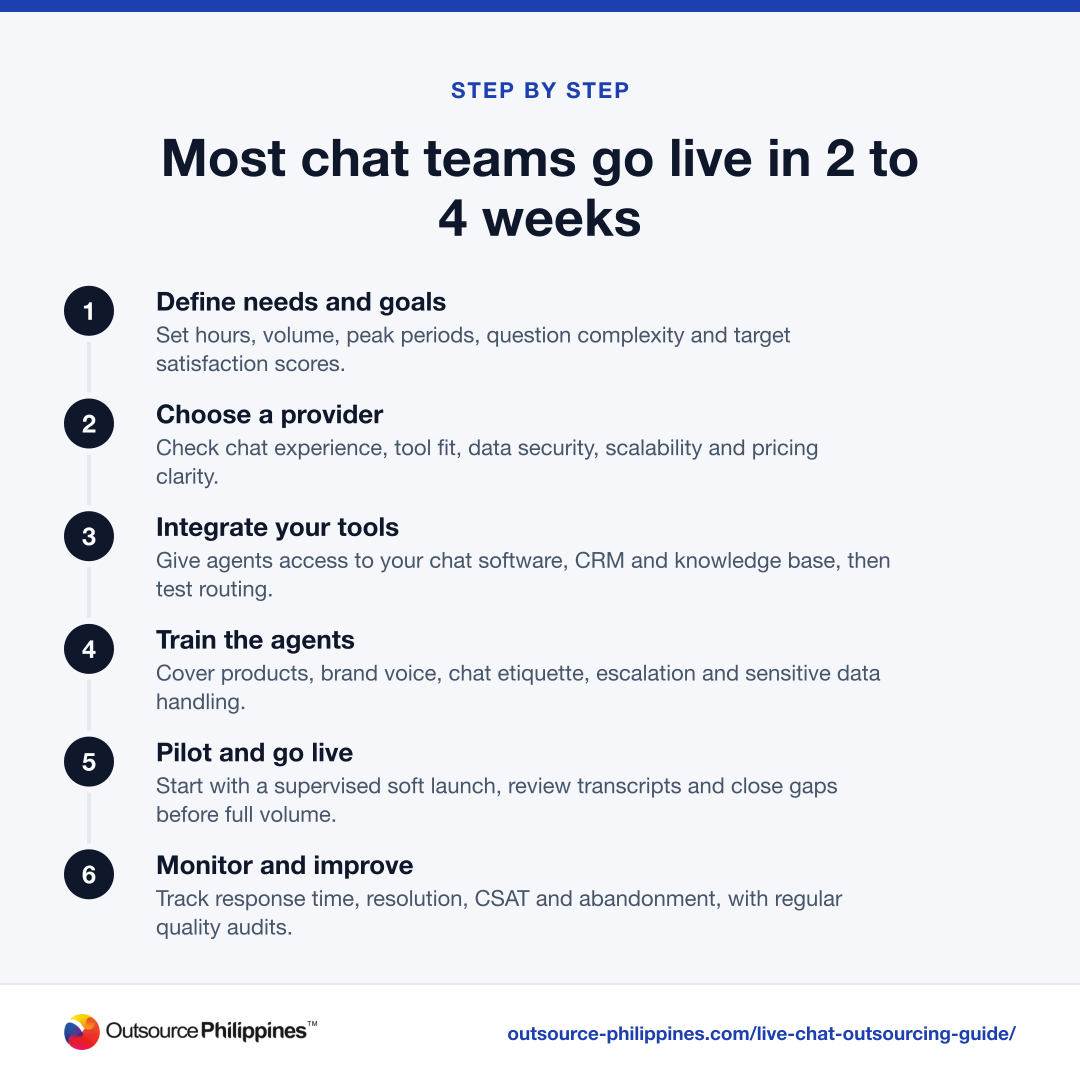
Setup follows a predictable path from goals to go-live. Most teams go live in 2 to 4 weeks, depending on the role.
- 1Define needs and goals
Set hours, volume, peak periods, question complexity and target satisfaction scores.
- 2Choose a provider
Check chat experience, tool fit, data security, scalability and pricing clarity.
- 3Integrate your tools
Give agents access to your chat software, CRM and knowledge base, then test routing.
- 4Train the agents
Cover products, brand voice, chat etiquette, escalation and sensitive data handling.
- 5Pilot and go live
Start with a supervised soft launch, review transcripts and close gaps before full volume.
- 6Monitor and improve
Track response time, resolution, CSAT and abandonment, with regular quality audits.
What to define up front:
- Support hours: business hours, weekends, or 24/7
- Volume and peak periods
- Technical complexity of the questions
- Target response time and customer satisfaction scores
Integration usually means giving agents logins to your chat software, CRM, and knowledge base, plus dashboard access and agreed workflows. Training should cover your products and services, brand voice, live chat etiquette and scripts, accurate answering, escalation procedures, and how to handle sensitive information.
After a supervised pilot, track average response time, first contact resolution, CSAT, chat abandonment and, for sales chats, conversion. Regular automated quality management and agent feedback sessions keep standards from drifting.
What Are the Main Benefits of Live Chat Outsourcing?
The main benefits are lower cost per conversation, better engagement, longer coverage, and access to good chat technology without building it yourself.
Lower Cost
Outsourcing reduces several cost lines at once:
- Recruitment and training overhead
- Salaries and employee benefits
- Infrastructure such as computers, office space, and software
- Management and HR costs
Outsource Philippines™ prices chat support as an hourly rate per agent in a written proposal.
Better Customer Engagement
Outsourced chat teams can:
- Proactively greet website visitors
- Give immediate help in the moment of need
- Resolve issues quickly so customers stay happy
- Personalize conversations using CRM data
- Collect feedback right after the chat
24/7 Service
Always-on chat matters for customers in other time zones and for industries like travel, gaming, and financial services, where problems do not wait for business hours. Outsource Philippines™ provides chat support in English only.
Technology and Analytics
Good providers work with:
- AI chatbots that answer simple FAQs and hand off to agents
- Chat software with canned responses, sentiment tracking, and secure integrations
- Real-time analytics dashboards
- Sentiment analysis to gauge customer mood
- Skills-based routing that sends each chat to the best agent
What Are the Challenges, and How Do You Overcome Them?
The four common challenges are brand voice, data security, system integration, and communication gaps. Each can be managed with clear rules from the start.
1. Maintaining Brand Consistency and Voice
Risk: agents miss your tone. Fix: write a brand voice guide, share examples of ideal chats, run regular refreshers, and review transcripts every week.
2. Data Security and Regulatory Compliance
Risk: customer data is shared outside your company. Fix: choose a provider that complies with the rules that apply to you, such as GDPR, HIPAA, or CCPA, sign non-disclosure agreements, and require encryption and access controls. Outsource Philippines™ complies with the Philippine Data Privacy Act of 2012 and protects client work with a managed firewall and WorQmate monitoring.
3. Integration and Technology Alignment
Risk: disconnected systems slow agents down. Fix: plan the integration between chat and back-end systems, test before launch, and name a technical contact on both sides.
4. Communication and Management Gaps
Risk: distance delays feedback and issue resolution. Fix: set communication protocols and escalation paths, hold frequent check-ins, and work with a dedicated account manager.
What Best Practices Get the Most from Outsourced Live Chat?
Treat the provider as part of your team and manage it with data. These six practices make the biggest difference:
- Set clear expectations: define SLAs, response times, and quality standards up front.
- Treat the partner as an extension of your team: share context, not just tickets.
- Use data and feedback: mine transcripts and surveys for improvements.
- Combine AI with human agents: bots take routine questions so agents handle complex ones.
- Train continuously: share product updates, policy changes, and customer insights.
- Monitor KPIs closely: average handle time, first response time, chat satisfaction, and conversion rate.
Be careful with automation, though. In a Gartner survey of 5,728 customers (December 2023), 64% said they would prefer companies did not use AI for customer service, and difficulty reaching a person was the top concern. A fast path from bot to human protects satisfaction.
How Do You Choose a Live Chat Outsourcing Provider?
Judge providers on experience, technology fit, security, scalability, agent quality, communication, and pricing clarity.
| Criteria | What to look for |
|---|---|
| Experience | A track record with chat support, ideally in your industry |
| Technology | Comfortable working in your chat and CRM tools |
| Security | Data privacy compliance and secure data handling |
| Scalability | Able to handle variable chat volumes |
| Agent quality | Strong written English, typing speed, and quality assurance |
| Communication | Dedicated account manager and transparent reporting |
| Pricing | Clear, written pricing with no hidden fees |
Before you sign, ask each provider how agents are screened for written English, how many concurrent chats an agent handles, how transcripts are scored, who your day-to-day contact is, and how quickly they can add agents before a peak. Vague answers to any of these are a warning sign.
What Trends Are Shaping Live Chat Outsourcing?
AI, omnichannel support, data-driven personalization, and remote agent models are changing how chat teams work.
- AI and automation: bots handle more routine questions, and the impact of AI in outsourcing is clearest in agents using AI suggestions for faster, more accurate replies.
- Omnichannel support: customers move between chat, social, SMS, and email and expect one connected conversation, which is why omnichannel outsourcing is growing.
- Personalization powered by data: CRM and behavior data let agents tailor recommendations.
- Remote and hybrid agent models: providers combine on-site and remote agents for flexibility.
Transparency matters as AI grows. In Salesforce’s State of the AI Connected Customer report (2026), 72% of customers said it is important to know if they are communicating with an AI agent.
Is Live Chat Outsourcing Right for Your Business?
It is a strong fit if chat volume is steady or growing, your answers are documented, and customers expect help outside your office hours. It is a weaker fit if chats are rare, or if most conversations need senior product judgment that is not written down anywhere yet.
Outsource Philippines™ provides dedicated live chat agents who work only on one client's account from a supervised office in the Philippines, and most teams go live in 2 to 4 weeks, depending on the role.
Frequently Asked Questions
What Does a Live Chat Outsourcing Provider Do?
A live chat outsourcing provider recruits, trains, and manages agents who answer chats on your website or app. They work in your chat software and CRM, follow your FAQs and escalation rules, and report on response time, resolution, and satisfaction, so you get trained coverage without building the team yourself.
How Much Does Live Chat Outsourcing Cost?
Cost depends on hours covered, volume, complexity, and team size. Outsource Philippines™ prices live chat support as an hourly rate per agent in a written proposal rather than publishing a rate card, and estimates most US clients pay 60% to 70% less than an equivalent in-house hire.
How Long Does It Take to Set Up Outsourced Live Chat?
Most teams go live in 2 to 4 weeks, depending on the role. That covers recruiting and screening agents, connecting them to your chat and CRM tools, training on your products and voice, and a supervised pilot with close quality review before the team takes full volume.
Can Outsourced Chat Agents Work with Our Existing Chat Software?
Yes. Outsourced agents normally work inside your existing chat platform, help desk, and CRM using accounts you provide, so customers see no change. Plan the integration early, give agents access to order or account tools they need, and test routing and escalation before the pilot starts.
Should We Use a Chatbot or Human Agents for Live Chat?
Most companies use both. A chatbot can answer simple, repetitive questions and collect details, while human agents handle complaints, complex issues, and sales conversations. Keep the handoff from bot to person quick and obvious, because difficulty reaching a person is a common customer complaint about automated service.