What Is Multi-Shoring? Benefits and How to Choose a Strategy

On This Page
- What Is Multi-shoring?
- How Does Multi-shoring Compare with Other Outsourcing Models?
- What Are the Pros and Cons of Multi-shoring?
- When Should You Consider Multi-shoring?
- What Mistakes Should You Avoid When Multi-shoring?
- Where Does the Philippines Fit in a Multi-shoring Model?
- Is Multi-shoring the Right Strategy for You?
- Frequently Asked Questions
Multi-shoring is an outsourcing strategy that spreads different business functions across several locations at once, combining onshore, nearshore, and offshore teams in one coordinated model. It gives companies wider talent access, lower risk from any single location, cost matched to each type of work, and coverage across time zones, at the price of more complex management.
If one outsourcing location no longer covers your needs, you are not alone. More businesses are spreading work across regions to stay competitive, reduce risk, and reach the right skills wherever they are. This guide explains what multi-shoring means, how it compares with other outsourcing models, its pros and cons, when it makes sense, the mistakes to avoid, and where the Philippines fits.
What Is Multi-shoring?
Multi-shoring distributes business functions across multiple locations at the same time, so each type of work runs where it fits best. The locations work together as one system rather than as separate contracts.
Here is how it can look in practice. Strategic project leads sit onshore, close to your internal team. A nearshore team in a similar time zone handles work that needs real-time collaboration. Customer support, quality checks, and back-office processing run offshore, where skilled talent costs less.
Unlike simply picking “the best location” for each task in isolation, multi-shoring looks at how all the parts work together. The goal is not only lower cost. It is a resilient, flexible operation that can adapt as your business grows or as global conditions shift.
How Does Multi-shoring Compare with Other Outsourcing Models?
Multi-shoring is the only model built around several locations working at once. The table shows how it compares with the other common options.
| Outsourcing model | Where work happens | Best for | Key limitation |
|---|---|---|---|
| Onshoring | Same country as the client | High compliance needs, sensitive data | Highest cost, limited talent pool |
| Nearshoring | Nearby country, similar time zone | Real-time collaboration, agile projects | Moderate cost savings only |
| Offshoring | Distant country, lower labor costs | Large-scale, cost-sensitive work | Time zone gaps, communication friction |
| Rightshoring | The best single location per task | Task-by-task cost optimization | Less focus on how teams interact |
| Multi-shoring | Multiple locations at once | Complex, growing operations that need resilience | Needs stronger governance and management |
The key difference between multi-shoring and rightshoring is the question each asks. Rightshoring asks “where is the best place for this task?” Multi-shoring asks “how do all our locations work together as a system?” That distinction matters when you are scaling or need operations to run 24/7 without disruption. A related approach, friendshoring, picks locations by political and economic alignment.
What Are the Pros and Cons of Multi-shoring?
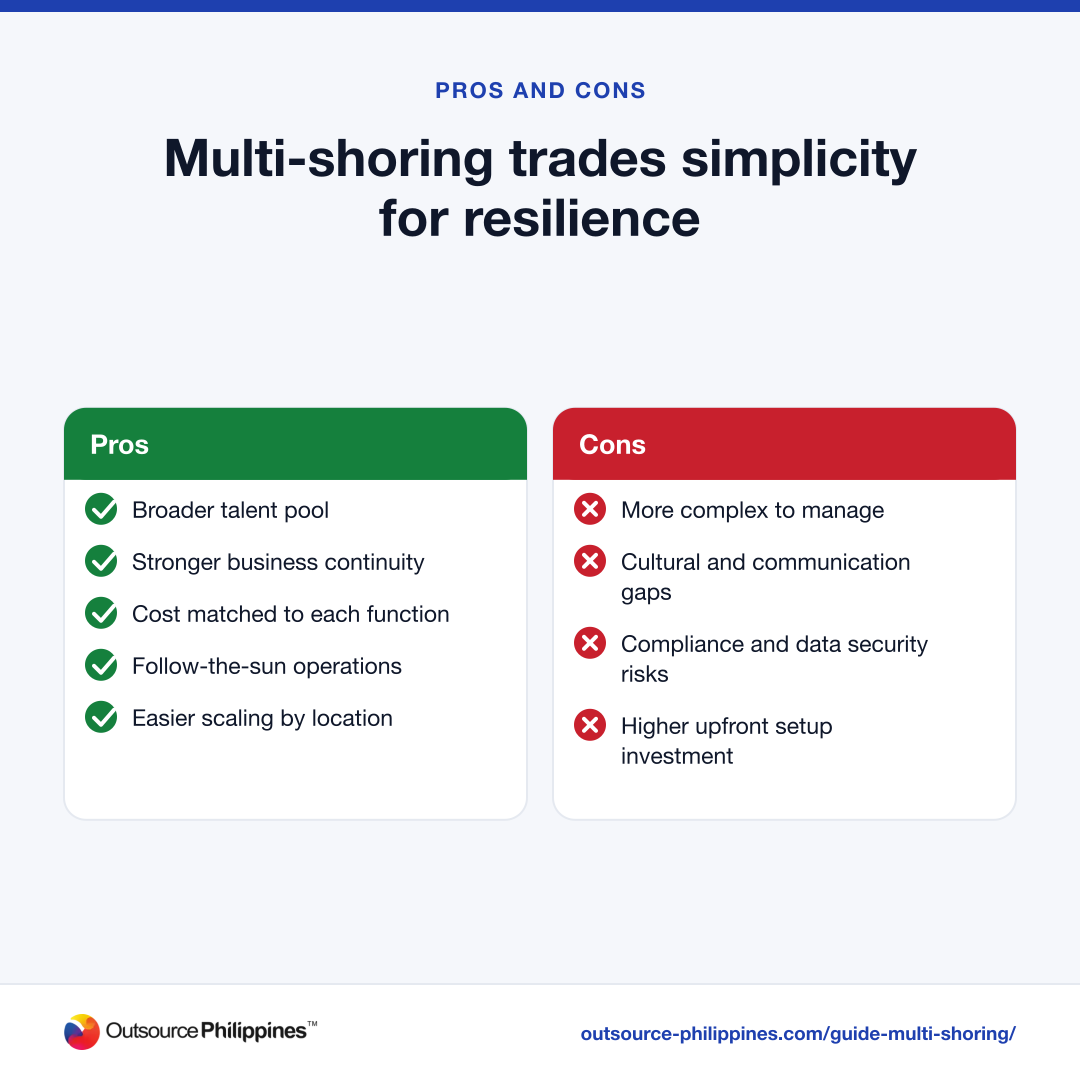
Multi-shoring brings wider talent access, continuity, and round-the-clock work, but it is harder to manage. Like any outsourcing decision, it has real advantages and real trade-offs.
Pros
- Broader talent pool
- Stronger business continuity
- Cost matched to each function
- Follow-the-sun operations
- Easier scaling by location
Cons
- More complex to manage
- Cultural and communication gaps
- Compliance and data security risks
- Higher upfront setup investment
The Pros
- Access to a broader talent pool: you are not limited to one country, so you can find the exact skills a project needs, from software engineers and data analysts to experienced customer support agents.
- Stronger business continuity: political instability, natural disasters, economic shifts, or a local labor shortage in one place no longer stop the whole operation, because other locations can absorb the load.
- Cost optimization across functions: high-touch, strategic work goes onshore or nearshore, and high-volume, repeatable work goes offshore, so you pay the right rate for each type of work.
- Follow-the-sun operations: teams in different time zones keep work moving around the clock, which helps customer support, IT monitoring, and projects with tight deadlines.
- Scalability and flexibility: you can scale specific functions up or down in one location without rebuilding the entire operation.
The Cons
- More complex to manage: coordinating teams in several countries needs strong project management, clear communication rules, and consistent governance.
- Cultural and communication gaps: different working styles and norms can cause friction unless training and onboarding address them early.
- Compliance and data security risks: each country brings its own data protection, employment, and cybersecurity rules. Breaches are costly: IBM’s Cost of a Data Breach Report 2026 puts the global average cost of a breach at $4.99 million.
- Higher upfront setup investment: planning and process standardization take time and money, and rushing creates hidden costs that erode savings.
When Should You Consider Multi-shoring?
Consider multi-shoring when one location can no longer meet your needs for capacity, coverage, or resilience. These five signs suggest it is time.
You Have Outgrown a Single Outsourcing Location
If your offshore or nearshore team is hitting capacity limits, talent shortages, or time zone constraints, adding a second location is a natural next step. You expand without abandoning what already works.
Your Business Operates across Multiple Markets
Teams closer to each market improve response times, cultural fit, and customer experience. A company with customers in the US, Australia, and the Middle East benefits from delivery capacity in each of those time zones.
You Need 24/7 Coverage without Burning Out Your Team
For round-the-clock operations such as IT support, ecommerce, or financial services, multi-shoring is one of the most practical ways to provide continuous coverage while keeping costs manageable.
Risk Reduction Is a Priority
If leadership is discussing business continuity or reducing reliance on one country, multi-shoring addresses that directly by spreading delivery across regions.
You Are Scaling Rapidly
High-growth companies often find that one location becomes a bottleneck. Multi-shoring lets you add capacity in a new region when one talent market gets tight.
What Mistakes Should You Avoid When Multi-shoring?
Most multi-shoring problems come from weak governance, cost-only decisions, and poor integration. Plan for these five pitfalls.
- Underestimating governance complexity: treat your locations as one integrated system with shared processes, standards, and accountability, not a collection of separate contracts. Make sure your first location has strong, documented processes before you add a second or third.
- Choosing locations on cost alone: talent quality, infrastructure, time zone fit, regulation, and culture all affect long-term performance. A location that looks cheap on paper can become expensive through turnover, rework, or compliance problems.
- Neglecting communication and integration: invest in collaboration tools, set meeting times that work across time zones and build a shared team culture on purpose.
- Skipping a proper vendor assessment: look for partners with experience delivering across locations, and ask about quality control, escalation management, and cross-location coordination.
- Ignoring data security and compliance from day one: compliance cannot be retrofitted. Map the data protection rules for each country before you expand, especially for personal, financial, or health data.
Where Does the Philippines Fit in a Multi-shoring Model?
The Philippines works well as the offshore hub in a multi-shoring model, especially for English-language customer support and back-office work.
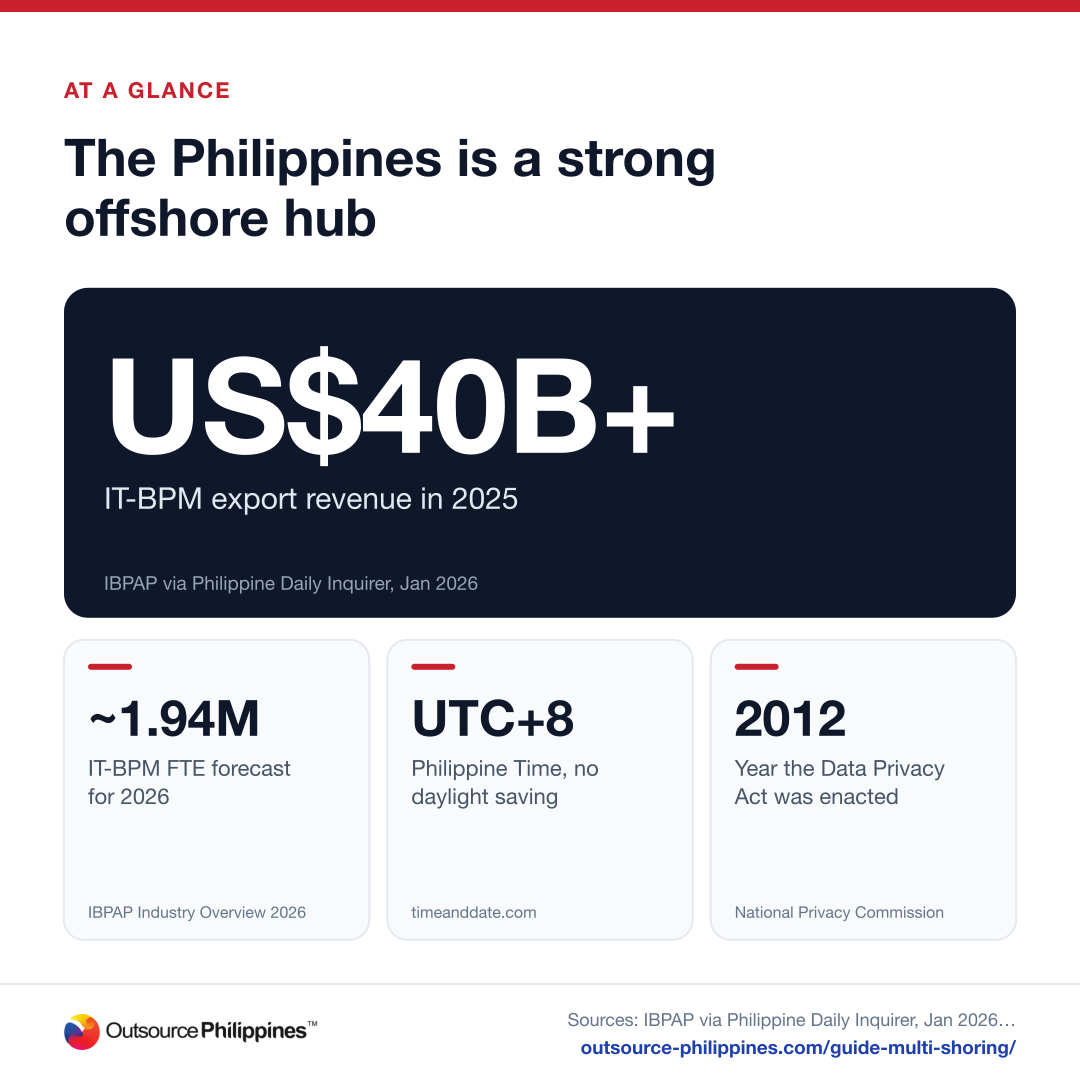
- US$40B+IT-BPM export revenue in 2025IBPAP via Philippine Daily Inquirer, Jan 2026
- ~1.94MIT-BPM FTE forecast for 2026IBPAP Industry Overview 2026
- UTC+8Philippine Time, no daylight savingtimeanddate.com
- 2012Year the Data Privacy Act was enactedNational Privacy Commission
Its IT and business process management industry earned more than US$40 billion in export revenue in 2025, according to IBPAP via the Philippine Daily Inquirer. Philippine Time is UTC+8, so a Manila team can cover the US overnight or work a night shift during US business hours. The Data Privacy Act of 2012 gives a clear legal framework for handling personal data, and our security page explains how Outsource Philippines™ protects client work with a managed firewall and WorQmate monitoring.
Outsource Philippines™ provides dedicated agents who work only on your account, which is one reason companies build teams in the Philippines as one consistent part of a wider multi-shoring setup. Most teams go live in 2 to 4 weeks, depending on the role.
Is Multi-shoring the Right Strategy for You?
Multi-shoring suits growing companies that already outsource successfully and now need more capacity, coverage, or resilience. If you are outsourcing for the first time, start with one well-run location and add more once processes are documented and stable.
Explore our customer service outsourcing teams as an offshore hub. When you know the roles and hours, request a proposal.
Frequently Asked Questions
What Is the Difference between Multi-shoring and Offshoring?
Offshoring moves specific business functions to a single foreign country, mainly for cost savings. Multi-shoring goes further by combining onshore, nearshore, and offshore locations into one coordinated delivery model. The goal is not only lower cost but also resilience, wider talent access, and round-the-clock capability.
Is Multi-shoring Only for Large Enterprises?
No. Multi-shoring has traditionally been linked with large corporations, but mid-sized and growing businesses increasingly adopt it as they scale. If you already have one outsourcing relationship and are considering another location or function, you are already moving toward a multi-shoring model.
How Do I Manage Quality across Multiple Outsourcing Locations?
Use standardized processes, shared KPIs, regular performance reviews, and strong communication tools across every location. Choose partners that already have quality frameworks and experience delivering alongside other teams, and make sure each location documents its work the same way so results can be compared.
What Industries Benefit Most from Multi-shoring?
Multi-shoring is common in technology, financial services, customer experience and support, healthcare back-office operations, digital marketing, and ecommerce. Any industry with high-volume, knowledge-based work that can be split across time zones is a strong candidate, especially when customers expect fast responses at any hour.
How Is the Philippines Positioned in a Multi-shoring Model?
The Philippines is a leading outsourcing destination with a large, English-proficient workforce at competitive cost. It works well as the offshore hub for customer support, back-office operations, technical support, and creative work, and its Data Privacy Act of 2012 makes it a trusted location for businesses with compliance requirements.