Insurance Back-Office Outsourcing: What Agencies and Carriers Hand Off

On This Page
Insurance back office outsourcing means handing the paperwork behind policies to a dedicated offshore team: policy data entry, endorsements, certificates of insurance, renewal prep, rater entry, claims intake admin, loss runs, and AMS cleanup. Binding coverage, giving advice, and anything that legally requires a producer or adjuster license stay with your licensed staff.
Key takeaways
- Most agency and carrier back-office work is data handling inside your systems, which an unlicensed offshore team can do under your procedures.
- Selling, soliciting, and negotiating insurance require a producer license in every US state, so those steps stay onshore.
- State insurance data security laws based on the NAIC model require a written security program, and your vendor's access falls inside it.
- Start with two or three high-volume tasks, write the procedures first, and add work only after error rates hold steady.
This guide is for independent agencies, MGAs, and small carriers deciding what to move offshore. It covers the tasks that transfer well, the ones that do not, the licensing and data security rules that draw the line, and a rollout plan you can run in the next quarter.
What Is Insurance Back-Office Outsourcing?
Insurance back-office outsourcing is the transfer of non-licensed administrative work on policies, renewals, and claims to an outside team that works inside your agency management system (AMS) and carrier portals. The team processes paperwork; your producers, account managers, and adjusters keep every coverage decision.
The split matters because insurance work runs on two tracks. One track is the conversation with the insured: advice, quotes, coverage choices, and binding. The other is everything that has to happen after the conversation: a driver gets added in the AMS, an ACORD certificate goes out to a general contractor, a renewal file gets built 90 days before expiration, a carrier download gets reconciled. That second track is where an agency's account managers lose most of their week, and it is the track that moves offshore.
Policyholder phone and email support is a separate decision with its own playbook, covered in outsourcing insurance customer service. This article stays on the processing work behind the phones, the same territory as general back-office outsourcing services but with insurance-specific rules on licensing and data.
Which Insurance Back-Office Tasks Can You Outsource?
Tasks that follow a written procedure and do not require a license transfer well: policy data entry, endorsements processing, certificate requests, renewal prep, rater entry, claims intake admin, loss run requests, AMS upkeep, and accounting support. The table shows where the line usually falls for each one.
| Task | What the offshore team does | What stays with licensed staff |
|---|---|---|
| Policy data entry | Enters new business and carrier downloads into the AMS | Confirms coverage was bound as quoted |
| Endorsements | Prepares change requests and updates the policy record | Approves any change in coverage or limits |
| Certificates of insurance | Issues standard ACORD certificates from the policy on file | Approves additional insured or wording requests |
| Renewal prep | Builds the renewal file and requests updated exposures | Reviews the account and recommends coverage |
| Quoting support | Enters risk data into comparative raters | Presents quotes and advises the client |
| Claims intake admin | Logs first notice of loss and gathers documents | Decides coverage and settlement |
| Loss runs | Requests loss runs from carriers and files them | Uses loss history in marketing the account |
| AMS and CRM upkeep | Cleans duplicates, attaches documents, updates contacts | Sets data standards and access rights |
| Accounting support | Reconciles direct-bill commission statements | Handles past-due premium collections |
Two tasks need extra care. In quoting, entering data into a rater is clerical work, but discussing the result with a prospect is soliciting, so the handoff happens before any client contact. In claims, a team can run insurance claims intake and document checks while your adjusters keep every coverage and payment decision, a split that holds at every stage of the claims management process, from first notice to closure.
Some agencies also ask about health insurance work. Checking patient eligibility and benefits for a medical practice is a different job, run under HIPAA, and sits under healthcare insurance verification rather than a property and casualty back office.
What Must Stay with Licensed Staff?
Any step that sells, solicits, or negotiates insurance must stay with licensed people, and so must coverage and claim decisions. In practice that means binding, advising on coverage, presenting quotes, and adjusting claims.
The NAIC producer licensing rules state that anyone who sells, solicits, or negotiates insurance in the United States must be licensed as a producer, a term that covers both agents and brokers. The US Bureau of Labor Statistics adds that insurance sales agents need a license in each state where they work, with separate licenses for life and health and for property and casualty lines (Occupational Outlook Handbook, 2025 data).
Claims follow a similar pattern. According to the BLS profile of claims adjusters, licensing requirements for adjusters vary by state, and some adjusters work under their company's license. Either way, the person deciding a claim is someone your state regulator recognizes, not an offshore processor.
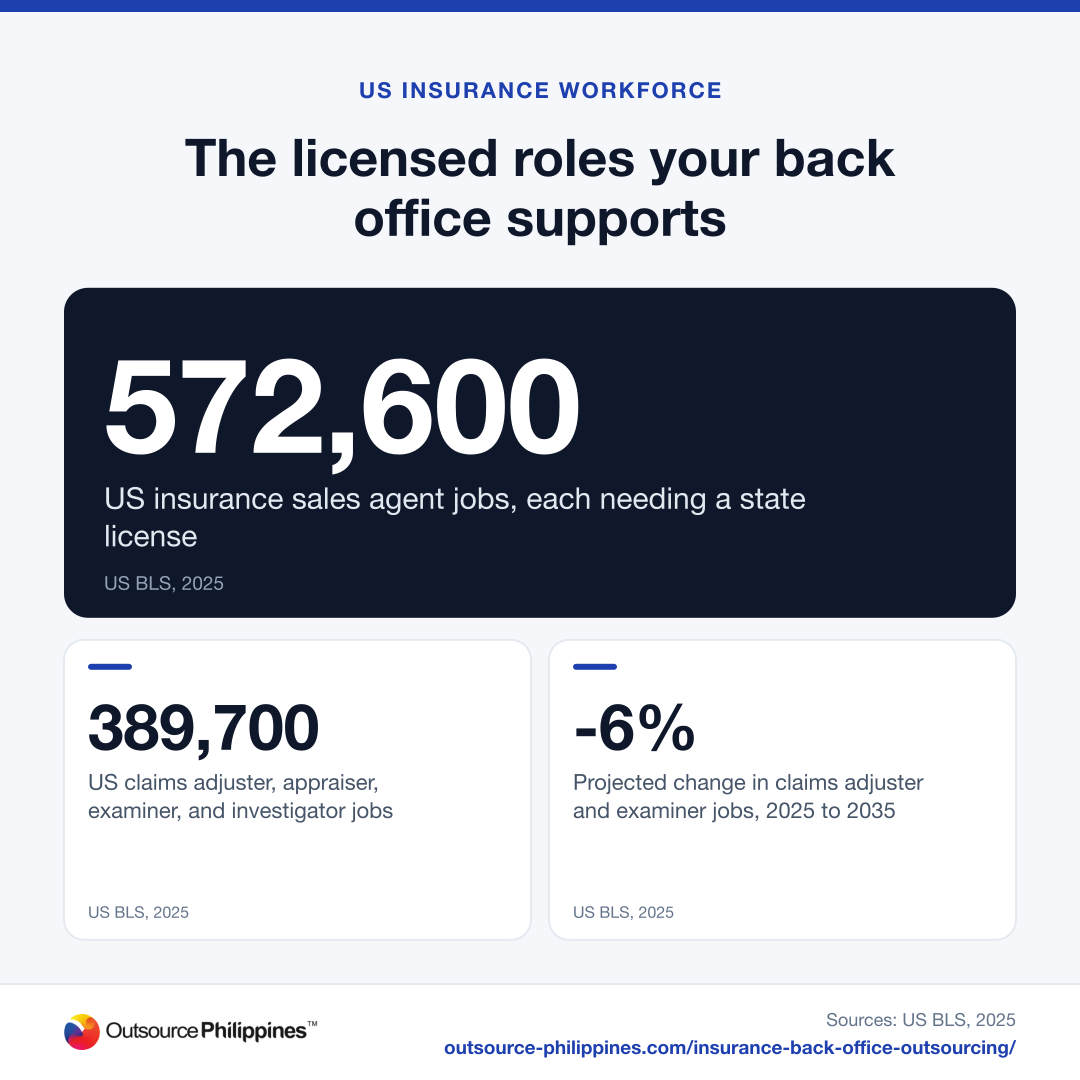
- 572,600US insurance sales agent jobs, each needing a state licenseUS BLS, 2025
- 389,700US claims adjuster, appraiser, examiner, and investigator jobsUS BLS, 2025
- -6%Projected change in claims adjuster and examiner jobs, 2025 to 2035US BLS, 2025
Those numbers explain why the line matters. The BLS projects claims adjuster, appraiser, examiner, and investigator jobs to fall 6% from 2025 to 2035, while about 21,600 openings a year still need to be filled as people retire or change careers. Licensed time is scarce, so the case for outsourcing is to stop spending it on certificate requests and download errors.
State rules on what unlicensed staff may say to a client are not uniform. Before go-live, write down what the offshore team may and may not tell an insured, have your compliance lead or errors and omissions (E&O) carrier review it, and keep the team out of any conversation about coverage.
How Do You Protect Policyholder Data with an Offshore Team?
You protect policyholder data the same way regulators expect you to protect it in-house: a written security program, controlled access, monitored devices, and a contract that holds the vendor to your standards. Outsourcing moves the work, not your responsibility for the data.
The NAIC Insurance Data Security Model Law (#668) requires insurers and other entities licensed by state insurance departments to develop, implement, and maintain an information security program, investigate cybersecurity events, and notify the state insurance commissioner. Agencies licensed in a state that adopted the model fall under it too, and a vendor working in your systems has to meet the controls your program sets.
Ask any provider for these controls in writing:
- Named access: each team member gets a personal login to your AMS, raters, and carrier portals, with roles limited to the tasks in scope. No shared passwords.
- Locked-down devices: work happens on company-managed computers in a supervised office, with USB storage, personal email, and printing blocked.
- Network controls: a managed firewall, VPN or IP allow-listing into your systems, and multi-factor authentication on every account.
- Activity records: login and screen activity logs you can review, and a defined process for reporting a suspected incident to you within your own notification window.
- Offboarding: access removed the same day someone leaves the account.
Outsource Philippines™ staff work only from a supervised office in San Pedro City, Laguna, on company-managed devices behind a managed firewall with WorQmate monitoring, and client data is handled under the Philippine Data Privacy Act of 2012 (RA 10173).
How Do You Roll Out an Insurance Back Office Team?
Roll out in stages: map the work, write the procedures, start with two or three high-volume tasks, measure errors for a month, then add more. Most teams go live in two to four weeks, depending on the role.
- Count the work. Pull 60 days of tasks from your AMS or ticket queue: endorsements, certificates, downloads, renewals, loss runs. Note volume, average minutes, and who does each one today.
- Draw the license line. Tag every task as clerical or licensed, using the table above as a starting point. Anything tagged licensed stays out of scope.
- Write the desk procedures. Use screenshots from your own AMS, list each carrier's quirks, and set rules for when the team must stop and escalate.
- Pick the first tasks. Certificates, carrier download cleanup, and renewal file prep are common starting points because errors are easy to catch and volume is steady.
- Hire and train. At Outsource Philippines™, we source, test, and shortlist candidates; final interviews are with your team and ours, and you make the hiring decision. Training then runs on your procedures and your systems.
- Check everything, then sample. Review 100% of work for the first two weeks, then drop to a sample once the error rate holds. Track turnaround time, error rate, and backlog.
- Expand one task at a time. Add the next task only after the current set is stable for a full month.
If you are weighing a single generalist instead of a team, an insurance agency virtual assistant can cover a mix of these tasks for a smaller book. Agencies that also want the business case for outsourcing phone and email service can compare it with the benefits for insurance agencies of an outsourced service desk.
When This Is Not the Right Fit
Back-office outsourcing is not the right fit when the work cannot be written down or when the bottleneck is licensed judgment rather than paperwork. A few cases come up often.
- Your procedures live in one person's head. If nobody can explain how a certificate request is handled step by step, fix that first. An outside team will copy the gaps.
- The volume is too small. An agency issuing a handful of certificates a week may not have enough steady work for a full-time person.
- You need collections. Chasing past-due premiums and agency-bill receivables is accounts receivable collections work, which Outsource Philippines™ does not offer. Commission reconciliation and insurance agency accounting support are in scope; collections are not.
- You need licensed people offshore. If the role must quote, advise, or bind, you need a licensed producer, not a back-office processor.
Outsource Philippines™ has run dedicated back-office teams from its supervised office in the Philippines since 2003, with each team member working full time on one client's account.
Frequently Asked Questions
What Does an Insurance Virtual Assistant Do?
An insurance virtual assistant handles clerical work inside your agency systems: entering policies and carrier downloads, preparing endorsements, issuing standard certificates, building renewal files, entering data into comparative raters, requesting loss runs, and cleaning AMS records. They do not quote, advise, or bind coverage. Licensed producers review anything that changes coverage before it reaches the insured.
Can Offshore Staff Enter Quotes into Comparative Raters?
Yes, offshore staff can enter risk data into comparative raters, because data entry is clerical work. The limit is client contact. Presenting quote results, recommending a carrier, or discussing coverage is soliciting or negotiating, which requires a state producer license. Set the handoff so a licensed producer takes over before any quote reaches the prospect.
Is Outsourcing Insurance Back-Office Work Secure?
It can be as secure as in-house work if the provider uses named logins, company-managed devices in a supervised office, a managed firewall, multi-factor authentication, and activity logs. State laws based on the NAIC data security model require your agency to run a written security program, so put these controls in the contract and review access every quarter.
How Do You Train an Offshore Insurance Back-Office Team?
Train on your own desk procedures, not generic insurance courses. Record short screen walkthroughs of each task in your AMS, list carrier-specific rules, and define when the team must escalate. Review every completed task for the first two weeks, then move to sampling. Most errors in the first month come from missing procedure steps, not skill gaps.
What Insurance Back-Office Tasks Should You Outsource First?
Start with steady, checkable work: certificates of insurance, carrier download cleanup, and renewal file preparation. These tasks have clear inputs and outputs, so errors are easy to spot during the first weeks. Add endorsements, loss runs, and claims intake admin once the first set holds a stable error rate for a full month.