Why Outsource Office Management for Your Business? (A Detailed Breakdown)

On This Page
- What Is Office Management Outsourcing?
- How Does Office Management Outsourcing Work?
- What Are the Benefits of Outsourcing Office Management?
- Which Office Management Tasks Are Commonly Outsourced?
- How Do You Choose an Office Management Outsourcing Provider?
- What Are the Risks, and How Do You Manage Them?
- What Are the Best Practices for Outsourcing Office Management?
- When Is It Time to Outsource Office Management?
- Is Outsourcing Office Management Right for Your Business?
- Frequently Asked Questions
Outsourcing office management means handing routine administrative work, such as scheduling, document management, data entry, and correspondence, to an outside provider. The main benefits are lower overhead than an in-house hire, written and consistent procedures, trained administrative staff, and more time for your own team to spend on customers and revenue.
- A US secretary or administrative assistant earned a median $48,310 a year in May 2025 (US Bureau of Labor Statistics), before benefits, desk space, and equipment.
- Benefits added 30.0% to private-industry compensation costs in June 2026 (US Bureau of Labor Statistics), so the true cost of an in-house hire is well above the salary.
- The tasks that move most easily are the ones with written rules: calendars, document filing, data entry, email triage, and records upkeep.
- Work that needs someone physically on site, such as signing for deliveries or greeting visitors, should stay local.
Administrative work grows quietly. A manager who answers vendor emails, books meetings, and files contracts for an hour a day loses more than 200 hours a year to it. Outsourcing office management moves that recurring work to a dedicated team that follows your procedures, so managers get those hours back and the work gets done on a fixed schedule instead of between other tasks.
What Is Office Management Outsourcing?
Office management outsourcing is contracting an outside team to run the recurring administrative work behind your business: calendars, documents, data, correspondence, and records. It is one part of outsourcing administrative tasks more broadly, which also covers finance and data processing.
The work is usually done off your premises, by staff who log in to your email, calendar, document storage, and other systems with accounts you control. You keep ownership of the systems and the data; the provider supplies trained people, supervision, and the workplace they work from.
How Does Office Management Outsourcing Work?
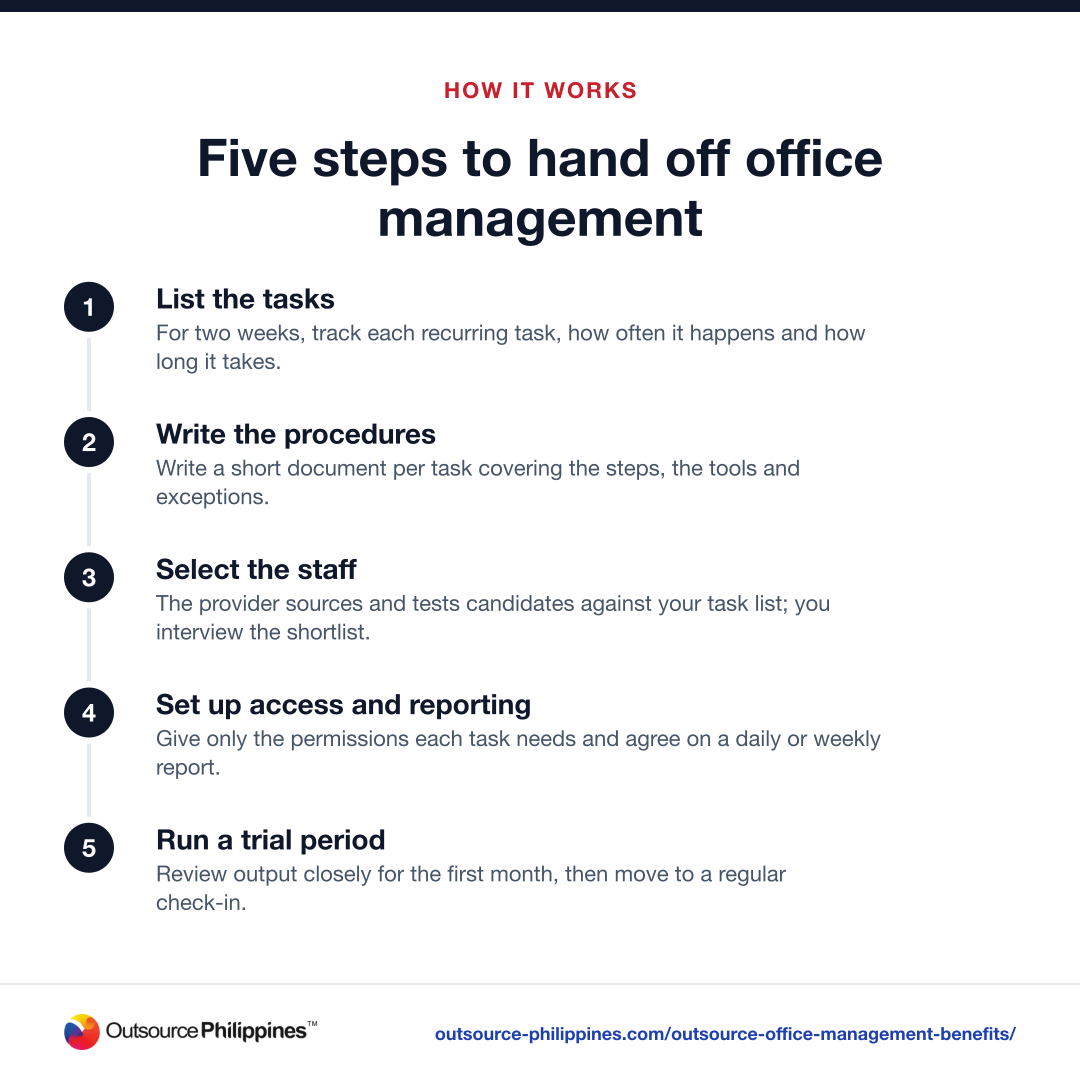
It works like hiring, with the provider handling recruitment, the workplace, and day-to-day supervision. A typical setup follows five steps:
- 1List the tasks
For two weeks, track each recurring task, how often it happens and how long it takes.
- 2Write the procedures
Write a short document per task covering the steps, the tools and exceptions.
- 3Select the staff
The provider sources and tests candidates against your task list; you interview the shortlist.
- 4Set up access and reporting
Give only the permissions each task needs and agree on a daily or weekly report.
- 5Run a trial period
Review output closely for the first month, then move to a regular check-in.
Most teams communicate through the tools the client already uses, such as email, chat, and a shared task board, so your internal staff and their outsourced counterparts see the same task list and deadlines.
What Are the Benefits of Outsourcing Office Management?
The three main benefits are lower total cost than an in-house hire, more consistent administrative work, and access to trained staff without a long recruiting cycle.
Lower Total Cost
The salary is only part of what an in-house administrative hire costs. The US Bureau of Labor Statistics puts the median annual wage for secretaries and administrative assistants at $48,310 (May 2025). The BLS Employer Costs for Employee Compensation release shows that wages made up 70.0% of private-industry compensation costs in June 2026, with benefits making up the other 30.0%.
A worked example, with each assumption labeled:
| Item | Figure | Assumption |
|---|---|---|
| Base salary | $48,310 | BLS median for secretaries and administrative assistants, May 2025 |
| Wages as a share of total compensation | 70.0% | BLS private-industry average, June 2026 |
| Estimated total compensation | About $69,000 | $48,310 divided by 0.70 |
| Not included | Desk, equipment, software, recruiting, turnover | These vary by location and add to the total |
That roughly $69,000 is the figure to compare against written quotes from outsourcing providers for the same hours and tasks, along with the time your managers would no longer spend recruiting and covering absences.
More Consistent Work
Outsourced administrative work runs on written procedures and a reporting schedule, which most in-house roles never get. When the process is documented, the work does not depend on one person's memory, and a replacement can pick it up quickly if someone leaves.
For example, outsourcing data entry to a team that works from a written field guide and spot-checks a sample of records each day produces fewer errors than data entry squeezed in between a manager's other tasks.
Faster Access to Trained Staff
Recruiting an administrative hire takes weeks of posting, screening, and interviewing. A provider with an existing hiring process can shortlist tested candidates faster, which matters most during a growth spurt, when the administrative backlog builds up fastest.
Which Office Management Tasks Are Commonly Outsourced?
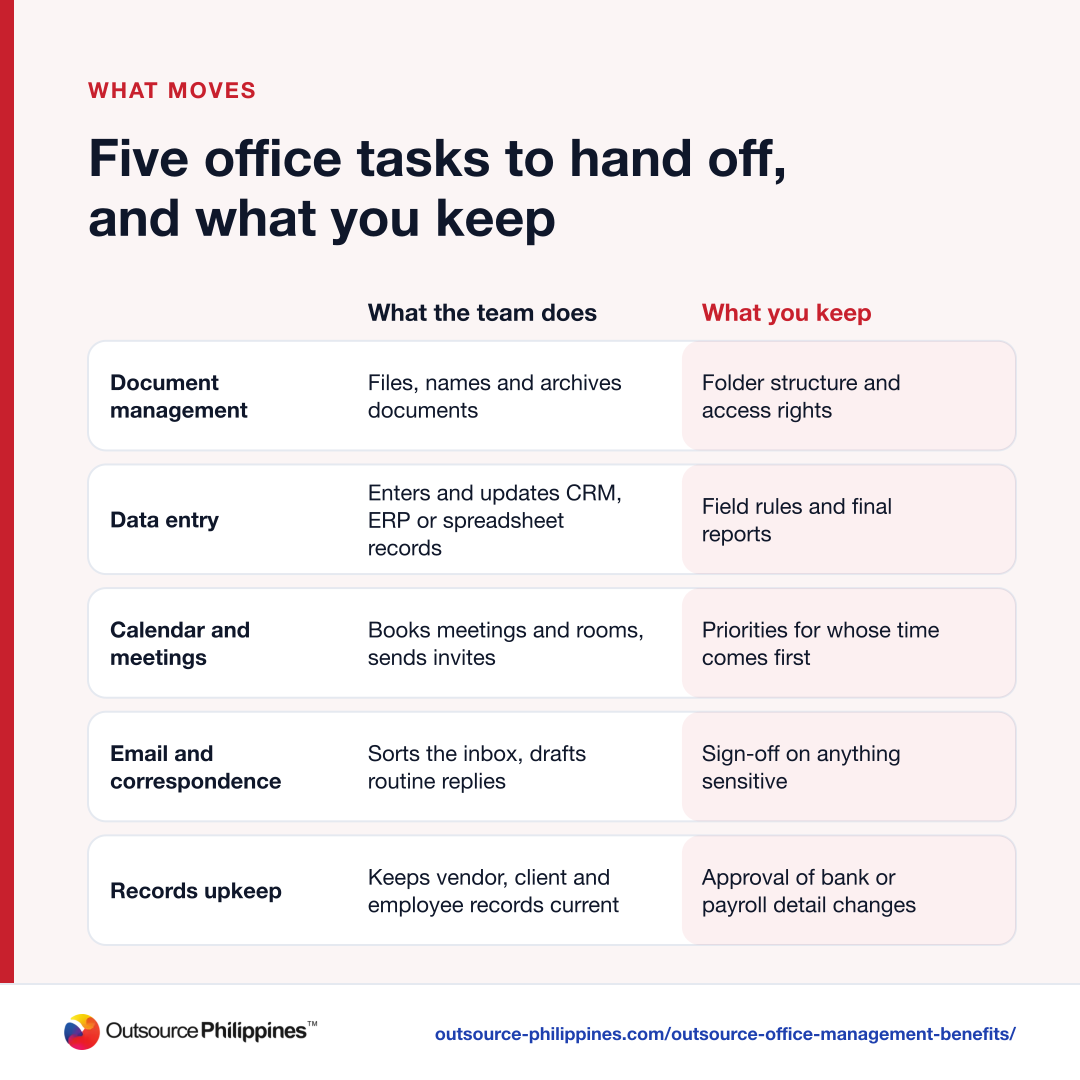
The tasks that move most easily are recurring, rules-based, and done entirely on a computer. Common examples:
| Task | What the team does | What you keep |
|---|---|---|
| Document management | Files, names and archives documents | Folder structure and access rights |
| Data entry | Enters and updates CRM, ERP or spreadsheet records | Field rules and final reports |
| Calendar and meetings | Books meetings and rooms, sends invites | Priorities for whose time comes first |
| Email and correspondence | Sorts the inbox, drafts routine replies | Sign-off on anything sensitive |
| Records upkeep | Keeps vendor, client and employee records current | Approval of bank or payroll detail changes |
Document Management
Document management means every file has a predictable name, a predictable location, and a retention rule. An outsourced team can rename and file incoming documents daily, archive old ones on schedule, and flag missing contracts or expired certificates before they cause a problem. You decide the folder structure and who can see what.
Data Entry
Data entry is a common starting point because it is easy to measure. A dedicated data entry team works to agreed fields, formats, and an accuracy target, and you check a random sample of records each week.
Meeting Room and Calendar Coordination
An offshore team can run the booking system for your meeting rooms, resolve double bookings, send invites with dial-in details, and request equipment from on-site staff. The physical setup of a room still needs someone in the building.
How Do You Choose an Office Management Outsourcing Provider?
Choose a provider that can show a documented hiring process, clear data protection controls, and references from clients with similar work. Four checks cover most of the risk.
Check Experience and Hiring Process
Ask how long the provider has run administrative teams, how it tests candidates, and whether you can interview the shortlist. A provider that hires to your task list, rather than assigning whoever is free, gives you more control over the result.
Check Data Security
Ask where staff work, how devices are managed, and who can access your systems. A supervised office with company-managed computers and a managed firewall gives you more control than staff working from personal laptops. If the team is in the Philippines, the Data Privacy Act of 2012 (Republic Act 10173) requires organizations handling personal information to use reasonable organizational, physical, and technical security measures. Your own obligations under the privacy laws of your country still apply.
Check References
Ask for references from clients with similar workloads, and ask those clients how the provider handles staff turnover, missed deadlines, and day-to-day communication.
Check Reporting
Agree before you sign on what you will see each day or week: tasks completed, open items, and errors found. If the provider cannot describe its reporting, you will have no way to tell whether the work is on track.
What Are the Risks, and How Do You Manage Them?
The three main risks are uneven quality, communication gaps, and data exposure. Each is managed with a specific control, not a general promise.
- Quality. Set a measurable target for each task, such as same-day filing or 99% data accuracy on a weekly sample, and review it in a short weekly call for the first three months.
- Communication. Agree on one chat channel, one task board, and fixed overlap hours with your time zone. Write instructions down rather than giving them only on calls.
- Data exposure. Give each person only the access their tasks need, use your own accounts so you can switch access off at any time, and sign a confidentiality and data processing agreement before work starts.
What Are the Best Practices for Outsourcing Office Management?
Start small, write everything down, and measure from the first week:
- Define goals in numbers. "Inbox cleared to zero by 5 p.m. Eastern" is a goal; "help with email" is not.
- Start with two or three tasks. Add more once the first ones run without errors.
- Hold a short weekly review. Fifteen minutes on what was done, what was late, and what changes next week.
- Use the tools you already have. Give the team accounts in your existing email, calendar, and task tools so all the work stays visible to you.
When Is It Time to Outsource Office Management?
It is time when administrative work is taking managers away from customers, when the backlog keeps growing, or when you need skills you do not have in-house.
Rapid growth. When order volume, headcount, or client numbers jump, administrative work grows with them, usually faster than anyone plans for. Entrusting administrative tasks to external providers adds capacity without a long hiring cycle.
Limited in-house skills. A small business may need someone who knows document management systems or CRM data cleanup for a few hours a day, but not enough to justify a specialist hire.
Managers doing admin work. If senior staff spend part of each day on scheduling, filing, or data entry, that time is better spent on sales, clients, and planning. A clear outsourcing strategy decides which tasks move first and how results will be measured.
Is Outsourcing Office Management Right for Your Business?
It is a good fit when administrative work is pulling managers away from customers, the tasks are repeatable and documented, and the work can be done on a computer away from your premises. It is a weaker fit for tasks that need someone physically on site, such as receiving deliveries or staffing a front desk, and for work that changes so often it cannot be written down yet.
At Outsource Philippines™, we source, test, and shortlist candidates; your team joins the final interviews, and you make the hiring decision. Staff work full time on one client's account from our supervised office, and most teams go live in 2 to 4 weeks, depending on the role.
Outsource Philippines™ has run office-based back-office teams in the Philippines since 2000, handling client data under the Philippine Data Privacy Act of 2012.
Frequently Asked Questions
What Is Office Management Outsourcing?
Office management outsourcing is contracting an outside team to handle recurring administrative work such as scheduling, document management, data entry, and correspondence. You keep ownership of your systems and data, and the provider supplies trained staff, supervision, and the workplace. It lets managers spend less time on administration and more on customers.
What Tasks Are Commonly Outsourced in Office Management?
The most common are document management, data entry, calendar and meeting room coordination, email and correspondence handling, and records upkeep. These tasks follow written rules and are done entirely on a computer, which makes them easy to hand off and measure. Tasks that need someone physically in your office should stay local.
How Much Does an In-House Administrative Assistant Cost?
The US Bureau of Labor Statistics puts the median wage for secretaries and administrative assistants at $48,310 a year (May 2025). Wages were 70.0% of private-industry compensation costs in June 2026, so total compensation is roughly $69,000 before desk space, equipment, software, and recruiting costs.
How Do I Choose the Right Outsourcing Provider?
Check the provider's experience and hiring process, where and how staff work, how it protects your data, and what reporting you will receive. Ask for references from clients with similar workloads, and ask how the provider handles staff turnover and missed deadlines. Confirm you can interview the shortlisted candidates before anyone starts.