Is Outsourcing Good or Bad? The Real Pros and Cons for Businesses

On This Page
- What Is Outsourcing, and Why Is It Debated?
- What Are the Benefits of Outsourcing?
- What Are the Disadvantages of Outsourcing?
- How Does Outsourcing Affect Employees, Customers, and the Economy?
- How Do the Pros and Cons of Outsourcing Compare?
- Which Work Should You Outsource, and Which Should Stay In-house?
- How Do You Make Outsourcing Work and Reduce the Risks?
- So, Is Outsourcing Good or Bad for Your Business?
- Frequently Asked Questions
Outsourcing is neither good nor bad on its own. It is good when the work is repeatable, documented, and measurable, and the provider is well managed: you get lower costs, more capacity, and longer coverage. It is bad when companies outsource poorly defined or core work, skip security checks, or stop managing quality.
Most of the outcomes people blame on outsourcing come from how it was set up, not from the decision itself. This guide gives a balanced view: what outsourcing is, its real benefits and disadvantages, how it affects employees, customers, and the wider economy, a side-by-side comparison of the pros and cons, which work to keep in-house, and the practices that separate successful outsourcing from expensive mistakes.
What Is Outsourcing, and Why Is It Debated?
Outsourcing is contracting an outside company to perform work you would otherwise do in-house. It is debated because the same decision can cut costs and add skills for one company, while causing quality problems, job losses, or security risks for another.
Companies have outsourced for decades, starting with manufacturing and simple administrative tasks and moving on to IT, customer service, finance, and other specialist work. Over time the goal has shifted from cutting headcount to building long-term partnerships that add capacity and skills. Today the decision also involves technology: in the 2024 Deloitte Global Outsourcing Survey of more than 500 executives, 83% said they already use AI as part of their outsourced services.
Types of Outsourcing
- IT outsourcing: software development, technical support, infrastructure, and data storage.
- Business process outsourcing (BPO): customer service, payroll, accounting, data entry, and HR administration.
- Knowledge process outsourcing (KPO): research, data analysis, legal, and consulting work that needs specialist expertise.
- Manufacturing outsourcing: production handled by third-party factories, often overseas.
- Supply chain outsourcing: logistics, procurement, and inventory management.
Each type carries different risks. Rule-based business process outsourcing is usually the easiest to measure and manage, while knowledge work and manufacturing bring more complex quality, intellectual property, and supply chain questions.
Outsourcing vs Offshoring
The two terms are often mixed up. Outsourcing is about who does the work: an outside company instead of your own employees. Offshoring is about where it happens: another country. You can outsource to a provider down the street, or offshore by opening your own office abroad. Most debates about whether outsourcing is good or bad are really about offshore outsourcing, which combines both.
Offshoring vs Nearshoring
Offshoring moves work to a distant country, such as the Philippines or India, mainly for lower labor costs and the ability to cover more hours. Nearshoring moves it to a nearby country, such as Mexico for a US company. Nearshoring’s main advantages are:
- Little or no time zone difference, so live collaboration is easier
- Cheaper, shorter travel for in-person meetings
- Cultural similarities that can make collaboration smoother
- Shorter supply chains and faster delivery for physical goods
- Shorter shipping distances and a lower carbon footprint for manufacturing
Offshoring’s advantages are larger savings and round-the-clock coverage: a team on the other side of the world can work while your office sleeps. Its trade-off is that collaboration takes more planning, because live overlap is limited unless the offshore team works your hours.
What Are the Benefits of Outsourcing?
The main benefits of outsourcing are lower costs, access to trained talent, more time for core work, flexible capacity, and productivity gains from providers who specialize in the process.
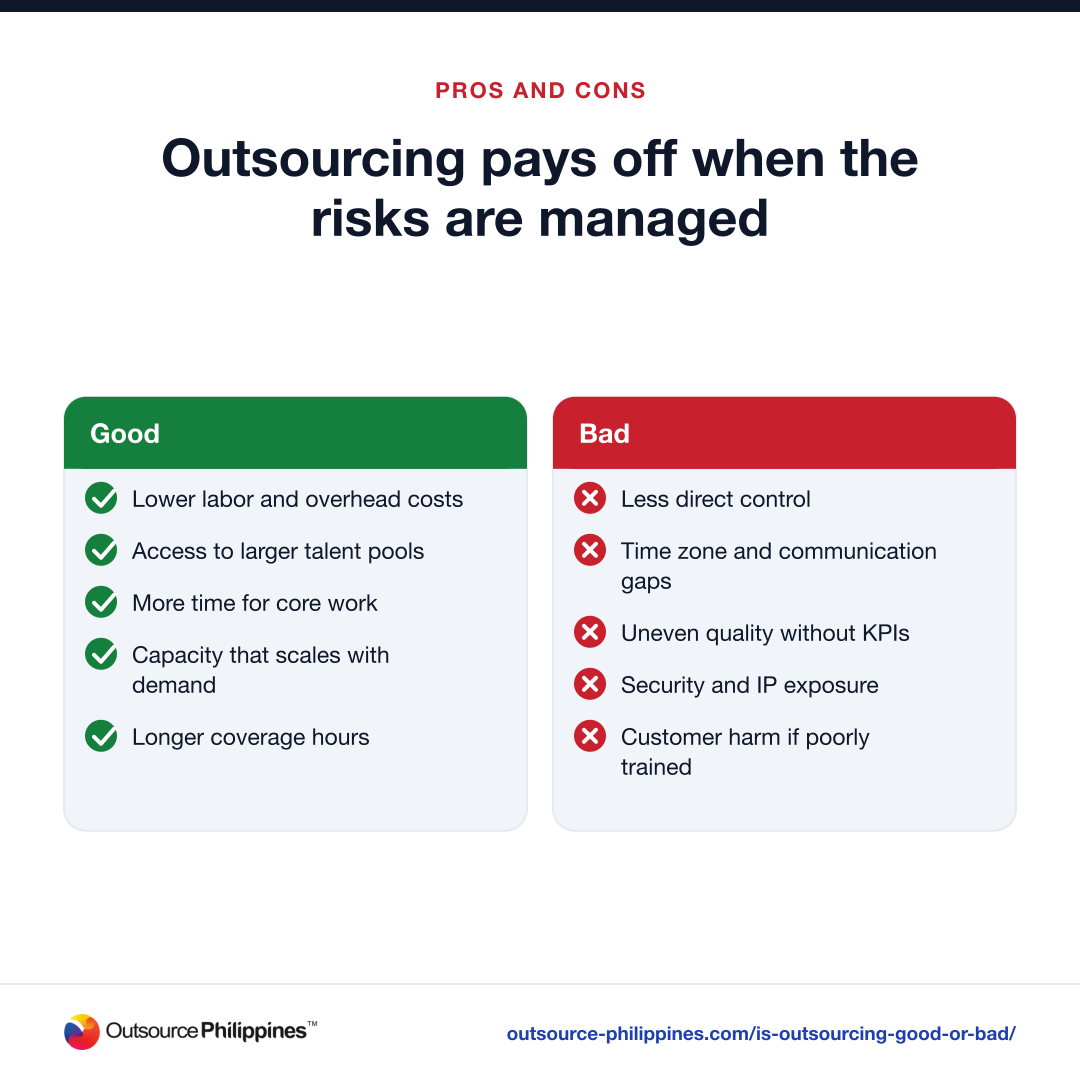
Good
- Lower labor and overhead costs
- Access to larger talent pools
- More time for core work
- Capacity that scales with demand
- Longer coverage hours
Bad
- Less direct control
- Time zone and communication gaps
- Uneven quality without KPIs
- Security and IP exposure
- Customer harm if poorly trained
Cost Efficiency
Cost is the most common reason to outsource, and the savings are bigger than salary comparisons suggest. In June 2026, benefits made up 30.0% of private employers’ compensation costs in the US, averaging $14.07 of the $46.89 total cost per hour worked, according to the US Bureau of Labor Statistics. On top of that come recruiting, training, office space, equipment, and management time.
Outsourcing replaces most of those costs with one rate. Outsource Philippines™ estimates most US clients pay 60% to 70% less than an equivalent in-house hire. Savings depend on the role, the shift, and how much management the work needs, so compare the full cost of an in-house hire, not just the wage.
Access to Global Talent
Outsourcing opens hiring markets far larger than your local one. Different countries are known for different strengths: India for large-scale IT and software work, the Philippines for English-language customer service, back-office, and administrative support, and Latin America for same-hours collaboration with the US. A provider that already recruits in those markets can staff roles you would struggle to fill locally.
Focus on Core Business Functions
When routine work moves out, managers and specialists get time back for product, sales, and strategy. This is often the benefit owners notice first: fewer hours spent on inbox triage, data entry, or scheduling, and more on the work only they can do.
Scalability and Flexibility
Outsourcing lets you add or reduce capacity without long hiring cycles or layoffs. Seasonal peaks, product launches, and new markets can be covered by expanding the outsourced team, then scaling back when volume drops. That flexibility protects margins during both growth and slowdowns.
Longer Coverage Hours
An offshore team can cover your evenings, nights, weekends, and holidays without overtime or a second in-house shift. For US companies, the Philippine workday falls during the US night, and teams there routinely work US business hours too. That makes 24/7 support or overnight back-office processing practical for companies that could never staff it locally.
Productivity through Specialized Providers
Providers run the same kind of process for many clients, so they bring tested workflows, quality assurance, reporting, and tools that would be expensive to build in-house. A well-run provider also improves the process over time, because measuring and refining it is their core business, which is one of the top benefits of outsourcing that grows the longer a team stays in place.
What Are the Disadvantages of Outsourcing?
The main disadvantages are less direct control, communication gaps, uneven quality, security and intellectual property risks, and damage to the customer experience when outsourced teams are poorly trained.
Loss of Operational Control
When work moves to a provider, you no longer manage the people doing it day to day. Extra layers between your company and the work can slow changes and make performance harder to see. This risk is highest when companies outsource core functions or hand over a process before documenting how it should run.
Communication Barriers across Time Zones
Distance and time zones can delay answers and cause misunderstandings, especially on complex or fast-moving projects. A question asked at the end of your day may not be answered until the next morning. Language and business-culture differences add to the problem when expectations are not written down clearly.
Quality Assurance Challenges
Contracts can define quality, but enforcing it from far away is harder. Without regular monitoring, problems may surface only after they have affected customers or financial records. Vague targets, high agent turnover, and weak training are the usual causes.
Security and Intellectual Property Risks
Giving a third party access to systems and data widens your attack surface. In the Verizon 2025 Data Breach Investigations Report, which analyzed 12,195 confirmed breaches, third-party involvement doubled to 30% of breaches. Intellectual property can also leak if contracts, access controls, and staff agreements are weak.
Hidden Costs
The quoted rate is rarely the whole cost. Transition time, knowledge transfer, management attention, extra quality checks, travel, and the cost of fixing errors all add up. If a provider has high staff turnover, you also pay repeatedly for retraining. Companies that compare only the hourly or monthly price with a salary often overestimate their savings.
Impact on Delivery and Customer Satisfaction
Customers judge the brand, not the provider. If outsourced agents lack product knowledge, follow rigid scripts, or are hard to understand, customer satisfaction and loyalty suffer. Poor outsourcing choices can therefore cost more in lost customers than they save in labor.
How Does Outsourcing Affect Employees, Customers, and the Economy?
Outsourcing’s effects reach beyond the company’s budget. It can unsettle existing staff, change how customers see the brand, and shift jobs and investment between countries.
Employee Morale and Job Security
Announcing an outsourcing plan often worries the existing team, even when no jobs are at risk. People fear for their roles, their career paths, and the company’s culture, and productivity can drop while uncertainty lasts. Companies that explain the plan early, show how in-house roles will change, and move staff into higher-value work handle this far better than those that announce it without context.
Practical steps that protect morale during a transition:
- Explain why the company is outsourcing and what it will not change
- Tell affected staff first, before rumors spread
- Show where in-house roles are heading, such as QA, training, or customer escalations
- Involve experienced staff in documenting processes and training the new team
Customer Perception and Brand Loyalty
Some customers react negatively to offshore support, especially after a poor experience. Others never notice, because the team uses the brand’s tone, tools, and policies. The difference is usually training, accent, and language fit, and whether agents are allowed to solve problems instead of reading scripts.
Job Displacement vs Job Creation
Outsourcing moves work from one labor market to another. In the source country, some roles are lost or change, particularly in manufacturing and routine administrative work. In recipient countries, outsourcing creates jobs, careers, and investment: the Philippines’ IT and business process management sector is a leading example, built largely on work outsourced from the US and other English-speaking markets.
Environmental and Infrastructure Effects
Manufacturing outsourcing can move pollution and emissions to countries with weaker environmental rules, and long supply chains add transport emissions. At the same time, outsourcing investment often drives better transport, power, and telecom infrastructure in recipient countries. Service outsourcing, such as customer support or bookkeeping, has a much smaller physical footprint than manufacturing.
How Do the Pros and Cons of Outsourcing Compare?
Every benefit of outsourcing comes with a matching risk. The table sets them side by side so you can see which ones matter most for your situation.
| Aspect | Benefits | Drawbacks |
|---|---|---|
| Cost | Lower labor costs; no recruiting, benefits, office, or equipment costs for outsourced roles | Vendor management, transition, and quality-control costs; savings shrink if rework is high |
| Operations | Tested processes, longer coverage hours, faster scaling | Less direct control; slower changes if communication is weak |
| Workforce | Access to larger talent pools; less administrative work | Morale and job-security concerns among existing staff |
| Customers | Shorter wait times and more channels when well staffed | Lower satisfaction if agents lack training or product knowledge |
| Security and IP | Providers with mature security controls and monitoring | Wider attack surface; third-party involvement in 30% of breaches |
| Economy | Jobs and investment in recipient countries | Job losses in some sectors of the source country; emissions from long supply chains |
The pattern is clear: the drawbacks are mostly management risks, and the benefits depend on managing them. That is why two companies can outsource the same process and reach opposite conclusions.
Which Work Should You Outsource, and Which Should Stay In-house?
Outsource work that is repeatable, documented, and measurable. Keep work in-house when it is what sets you apart from competitors, depends on undocumented judgment, or needs constant in-person collaboration.
| Usually good to outsource | Usually better in-house |
|---|---|
| Customer service queues with clear policies | Key account management and strategic partnerships |
| Bookkeeping, accounts payable, and data entry | Financial strategy and final sign-off on reporting |
| Tier 1 and tier 2 technical support | Core product engineering and roadmap decisions |
| Appointment setting and lead research | Brand strategy and senior sales relationships |
| Scheduling, inbox, and admin support | Hiring decisions and company culture |
Four questions help sort any task:
- Is it repeatable? Work that follows the same steps most days is easier to hand over.
- Is it documented? If nobody can write down how it is done, document it before outsourcing it.
- Can results be measured? Accuracy, speed, and customer ratings make quality visible from a distance.
- Is it a differentiator? If customers choose you because of how this work is done, keep tight control of it.
In-house teams offer direct control, fast communication, and deep knowledge of company culture, at a higher cost and with more administrative work. Outsourced teams offer lower cost, specialist skills, and fast scaling, with more effort needed on communication and oversight. That trade-off between control and cost sits at the center of the insourcing vs outsourcing decision, and it rarely has the same answer for every function.
How Do You Make Outsourcing Work and Reduce the Risks?
Successful outsourcing comes down to choosing the right partner, setting clear expectations, and measuring results from day one. Most failures trace back to skipping one of those steps.
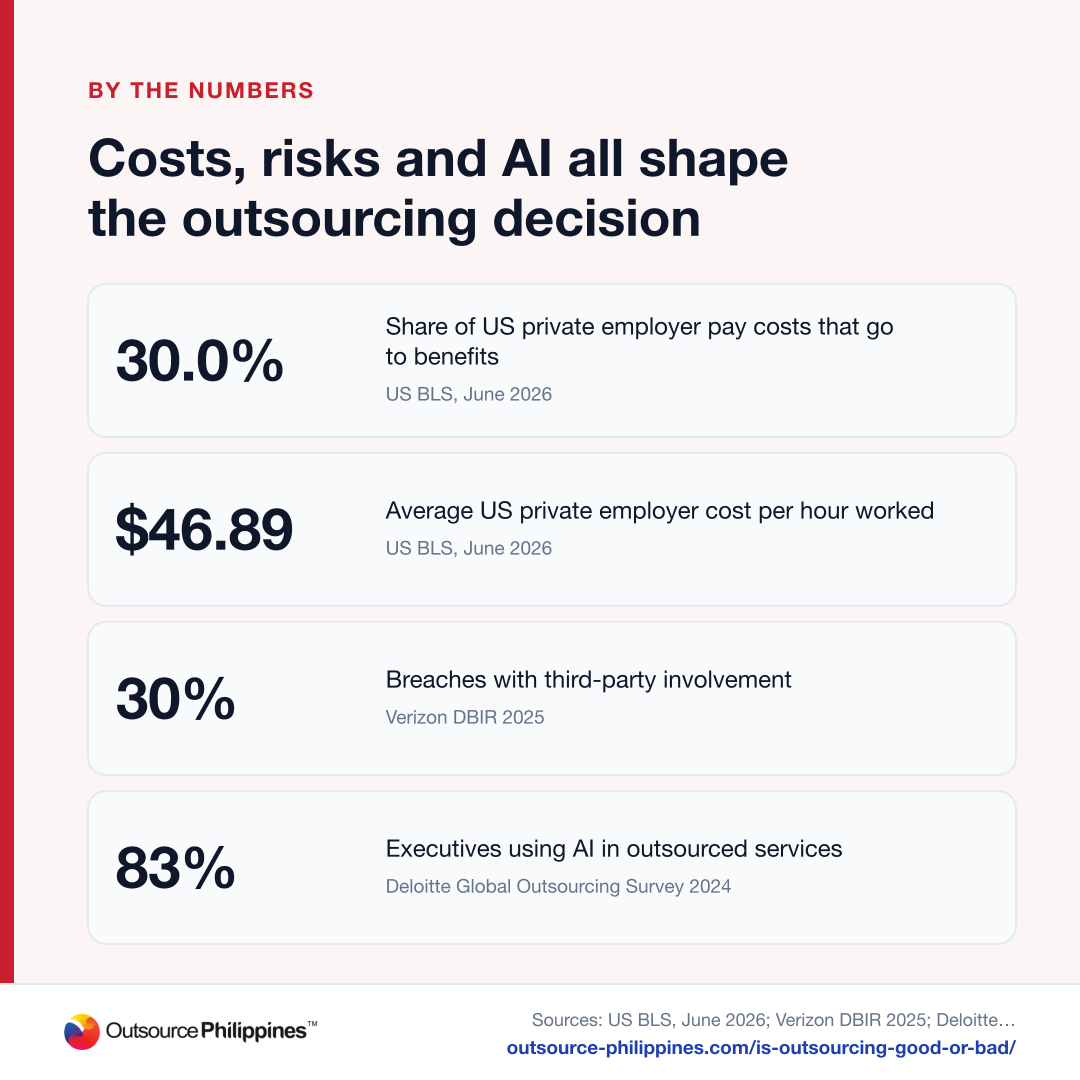
- 30.0%Share of US private employer pay costs that go to benefitsUS BLS, June 2026
- $46.89Average US private employer cost per hour workedUS BLS, June 2026
- 30%Breaches with third-party involvementVerizon DBIR 2025
- 83%Executives using AI in outsourced servicesDeloitte Global Outsourcing Survey 2024
How to Choose an Outsourcing Partner
- Relevant experience: a track record with the specific process and, ideally, your industry.
- Location and hours: a time zone setup that fits how much live collaboration you need.
- Language and cultural fit: agents who match your customers’ expectations and your brand’s tone.
- Communication: a named contact, regular reporting, and fast responses to issues.
- Security: documented access controls, monitoring, and compliance with relevant privacy law.
- Staffing model: clarity on whether people are dedicated to your account or shared.
Best Practices for Outsourcing Success
- Define the scope: write down the tasks, deliverables, hours, and volumes before you start.
- Set measurable KPIs: agree on targets such as response time, accuracy, and customer satisfaction.
- Document processes: share playbooks, policies, and examples to avoid guesswork.
- Communicate regularly: use chat, video calls, and scheduled reviews to stay aligned.
- Review and adjust: compare results with KPIs, give specific feedback, and refine the process.
How to Reduce Outsourcing Risks
- Do due diligence: check references, security practices, and financial stability.
- Write clear contracts: cover service levels, confidentiality, data handling, and exit terms.
- Limit data access: give each person only the access their role needs.
- Audit regularly: review performance, security, and compliance on a set schedule.
- Plan for disruption: keep documentation current and have backup contacts and channels.
Common Outsourcing Mistakes
- Outsourcing a broken process: if the work is unclear in-house, it will be worse at a distance.
- Choosing on price alone: the cheapest provider often has the highest turnover and weakest QA.
- Moving everything at once: a phased start with one process limits risk.
- No internal owner: someone on your side must manage the relationship and answer questions.
- Ignoring the existing team: silence breeds rumors and hurts morale.
Signs Outsourcing Is Working, and Signs It Isn’t
Working well:
- KPIs are stable or improving after the first few months
- Your managers spend less time on the outsourced work, not more
- Customers and colleagues rarely notice the work moved
- The provider suggests process improvements without being asked
Warning signs:
- Repeated errors on the same tasks
- Frequent changes of the people on your account
- Reports that arrive late or avoid bad news
- Complaints from customers or internal teams that keep rising
Security deserves the most attention because a breach can wipe out years of savings. Outsource Philippines™ complies with the Philippine Data Privacy Act of 2012 and protects client work with a managed firewall and WorQmate, its in-house project and employee monitoring platform; our security practices page describes the controls in detail.
So, Is Outsourcing Good or Bad for Your Business?
Outsourcing is likely to be good for you if the work is repeatable and measurable, you have documented processes, and you are willing to manage the relationship with clear targets and regular reviews. It is likely to be bad if you are outsourcing to escape a process nobody understands, if the work is your main competitive advantage, or if you choose a provider on price alone. Before deciding, check these five points:
- Which tasks need outside capacity and which must stay in-house
- Whether communication routines and security controls are in place first
- The full cost, including management time, quality checks, and transition
- How you will support and redeploy existing staff
- Whether offshore, nearshore, or a mix fits your collaboration needs
If you want to test the idea on one process, the case for building a team in the Philippines is strongest for English-language support and back-office work. When you are ready, request a proposal and we will outline the roles, hours, and hourly rate per agent in writing.
Frequently Asked Questions
What Are the Main Benefits of Outsourcing?
The main benefits are lower labor and overhead costs, access to larger and more specialized talent pools, more time for core business work, the ability to scale capacity up or down quickly, and productivity gains from providers who specialize in the process. Longer coverage hours, including nights and weekends, are another common benefit of offshore teams.
What Are the Disadvantages of Outsourcing?
The main disadvantages are less direct control over day-to-day work, communication delays across time zones, uneven quality if targets are vague, security and intellectual property risks from third-party access, and harm to customer satisfaction when outsourced staff are poorly trained. Most of these risks can be reduced with clear contracts, KPIs, and regular reviews.
How Does Outsourcing Affect Employees?
Outsourcing can lower morale among existing staff, who may worry about job security, career growth, and company culture. The effect is strongest when plans are announced without explanation. Companies that communicate early, show how in-house roles will change, and move people into higher-value work usually keep trust and productivity steadier through the transition.
Is Outsourcing Good or Bad for the Economy?
It is both. Outsourcing can reduce jobs in some sectors of the source country, particularly manufacturing and routine administrative work, while creating jobs, skills, and investment in recipient countries. Consumers and businesses can benefit from lower costs. The overall effect depends on the industry, the countries involved, and how displaced workers are supported.
How Can a Business Make Outsourcing Successful?
Start with one well-documented process, choose a provider with relevant experience and strong security, and agree on clear KPIs before launch. Communicate regularly, review results against targets, give specific feedback, and keep documentation current. Calculate the full cost, including management time, and support existing staff through the change.