Virtual CFO Services: What They Do and Why Growing Businesses Use Them

On This Page
- What Are Virtual CFO Services?
- Why Are More Businesses Choosing a Virtual CFO?
- What Does a Virtual CFO Do?
- How Is a Virtual CFO Different from a Bookkeeper or Accountant?
- What Are the Advantages of Working with a Virtual CFO?
- When Should You Hire a Virtual CFO?
- What Should You Look for in a Virtual CFO Provider?
- Is a Virtual CFO Right for Your Business?
- Frequently Asked Questions
Virtual CFO services give a business senior financial leadership on a part-time, retainer, or project basis, delivered remotely. A virtual CFO handles strategy rather than record-keeping: budgeting, forecasting, cash flow planning, KPIs, fundraising support, and risk management. Growing companies use one when they need CFO-level judgment but cannot justify a full-time executive salary.
Many small and mid-sized businesses reach a point where basic bookkeeping is no longer enough, but a full-time chief financial officer is still out of reach. This guide explains what a virtual CFO does, why more companies are choosing the model, how it differs from a bookkeeper or accountant, when to hire one and what to look for in a provider.
What Are Virtual CFO Services?
A virtual CFO is an experienced financial leader who provides high-level strategy, planning, and analysis without being on site or on your permanent payroll. They are not an outsourced accountant or a remote number cruncher; they help you decide where the business is going and how its finances will get it there.
Instead of committing to the expense of a full-time executive, companies work with a virtual CFO in one of three ways:
- Part-time: a set number of hours or days each month for ongoing leadership.
- Retainer: a fixed monthly scope, such as monthly reporting, a board pack, and a forecast update.
- Project: a defined engagement, such as a fundraising round, an audit, or a new market launch.
Using cloud accounting software and secure data-sharing tools, a virtual CFO works with your team remotely on forecasting, cash flow management, risk assessment, and investor relations. In short, you get the leadership and vision of a CFO in a format that fits your company’s size and budget. Startups, small and mid-sized businesses, and scaling companies use the model most.
Why Are More Businesses Choosing a Virtual CFO?
The main reason is cost: a virtual CFO gives you senior expertise for a fraction of a full-time salary. Flexibility, objectivity, and better decisions follow close behind.
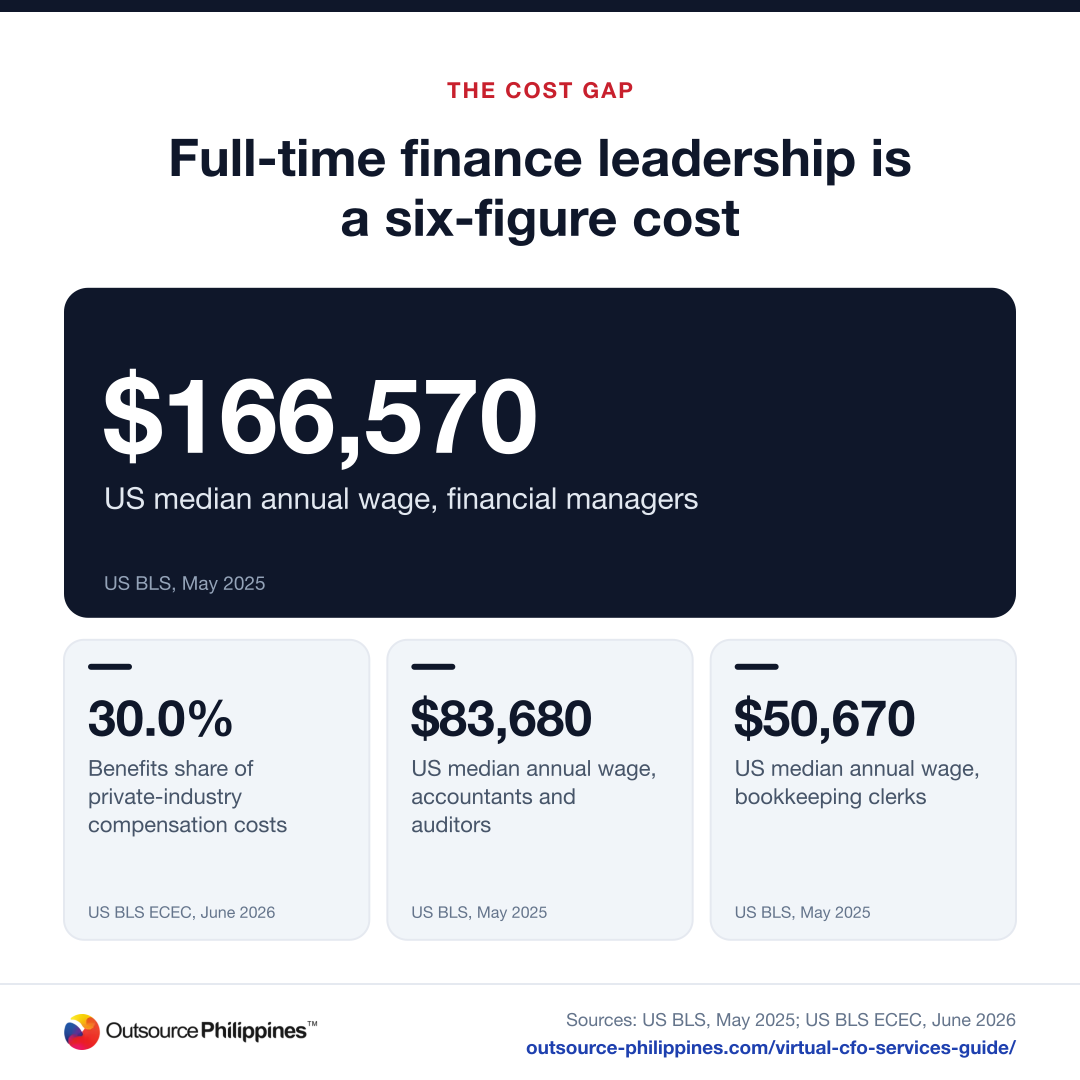
- $166,570US median annual wage, financial managersUS BLS, May 2025
- 30.0%Benefits share of private-industry compensation costsUS BLS ECEC, June 2026
- $83,680US median annual wage, accountants and auditorsUS BLS, May 2025
- $50,670US median annual wage, bookkeeping clerksUS BLS, May 2025
You Get Senior Expertise without the Full-time Salary
The US Bureau of Labor Statistics puts the median annual wage for financial managers, the occupation that includes CFOs and controllers, at $166,570 (May 2025). Benefits add more: they made up 30.0% of private-industry compensation costs in June 2026, according to the BLS Employer Costs for Employee Compensation release. A virtual CFO lets you pay only for the hours you use.
Support Scales as Your Business Grows
You might need a few hours a month in a quiet year and much more during a fundraising round or an acquisition. Virtual CFO support scales up or down with those needs, so you pay for what each stage requires.
An Outside Perspective Is an Asset
Because a virtual CFO is not caught up in your company’s daily habits or internal politics, they often spot inefficiencies, cash leaks, and missed opportunities that an internal team overlooks.
You Get Access to Broader Talent and Tools
Many virtual CFOs work within consulting firms or networks. Hiring one can give you access to controllers, tax advisors, and analysts as well, along with the financial platforms they already use.
Leaders Can Focus on Strategic Priorities
With financial oversight handled, owners and leadership teams get time back for operations, customers, product development, and long-term planning instead of spreadsheets and compliance tasks.
Decisions Get Faster and Better Informed
Accurate reporting, current dashboards, and expert analysis mean decisions rest on data, not assumptions. The result is better resource allocation and fewer financial surprises.
What Does a Virtual CFO Do?
Traditional accounting records what already happened; a virtual CFO focuses on what happens next. Their work usually covers five areas.
Strategic Financial Planning
- Multi-year budgets aligned with growth goals.
- Revenue and expense forecasts under different scenarios.
- Financial roadmaps for market expansion or product development.
- Pricing and margin reviews to protect profitability.
Cash Flow Oversight
Cash shortfalls sink otherwise healthy small businesses. A virtual CFO watches your cash position for the weeks and months ahead, builds rolling forecasts and contingency plans, and advises on credit lines or financing so you are not caught off guard.
Performance Monitoring through Data
A virtual CFO sets KPIs that fit your business model and builds dashboards to track them, such as:
- Gross margin trends.
- Customer acquisition cost.
- Inventory turnover.
- Cash conversion cycle.
- Budget vs actual comparisons.
Financial Leadership during Fundraising
- Financial models and investor-ready forecasts.
- Organized documentation for due diligence.
- Support in investor meetings and answers to complex questions.
- Input on valuation and deal terms.
Compliance, Controls, and Risk Management
- Financial operations that follow tax rules and industry standards.
- Internal controls that reduce fraud and human error.
- Early action on risks such as currency exposure, too much debt, or supplier instability.
How Is a Virtual CFO Different from a Bookkeeper or Accountant?
A bookkeeper records transactions, an accountant turns them into statements and tax filings, and a virtual CFO uses both to set direction. Each layer depends on the one below it.
| Role | Focus area | Level of strategy | US median annual wage (May 2025) |
|---|---|---|---|
| Bookkeeper | Records daily financial transactions | Low | $50,670 |
| Accountant | Prepares financial statements and tax filings | Medium | $83,680 |
| Virtual CFO | Long-term strategy, forecasting, and oversight | High | Benchmark: $166,570 for financial managers |
Wages come from the BLS pages for bookkeeping clerks and accountants and auditors. Understanding the difference between bookkeeping and accounting helps you see which layer you are missing. Bookkeepers and accountants are essential, but a virtual CFO adds the forward-looking leadership that ties their work to your plans.
What Are the Advantages of Working with a Virtual CFO?
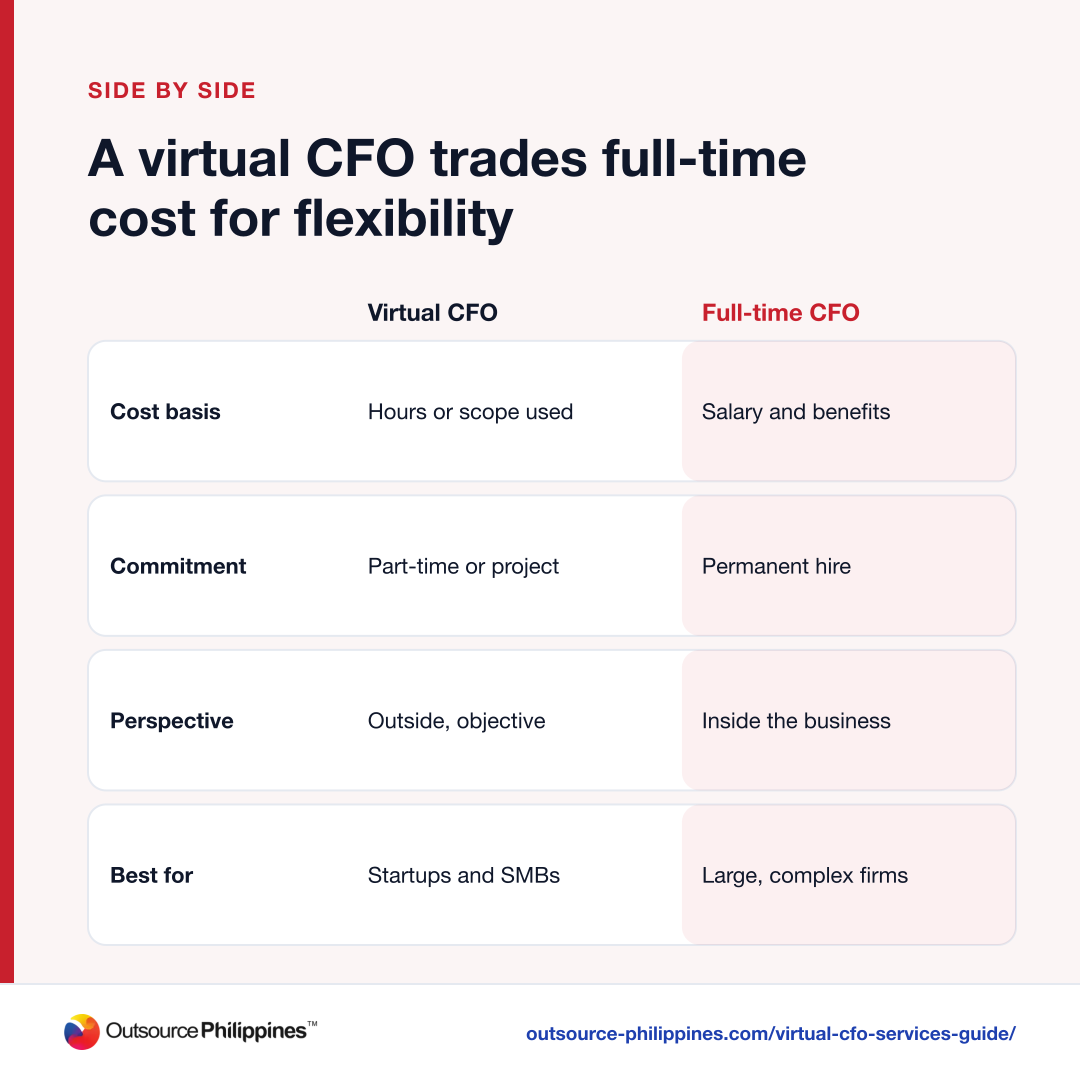
Beyond cost, a virtual CFO changes how well you understand and manage the business. Four advantages stand out:
| Factor | Virtual CFO | Full-time CFO |
|---|---|---|
| Cost basis | Hours or scope used | Salary and benefits |
| Commitment | Part-time or project | Permanent hire |
| Perspective | Outside, objective | Inside the business |
| Best for | Startups and SMBs | Large, complex firms |
- Greater visibility: systems and reports that show where you stand today and where you are heading.
- More time for growth: less time on spreadsheets and payroll worries, more on product, customers, and innovation.
- Better financial outcomes: lower overhead, sharper pricing, and stronger long-term planning.
- Stronger stakeholder confidence: lenders, investors, and partners trust projections backed by professional financial leadership.
When Should You Hire a Virtual CFO?
Not every company needs one from day one. Consider a virtual CFO when one or more of these is true:
- You are growing fast and need financial infrastructure to keep up.
- Your monthly reports are inconsistent, late, or hard to interpret.
- You plan to raise outside funding.
- Cash flow has become unpredictable.
- You are expanding into new regions or product lines.
- You want financial insight to guide decisions, not just compliance.
Even if you already have a bookkeeper or accountant, a virtual CFO adds the strategic layer on top. Many businesses also bring one in temporarily for an audit, a merger, or a product launch, then step back to a lighter retainer.
What Should You Look for in a Virtual CFO Provider?
Look for relevant industry experience, clear communication, fluency with your tools, and engagement terms that can change as you grow. Use these points when choosing an outsourcing partner for finance.
Relevant Industry Experience
A SaaS business needs someone who understands subscription revenue, churn, and deferred revenue. Industry experience changes the quality of the advice you receive.
Strong Communication Skills
Financial insight is useless if no one understands it. Look for a CFO who explains numbers in plain language and ties them to business decisions.
Technological Proficiency
Virtual CFOs often work in QuickBooks, Xero, NetSuite, and forecasting tools. They should work inside your systems or recommend better ones when needed.
Flexible Engagement Options
Whether you need month-end oversight or day-to-day involvement, the engagement should fit your current needs and adjust as you grow.
Is a Virtual CFO Right for Your Business?
A virtual CFO is a strong fit if you are growing, raising capital, or struggling to read your own numbers, and a full-time CFO is not yet justified. It is a weaker fit if your books are not yet accurate and current, because strategy built on unreliable data is guesswork. Fix the foundation first.
Outsource Philippines™ provides dedicated, English-language finance and bookkeeping staff who handle reconciliations and monthly reporting, so a virtual CFO works from clean, timely numbers.
Frequently Asked Questions
Can a Virtual CFO Work Alongside Our Current Accountant or Bookkeeper?
Yes. A virtual CFO usually works with your in-house or outsourced accountant and bookkeeper. The bookkeeping team handles daily tasks such as data entry, reconciliations, and payroll records, while the virtual CFO uses that information for strategic planning, forecasting, and financial analysis. Clean, timely books make the CFO’s advice faster and more reliable.
Are Virtual CFO Services Suitable for Short-term or Project-based Needs?
Yes. Many businesses hire a virtual CFO for a specific project, such as preparing for an audit, launching a new product line, raising capital, or navigating a merger. A project engagement gives you senior financial leadership for a defined period without a long-term commitment, and it can move to a lighter retainer once the project ends.
What Should I Expect during Onboarding with a Virtual CFO?
During onboarding, a virtual CFO reviews your financial systems, reporting tools, and recent statements, learns your business goals, and identifies the most urgent gaps. They then set out a roadmap for improving financial visibility, such as new KPIs, a rolling cash forecast, and a monthly reporting schedule, and agree on how often you will meet.
How Do Virtual CFOs Handle Confidentiality and Data Security?
Reputable virtual CFOs use encrypted communication tools and secure cloud platforms with role-based access to protect financial data. Most sign confidentiality agreements and follow written data-handling policies. Before you share access, ask how they store files, who else can see your data and what happens to it when the engagement ends.
Will a Virtual CFO Help with External Audits or Investor Presentations?
Yes. Many virtual CFOs prepare audit-ready financial statements and investor-grade reports. They gather supporting documents, refine financial models and forecasts, and help leadership present results clearly to auditors, lenders, or potential investors. Their experience with these conversations often makes the process faster and strengthens the company’s credibility.