Outsourcing to the Philippines from Australia: A Practical Guide

On This Page
- Why Do Australian Businesses Outsource to the Philippines?
- How Much Do Australian and Manila Working Hours Overlap?
- Which Australian Laws Still Apply When You Offshore Work?
- Which Roles Do Australian Businesses Outsource to the Philippines?
- Should You Choose a Dedicated or Shared Team?
- How Do You Outsource to the Philippines from Australia?
- When Is Outsourcing to the Philippines Not the Right Fit?
- Frequently Asked Questions
Outsourcing to the Philippines from Australia works well because Manila sits only zero to three hours behind Australian business hours, so a Philippine day shift covers your working day without night work. You keep your Australian obligations, mainly the Privacy Act 1988 and APP 8 on cross-border disclosure, and you set them in a written contract with your provider.
This guide covers working-hour overlap, the Australian rules that still apply offshore, the roles that fit, dedicated versus shared staffing, and a setup checklist.
Key takeaways
- Manila is on UTC+8 all year. It matches Perth and sits two hours behind Sydney in winter and three hours behind in summer.
- If the Privacy Act covers your business, APP 8 makes you take reasonable steps before you send personal information overseas, and you stay accountable for how your provider handles it.
- The Office of the Australian Information Commissioner (OAIC) expects an enforceable contract with an overseas provider in most cases.
- If offshoring replaces Australian roles, the consultation rules in your award or enterprise agreement apply before anyone is made redundant.
Why Do Australian Businesses Outsource to the Philippines?
Australian businesses outsource to the Philippines for three practical reasons: the working day overlaps with theirs, business English is strong, and the country has a large workforce already trained in customer service, finance, and admin work for foreign clients. Cost matters too, but the overlap is what separates the Philippines from destinations further west.
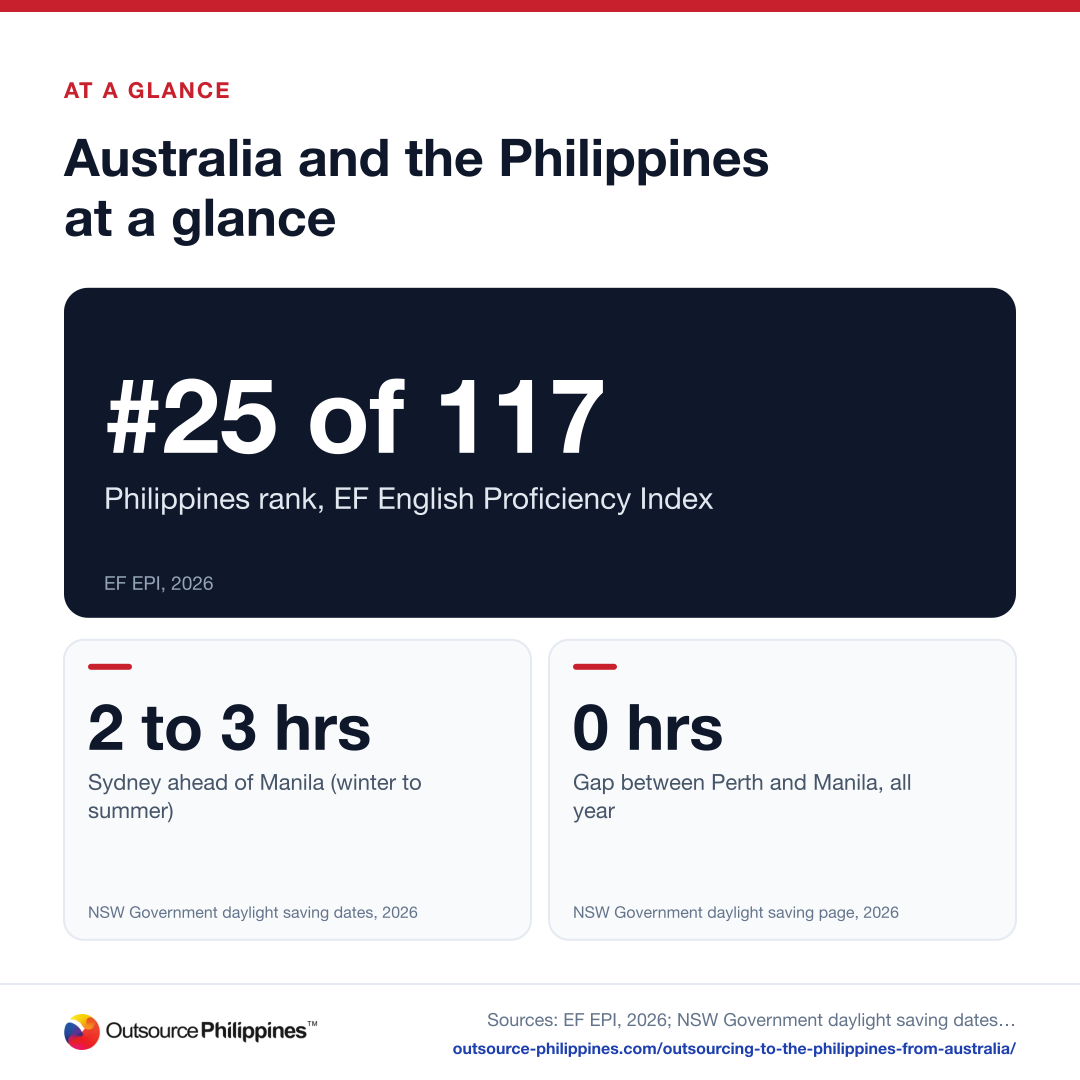
English is the first test for any customer-facing role. The Philippines ranked 25th of 117 countries in the EF English Proficiency Index 2026, placing it in the "high proficiency" band and second in Asia. That matters when your staff answer calls from customers in Brisbane or reply to supplier emails in Melbourne.
- #25 of 117Philippines rank, EF English Proficiency IndexEF EPI, 2026
- 2 to 3 hrsSydney ahead of Manila (winter to summer)NSW Government daylight saving dates, 2026
- 0 hrsGap between Perth and Manila, all yearNSW Government daylight saving page, 2026
Workforce size and country comparisons add to the case for outsourcing to the Philippines, but for Australian buyers the deciding points are shared hours, shared language, and an industry that already serves foreign clients.
How Much Do Australian and Manila Working Hours Overlap?
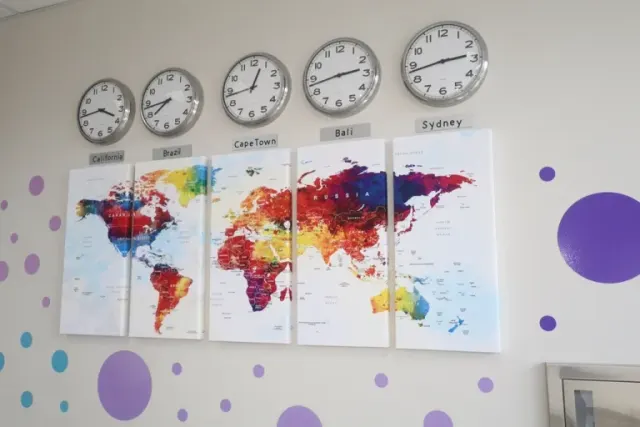
Australian and Manila working hours overlap almost completely. A Philippine team working a normal day shift, starting between 6 a.m. and 9 a.m. Manila time, covers a 9 a.m. start anywhere in Australia, so your staff are online when you are.
The Philippines uses UTC+8 all year and does not observe daylight saving time. On the Australian side, the NSW Government confirms that daylight saving runs from October 4, 2026 to April 4, 2027 in New South Wales, Victoria, South Australia, Tasmania, and the ACT, while Queensland, Western Australia, and the Northern Territory do not change their clocks.
| City | Ahead of Manila (standard time) | Ahead of Manila (daylight saving) | 9 a.m. local is, in Manila |
|---|---|---|---|
| Sydney, Melbourne, Canberra, Hobart | 2 hours | 3 hours | 7 a.m. or 6 a.m. |
| Brisbane | 2 hours | No daylight saving | 7 a.m. |
| Adelaide | 1.5 hours | 2.5 hours | 7:30 a.m. or 6:30 a.m. |
| Darwin | 1.5 hours | No daylight saving | 7:30 a.m. |
| Perth | None | No daylight saving | 9 a.m. |
Two things follow from this. First, Australian clients rarely need a night shift, which is the norm for US accounts, so staff work daytime hours. Second, the October and April clock changes move the Manila start time by one hour for clients in the southeastern states. Put both daylight saving clock changes in a shared calendar so shift times move with them. If you also serve customers outside business hours, a second shift in Manila can extend coverage, one of the advantages of time zones that suit evening and weekend support.
Which Australian Laws Still Apply When You Offshore Work?
Your Australian obligations do not stop at the border. The two that come up most are the Privacy Act 1988, especially Australian Privacy Principle 8 (APP 8) on sending personal information overseas, and the Fair Work consultation rules if offshoring changes or removes existing Australian jobs. This is general information, not legal advice, so confirm your position with your adviser.
The Privacy Act 1988 and APP 8
The Privacy Act 1988 covers most businesses with annual turnover above A$3 million. The OAIC's small business guidance adds that some smaller businesses are covered regardless of turnover, including health service providers, businesses that trade in personal information, and contractors working under a Commonwealth contract.
If you are covered, APP 8 applies when your offshore team can see customer, patient, or employee records. The OAIC's APP 8 guidelines (updated October 2025) set out four points that shape any offshore arrangement:
- Giving an overseas contractor personal information is, in most cases, a disclosure. You must take reasonable steps before the disclosure to make sure the recipient does not breach the APPs.
- You stay accountable. Under section 16C, an act by the overseas recipient that would breach the APPs is treated as your breach.
- A contract is the expected baseline. The OAIC generally expects an enforceable contract that names the types of information and the purpose, requires APP compliance (including by any subcontractors), sets a complaint process, and requires a data breach response plan that tells you about a suspected breach.
- Sensitive information needs more. Health information and similar records call for stricter steps, such as audits of how the provider handles data.
A breach at your provider still falls under the OAIC's Notifiable Data Breaches scheme for you: if a breach is likely to result in serious harm, you must notify the affected individuals and the OAIC. That is why the breach-notice clause in your contract needs a short, fixed deadline. A non-disclosure agreement with the provider covers your confidential business information, but it does not replace the APP 8 terms.
On the Philippine side, providers are bound by the Philippine Data Privacy Act of 2012 (RA 10173). That helps, but it does not remove your APP 8 duty.
Fair Work Rules When Roles Move Offshore
If offshoring means an existing Australian role is no longer needed, redundancy rules apply. The Fair Work Ombudsman's redundancy guidance lists relocating overseas as one reason a redundancy can happen, and says a redundancy is genuine only if the employer followed the consultation requirements in the relevant award or enterprise agreement.
Once you decide on a major change, you must notify affected employees as soon as possible, give them the relevant information in writing, and discuss the change and its effects. One way to avoid this is to offshore new or growth work rather than replace current staff.
Which Roles Do Australian Businesses Outsource to the Philippines?
The roles that move offshore most easily are those done on a screen, measured by output, and guided by written procedures. Customer service, bookkeeping, admin support, data entry, and digital marketing are good starting points.
| Role | Typical tasks | Needs live overlap with you |
|---|---|---|
| Customer service agent | Phone, email, and chat support, Tier 1 to Tier 3 | Yes |
| Bookkeeper or AP clerk | Bank reconciliations, supplier invoices, payroll preparation | Partly |
| Virtual assistant | Inbox, calendar, CRM updates, quotes, and documents | Yes |
| Data entry specialist | Order entry, catalog updates, record cleanup | No |
| Digital marketing specialist | SEO, paid search, social media, and content scheduling | Partly |
A common first hire is a dedicated virtual assistant or a bookkeeper, with more roles added once processes are written down. For finance, data entry, and other back-office outsourcing work, decide early which tasks need sign-off from someone in Australia, such as releasing supplier payments.
Should You Choose a Dedicated or Shared Team?
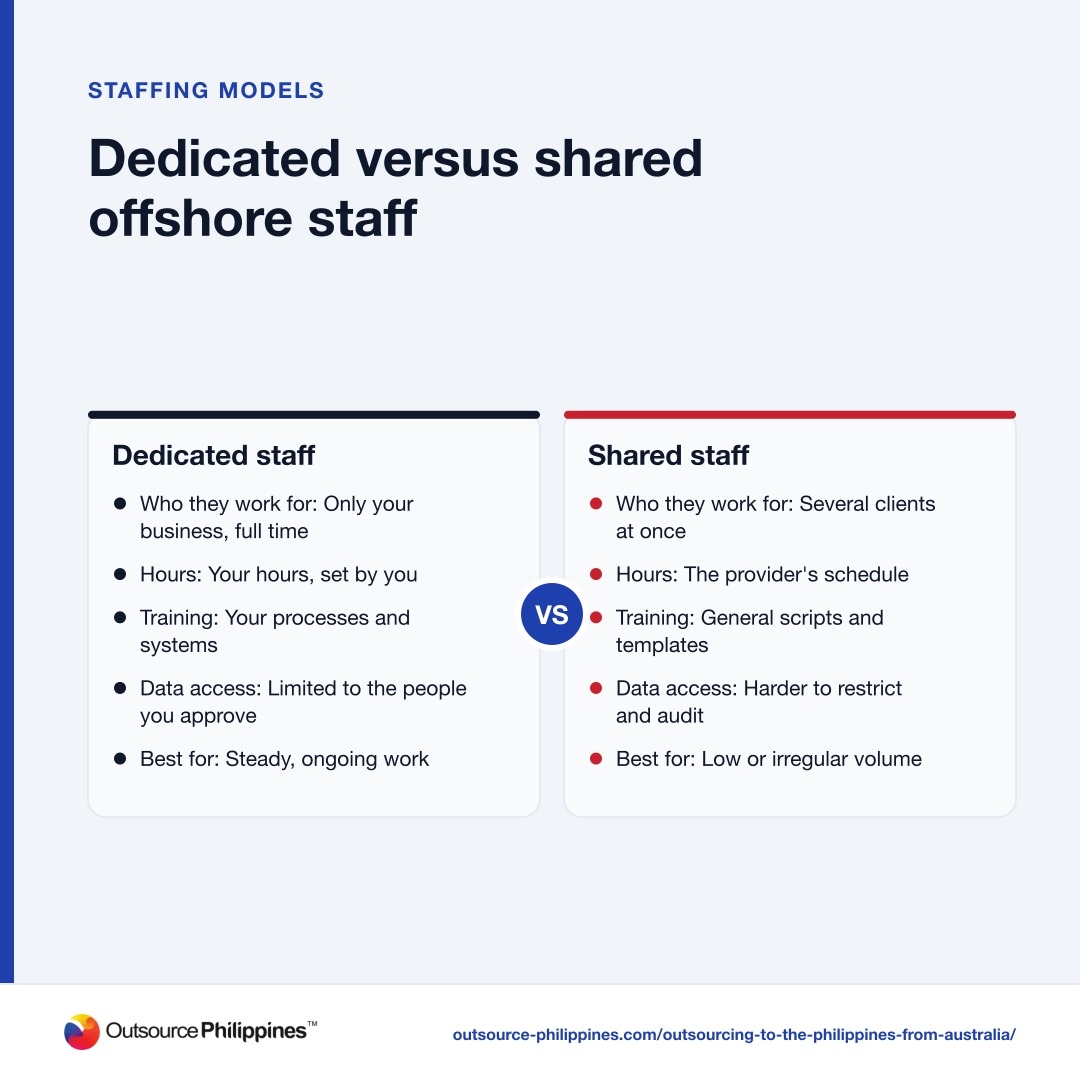
Choose a dedicated team when the work is ongoing, needs knowledge of your business, or touches personal information you must control under APP 8. A shared team, where agents split their time across several clients, suits low or irregular volume, such as after-hours overflow.
Dedicated staff
- Who they work for
- Only your business, full time
- Hours
- Your hours, set by you
- Training
- Your processes and systems
- Data access
- Limited to the people you approve
- Best for
- Steady, ongoing work
Shared staff
- Who they work for
- Several clients at once
- Hours
- The provider's schedule
- Training
- General scripts and templates
- Data access
- Harder to restrict and audit
- Best for
- Low or irregular volume
Dedicated staff also make APP 8 easier to manage: you know who can see your records and can audit their access. The trade-off is that you commit to a full-time role, so the workload has to justify it, and you still manage the person day to day, as with any offshore staffing arrangement.
How Do You Outsource to the Philippines from Australia?
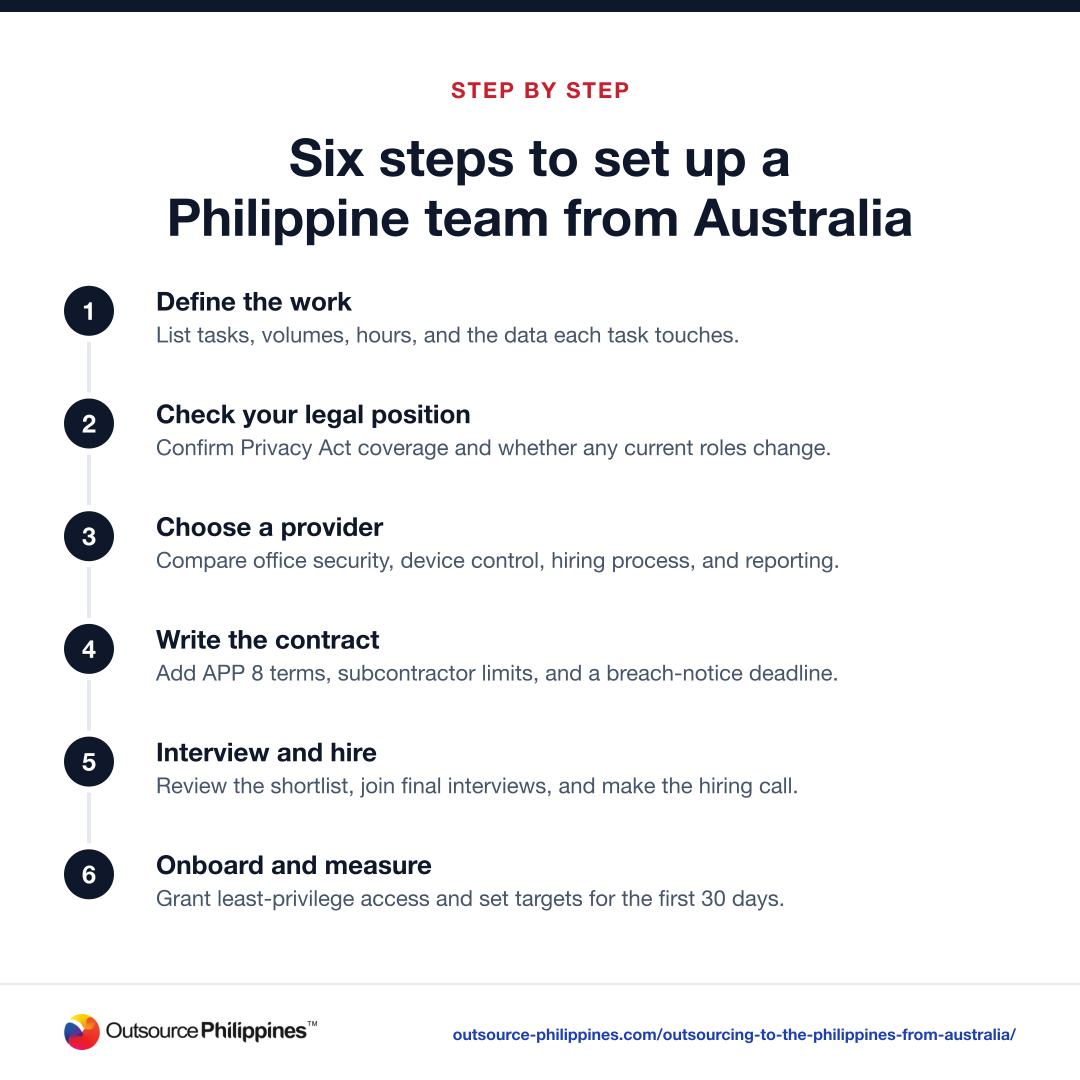
Most Australian businesses follow the same six steps: define the work, check your legal position, choose a provider, write the contract, hire, and onboard. With a provider that already has an office and recruiters, most teams go live in two to four weeks, depending on the role.
- 1Define the work
List tasks, volumes, hours, and the data each task touches.
- 2Check your legal position
Confirm Privacy Act coverage and whether any current roles change.
- 3Choose a provider
Compare office security, device control, hiring process, and reporting.
- 4Write the contract
Add APP 8 terms, subcontractor limits, and a breach-notice deadline.
- 5Interview and hire
Review the shortlist, join final interviews, and make the hiring call.
- 6Onboard and measure
Grant least-privilege access and set targets for the first 30 days.
Use this checklist before the first staff member starts:
- Map tasks to data. For each task, note whether it touches personal information and whether that information is sensitive, such as health or financial records.
- Confirm coverage. Check whether the Privacy Act covers your business, and get advice if any current employee's role will change.
- Ask about the workplace. Find out whether staff work from a supervised office on company-managed devices, or from home on personal laptops. The answer changes how much control you have under APP 8.
- Write APP 8 into the contract. Cover the information types and purpose, APP compliance, subcontractor rules, complaint handling, and a breach-notice deadline.
- Run the hiring yourself at the final stage. At Outsource Philippines™, we source, test, and shortlist candidates; final interviews include your team and ours, and you make the final hiring decision.
- Set access and targets. Give each person only the system access their tasks need, and agree on output, quality, and response-time targets for the first month.
When Is Outsourcing to the Philippines Not the Right Fit?
Outsourcing to the Philippines is the wrong choice when the work needs someone physically in Australia, when volume is too low or irregular for a full-time role, or when the task falls outside what offshore staff can do. Be clear about these limits before you sign.
- On-site work. Reception, site visits, deliveries, and anything that needs hands on equipment in Australia.
- Small or irregular workloads. A few hours a week rarely justify a dedicated hire; a shared service or part-time local help may fit better.
- Clinical or licensed work. Offshore healthcare staff handle non-clinical admin only, such as scheduling and billing, never medical advice or clinical decisions.
- Debt collection. Our accounting teams do not handle accounts receivable collections.
- Languages other than English. Our support work is in English only.
- Directing staff entirely yourself. If you want to manage staff directly while a local company acts as their legal employer, an employer of record in the Philippines is the closer match.
Outsource Philippines™ runs dedicated customer service teams from a supervised office in San Pedro City, Laguna, where each staff member works full time on one client's account on company-managed devices, and client data is handled under the Philippine Data Privacy Act of 2012.
Frequently Asked Questions
Is It Legal for an Australian Business to Outsource Work to the Philippines?
Yes. No Australian law stops a business from outsourcing work to the Philippines. If the Privacy Act 1988 covers you, APP 8 requires reasonable steps before you disclose personal information to an overseas provider, usually through an enforceable contract, and you remain accountable for the provider's handling. If current roles are affected, your award or agreement's consultation rules apply.
Why Do Australian Companies Outsource to the Philippines Instead of India?
The main reasons are time zone and English. Manila is zero to three hours behind Australian cities, so staff work normal daytime hours that match yours, while India is further behind the eastern states. The Philippines also ranked 25th of 117 countries in the EF English Proficiency Index 2026, in the high proficiency band, which suits customer-facing roles.
What Is the Time Difference Between Sydney and Manila?
Sydney is two hours ahead of Manila during Australian standard time and three hours ahead during daylight saving, which runs from October 4, 2026 to April 4, 2027 in New South Wales. Manila stays on UTC+8 all year. A 9 a.m. start in Sydney is 7 a.m. in Manila in winter and 6 a.m. in summer.
Does APP 8 Apply If My Offshore Staff Only View Data in My Systems?
Usually, yes. The OAIC says giving an overseas contractor personal information is a disclosure in most cases, and its examples include giving an overseas party access to a customer database. Only limited arrangements where you keep effective control under a binding contract count as a use instead. Plan for APP 8 from the start and get advice on your setup.
How Long Does It Take to Set Up a Team in the Philippines?
With a provider that already has an office, recruiters, and IT in place, most teams go live in two to four weeks, depending on the role. Specialist roles such as experienced bookkeepers can take longer to source than general admin roles. Allow extra time for your own steps, such as legal review of the contract and setting up system access.