Outsourcing Property Management Services: Tasks and Benefits

On This Page
- What Is Outsourced Property Management?
- Which Property Management Tasks Can You Outsource?
- What Technology Does an Outsourced Property Management Team Use?
- What Are the Benefits of Outsourcing Property Management Services?
- How Do You Choose the Right Outsourcing Partner?
- What Should You Consider Before Outsourcing Property Management?
- How Does Outsourcing Improve Tenant Satisfaction?
- Is Outsourcing Property Management Right for Your Business?
- Frequently Asked Questions
Outsourcing property management services means handing routine property work, such as rent collection, maintenance coordination, tenant communication, listings, and bookkeeping, to an outside team. Property owners and management firms use it to cut overhead, answer tenants faster, and free their own managers for leasing, owner relations, and growth.
Property management runs on a long list of repeatable tasks: posting payments, logging work orders, chasing renewals, updating listings, and answering the same tenant questions every day. This guide covers what outsourced property management is, which tasks you can hand off, the technology that makes it work, the benefits and trade-offs, how to choose a partner, and what to settle before you sign.
What Is Outsourced Property Management?
Outsourced property management is the practice of delegating property tasks to a specialized third-party team instead of doing all of them in-house. You keep ownership of decisions, while the outside team handles the volume.
Some owners outsource the whole job to a full-service local manager. Many small and mid-size firms take a hybrid route: their local staff keep the work that needs a person on site, such as showings, inspections, and vendor walk-throughs, while a remote team handles the administrative and tenant-facing work that can be done from anywhere.
That second model is where offshore teams fit. A remote team can run the back office and the phones for your portfolio during your business hours, working inside your property management software and following your policies. The local manager spends less time at a desk and more time with owners, tenants, and properties.
Which Property Management Tasks Can You Outsource?
Most tasks that follow a documented process and live inside your software can be outsourced. Rent collection, maintenance coordination, and marketing are the three most common starting points.
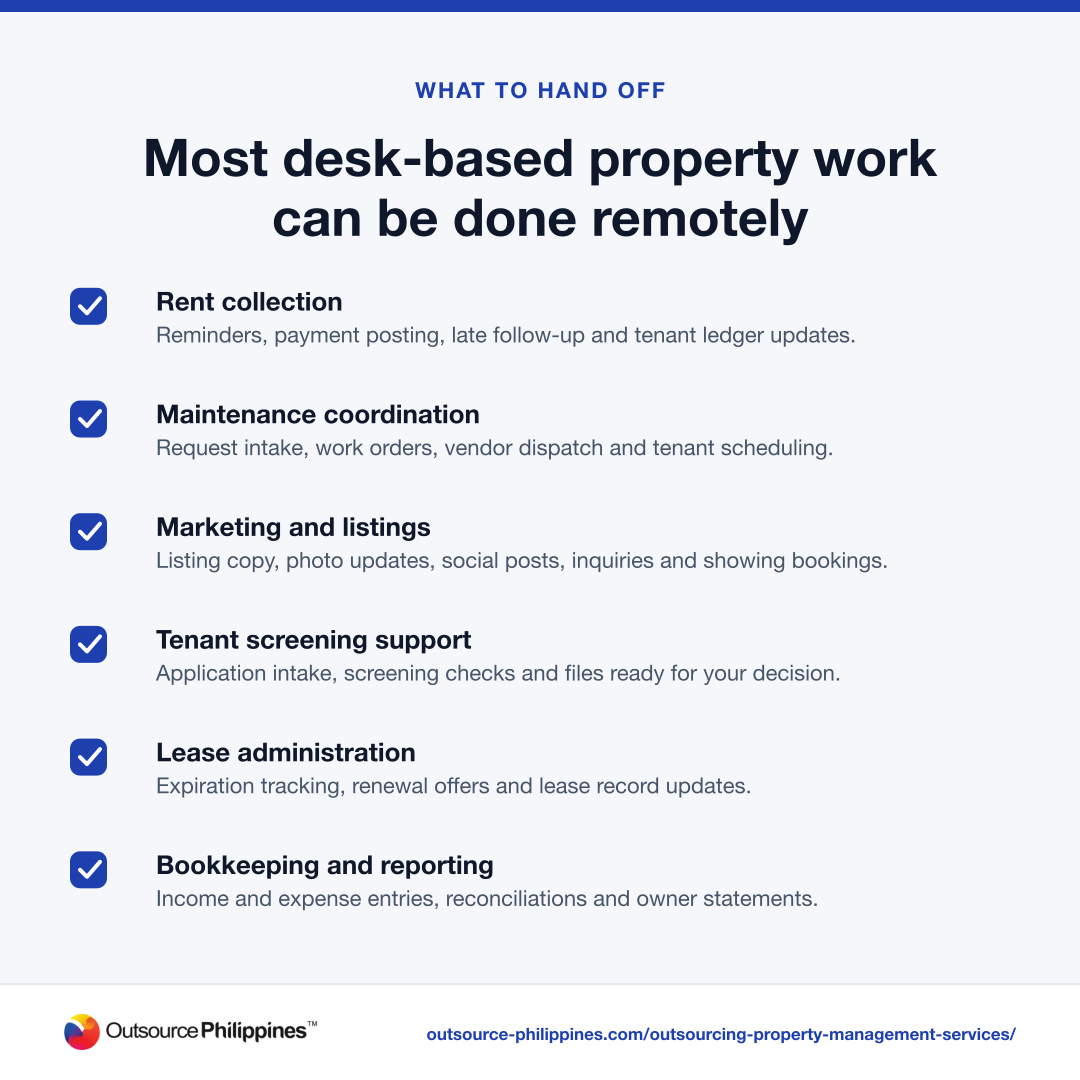
- Rent collection
Reminders, payment posting, late follow-up and tenant ledger updates.
- Maintenance coordination
Request intake, work orders, vendor dispatch and tenant scheduling.
- Marketing and listings
Listing copy, photo updates, social posts, inquiries and showing bookings.
- Tenant screening support
Application intake, screening checks and files ready for your decision.
- Lease administration
Expiration tracking, renewal offers and lease record updates.
- Bookkeeping and reporting
Income and expense entries, reconciliations and owner statements.
Rent Collection
An outsourced team sends rent reminders, posts payments, follows up on late accounts, and keeps tenant ledgers current. Most firms already collect rent through online portals and ACH transfers, so the work is mostly monitoring, reconciling, and contacting tenants who fall behind. Your team keeps decisions on late fees, payment plans, and legal notices.
Property Maintenance
Maintenance outsourcing usually means coordination, not the repairs themselves. The remote team takes requests by phone, email, or portal, creates work orders, dispatches your preferred vendors, confirms appointments with tenants, and closes the ticket once the job is done. Prompt replies on repairs protect the property and are one of the clearest drivers of tenant renewals.
Marketing and Advertising
Filling vacancies quickly depends on good listings and fast follow-up. An outside team can write and post listings, refresh photos and descriptions, manage social media, answer inquiries, and book showings for your leasing agents. Creative and digital marketing specialists can also run targeted campaigns aimed at the renters each property suits best.
Other Common Tasks
- Tenant screening support: collecting applications, running checks through your screening tool, and preparing files for your decision.
- Lease administration: tracking expirations, sending renewal offers, and updating lease records.
- Bookkeeping and owner reporting: recording income and expenses, reconciling accounts, and preparing monthly owner statements, the core of property management accounting.
- Tenant support: answering calls, emails, and chats about payments, policies, and move-in or move-out steps.
What Technology Does an Outsourced Property Management Team Use?
A good outsourced team works inside your existing systems rather than adding new ones. Three kinds of tools do most of the work.
Property Management Software
Property management software is the central record for leases, payments, tenant details, and maintenance requests. When the remote team works in the same platform as your local staff, everyone sees the same ledger and the same open work orders, which cuts duplicate data entry and missed requests. Give each team member a named login with only the permissions their role needs.
Cloud-based Communication Platforms
Cloud phone systems, shared inboxes, tenant portals, and team chat let tenants reach someone quickly and let your remote and local staff hand work back and forth in real time. Alerts for urgent issues, such as a leak or a lockout, should route straight to whoever is on call.
Automation Tools
Automation handles the repetitive steps: payment reminders, late notices, renewal prompts, maintenance scheduling, and standard reports. The outsourced team then manages the exceptions automation cannot handle, such as a tenant disputing a charge or a vendor who misses an appointment. Fewer manual steps also mean fewer keying errors in tenant ledgers.
What Are the Benefits of Outsourcing Property Management Services?
The three main benefits are lower costs, more efficient operations, and access to specialized skills. Each depends on choosing the right tasks to outsource and documenting them well.
Cost Savings
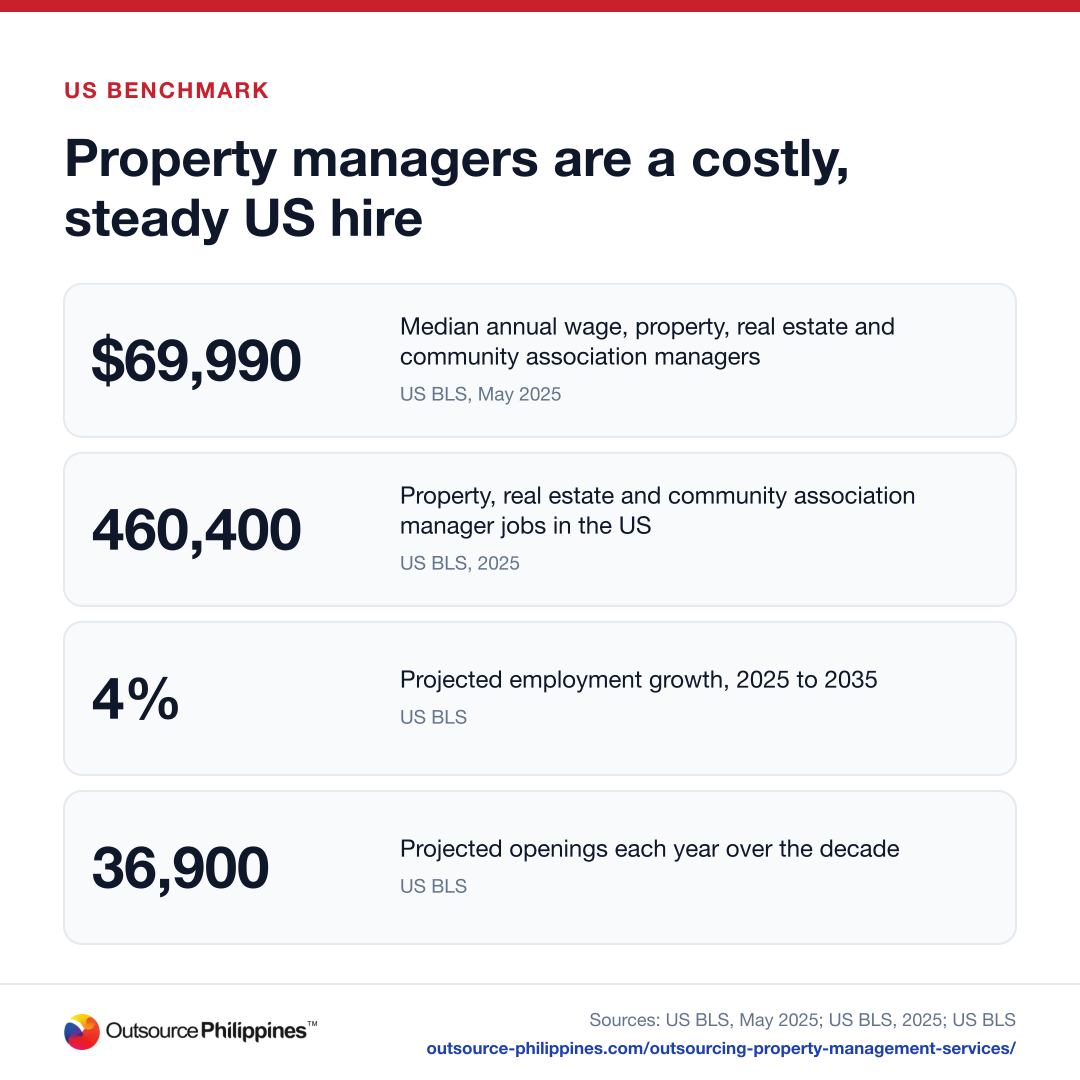
Labor is the largest cost in property management. The US Bureau of Labor Statistics puts the median annual wage for property, real estate, and community association managers at $69,990 (May 2025), before benefits, payroll taxes, and office space. Moving administrative work off a manager’s desk lets each manager oversee more units.
- $69,990Median annual wage, property, real estate and community association managersUS BLS, May 2025
- 460,400Property, real estate and community association manager jobs in the USUS BLS, 2025
- 4%Projected employment growth, 2025 to 2035US BLS
- 36,900Projected openings each year over the decadeUS BLS
Offshore support lowers the cost of that administrative work further. Outsource Philippines™ estimates most US clients pay 60% to 70% less than an equivalent in-house hire. Pricing is an hourly rate per agent, quoted in a written proposal, and you can read how our pricing works before you ask for a quote. Outsourcing also reduces spending on extra desks, equipment, and recruiting.
Increased Efficiency
When a dedicated team owns payment posting, work orders, and renewals, those tasks happen on schedule instead of when a manager finds time. Automation for lease renewals and report generation speeds things up further. Managers can then focus on owner relationships, inspections, and leasing, which are the parts of the job that grow a portfolio.
Access to Specialized Expertise
An outsourcing partner gives you people already trained in property software, tenant communication, and bookkeeping, plus specialists you may not need full time, such as a marketing designer or an accountant. You get those skills without hiring for each one, and coverage continues when someone on the team is out.
How Do You Choose the Right Outsourcing Partner?
Choose a partner whose services match your actual task list, who can show relevant experience, and whose price makes sense for the quality you need. Check all three before you commit.
Evaluate the Service Range
List the tasks you want to hand off and confirm the provider can cover each one, in your software and during your hours. A mismatch between what you need and what the provider does well leads to workarounds, rework, and frustrated tenants.
Check Industry Experience and Reputation
Ask how the provider has handled property or real estate work before, how it trains agents on a new client’s policies, and what references it can share. Read independent reviews and ask how escalations are handled when something goes wrong.
Balance Cost and Quality
The lowest quote is rarely the cheapest result if errors in tenant ledgers or slow maintenance replies cost you renewals. When outsourcing real estate work, compare proposals on what is included: training, quality checks, reporting, supervision, and security, as well as the rate.
What Should You Consider Before Outsourcing Property Management?
Settle compliance, budget, the provider’s reputation, and the scope of work before you sign. Gaps in any of these cause most outsourcing problems later.
- Legal compliance: landlord-tenant rules, fair housing, and screening laws change often and vary by state and city. Keep legal decisions with your licensed staff and counsel, and give the outside team clear scripts and escalation rules.
- Clear budget: share your budget early so the proposal matches the service level you can afford.
- Market reputation: check reviews and references, and ask how the provider handles staff turnover on an account.
- Defined scope of work: write down which tasks move, which stay, what “done” means for each, and who signs off on payments and notices.
- Data security: tenant files hold personal and financial data, so confirm access controls, monitored workstations, and how records are protected.
Outsource Philippines™ complies with the Philippine Data Privacy Act of 2012 and secures client work with a managed firewall and WorQmate, our in-house project and employee monitoring platform, as part of its wider security practices.
How Does Outsourcing Improve Tenant Satisfaction?
Outsourcing improves tenant satisfaction mainly through faster, more consistent responses. When a dedicated team answers calls and logs requests right away, tenants are not left waiting while a local manager is out at a property.
A remote team also gives your local managers time back. With routine admin off their plates, they can return calls personally, handle sensitive conversations, and visit properties more often. Tenants notice both the quick acknowledgment and the personal follow-through, and that combination supports renewals and lower vacancy.
Is Outsourcing Property Management Right for Your Business?
It is a strong fit if you manage enough units that admin work crowds out leasing and owner relations, your processes run through property management software, and you want tenant support across longer hours. It is a weaker fit if you manage only a handful of units, or if most of your work needs someone physically on site.
Outsource Philippines™ staffs dedicated agents for tenant calls, owner reporting, and property bookkeeping such as ledgers, reconciliations, and owner statements, with each agent working only on one client's portfolio.
Frequently Asked Questions
What Tasks Can Be Outsourced in Property Management?
You can outsource rent collection follow-up, payment posting, maintenance request intake and vendor dispatch, listing and marketing work, tenant screening support, lease renewals, bookkeeping and owner reporting, and tenant phone, email, and chat support. Tasks that need someone on site, such as showings and inspections, usually stay with local staff.
How Does Outsourcing Property Management Lead to Cost Savings?
It lowers labor and overhead costs by moving routine work to a lower-cost team, so each local manager can oversee more units. You also spend less on desks, equipment, and recruiting. Outsource Philippines™ estimates most US clients pay 60% to 70% less than an equivalent in-house hire, with an hourly rate per agent in a written proposal.
What Role Does Technology Play in Outsourced Property Management?
Technology lets a remote team work as part of your operation. Property management software keeps leases, payments, and work orders in one record, cloud phone and chat tools connect tenants and staff in real time, and automation handles reminders and reports so the team can focus on exceptions and follow-up.
How Can I Choose the Right Property Management Outsourcing Partner?
Match the provider’s services to your task list, confirm it can work in your software during your hours, and check its experience with property or real estate work through references and reviews. Compare proposals on training, quality checks, reporting, and security as well as the rate, and ask how it handles escalations.
How Does Outsourcing Improve Tenant Satisfaction?
A dedicated team answers tenant calls and logs maintenance requests right away, so tenants get a quick, consistent reply even when local managers are out. With routine admin handled, managers have more time for personal follow-up and property visits, which helps renewals and keeps vacancy low.