Customer Service QA Scorecard: Free Template and How to Use It

On This Page
- What Is a QA Scorecard in Customer Service?
- What Should a Customer Service QA Scorecard Include?
- How Do You Score a QA Scorecard?
- How Many Interactions Should You Review per Agent Each Week?
- How Do You Run a QA Calibration Session?
- How Do You Use a QA Scorecard to Compare Outsourcing Providers?
- How Do You Run Your First Weekly QA Review?
- What Are Common QA Scorecard Mistakes?
- When Is a QA Scorecard Not Enough?
- Frequently Asked Questions
A customer service QA scorecard is a fixed list of checks a reviewer applies to a sample of real tickets, chats, or calls to judge whether each agent answered correctly, documented the case, escalated properly, and knows what to improve. Scores only matter when every check is tied to evidence in the record and an owner for the next action.
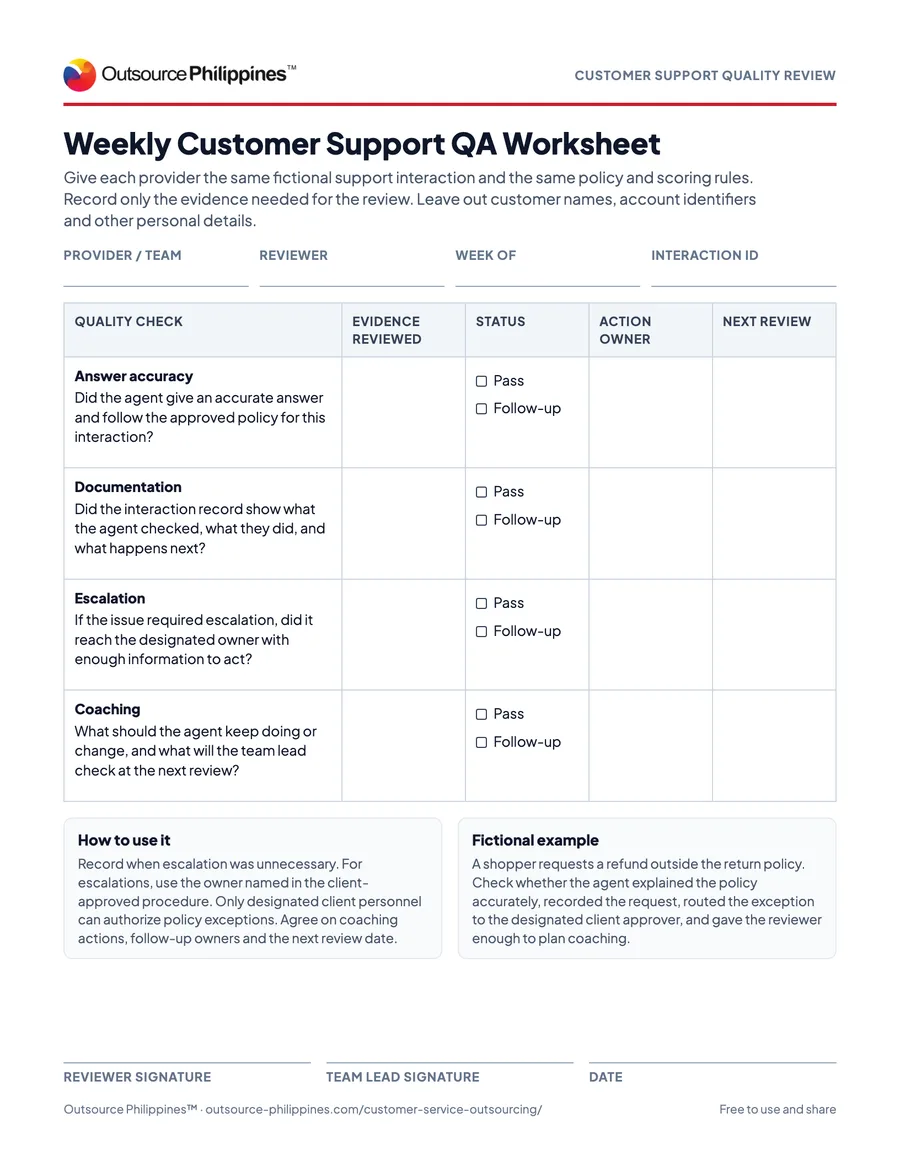
Print it or fill it in on screen. Each weekly review covers:
- Answer accuracy against the approved policy
- Documentation of what was checked and done
- Escalation to the right owner
- Coaching actions and the next review date
This guide covers what goes on the template, how to score it, how many interactions to review, reviewer calibration, and using the sheet to compare providers in a pilot. Every example is fictional.
What Is a QA Scorecard in Customer Service?
A QA scorecard is the form a reviewer fills in for one customer interaction, recording whether the agent met each written standard and what evidence supports that call. It turns "that ticket felt off" into a specific finding with an owner and a date.
Customer service quality assurance is the wider process: sampling interactions, scoring them, coaching agents, and fixing policies that cause repeat errors. A scorecard also differs from the customer satisfaction metrics you collect by survey. CSAT tells you a customer was unhappy. The scorecard tells you whether the agent gave a wrong answer, skipped a note, or followed a policy the customer disliked.
What Should a Customer Service QA Scorecard Include?
Keep it to four checks: answer accuracy, documentation, escalation, and coaching. Each one maps to a different failure, and four checks fit on one page that a reviewer can finish in a few minutes per interaction.
The template uses these checks and these questions:
- Answer accuracy. Did the agent give an accurate answer and follow the approved policy? This is the check customers feel most. A friendly reply with a wrong return window still sends a second contact your way.
- Documentation. Does the record show what the agent checked, did, and what happens next? Without it, the next agent starts from zero and the customer repeats the story.
- Escalation. Did an escalation reach the designated owner with enough information to act? A ticket sent to a general inbox with "please help" in the notes is a follow-up.
- Coaching. What should the agent keep or change, and what will the team lead check next? This line makes the review useful to the agent instead of a grade filed away.
For each check, the sheet has four columns: Evidence reviewed (the ticket ID, timestamp, or note you relied on), Status (Pass or Follow-up), Action owner, and Next review. Header fields record the provider or team, reviewer, week, and interaction ID, and signature lines at the bottom confirm the agent and team lead saw the result.
Tone is left off on purpose because it is the hardest item for two reviewers to score alike. Cover it in coaching notes, or add a fifth check once reviewers agree on the first four.
How Do You Score a QA Scorecard?
Score each check as Pass or Follow-up when you are starting out, and move to a numeric or weighted scale only when you need trend data across many agents. The simpler the scale, the easier it is for two reviewers to agree.
| Method | How it works | Best for | Main risk |
|---|---|---|---|
| Pass / Follow-up | Each check either meets the standard or needs an action | Small teams, new programs, vendor pilots | Hides the difference between a minor slip and a serious error |
| 1–5 scale | Each check gets a score from poor to excellent | Tracking gradual improvement per agent | Reviewers disagree on the middle scores |
| Weighted scoring | Checks carry different point values that add to 100 | Large programs reporting one quality score | A strong score on minor items can mask a wrong answer |
Pass/follow-up forces a decision and always produces an action, which is why the template uses it. The cost is detail: small weekly gains stay invisible. A 1–5 scale shows them, but one reviewer's "3" is often another's "4", so calibration takes longer.
Weighted scoring rolls everything into one reporting number. If you use it, add an auto-fail rule: a wrong answer on a policy, billing, or privacy question fails the interaction no matter how many other points it earned. Otherwise an agent who greets well and closes politely can score 85 on a call where the customer got the wrong refund amount.
How Many Interactions Should You Review per Agent Each Week?
No industry standard sets the number, so treat the figure here as editorial guidance: review 3 to 5 interactions per agent per week, chosen at random across channels, plus every escalation and complaint. That is enough to see patterns without turning reviews into a full-time job.
Double the sample for agents in their first month, and drop to two a week for experienced agents on a simple queue. If one agent's follow-ups cluster on a single check, pull extra interactions on that topic.
Random selection matters more than volume: reviewers who pick their own samples choose the messy ones.
How Do You Run a QA Calibration Session?
A calibration session is a meeting where every reviewer scores the same interactions on their own, then compares results and agrees on the correct call. Run one before your first review cycle and then monthly.
Use three to five interactions per session, including one borderline case. Where reviewers split, settle the rule and write it into the scorecard's guidance so the argument does not repeat.
Measure agreement as the share of checks where reviewers gave the same status. A review of interrater reliability by Mary McHugh in Biochemia Medica (2012) notes that many texts recommend 80% agreement as the minimum acceptable level, and that simple percent agreement does not account for agreement by chance. For a four-check scorecard, that means reviewers should match on at least four of every five checks before their scores feed any report or vendor decision.
How Do You Use a QA Scorecard to Compare Outsourcing Providers?
Give every provider in a pilot the same scorecard, the same sample rules, and the same reviewer on your side, then compare follow-up rates check by check. Matching scorecards turn a sales comparison into evidence from your own tickets.
The scorecard measures delivery during the pilot. The selection step before it, covered in the framework for comparing support providers, decides who gets a pilot at all. Once the pilot starts:
- Ask each provider's team lead to score the same sample you score, and compare the two. A provider whose internal QA passes interactions you would send back has a calibration problem that will grow after go-live.
- Track the escalation check closely. It shows whether the team routes exceptions to your designated approver or tries to resolve them alone.
- Write the scorecard, sample size, and review cadence into the service level agreement before contract signature, so quality reporting does not depend on goodwill.
A fictional example from the template shows how this works. A shopper requests a refund outside the return policy. The reviewer checks that the agent explained the policy, recorded the request, routed the exception to the designated client approver, and left enough detail to plan coaching. If the agent issued the refund without approval, accuracy and escalation both go to follow-up, whatever the customer said in the survey.
How Do You Run Your First Weekly QA Review?
Pick the sample, score it with evidence, assign owners, and close the loop with the agent within the same week.
- Write the standards first. List the approved policies, macros, and escalation owners the agents should follow. A reviewer cannot score accuracy against rules nobody wrote down.
- Pull a random sample. Take 3 to 5 interactions per agent from the past week across phone, chat, and email, plus all escalations.
- Fill in the header. Record provider or team, reviewer, week of, and interaction ID on each sheet.
- Score each check with evidence. Note the timestamp or record line behind every Pass or Follow-up. No evidence, no score.
- Assign an owner and a date. Every follow-up gets a name in Action owner and a date in Next review.
- Separate agent errors from process errors. If the agent followed a bad policy correctly, the follow-up belongs to whoever owns the policy, not the agent.
- Coach within the week. The team lead shares the sheet with the agent, both sign, and the next review checks the change.
- Log the trends. Record follow-up counts per check in one sheet, which becomes the base for broader data-driven quality management later.
What Are Common QA Scorecard Mistakes?
The most common mistakes are too many checks, scores without evidence, and blaming agents for problems the process created. Each one makes reviews slower and less trusted.
- Thirty-line forms. Long checklists reward box-ticking, and agents cannot tell which items matter.
- Scoring from memory. A status without a cited record line cannot be defended when an agent disputes it.
- Grading the policy through the agent. SQM Group's first call resolution research (updated August 2026) attributes 38% of unresolved first contacts to agent errors, 13% to customer miscommunication, and 49% to organizational policies, processes, and procedures. A scorecard that only scores agents misses the largest share.
- No follow-through. If the next review never checks the coaching item, agents learn that the form is paperwork.
- Skipping calibration. Two reviewers with different standards produce scores that measure the reviewer, not the agent.
When Is a QA Scorecard Not Enough?
A scorecard reviews a small sample of past interactions, so it cannot catch problems that happen between samples or that live outside the conversation. Pair it with other controls in those cases.
Use more than a scorecard when error costs are high, such as billing disputes or account security, where every affected interaction may need a second check. Use operational data when the issue is speed or volume, because first call resolution and handle times show what a sample of five tickets cannot. Use an external framework when you need a full management system: the COPC Customer Experience Standard, now at Release 8.0, covers human and automated channels under one set of requirements. And if your queue needs licensed or clinical judgment, a QA form will not make an offshore team the right fit for that work.
Supervision also counts. A call center team working from one supervised floor gives team leads the chance to coach between reviews instead of waiting for the next sheet. Outsource Philippines™ runs dedicated customer service teams for Tier 1 to Tier 3 support from a supervised office in San Pedro City, Laguna, on company-managed devices with WorQmate monitoring.
Frequently Asked Questions
How Do You Build a QA Scorecard?
Start from your written policies and escalation rules, then choose three to five checks that cover the errors that cost you most, such as wrong answers or missed escalations. Phrase each check as a yes-or-no question, add columns for evidence, status, owner, and next review, and test it with two reviewers on the same tickets before rollout.
What Is Customer Service Quality Assurance?
Customer service quality assurance is the process of reviewing a sample of real customer interactions against written standards, coaching agents on what the reviews find, and fixing the policies or tools behind repeat errors. It includes sampling rules, a scorecard, calibration between reviewers, and a record of follow-up actions, so quality is checked on purpose rather than after complaints.
Why Is Quality Assurance Important in Customer Service?
Quality assurance catches wrong answers, missing notes, and failed escalations before they become repeat contacts, refunds, or complaints. It also shows whether a problem sits with one agent, a training gap, or a policy. When support is outsourced, QA gives the client independent evidence of how the provider's team handles real customers each week.
Should a QA Scorecard Use Weighted Scores?
Weighted scores help large teams report one quality number and track trends, but they need an auto-fail rule for wrong answers on billing, policy, or privacy questions. Without that rule, polite greetings and closings can outweigh a serious error. Small teams and vendor pilots usually get clearer results from pass or follow-up scoring on each check.
How Often Should QA Calibration Happen?
Hold a calibration session before the first review cycle, then monthly, and again whenever a reviewer joins or a policy changes. Each session scores three to five shared interactions, including a borderline case. Keep going until reviewers agree on at least 80% of checks, the minimum many research texts treat as acceptable agreement between raters.