How to Compare Customer Support Outsourcing Providers

On This Page
- Why Is a Ranked List of Providers Not Enough?
- What Should You Define Before You Contact Providers?
- How Do You Score Customer Support Outsourcing Companies?
- What Questions Should You Ask on a Sales Call?
- What Red Flags Should Rule a Provider Out?
- How Do You Run a Pilot With an Outsourced Support Team?
- Which Contract Terms Should You Read Twice?
- How Was This Framework Built?
- When Is Outsourcing Customer Support Not the Right Fit?
- Frequently Asked Questions
To compare customer support outsourcing providers, score each one on the same weighted criteria: dedicated or shared agents, where and how agents are supervised, security and compliance, QA and reporting, tier coverage, ramp time, contract terms, and references. Ask every provider for evidence, not descriptions, then run a short pilot before you sign a long contract.
Key takeaways
- Send every provider the same written scope, so their answers and quotes can be compared line by line.
- Weight the scorecard before the first sales call, so a polished demo cannot change what matters to you.
- Ask for proof: a sample QA form, a sample weekly report, an escalation walkthrough, and two references with similar work.
- A pilot on one queue, with targets agreed in writing, tells you more than any proposal.
Most search results for this topic are ranked lists of companies. This guide gives you a vendor-neutral scorecard, sales-call questions, red flags, contract terms to check, and a pilot plan that tests a provider on your real tickets.
Why Is a Ranked List of Providers Not Enough?
A ranked list tells you who exists, not who fits your queue. Most "top companies" lists score on size, awards, or client logos, while your decision turns on details such as ticket mix, hours, tools, and compliance rules that no list can see.
A provider built for 5,000-seat telecom programs may be a poor match for a 12-agent SaaS help desk that needs Tier 2 troubleshooting in Zendesk. Use lists to build a longlist of four to six names, then let the scorecard decide.
What Should You Define Before You Contact Providers?
Write a one-page scope before the first call: channels, hours, monthly contact volume, the tiers of work agents will handle, the tools they will use, and the compliance rules that apply. Without it, every provider prices and staffs a different job.
Include current numbers: tickets per month by channel, average handle time, first response time, and CSAT. If you plan to cover US evenings or weekends from overseas, note the hours, because time zone coverage changes shift design and supervision. The same brief also makes quotes comparable, which matters because customer service outsourcing cost varies with roles, hours, and team size more than with the headline rate.
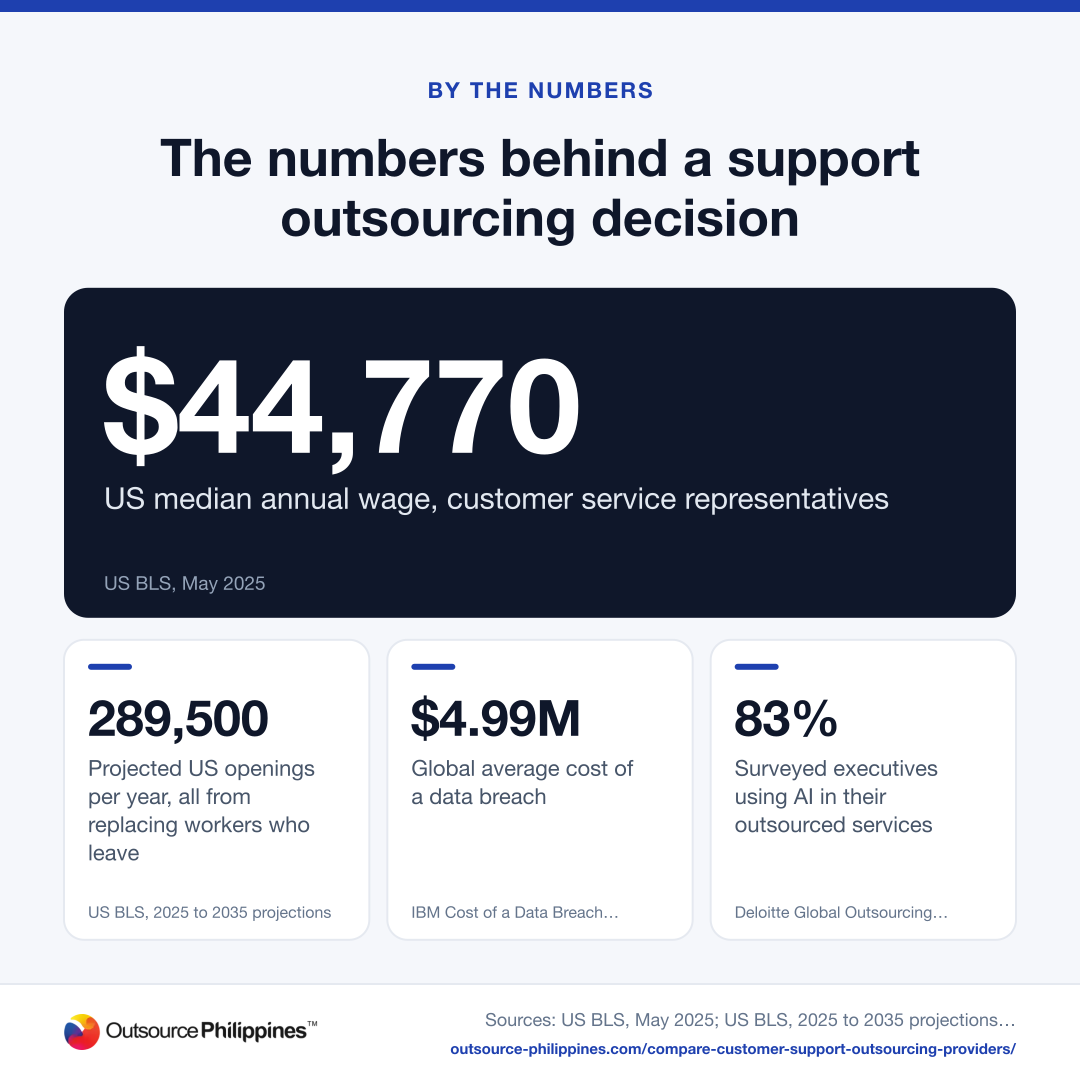
Four numbers frame the decision:
- $44,770US median annual wage, customer service representativesUS BLS, May 2025
- 289,500Projected US openings per year, all from replacing workers who leaveUS BLS, 2025 to 2035 projections
- $4.99MGlobal average cost of a data breachIBM Cost of a Data Breach Report, 2026
- 83%Surveyed executives using AI in their outsourced servicesDeloitte Global Outsourcing Survey, 2024
The US Bureau of Labor Statistics puts the median annual wage for customer service representatives at $44,770 (May 2025) and projects about 289,500 openings a year through 2035, all of them from replacing workers who change jobs or leave the workforce. Turnover is built into this occupation, so how a provider hires, trains, and replaces agents deserves real weight in your scoring.
How Do You Score Customer Support Outsourcing Companies?
Give the criteria weights that add up to 100, score each provider from 1 to 5 on each, multiply, and add. A provider's total out of 500 lets you compare them on the same scale, and the weights force your team to agree on priorities before the demos start.
The weights below are a starting point for a typical Tier 1 to Tier 2 support team. Move points toward security if you handle payment or health data, or toward tier coverage if most of your tickets are technical.
| Criterion | Suggested Weight | What a Strong Answer Looks Like |
|---|---|---|
| Dedicated or shared agents | 15 | Named agents who work only on your account, with a dedicated team lead |
| Work location and supervision | 15 | Agents in a supervised office, with team leads on the same shift and floor |
| Security and compliance | 15 | Company-managed devices, role-based access, and the audit reports your industry requires |
| QA and reporting | 15 | A written QA form, a stated sample size, and a weekly report you can see before signing |
| Tier coverage and escalation | 10 | Clear rules for what agents resolve and what they hand back, with named contacts |
| Hiring and ramp time | 10 | A written hiring plan with timelines, assessments, and a backfill process for departures |
| Contract terms | 10 | Clear notice periods, staffing changes, SLA remedies, and data return on exit |
| References | 10 | Two or more current clients with similar channels, volume, and ticket complexity |
Dedicated or Shared Agents
Dedicated agents work only on your account, so product knowledge builds over months. Shared agents split time across several clients, which suits overflow and simple FAQs but rarely technical or high-value support.
Office-Based or Work From Home
Where agents work decides how fast a team lead can spot a struggling agent and how customer data is protected. An office floor lets supervisors coach in real time on managed equipment. If a provider uses home-based agents, ask how it secures devices and stops data from being printed or photographed.
Security, QA, and Tier Coverage
Security answers should name specific frameworks, such as PCI DSS for card data or an AICPA SOC 2 report on controls, plus the Philippine Data Privacy Act of 2012 (RA 10173) for teams in the Philippines. The IBM Cost of a Data Breach Report 2026 puts the global average cost of a breach at $4.99 million, up 12% from the prior year. For QA, a strong provider shows its scoring form and explains how data-driven quality management turns scores into coaching. For tier coverage, confirm which ticket types fall under Tier 1, Tier 2, and Tier 3, and where escalations go after hours.
What Questions Should You Ask on a Sales Call?
Ask questions that require a document, a number, or a walkthrough as the answer. A provider that answers everything with "it depends" has likely not run work like yours.
- Will my agents work only on my account, and who is their team lead?
- Where will agents sit, and who supervises them on each shift?
- Who chooses the agents? At Outsource Philippines™, for example, we source, test, and shortlist candidates; the client's team joins final interviews with ours, and the client makes the hiring decision.
- Can I see a blank QA form and a sample weekly report with client data removed?
- Walk me through one urgent ticket that arrives 10 minutes before shift change.
- How do you cover sick days, holidays, and sudden spikes in volume?
- How long does it take from signed contract to agents answering live tickets?
- What happens when an agent resigns, and how fast is the seat refilled and trained?
- Do you use AI tools on client tickets, and who reviews their output?
- Can I speak with two current clients whose work resembles mine?
Question 9 matters more each year. The Deloitte 2024 Global Outsourcing Survey of more than 500 executives found 83% using AI in their outsourced services, while noting that governance and contracting gaps have limited the gains. Put AI use, review steps, and data handling for AI tools into the contract.
What Red Flags Should Rule a Provider Out?
Rule out any provider that will not show you evidence before you sign. Sales slides are easy to produce; a real QA form, report, and reference are not.
- No named team lead. Your account reports to "the operations team" rather than a person.
- Agents shared across many accounts with no way to see which ones.
- Vague security answers. No mention of device control, access rights, or the audit reports you asked about.
- Metrics you cannot audit. The provider reports targets met but will not explain how it counts business hours, auto-replies, or reopened tickets.
- Pressure to sign a long term before any pilot, or penalties for ending a pilot that misses targets.
- Ramp promises without a hiring plan. A start date with no written steps for sourcing, testing, and training agents.
How Do You Run a Pilot With an Outsourced Support Team?
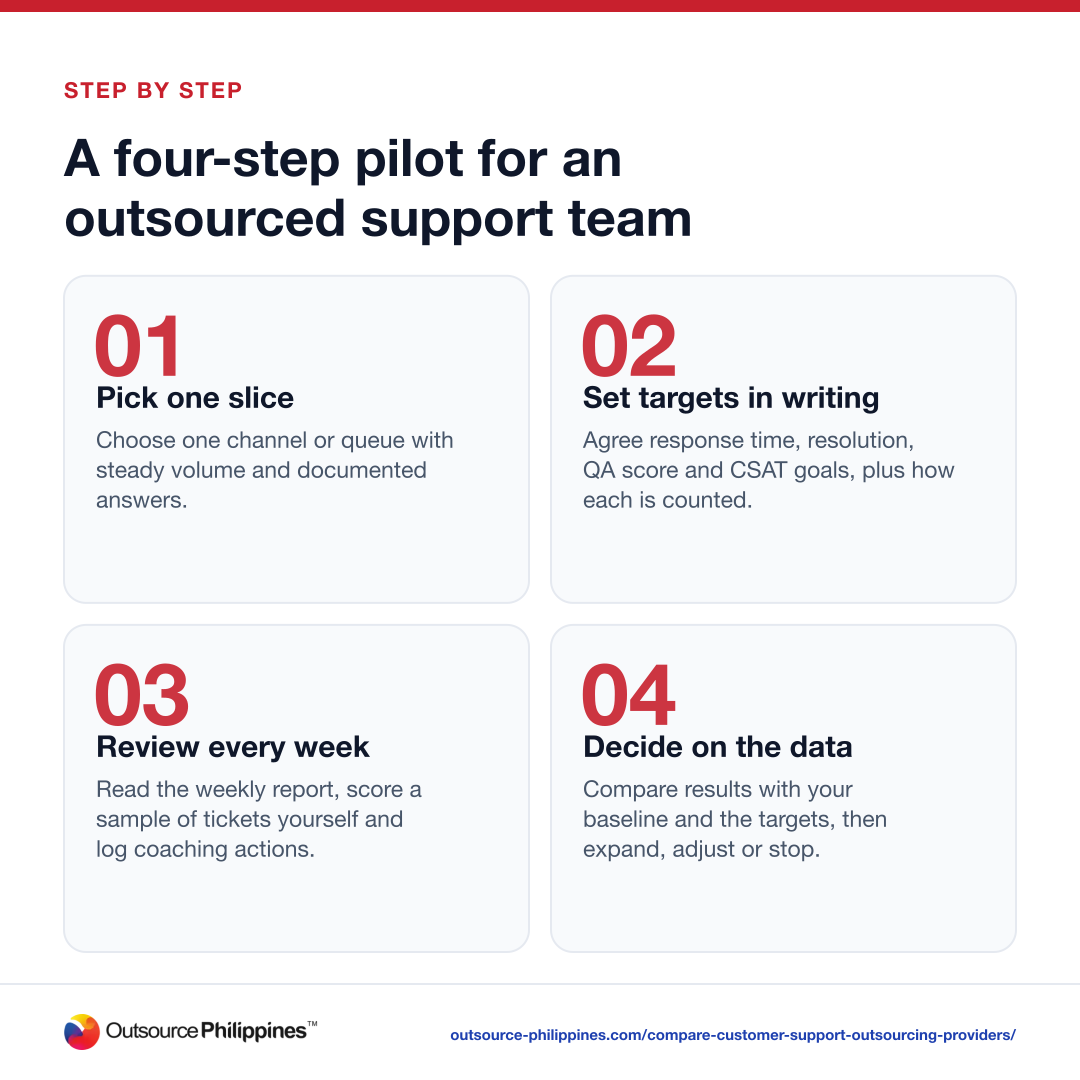
Run a pilot on one queue or channel with real tickets, targets agreed in writing, and a fixed end date. A pilot shows how the team handles your product, your customers, and your escalation rules, which no proposal can prove.
- 1Pick one slice
Choose one channel or queue with steady volume and documented answers.
- 2Set targets in writing
Agree response time, resolution, QA score and CSAT goals, plus how each is counted.
- 3Review every week
Read the weekly report, score a sample of tickets yourself and log coaching actions.
- 4Decide on the data
Compare results with your baseline and the targets, then expand, adjust or stop.
Include at least one full month of normal volume, so a quiet first week does not flatter the results. Score a sample of tickets yourself with the same form the provider uses; if your scores and theirs differ widely, the QA process needs work before you add seats. Track the same customer satisfaction metrics you use in-house, so the comparison with your baseline is fair. Teams that are new to offshore support can follow a four-week Philippine setup plan to prepare the knowledge base, tools access, and training before the pilot starts.
Which Contract Terms Should You Read Twice?
Read the clauses that decide what happens when something goes wrong: notice periods, staffing changes, service level remedies, and the return of your data. These terms cost little to fix before signing and a great deal to fix later.
- Term and notice. How long the initial term runs, how much notice either side must give, and whether a pilot converts automatically.
- Service levels. The targets, how each is measured, and what the provider owes when it misses. A customer service SLA should spell out each metric and its reporting rules.
- Staffing changes. How fast a departed agent is replaced, who pays for retraining, and whether you can request a different agent.
- Subcontracting. Whether the provider can move your work to another company or location without your written consent.
- Data and knowledge on exit. Return or deletion of your data, and handover of macros, process notes, and training material you paid to build.
- Compliance duties. Who reports a breach, how fast, and which call center compliance rules and frameworks apply to your account.
How Was This Framework Built?
The eight criteria follow the parts of a support operation that a contract and SLA must govern: who the agents are, where and how they work, how data is protected, how quality is measured, what work is in scope, how fast seats are filled, and what happens at exit. The weights reflect editorial judgment for a typical Tier 1 to Tier 2 team, not survey data.
We did not score, rank, or name any provider, including Outsource Philippines™. Statistics come from the US Bureau of Labor Statistics, IBM, and Deloitte, checked on November 24, 2026. A payments or healthcare team should give security more points, and a team with mostly technical tickets should weight tier coverage and technical support outsourcing experience higher.
When Is Outsourcing Customer Support Not the Right Fit?
Outsourcing customer support is a poor fit when volume is too small or irregular to keep a dedicated agent busy, when most contacts need senior staff to make judgment calls that are not written down, or when your processes change weekly and no one owns documentation.
It also fails when the work falls outside a provider's scope. Field repairs, licensed advice, and on-site work in the US stay in-house. If you need Spanish or French support, or engineering fixes beyond Tier 3, rule out any provider that cannot staff them. Outsource Philippines™ runs dedicated, office-based customer support teams for Tier 1 to Tier 3 work in English, and most of its teams go live in 2 to 4 weeks.
Frequently Asked Questions
What Is the Best Way to Outsource Customer Support Overseas?
Start with a written scope covering channels, hours, volume, tiers, tools, and compliance rules. Send it to four to six providers, score their answers on the same weighted scorecard, and ask each for a sample QA form, a sample weekly report, and references. Run a pilot on one queue before expanding, and write AI use, data handling, and exit terms into the contract.
How Many Providers Should You Compare?
Compare four to six providers at the proposal stage and two or three at the reference and pilot stage. Fewer than four gives you little sense of what normal answers look like. More than six makes it hard to give each provider the same attention, and the scoring starts to reward the best presentation rather than the best operation.
How Long Should a Customer Support Outsourcing Pilot Run?
Run the pilot for at least one full month of normal volume, and longer if your business has a weekly or monthly peak you need to test. Agree the end date and the targets in writing before it starts. Review results every week, and make the expand, adjust, or stop decision against your own baseline numbers.
Should You Choose a Dedicated or Shared Support Team?
Choose a dedicated team when your product needs training, your tickets vary, or you want agents who learn your brand voice over time. A shared model can work for overflow, after-hours FAQs, or very simple requests. Ask any provider how many accounts each agent handles, because a "dedicated" label sometimes covers agents who switch between clients.
How Do You Check a Provider's References?
Ask for references whose channels, volume, and ticket complexity resemble yours, and speak with the person who manages the vendor day to day. Ask how long the relationship has lasted, how the provider handled a missed target, how quickly departed agents were replaced, and whether the reference would sign the same contract again.