Boosting Sales Performance Through Expert B2B Appointment Setting

On This Page
- What Is B2B Appointment Setting?
- Why Does Appointment Setting Improve Sales Results?
- What Rules Apply to B2B Calls and Emails?
- Should You Outsource Appointment Setting or Keep It In-House?
- How Do You Run an Outsourced Appointment Setting Campaign?
- Is Outsourced B2B Appointment Setting Right for Your Business?
- Frequently Asked Questions
When account executives prospect for themselves, hours go to finding contacts, leaving voicemails and chasing replies instead of selling. Appointment setting moves that work to a dedicated person or team whose only job is to turn target accounts into qualified sales leads and put confirmed meetings on the closer's calendar.
The method is simple to describe and hard to run well. It needs a written definition of a qualified meeting, outreach that follows US, Canadian and UK calling and email rules, and weekly measurement of meeting quality rather than meeting count.
What Is B2B Appointment Setting?
B2B appointment setting is the work of finding, contacting and qualifying business decision-makers, then booking meetings between them and your sales team. Setters reach prospects by phone, email and LinkedIn, confirm fit against criteria you agree on in advance (role, company size, need, timing), and hand over only meetings that meet those criteria.
- B2B calls are mostly exempt from the US Telemarketing Sales Rule, but B2B email is fully covered by CAN-SPAM (FTC guidance, checked November 2026).
- In the UK, sole traders and most partnerships are treated as individuals under PECR, so they need consent before you email them.
- The most useful success measure is the share of booked meetings your sales team accepts as qualified, not the number booked.
- An outsourced setter needs a written ideal customer profile, scripts and qualification rules before the first dial.
A setter's day is mostly research and outreach. They build lists that match your ideal customer profile, find the right contact at each company, and work a sequence of calls, emails and social media touches until the prospect replies or the sequence ends. When a prospect agrees to talk, the setter checks the qualification criteria, books the slot in the account executive's calendar, and writes a short handoff note: who they spoke to, what problem came up, and what the prospect expects from the call.
That handoff note is where most programs succeed or fail. A meeting with no context forces the account executive to start discovery from zero, and prospects notice.
Why Does Appointment Setting Improve Sales Results?
Appointment setting improves results because it separates two jobs that need different skills and different calendars: prospecting and closing. When one person does both, prospecting gets squeezed out by deals in progress, and the pipeline dries up a quarter later.
Splitting the work gives you four practical gains:
- Closers spend their hours on qualified buyers. An account executive who starts each day with three confirmed meetings sells more than one who starts with a call list.
- Pipeline becomes predictable. A setter working a steady daily volume of outreach produces a measurable flow of meetings you can forecast against.
- Qualification becomes consistent. One set of written criteria, applied by the same people, gives cleaner data than five reps each using their own judgment.
- Feedback reaches marketing faster. Setters hear objections and buying signals every day, which helps you match prospects to the right stage of your funnel and fix messaging that is not landing.
The gain disappears if setters are paid or measured only on volume. Meetings booked with the wrong people waste more sales time than no meeting at all.
What Rules Apply to B2B Calls and Emails?
B2B outreach is more lightly regulated than consumer outreach, but it is not exempt, and the rules differ by country. Check these before any campaign starts:
| Market and channel | Main rule | What it means for setters |
|---|---|---|
| US phone calls | FTC Telemarketing Sales Rule | Most B2B calls are exempt, except sales of nondurable office or cleaning supplies and calls selling to employees for personal use |
| US calls to mobile numbers | Telephone Consumer Protection Act | Autodialed or prerecorded calls to cell numbers need prior express consent, even for business contacts |
| US email | CAN-SPAM Act | Applies to B2B email; honor opt-outs within 10 business days |
| Canada email | Canada's Anti-Spam Legislation (CASL) | Commercial electronic messages need consent, express or implied |
| UK email | PECR regulation 22 | Consent rules cover individual subscribers, which include sole traders and most partnerships |
| UK phone calls | PECR regulations 21 and 26 | Screen lists against the TPS and Corporate TPS registers |
The Federal Trade Commission's Telemarketing Sales Rule guide lists "business-to-business calls" among exempt calls unless they involve retail sales of nondurable office or cleaning supplies or solicit employees. Email is different: the FTC's CAN-SPAM compliance guide states that the law makes no exception for business-to-business email and sets penalties of up to $53,088 per violating email (FTC, checked November 2026).
For calls to mobile phones, Section 227 of the Communications Act, the TCPA, bars calls made with an autodialer or prerecorded voice to cellular numbers without the called party's prior express consent. The restriction covers the dialing method, so ask any partner whether its setters dial manually or through an autodialer before they call mobile numbers.
In Canada, section 6 of Canada's Anti-Spam Legislation prohibits sending commercial electronic messages without consent. In the UK, PECR regulation 22 applies the email consent rule to individual subscribers, and the PECR definitions in regulation 2 count an unincorporated body of individuals, such as a sole trader or most partnerships, as an individual. Limited companies are corporate subscribers. This is general information, not legal advice; have counsel review scripts and lists for each market.
Should You Outsource Appointment Setting or Keep It In-House?
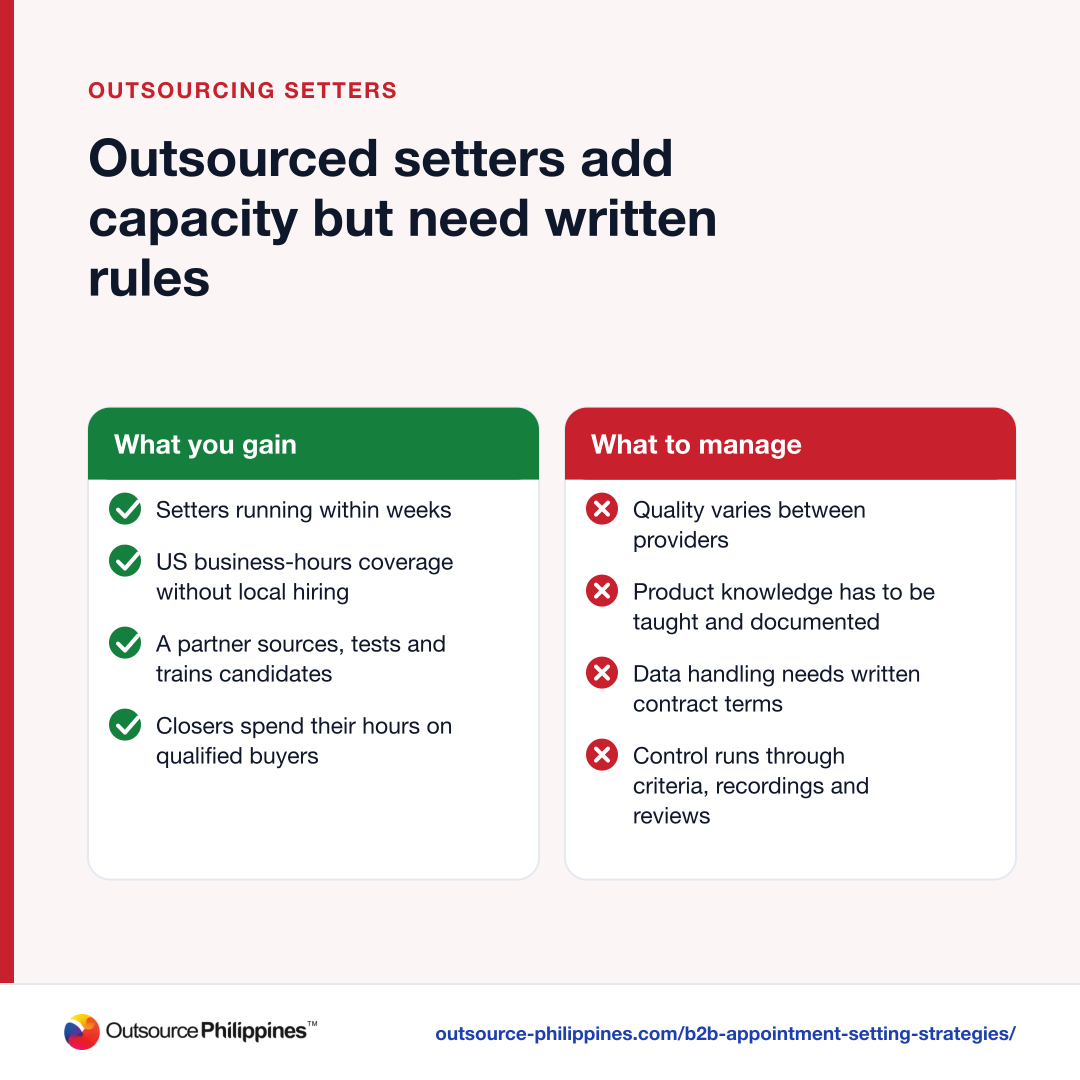
Outsource when you need setters running within weeks, want coverage of US business hours without hiring locally, and can give a partner a clear ideal customer profile. Keep it in-house when your buyer list is small, relationship-driven and needs senior product knowledge on the first call.
| Factor | In-house setters | Outsourced dedicated setters |
|---|---|---|
| Time to start | Local recruiting and ramp-up | A partner sources and trains candidates for you |
| Control | Direct daily supervision | Control through written criteria, call recordings and weekly reviews |
| Product knowledge | Absorbed from colleagues | Has to be taught and documented |
| Hiring decision | Yours | Yours, from a shortlist the partner tests |
| Data security | Your own systems and policies | Depends on the partner's controls and your contract terms |
The risks of outsourcing are real. Quality varies between providers, and a setter who does not understand your product books weak meetings. Data handling needs written terms. You reduce these risks by choosing dedicated setters who work only on your account, listening to recorded calls in the first month, and agreeing on qualification rules before the first dial. At Outsource Philippines™, we source, test and shortlist setter candidates against your profile; your team joins the final interviews and makes the hiring decision.
What you gain
- Setters running within weeks
- US business-hours coverage without local hiring
- A partner sources, tests and trains candidates
- Closers spend their hours on qualified buyers
What to manage
- Quality varies between providers
- Product knowledge has to be taught and documented
- Data handling needs written contract terms
- Control runs through criteria, recordings and reviews
How Do You Run an Outsourced Appointment Setting Campaign?
Run it like a sales hire, not a vendor order: define the job in writing, train for it, and review results every week. These six steps cover the work, and onboarding new appointment setters well is what makes the rest of them hold.
- Write the ideal customer profile. Industry, company size, region, job titles, and the trigger events that suggest a need (new funding, a new hire in a key role, expansion).
- Define a qualified meeting. For example: director level or above, at a company with 50 to 500 employees, with a stated problem your product solves and a decision expected within six months. Sales leadership signs off on this before launch.
- Pick the partner on evidence. Ask to hear recorded calls, see a sample handoff note, and review how they screen lists against do-not-call registers. Share your goals and target volume when you request a proposal so the partner can scope seats and hours.
- Connect the tools. Setters should work inside your CRM, with meetings booked directly into account executives' calendars and every touch logged.
- Hold a weekly review. Go through accepted and rejected meetings with the setter and a sales manager. Rejected meetings show where criteria or scripts need changes.
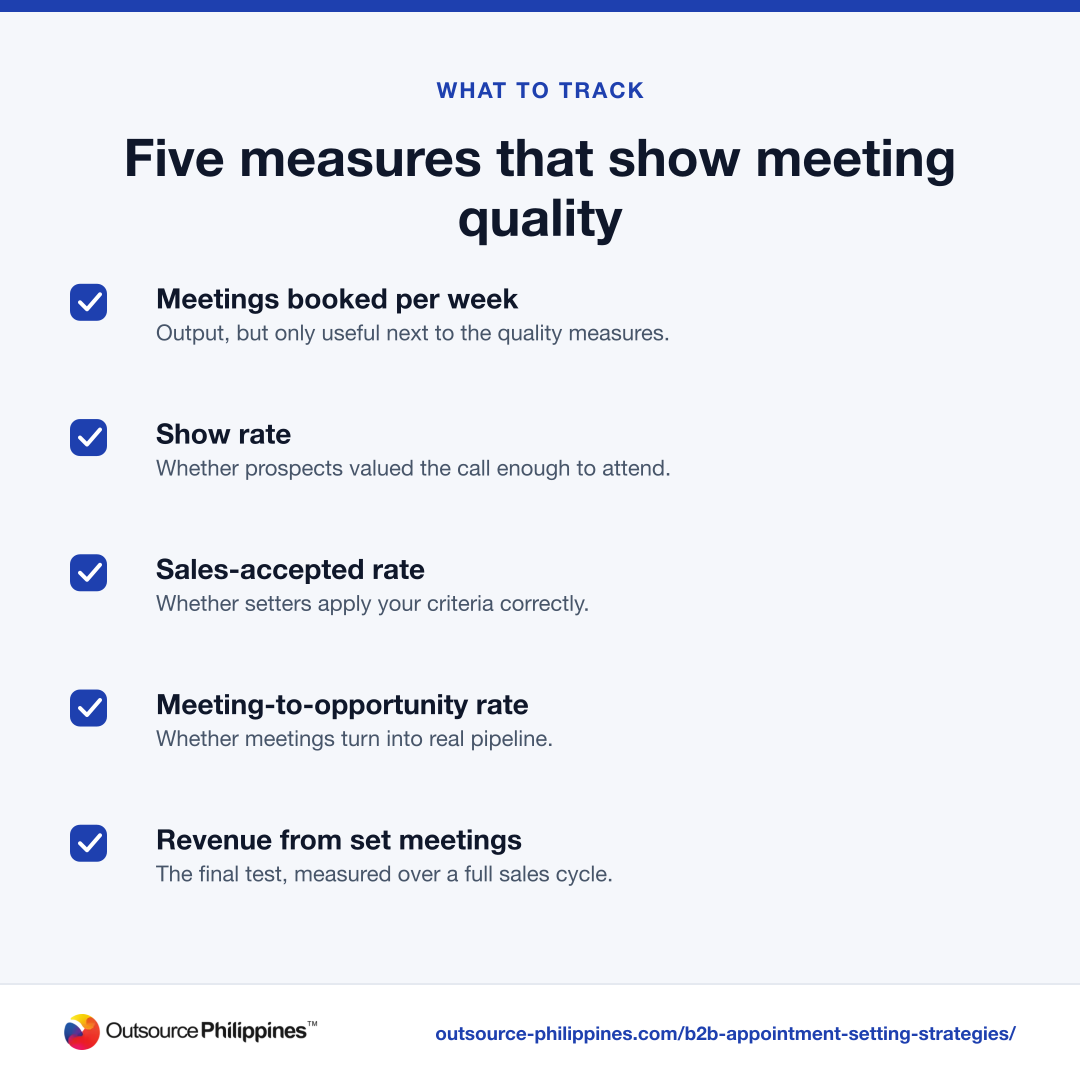
- Measure quality first. Track the five measures below and change the program based on them.
- Meetings booked per week
Output, but only useful next to the quality measures.
- Show rate
Whether prospects valued the call enough to attend.
- Sales-accepted rate
Whether setters apply your criteria correctly.
- Meeting-to-opportunity rate
Whether meetings turn into real pipeline.
- Revenue from set meetings
The final test, measured over a full sales cycle.
Is Outsourced B2B Appointment Setting Right for Your Business?
It fits when you have a defined ideal customer profile, account executives with open calendar time, and an offer you can explain in a short first call. It is a weaker fit if your target list is a few dozen accounts that need executive-to-executive contact, or if your offer and pricing are still changing every few weeks.
Outsource Philippines™ runs dedicated appointment setting teams from a supervised office in the Philippines, where each setter works only on one client's account.
Frequently Asked Questions
What Is the Difference Between Lead Generation and Appointment Setting?
Lead generation finds and lists potential buyers who match your ideal customer profile. Appointment setting contacts those leads, checks interest, authority and timing, and books a meeting with your sales team. Many B2B teams run both together, so researched leads move straight into outreach and the setter owns the account until a qualified meeting is booked.
Which KPIs Should I Track for B2B Appointment Setting?
Track meetings booked, show rate, the share of meetings your sales team accepts as qualified, meeting-to-opportunity rate and, over a full sales cycle, revenue from set meetings. Calls and emails sent show effort, but the sales-accepted rate shows whether setters are booking the right people.
Do Do-Not-Call Rules Apply to B2B Cold Calls?
In the US, most business-to-business calls are exempt from the FTC Telemarketing Sales Rule, with exceptions for nondurable office or cleaning supplies and calls selling to employees for personal use. The TCPA still restricts autodialed or prerecorded calls to cell phones. In the UK, screen call lists against both the TPS and Corporate TPS registers.
Does CAN-SPAM Apply to B2B Cold Email?
Yes. The FTC states that CAN-SPAM makes no exception for business-to-business email. Each message needs accurate header information, a non-deceptive subject line, a valid postal address and a working opt-out, and you must honor opt-out requests within 10 business days. Penalties reach up to $53,088 per violating email.
What Are the Risks of Outsourcing Appointment Setting?
The main risks are weaker day-to-day control, uneven quality between providers, gaps in product knowledge and data security. Manage them with written qualification criteria, recorded calls you review in the first month, weekly reviews of rejected meetings, dedicated setters who work only on your account, and data-handling terms in the contract.