Nonprofit Accounting: What It Is, Key Documents, and Best Practices

On This Page
- What Is Nonprofit Accounting?
- How Is Nonprofit Accounting Different from For-profit Accounting?
- What Financial Documents Does Every Nonprofit Need?
- What Are the Best Practices for Nonprofit Accounting?
- What Are the Common Challenges in Nonprofit Accounting?
- Why Outsource Nonprofit Accounting?
- Is Outsourcing Nonprofit Accounting Right for Your Organization?
- Frequently Asked Questions
Nonprofit accounting is the system a nonprofit uses to record, track, and report its money so that every dollar can be traced to its purpose. It centers on fund accounting, which separates restricted from unrestricted funds, and on public reporting such as IRS Form 990, which together keep the organization compliant and trusted by donors.
Donors, grantmakers, board members, and the IRS all want to know where a nonprofit’s money goes. This guide explains what nonprofit accounting is, how it differs from for-profit accounting, the financial documents every nonprofit needs, five best practices, the six most common challenges, and when it makes sense to outsource the work.
What Is Nonprofit Accounting?
Nonprofit accounting is a way of managing finances that keeps an organization transparent, accountable, and compliant. It tracks income and expenses like any accounting system, but it also shows that each dollar was used the way the donor or grantor intended.
At its core is fund accounting, a method that separates and tracks money by source and purpose. Here are the key aspects:
- Restricted funds: can only be used for specific purposes or time periods defined by the donor.
- Unrestricted funds: offer more flexibility and may be allocated to any organizational need, including overhead.
- IRS Form 990: the annual information return most tax-exempt organizations file, which is open to the public.
- Financial transparency: clear, accessible records for audits, board reviews, and donor reports.
On financial statements, these funds appear as net assets with donor restrictions and net assets without donor restrictions.
How Is Nonprofit Accounting Different from For-profit Accounting?
The biggest difference is purpose. A for-profit business exists to make money for its owners, while a nonprofit exists to serve a mission, and that shapes how finances are tracked and reported.
A nonprofit has to follow every grant, donation, and restricted gift to make sure it is used exactly as promised. A for-profit company has far fewer rules about how its money is spent once earned.
| Aspect | Nonprofits | For-profits |
|---|---|---|
| Financial goals | Focus on supporting a mission | Focus on generating profit |
| Reporting requirements | Detailed nonprofit financial statements and an annual Form 990 to keep tax-exempt status | Standard income statements and balance sheets |
| Use of funds | Must follow donor and grant restrictions and use money exactly as promised | Can use profits however owners choose |
| Equity | Net assets, split by donor restrictions | Owners’ or shareholders’ equity |
| Main audience | Donors, grantmakers, board, and public | Owners, investors, and lenders |
What Financial Documents Does Every Nonprofit Need?
Every nonprofit needs its core financial statements, an annual Form 990 filing, a budget, and records that prove how grants and restricted gifts were spent. Larger organizations also need audit reports and written financial policies.
Nonprofit Financial Statements
- Statement of financial position (balance sheet): what the nonprofit owns and owes at a point in time.
- Statement of activities (income statement): revenue and expenses, showing how money supports the work.
- Statement of cash flows: how cash moves in and out, which helps manage day-to-day needs.
- Statement of functional expenses: spending broken down by programs, administration, and fundraising.
IRS Form 990
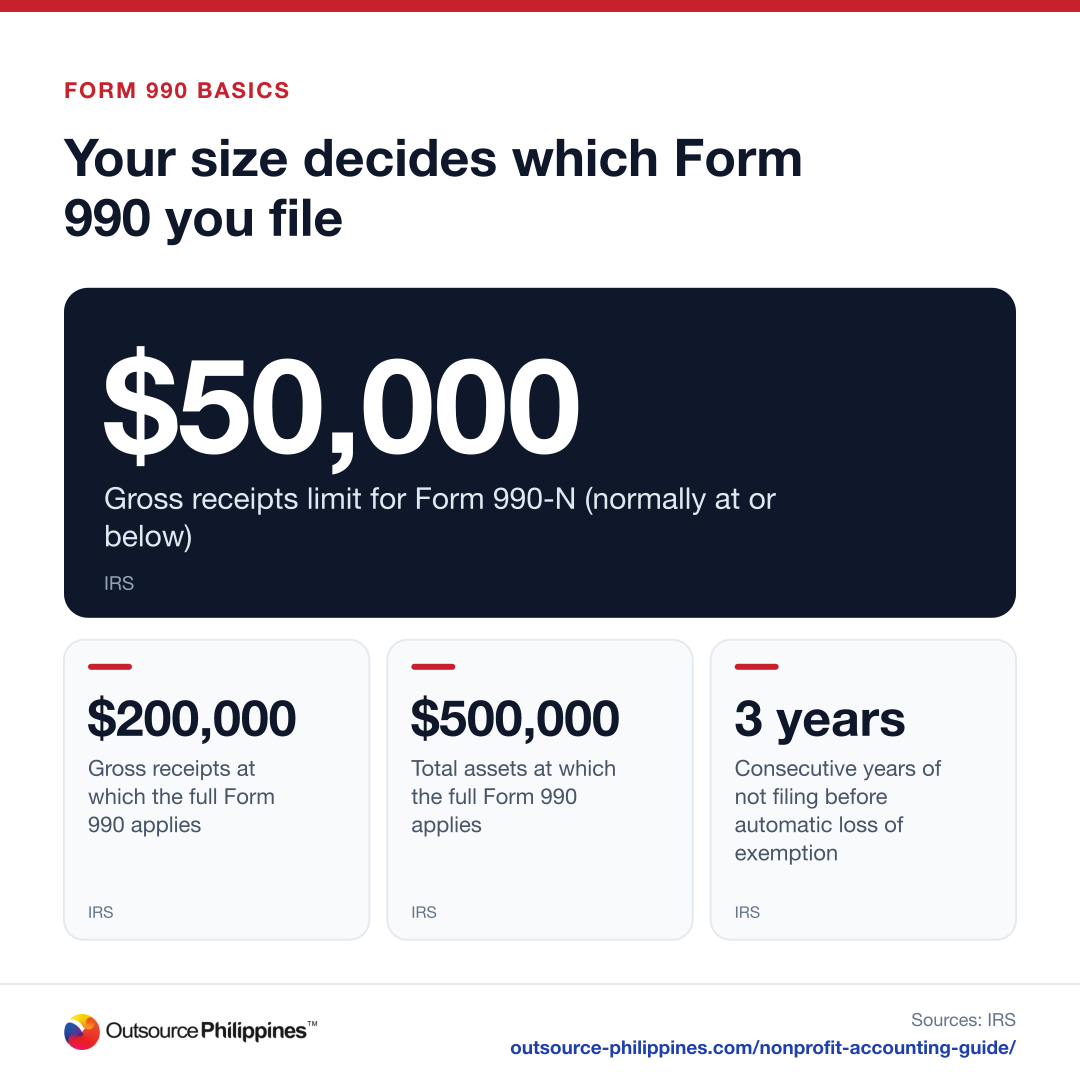
This annual return reports income, spending, leadership pay, and program activity, and because it is public, it supports transparency. Which version you file depends on size, according to the IRS: Form 990-N for gross receipts normally of $50,000 or less, Form 990-EZ for gross receipts under $200,000 and total assets under $500,000, and the full Form 990 above either limit.
- $50,000Gross receipts limit for Form 990-N (normally at or below)IRS
- $200,000Gross receipts at which the full Form 990 appliesIRS
- $500,000Total assets at which the full Form 990 appliesIRS
- 3 yearsConsecutive years of not filing before automatic loss of exemptionIRS
Deadlines matter. Form 990 is due by the 15th day of the 5th month after the fiscal year ends, which is May 15 for calendar-year filers, and Form 8868 gives an automatic 6-month extension, per the IRS due-date guidance. Missing filings has real consequences: organizations that do not file for three consecutive years automatically lose their tax-exempt status, according to the IRS automatic revocation rules.
Other Essential Documents
- Budget planning documents: your financial guide for spending, fundraising targets, and resource allocation, reviewed regularly.
- Grant accounting records: proof of how each grant was spent, which supports compliance and future funding.
- Annual reports: financial highlights and impact stories for donors and stakeholders.
- Audit reports: an independent check on the accuracy of your records, if your organization is audited.
- Internal financial policies: written rules for authorizing spending, recording donations, and managing bank accounts, which shape day-to-day bookkeeping for nonprofit organizations.
What Are the Best Practices for Nonprofit Accounting?
Five practices cover most of what keeps nonprofit finances accurate and trusted. They are simple to start and get more valuable as the organization grows.
- Set up strong internal controls: split financial duties so no single person handles everything. For example, one person authorizes payments while another records them.
- Use the right accounting software: choose a tool built for nonprofits that tracks donations, restrictions, budgets, and grant reports.
- Keep a close eye on donor funds: tag every gift with its restrictions and spend it only as the donor intended.
- Be transparent about your finances: share annual reports and your Form 990 so donors, board members, and the public can see your impact.
- Follow standard accounting rules (GAAP): generally accepted accounting principles keep reports consistent from year to year and comparable for funders.
A clear monthly close helps all five practices stick. Reconcile bank accounts, review restricted balances, and share a short report with the board each month, rather than cleaning up the books once a year before the Form 990 is due.
What Are the Common Challenges in Nonprofit Accounting?
Most nonprofit accounting problems come from tracking restricted money, meeting IRS rules, and managing uneven cash flow with a small team. These are the six challenges that come up most often:
- Keeping track of different types of funds: restricted and unrestricted money must stay clearly separated.
- Staying tax-exempt: you must follow IRS rules and file the right Form 990 on time.
- Managing cash flow: donations rarely arrive evenly, which makes covering daily costs harder.
- Handling grant money: grants often come with strict spending and reporting rules.
- Lacking financial expertise: staff and volunteers may not know nonprofit-specific accounting.
- Dealing with unpredictable income: giving rises and falls through the year, so a solid budget and reserve plan are essential.
Why Outsource Nonprofit Accounting?
Outsourcing gives a nonprofit trained accounting help without a full-time hire, so staff can focus on the mission. It suits small and mid-size organizations best, where one finance person often covers everything.
An outsourced bookkeeper or accountant can record donations and expenses, track restricted funds, reconcile accounts, prepare monthly reports, and keep records ready for audits and Form 990 preparation. Your executive director, board, and treasurer keep control over budgets and spending decisions, and your tax advisor or auditor keeps responsibility for the filings they sign.
Cost is often the deciding factor. Outsource Philippines™ estimates most US clients pay 60% to 70% less than an equivalent in-house hire, and pricing is an hourly rate per agent in a written proposal, explained in how our pricing works. Donor and financial data stay protected under the Philippine Data Privacy Act of 2012, a managed firewall, and WorQmate, our in-house project and employee monitoring platform.
Is Outsourcing Nonprofit Accounting Right for Your Organization?
It is a strong fit if your finance work is handled by one overstretched person or by volunteers, if restricted funds and grants are hard to track, or if month-end reports are always late. It is a weaker fit if your organization is very small and files the Form 990-N, or if you already have a stable, experienced finance team.
Explore our accounting outsourcing services to see how a dedicated team works. When you are ready, request a proposal with your transaction volume and reporting needs.
Frequently Asked Questions
What Is Fund Accounting for Nonprofits?
Fund accounting is a method that tracks a nonprofit’s money by source and purpose instead of as one pool. It separates restricted funds, which donors limit to specific uses or periods, from unrestricted funds the organization can use for any need. This shows donors and auditors that each gift was spent as intended.
Which Form 990 Does a Nonprofit Need to File?
According to the IRS, organizations with gross receipts normally of $50,000 or less can file Form 990-N. Form 990-EZ is for gross receipts under $200,000 and total assets under $500,000. Organizations at or above either limit file the full Form 990. Confirm the right form with your tax advisor each year, since receipts and assets can change.
What Happens If a Nonprofit Does Not File Form 990?
The IRS states that organizations that do not file for three consecutive years automatically lose their tax-exempt status. Late filings can also bring penalties. Form 990 is due by the 15th day of the 5th month after the fiscal year ends, and Form 8868 provides an automatic 6-month extension.
Can a Nonprofit Outsource Its Accounting?
Yes. Many nonprofits outsource bookkeeping, fund tracking, reconciliations, and monthly reporting so staff can focus on programs. The board and leadership keep control over budgets and spending decisions, while a tax advisor or auditor remains responsible for the returns and audit opinions they sign. Outsourcing works best with clear written financial policies.