Philippines Customer Service Outsourcing: A 4-Week Setup Guide (2026)

On This Page
- Why Do US Companies Outsource Customer Service to the Philippines?
- What Customer Service Work Can a Philippine Team Handle?
- What Does a 4-week Setup Plan Look Like?
- Week 1: What Should You Define Before You Contact Providers?
- Week 2: How Do You Choose the Right Philippine Provider?
- Week 3: What Should the Contract and SLA Cover?
- Week 4: How Do You Onboard and Launch the Team?
- How Do You Keep Quality High After Launch?
- Is Philippines Customer Service Outsourcing Right for Your Business?
- Frequently Asked Questions
Philippines customer service outsourcing means a Philippine provider recruits, trains, and manages agents who handle your phone, email, chat, and social support while working only on your account. US companies use it to extend coverage hours and add capacity at a fraction of in-house cost, and most teams go live in 2 to 4 weeks, depending on the role.
This guide is a practical setup plan for US founders and CX leaders. It covers why the Philippines is the default choice for English-language support, which queues to move first, and what to do in each of the first four weeks: defining goals, choosing a provider, writing the contract, and launching the team. It ends with how to keep quality steady once the team is live.
Why Do US Companies Outsource Customer Service to the Philippines?
Because the country combines a very large, experienced support workforce with strong English and long familiarity with US customers. Few other markets offer all three at this scale, which shows when you compare the Philippines with India.
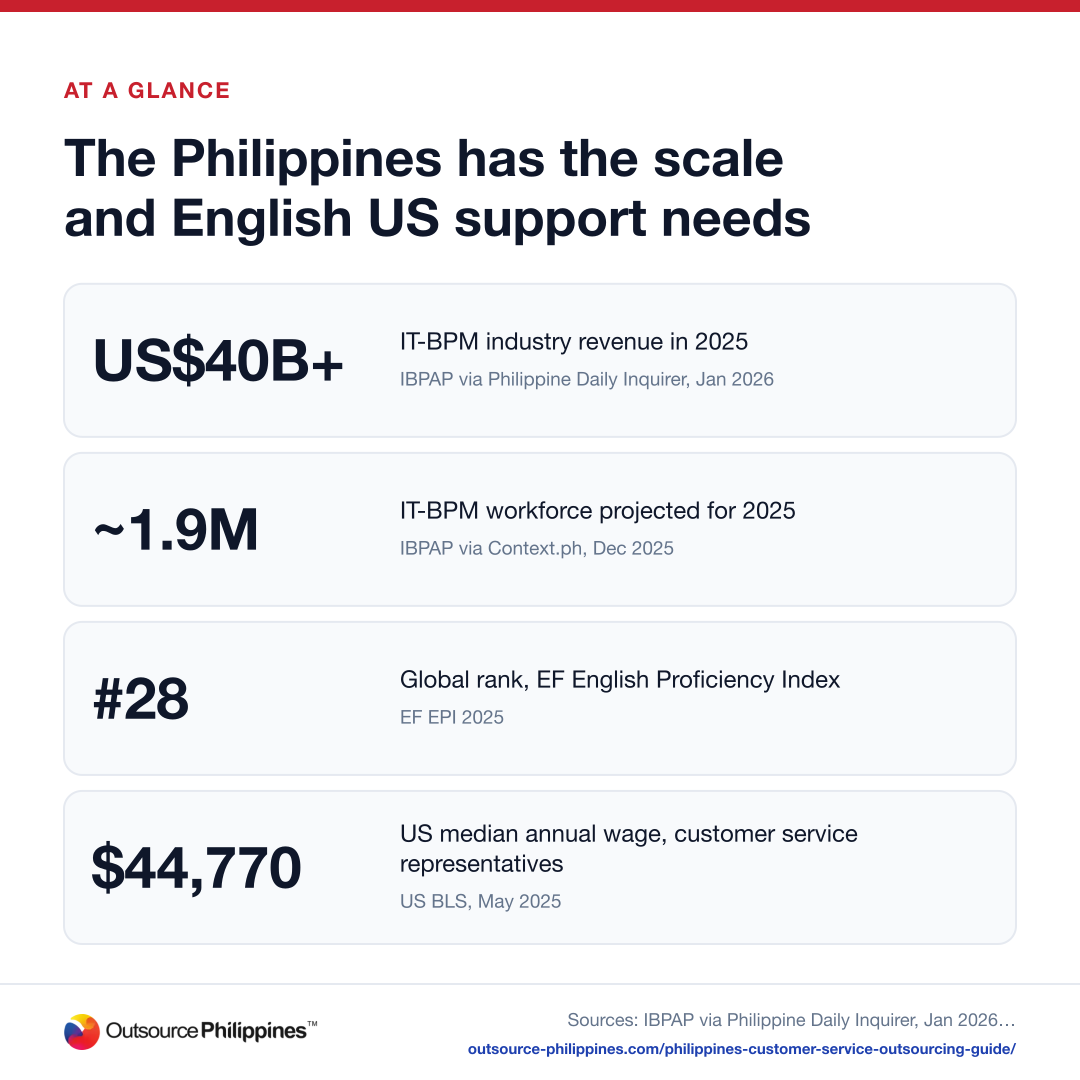
- US$40B+IT-BPM industry revenue in 2025IBPAP via Philippine Daily Inquirer, Jan 2026
- ~1.9MIT-BPM workforce projected for 2025IBPAP via Context.ph, Dec 2025
- #28Global rank, EF English Proficiency IndexEF EPI 2025
- $44,770US median annual wage, customer service representativesUS BLS, May 2025
The scale is real. The IT and Business Process Association of the Philippines (IBPAP) reported that industry revenue passed US$40 billion in 2025, and IBPAP projected employment of about 1.9 million people for the same year, up from 1.82 million in 2024 (Context.ph). A workforce that size means providers can fill seats, team lead roles, and attrition gaps quickly.
English is the other half. The Philippines ranks 28th worldwide on the 2025 EF English Proficiency Index. Agents grow up with English in school, business, and media, which shows in written tickets as much as on calls.
Cost matters too. The US Bureau of Labor Statistics puts the median annual wage for customer service representatives at $44,770 (May 2025), before benefits, payroll taxes, equipment, and management time. Outsource Philippines™ quotes costs based on the role, scope, coverage hours, and team size.
What Customer Service Work Can a Philippine Team Handle?
Almost any queue that follows a documented process. Most companies start with one high-volume channel and add more once the team is stable.
- Phone support: inbound calls for orders, billing, account changes, and complaints, handled by an outsourced call center team.
- Email and ticket support: written replies in your help desk, using your macros and tone.
- Live chat and social messaging: fast, short-form replies during peak shopping or service hours.
- Tier 1 technical support: troubleshooting, triage, and clean escalation to your product team.
- Back-office support: order processing, refunds, data updates, and QA reporting that keep the front line moving.
A simple test: if a task has clear steps, a measurable outcome and can be done inside your existing tools, it can be run from Manila or Cebu. Keep work that needs senior judgment, on-site presence, or undocumented decisions with your in-house team. Many US companies keep tier 3 engineering work at home and move tier 1 and tier 2 support offshore.
What Does a 4-week Setup Plan Look Like?
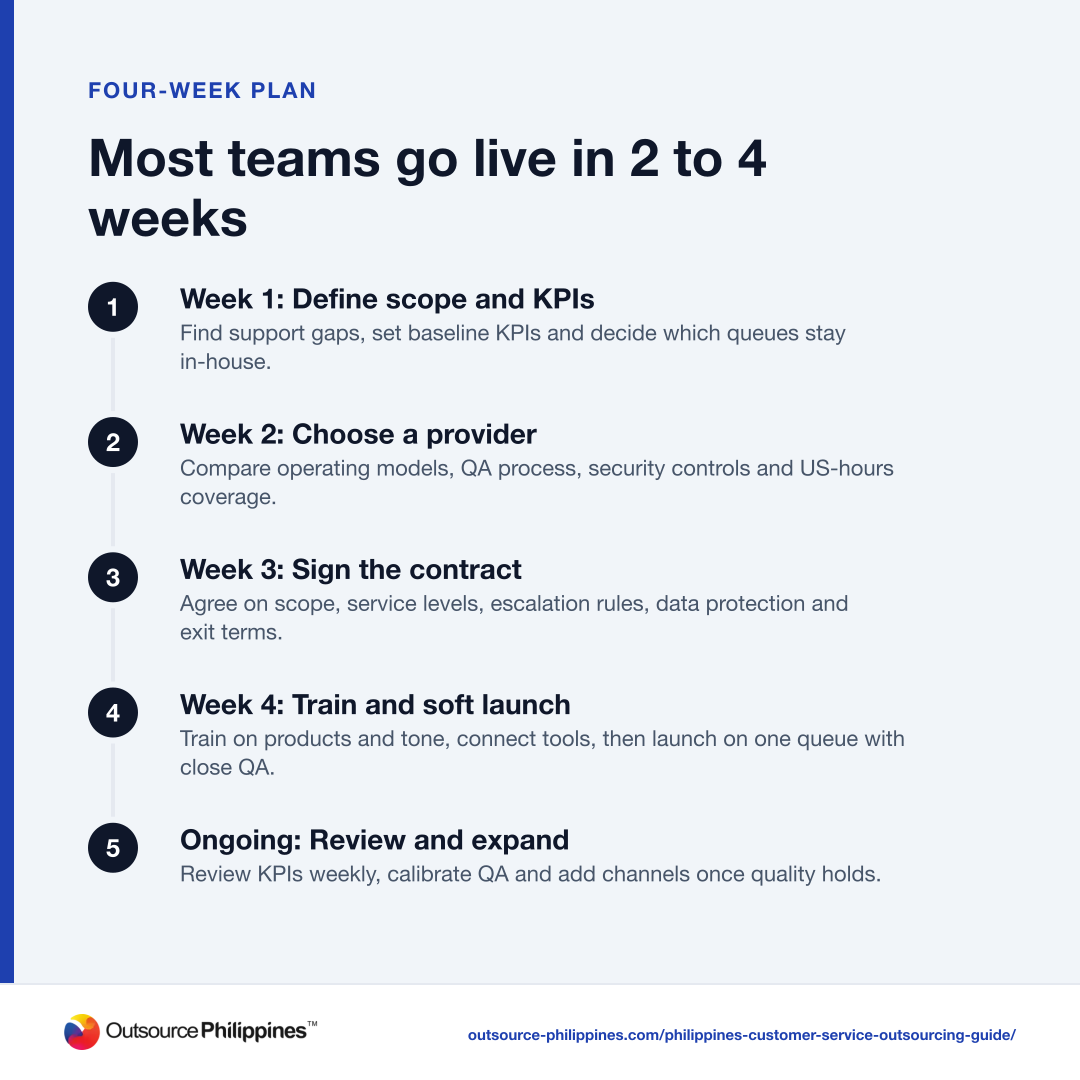
Each week has one job. If you finish it before moving on, the launch stays low-risk for customers. The exact timeline depends on the role: a general support queue can launch faster, while technical or specialized roles take longer to recruit and train.
- 1Week 1: Define scope and KPIs
Find support gaps, set baseline KPIs and decide which queues stay in-house.
- 2Week 2: Choose a provider
Compare operating models, QA process, security controls and US-hours coverage.
- 3Week 3: Sign the contract
Agree on scope, service levels, escalation rules, data protection and exit terms.
- 4Week 4: Train and soft launch
Train on products and tone, connect tools, then launch on one queue with close QA.
- 5Ongoing: Review and expand
Review KPIs weekly, calibrate QA and add channels once quality holds.
Week 1: What Should You Define Before You Contact Providers?
Define the problem, the scope, and how you will measure success. Providers can only price and staff accurately when you know these three things.
Find the Gaps in Your Current Support
Pull a month of tickets and calls. Look for long queues after hours, slow first responses, repeat contacts on the same issue, and seasonal spikes your team cannot absorb. These gaps tell you which hours and channels to cover first.
Set Measurable Goals
Pick a short list of KPIs: first response time, resolution rate, customer satisfaction (CSAT) and handle time. Write down today’s baseline for each. Without a baseline, nobody can prove the new team is working.
Decide What Stays In-house
Keep sensitive escalations, VIP accounts, and anything needing policy exceptions with your own staff. Move routine, repeatable contacts first. You can widen the scope once the team proves itself.
Week 2: How Do You Choose the Right Philippine Provider?
Choose on operating model, track record, and security, not on the lowest hourly figure. The cheapest option is often a shared-agent model that dilutes product knowledge.
| Factor | Shared agents | Dedicated team |
|---|---|---|
| Who the agent works for | Several clients at once | Only your account |
| Product knowledge | General | Deep, built over time |
| Brand voice | Generic scripts | Your tone and macros |
| Best for | Overflow and simple FAQs | Core support and growth |
When you compare providers, ask for:
- Relevant experience: references from companies with similar products, channels, and volumes.
- Quality process: how they score calls and tickets, how often they coach, and what their weekly report looks like.
- Security controls: access management, monitored workstations, and data-handling rules.
- Coverage model: how they staff US hours, weekends, and holidays.
Time zones work in your favor. Manila is roughly half a day ahead of the US, so US business hours fall on the Philippine night shift, which the industry has staffed for decades. You can choose US-hours coverage, round-the-clock rotations, or a follow-the-sun setup where the Philippine team clears overnight queues.
Week 3: What Should the Contract and SLA Cover?
The contract should turn your Week 1 goals into commitments both sides can measure. Vague agreements create disputes later.
- Scope: channels, hours, languages, and the exact tasks agents handle.
- Service levels: response time, resolution, and quality targets in a customer service SLA, plus how they are reported.
- Escalation rules: what agents must hand back, to whom, and how fast.
- Data protection: compliance with the Philippine Data Privacy Act of 2012 and any framework your industry needs, such as HIPAA or PCI DSS.
- Exit terms: notice periods and a clear handover of knowledge, documents, and data.
Under a managed model, the provider is the employer. It handles Philippine labor law, mandatory benefits, payroll, and government contributions, so you do not need a local entity. Pricing arrives as a written proposal with an hourly rate per agent.
Week 4: How Do You Onboard and Launch the Team?
Train on your products and tone, connect the tools, then launch on a limited queue with close review. Rushing this week is the most common cause of a rough start.
- Product and brand training: walk agents through your products, customer types, policies, and voice, using real tickets as examples.
- Tool access: set up your help desk, CRM, knowledge base, and chat channels with role-based permissions.
- Practice scenarios: run mock contacts, including angry customers and edge cases, and score them against your rubric.
- Soft launch: start with one channel or shift, review a large sample of contacts daily, then widen scope once quality holds.
Treat the new agents as part of your team. Invite them to product updates and share customer feedback with them directly. People who understand why a policy exists apply it better.
How Do You Keep Quality High After Launch?
Review the same KPIs every week, coach on real contacts, and plan staffing ahead of known peaks, following standard call center best practices. Quality holds when feedback loops are short.
- Weekly reviews: compare results with your baseline and agree on one or two fixes at a time.
- Calibration: have your QA lead and the provider’s QA lead score the same contacts so standards stay aligned.
- Customer feedback: read low CSAT responses together and turn them into training updates.
- Seasonal planning: share forecasts early so the provider can recruit and train before holiday or launch spikes.
Outsource Philippines™ secures client work with a managed firewall and WorQmate, our in-house project and employee monitoring platform, so you can see activity and output without micromanaging.
Is Philippines Customer Service Outsourcing Right for Your Business?
It is a strong fit if you have steady or growing contact volume, documented processes, and customers who expect English-language support across long hours. It is a weaker fit if your volume is tiny and irregular, or if most contacts depend on undocumented judgment from senior staff. In that case, document the process first, then outsource.
Want to see what a dedicated team would look like for your queues? Explore our customer service outsourcing services or request a proposal with your channels, hours, and volume.
Frequently Asked Questions
How Long Does It Take to Set Up Customer Service in the Philippines?
Most teams go live in 2 to 4 weeks, depending on the role. That window covers defining scope and KPIs, recruiting and screening agents against your profile, training them on your products and tools, and a soft launch with close quality review before the team takes full volume. Complex products or regulated industries can add time.
How Much Does Customer Service Outsourcing to the Philippines Cost?
Cost depends on the channel, shift, role complexity, team size, and coverage hours. Outsource Philippines™ quotes costs based on the role, scope, coverage hours, and team size. Outsource Philippines™ sends a written proposal with an hourly rate per agent instead of publishing a rate card.
Can a Philippine Customer Service Team Work US Hours?
Yes. Manila is roughly half a day ahead of US time zones, so US business hours fall on the Philippine night shift, which the industry has staffed for decades. Agents on US accounts usually work fixed night schedules, and providers can run round-the-clock rotations for companies that need weekend, holiday, or overnight coverage.
Is Customer Data Safe with an Offshore Support Team?
It can be, when the provider complies with the Philippine Data Privacy Act of 2012 and your industry’s rules, such as HIPAA or PCI DSS. Look for role-based access to your systems, monitored workstations, a managed firewall, and data-handling rules written into the contract, not just promised in a sales call.