Customer Service Excellence: 10 Real-Life Examples to Learn From

On This Page
- What Defines Excellent Customer Service?
- What Are the Best Real-world Customer Service Examples?
- What Do These Brands Get Right?
- How Can Small Businesses Apply These Lessons?
- When Does Outsourcing Customer Service Make Sense?
- Is Outsourced Customer Service Right for Your Business?
- Frequently Asked Questions
Ten well-known customer service examples come from Zappos, Amazon, Ritz-Carlton, Southwest Airlines, Apple, Chewy, Nordstrom, Trader Joe’s, Spotify, and Starbucks. Each shows the same pattern: staff who listen, act quickly, have the freedom to bend a rule, and add a personal touch that makes the customer feel valued rather than processed.
Great customer service turns one-time buyers into loyal customers, and poor service sends them to a competitor. This guide explains what defines excellent customer service, retells the 10 examples with what each one teaches, lists the common threads, and shows how small and midsize businesses can apply the same lessons, including when outsourcing support makes sense.
What Defines Excellent Customer Service?
Excellent customer service means going beyond the basics to make sure the customer’s need is fully met, quickly and with care. It is judged by how the customer feels afterward: heard, respected, and valued.
Five simple things separate great service from average service:
- Fast replies: customers get an answer before frustration builds.
- Friendly and polite staff: tone matters as much as the answer.
- Problems solved the first time: no repeated calls or transfers.
- Personal touches: names, history, and small gestures.
- Easy, hassle-free service: simple returns, clear policies, and few steps.
None of these require a large budget. They require clear standards, trained people, and the authority to act.
What Are the Best Real-world Customer Service Examples?
The best-known examples share one trait: an employee saw a person, not a ticket, and had the freedom to act. Here are 10 stories that show what excellent customer service looks like.
1. Zappos
A customer meant to return a pair of shoes, but her mother died and she couldn’t get to it. When she explained, Zappos arranged for a courier to pick up the shoes so she didn’t have to, and then sent her a flower arrangement. The story spread widely online and is still cited as a model of thoughtful service.
Lesson: remove effort for customers going through a hard time, then acknowledge it.
2. Amazon
Amazon is known for making returns and refunds easy. Customers regularly share stories of Amazon refunding or replacing items, such as a broken game controller, with few questions asked, even when the customer expected to be turned down.
Lesson: a fast, low-friction refund often costs less than the loyalty you lose by arguing.
3. Ritz-Carlton
A family left their son’s stuffed giraffe, Joshie, at a Ritz-Carlton hotel. Staff found it, called the family, and at the father’s request photographed Joshie by the pool before shipping him home. He arrived with hotel souvenirs and a photo album of his “extended stay,” including pictures at the spa and driving a golf cart.
Lesson: a small creative effort can turn a stressful moment into a story customers retell for years.
4. Southwest Airlines
A grandfather was rushing to reach his family after his three-year-old grandson was fatally injured, and long security lines made him late for his Southwest flight. The pilot held the plane for about 12 minutes until he arrived, telling him the plane could not leave without him, as reported by the Elliott Report in 2011.
Lesson: give front-line staff room to make exceptions when a customer’s situation clearly calls for one.
5. Apple
Customers often describe walking into an Apple Store with a broken iPhone, expecting a repair bill, and leaving with a replacement or a repair at no charge, even outside the warranty. These stories are a large part of why Apple’s in-store support has such a strong reputation.
Lesson: a generous call on a borderline case builds long-term loyalty.
6. Chewy
After her dog died, a customer contacted Chewy to return an unopened bag of food. The agent gave her a full refund, suggested she donate the food to a local shelter, and a few days later she received flowers with a note signed by the agent, according to KTVU’s 2022 report.
Lesson: empathy at the moment of loss is remembered far longer than the refund.
7. Nordstrom
A customer rolled a set of tires into a Nordstrom store in Fairbanks, Alaska, and asked to return them, though Nordstrom never sold tires. The store had been bought from Northern Commercial, which did sell automotive supplies, in 1975. The employee checked the tires’ value and paid the customer. Nordstrom has confirmed that the story is true.
Lesson: customer satisfaction can be worth more than the strict letter of a policy.
8. Trader Joe’s
A story widely shared online describes a Trader Joe’s store delivering groceries during a heavy snowstorm to an elderly man who was stuck at home, even though the chain doesn’t offer delivery. Staff made an exception because the need was real and urgent.
Lesson: local teams who know their community can spot when a rule should bend.
9. Spotify
A customer sent Spotify positive feedback. In reply, a Spotify team member built her a custom playlist whose song titles, read in order, spelled out a personal thank-you message. She shared a screenshot, and it spread widely.
Lesson: a playful, on-brand reply shows customers someone is really paying attention.
10. Starbucks
Regular customers often find that baristas remember their name and usual drink, and Starbucks Rewards members get a free drink or food item on their birthday. Recognition at both the personal and the program level makes repeat customers feel known.
Lesson: remembering a customer is one of the cheapest and most effective loyalty tools.
What Do These Brands Get Right?
The 10 companies are very different, but they treat customers in similar ways. Five threads run through every example.
- Empathy: they show real care, such as flowers or a hand during a hard time, the kind of empathy in customer service agents can be trained for.
- Speed: they solve problems fast and don’t leave customers waiting.
- Frontline authority: employees can make decisions on the spot without escalating.
- Personalization: the service feels specific to the person, from a name to a personal note.
- Consistency: customers get reliable, high-quality service whether they reach out online, by phone, or in person.
You don’t need a huge budget or a massive team to follow these principles. Empathy, speed, and personal touches scale down well.
How Can Small Businesses Apply These Lessons?
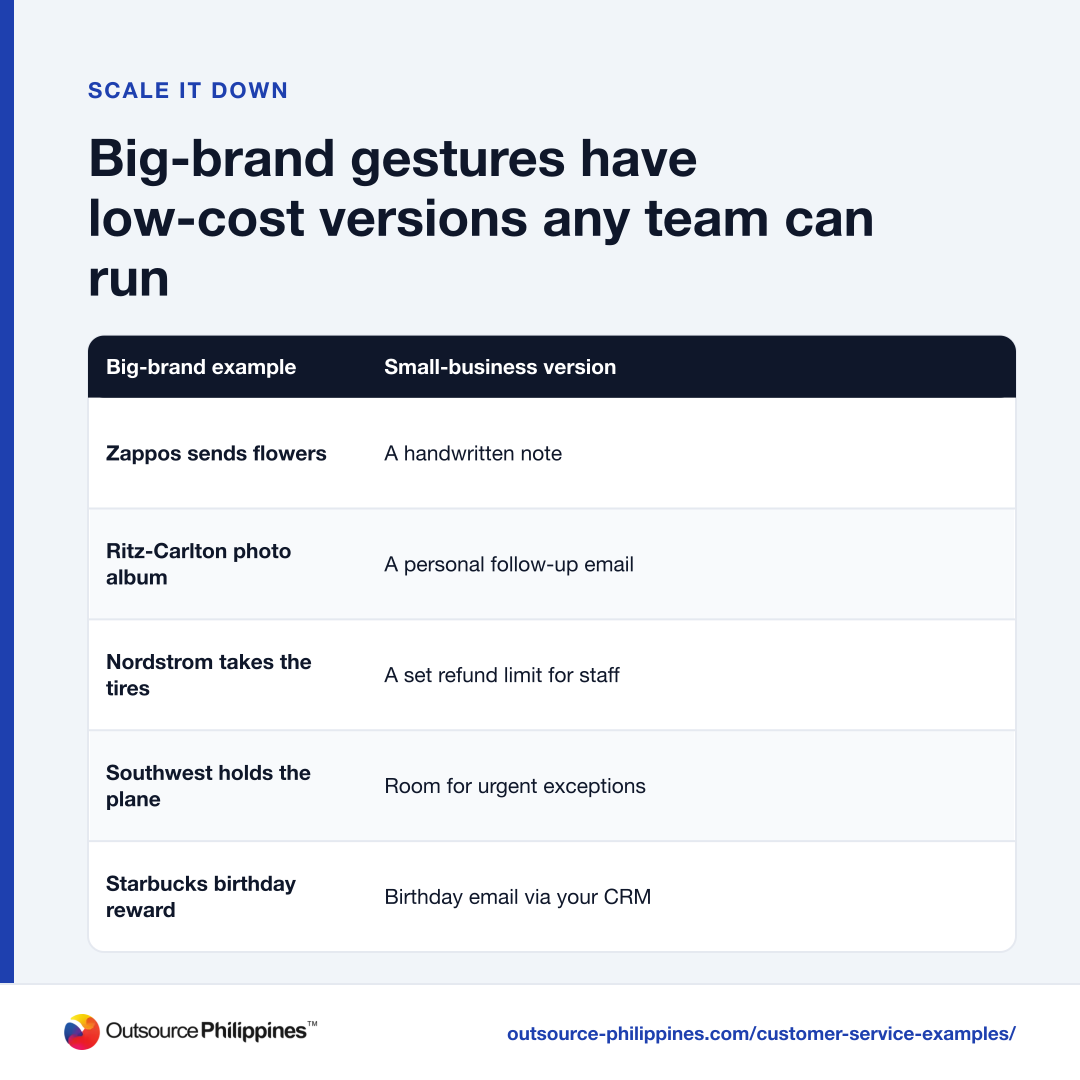
Small businesses can copy the principles, not the price tag. Most of the gestures above have a low-cost version any team can run.
| Big-brand example | Small-business version |
|---|---|
| Zappos sends flowers | A handwritten note |
| Ritz-Carlton photo album | A personal follow-up email |
| Nordstrom takes the tires | A set refund limit for staff |
| Southwest holds the plane | Room for urgent exceptions |
| Starbucks birthday reward | Birthday email via your CRM |
- Teach your team to really listen and respond with kindness.
- Use simple tools such as chatbots or a helpdesk to answer faster.
- Follow up after a sale or support call to show you care about the experience.
- Ask for feedback so you can find and fix weak spots.
- Celebrate wins by sharing stories of great service with your team.
Write down how much discretion agents have, for example a refund or credit limit they can give without checking with a manager, so agents know exactly what they can decide on their own. Applied consistently, these habits build happy, loyal customers without a large spend.
When Does Outsourcing Customer Service Make Sense?
Outsourcing makes sense when your team is stretched and response times or quality are slipping. A dedicated outsourced team adds capacity and longer hours at a lower cost than hiring in-house.
Building an excellent support team takes time, money, and management attention. Outsourcing removes much of the hiring and training burden, lets support grow with your business, and can extend coverage into evenings, weekends, or around the clock. Many US companies choose Philippines customer service outsourcing for English-language support with strong service skills. Outsource Philippines™ estimates most US clients pay 60% to 70% less than an equivalent in-house hire.
Is Outsourced Customer Service Right for Your Business?
It fits if your support work is repeatable, in English, and documented well enough to train someone on, and you want longer hours or more capacity without a big hiring push. It is a poor fit if your support depends on one founder’s personal relationships or on in-person work. Outsourced teams can deliver the kind of service in these examples only if you give them the same freedom to act that Zappos and Nordstrom give their staff.
Outsource Philippines™ runs customer service outsourcing teams for voice, email, and live chat and messaging, with English-speaking agents who work only on one client's account. Most teams go live in 2 to 4 weeks, depending on the role.
Frequently Asked Questions
What Is an Example of Good Customer Service?
A good example is Chewy refunding a grieving customer for unopened pet food, suggesting she donate it to a shelter, and then sending her flowers with a personal note. It solved the practical problem quickly, showed real empathy, and added a personal gesture the customer did not expect, which is why the story spread.
What Are the Five Key Traits of Excellent Customer Service?
The five traits that show up in almost every strong example are empathy, speed, frontline authority, personalization, and consistency. Empathy and personalization make customers feel valued, speed keeps frustration low, frontline authority lets staff fix problems on the spot, and consistency means the same quality on every channel.
How Can a Small Business Deliver Great Customer Service on a Budget?
Focus on low-cost habits: reply quickly, use customers’ names and history, follow up after a purchase or support call, and ask for feedback. Give staff a clear limit for refunds or credits they can grant without asking a manager, and share good service stories with the team so the standard spreads.