BPO vs Call Center: Key Differences and How to Choose

On This Page
- What Does BPO Mean in Business?
- What Is a Call Center and What Does It Do?
- What Are the Main Differences between a BPO and a Call Center?
- When Should a Business Choose BPO over a Call Center?
- What Are the Benefits of Each Model?
- What Are Common Mistakes When Comparing a BPO and a Call Center?
- How Do You Choose the Right Outsourcing Model?
- Which Model Is Right for Your Business?
- Frequently Asked Questions
The difference between a BPO and a call center is scope. A BPO (business process outsourcing) provider runs a wide range of business functions, such as finance, HR, data entry, and customer support. A call center is one type of BPO that focuses only on customer communication: inbound and outbound calls, and often email, chat, and social messages.
Choosing the wrong model can leave you paying for services you do not need, or missing the support you do. This guide explains what BPO means, what a call center does, the key differences side by side, when to choose each, the benefits of both, common mistakes in comparing them, and a checklist for picking the right model.
What Does BPO Mean in Business?
Business process outsourcing (BPO) means hiring a third-party provider to run specific business functions or processes for you. It covers customer support but also finance and accounting, HR administration, procurement, data management, and IT support.
Companies use BPO to improve efficiency, reduce operational strain, and free internal teams for core work. A business might outsource payroll processing, technical support, and customer service while its own staff focus on product, sales, and strategy. The Philippines is one of the largest BPO destinations: its IT and business process management industry passed US$40 billion in export revenue in 2025, a 5% increase on the year before, according to the IT and Business Process Association of the Philippines (IBPAP).
BPO services are commonly divided into two categories:
- Front-office BPO: customer-facing services such as customer support, sales, marketing, and technical assistance.
- Back-office BPO: internal functions such as accounting, bookkeeping, HR administration, data entry, and procurement.
What Is a Call Center and What Does It Do?
A call center is a centralized team, either in-house or outsourced, that manages inbound and outbound customer communications. Its focus is customer support, telemarketing, technical assistance, lead generation, and other voice-based work, and modern call centers also handle email, chat, and social media.
The main goal of a call center is customer engagement. Agents are trained to handle high volumes of inquiries while keeping quality and brand voice consistent. Telecommunications, ecommerce, healthcare, and banking companies often use outsourced call centers to handle peak demand and extend their hours. Call centers come in three types:
- Inbound call centers handle questions, complaints, and requests that customers start.
- Outbound call centers focus on outreach such as telesales, surveys, and appointment setting.
- Blended call centers combine inbound and outbound work for more flexibility.
What Are the Main Differences between a BPO and a Call Center?
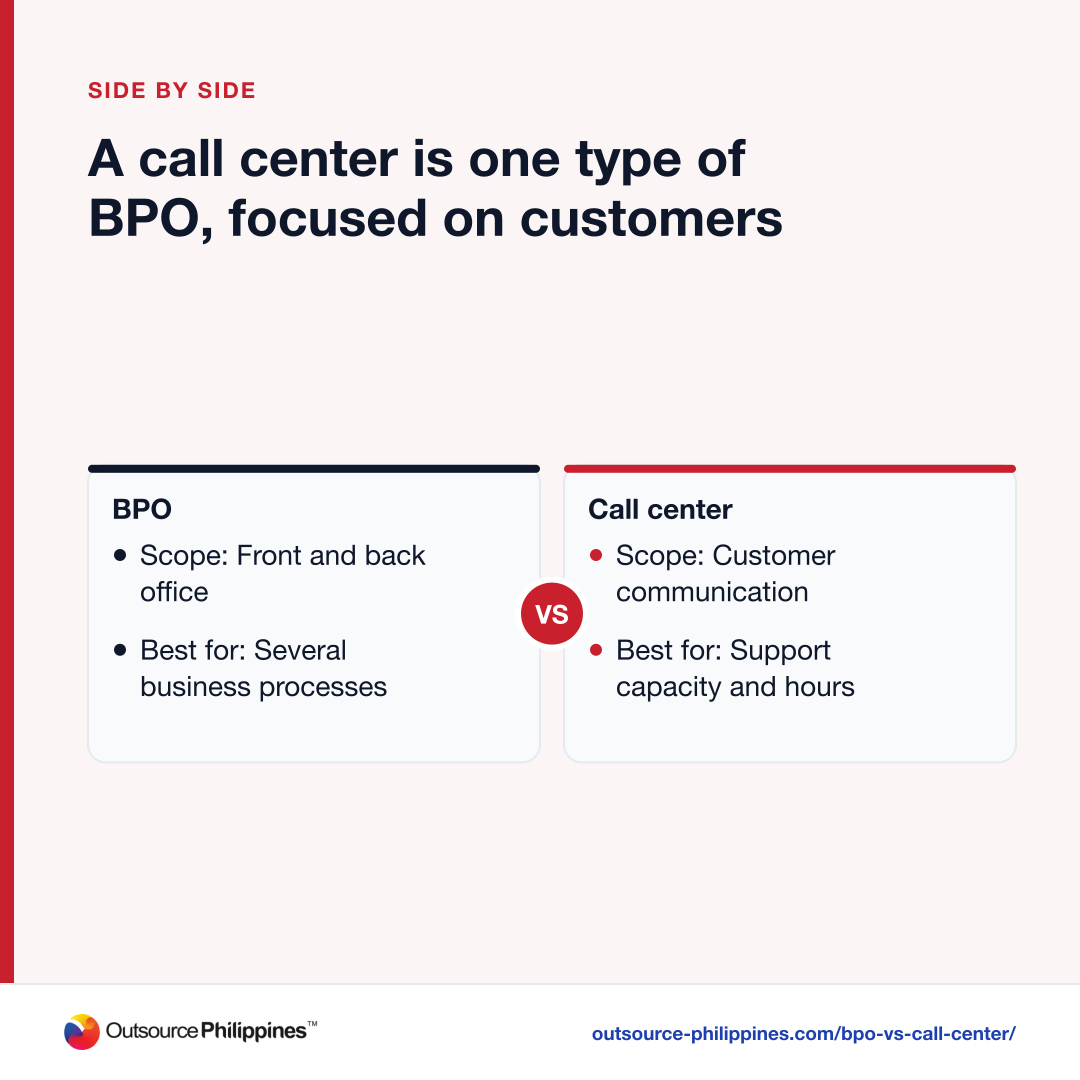
A call center is a type of BPO that focuses only on customer communication. A BPO is the broader category and can run many business functions beyond customer interaction.
BPO
- Scope
- Front and back office
- Best for
- Several business processes
Call center
- Scope
- Customer communication
- Best for
- Support capacity and hours
The terms are often used interchangeably, which causes confusion when companies compare providers. The table below summarizes the key distinctions.
| Aspect | BPO | Call center |
|---|---|---|
| Core focus | Outsourcing multiple business processes | Managing customer communications only |
| Scope | Front-office and back-office operations | Customer support and telemarketing |
| Functions | Finance, HR, data entry, IT support, customer experience | Inbound and outbound calls, plus email, chat, and social |
| Technology | Process automation, analytics, workflow tools | Contact center platforms and CRM tools |
| Industry application | Applies to almost every sector | Mainly service, retail, and consumer businesses |
| Strategic value | Supports long-term process improvement | Improves customer service metrics |
Understanding these differences helps you match the provider to your goals, performance targets, and compliance needs. Work that depends on analysis and judgment rather than set processes falls outside both models, which is where the BPO vs KPO distinction comes in.
When Should a Business Choose BPO over a Call Center?
Choose BPO when you need to hand off several connected processes beyond customer support. Choose a call center when your main need is more customer service capacity or longer coverage hours.
BPO is usually the better fit for:
- Companies that need consistent processes across finance, HR, or operations.
- Businesses modernizing workflows that benefit from a provider’s process automation experience.
- Organizations that want analytics, reporting, or shared services handled in one place.
Startups and growing companies often start with a call center model when they need immediate customer service coverage or 24/7 support without restructuring operations. Many later add back-office outsourcing such as bookkeeping or data entry once the first team is stable.
A hybrid setup is common. A retailer, for example, might outsource phone, email, and chat support to a call center team, then hand order processing, returns data entry, and supplier invoice matching to a back-office team at the same provider. The two teams share information, so a refund promised on the phone is processed the same day. The deciding question is not which label a provider uses but which of your processes it can run well, to your standards and with the reporting you need.
What Are the Benefits of Each Model?
Both models lower costs and add capacity. BPO improves efficiency across many functions, while a call center improves the speed and consistency of customer conversations.
Benefits of BPO Services
- Improved efficiency across multiple business functions
- Lower operational and labor costs
- Access to skilled professionals and specialized tools
- Better process automation and workflow management
- Scalability to support business growth
- Data-driven reporting and performance insights
Benefits of Call Center Services
Call centers focus on the agent skills that shape customer experience: fast responses, consistent support, and efficient resolution.
- Faster handling of customer inquiries and support requests
- Higher customer satisfaction and retention
- Longer hours, including 24/7 coverage, without US night-shift staffing
- Consistent customer communication across agents and shifts
- Scalable capacity for seasonal peaks and launches
- Stronger brand reputation through responsive support
Shared Advantages and Customer Experience
Both models rely on technology, training, and performance management to keep quality steady. Call centers shape customer experience directly through every conversation. BPO shapes it indirectly by keeping billing, order processing, and other back-office work accurate, so customers have fewer reasons to call in the first place. Companies that use both get consistent service from first contact to fulfillment.
Cost is a major driver for both. The US Bureau of Labor Statistics puts the median annual wage for customer service representatives at $44,770 (May 2025), before benefits, recruiting, and equipment. Outsource Philippines™ quotes costs based on the role, scope, coverage hours, and team size, with pricing set as an hourly rate per agent in a written proposal.
What Are Common Mistakes When Comparing a BPO and a Call Center?
Most mistakes come from comparing on price alone or misunderstanding what each model covers. These five cause the most trouble.
Confusing Scope and Specialization
Many buyers assume every BPO mainly does phone support. In reality, BPO providers may run finance, HR, data processing, and more, while a call center is focused on customer communication. Mixing the two up leads to a provider that does not match your needs.
Overlooking Integration Requirements
Outsourced work must connect to your systems and teams. Without shared tools, clear communication channels, and coordinated workflows, you get delays, inconsistent reporting, and lost value.
Prioritizing Cost over Service Quality
The cheapest provider may cut corners on training, quality assurance, and brand consistency. Weigh expertise, reliability, scalability, and performance standards alongside price.
Ignoring Cultural and Communication Alignment
Tone, communication style, and cultural understanding shape every customer interaction. Check English proficiency and brand voice fit before you sign. The Philippines ranks 28th worldwide on the 2025 EF English Proficiency Index, with a score of 569 against a global average of 488.
Failing to Set Up Performance Governance
Without agreed KPIs, reporting, and regular reviews, you cannot tell whether the outsourced work is paying off. Set service levels, quality scores, and review meetings from the start.
How Do You Choose the Right Outsourcing Model?
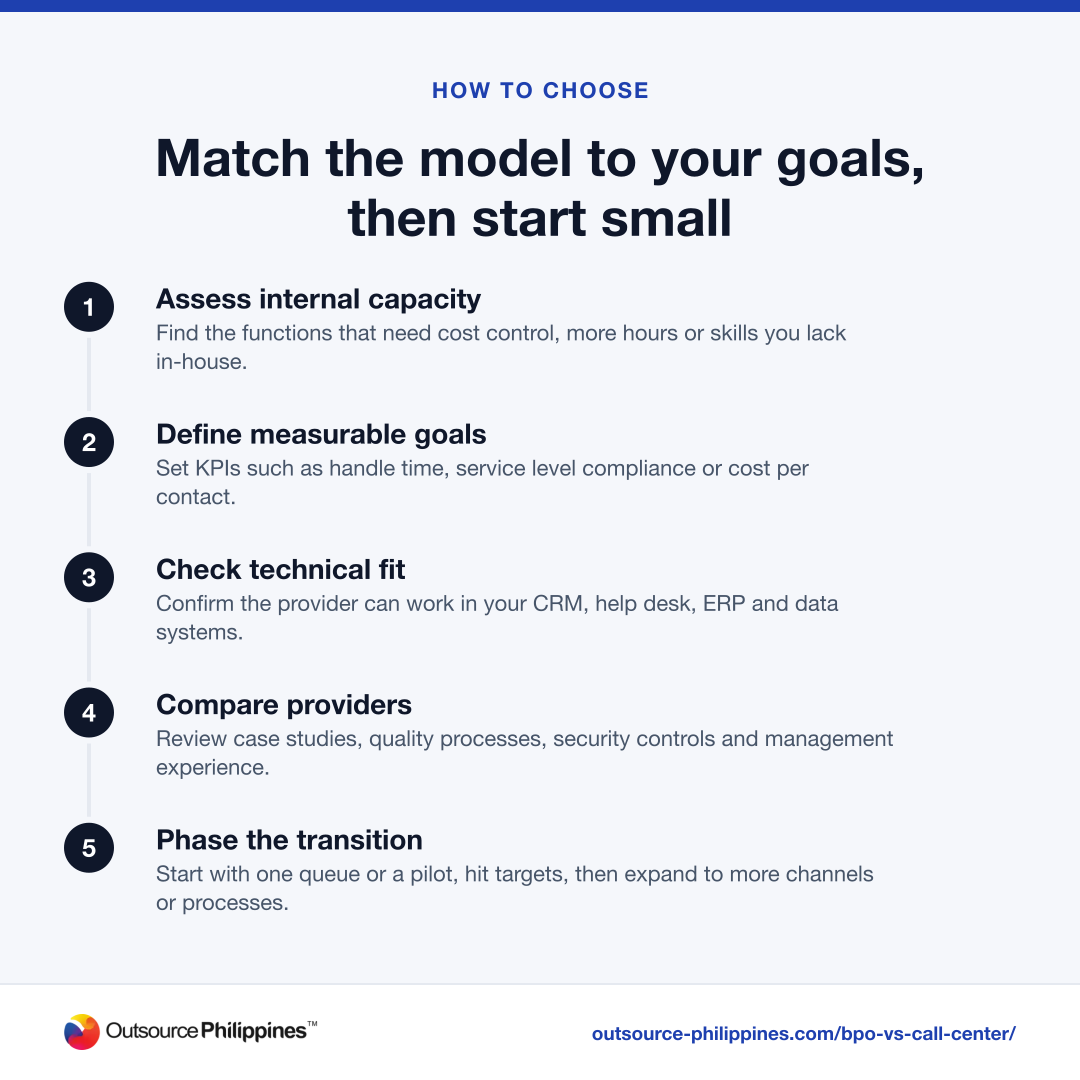
Match your goals to what each provider can actually do, then start small and expand. A structured process lowers the risk.
- 1Assess internal capacity
Find the functions that need cost control, more hours or skills you lack in-house.
- 2Define measurable goals
Set KPIs such as handle time, service level compliance or cost per contact.
- 3Check technical fit
Confirm the provider can work in your CRM, help desk, ERP and data systems.
- 4Compare providers
Review case studies, quality processes, security controls and management experience.
- 5Phase the transition
Start with one queue or a pilot, hit targets, then expand to more channels or processes.
Before you talk to providers, run through this checklist:
- Document your current operational pain points.
- Decide whether the problems are customer-facing or process-related.
- Estimate the potential return from outsourcing each function.
- Set your data security, confidentiality, and compliance requirements.
- Confirm the provider’s plans for scaling and technology integration.
- Agree how service levels will be measured, such as KPI dashboards and weekly reports.
If most items point to customer conversations, start with a call center team. If they point to finance, data, or administrative work, a broader BPO arrangement fits better. Most teams go live in 2 to 4 weeks, depending on the role.
Which Model Is Right for Your Business?
A call center is the right fit if your main challenge is answering customers faster, covering more hours, or handling seasonal peaks. A broader BPO arrangement fits if you also need back-office, finance, or data work done reliably. Neither is a good fit if your processes are undocumented and change daily; document them first.
Outsource Philippines™ has run both models since 2003, from dedicated call center teams to back-office staff, with every agent working only on one client's account from a supervised office in the Philippines.
Frequently Asked Questions
Is a Call Center Part of a BPO?
Yes. A call center is a type of BPO that focuses on customer communication, while full-service BPO providers also run back-office functions such as finance, HR administration, and data entry. The relationship is hierarchical: every outsourced call center is a form of BPO, but not every BPO provider operates a call center.
Which Is More Cost-effective, a BPO or a Call Center?
It depends on what you need. A broader BPO arrangement can save more when several processes move to one provider, while a call center is cost-efficient for businesses with high customer contact volume and simpler processes. In both cases, compare the total cost of an in-house team, including benefits, recruiting, and equipment, with the provider’s proposal.
Can One Provider Offer Both BPO and Call Center Services?
Yes. Many outsourcing companies offer customer service alongside back-office work such as bookkeeping, payroll, and data entry. Using one provider lets a business start with customer support and add back-office processes later, with consistent reporting, one point of contact, and shared security and data privacy controls across every team.
What KPIs Should Be Tracked in BPO or Call Center Operations?
Call centers usually track service level compliance, average handle time, first contact resolution, and customer satisfaction score. BPO processes add metrics such as cycle time, accuracy rate, and cost per transaction. Agree on the KPIs, targets, and reporting schedule before launch so both sides know what good performance looks like.
How Can a Company Ensure Quality When Outsourcing?
Set clear service levels and quality standards in the contract, score calls and tickets against your own rubric, and hold regular performance reviews. Dedicated agents who work only on your account, weekly reporting, and a phased rollout that starts with one queue all make it easier to catch and fix problems early.